Parody is part of all our lives. It occurs not only in literature, but also in everyday speech, in theatre and television, architecture and films. Drawing on examples from Aristophanes to The Simpsons, Simon Dentith explores:
* the place of parody in the history of literature
* parody as a subversive or conservative mode of writing
* parody's pivotal role in debates about postmodernism
* parody in the culture wars from ancient times to the present
This lively introduction situates parody at the heart of literary and cultural studies and offers a remarkably clear guide to this sometimes complex topic. Parody will serve as an essential resource, to be read and re-read by students of all levels.
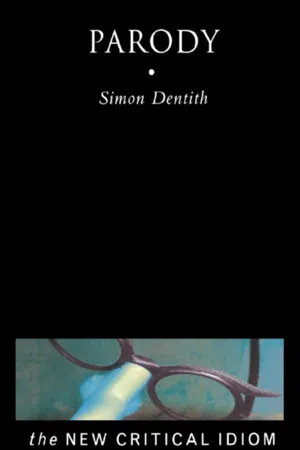
- 224 pages
- English
- ePUB (mobile friendly)
- Available on iOS & Android
eBook - ePub
Parody
About this book
Information
1
APPROACHES TO PARODY
PARODY AND THE TO-AND-FRO OF LANGUAGE
In George Eliot’s novel Middlemarch—a novel not generally characterised by parodic playfulness—there is a scene in which Mr Brooke, who is standing for election, has to make a speech to an unruly crowd. As he speaks from the balcony of an inn, an effigy of himself is displayed which, by virtue of a ventriloquist’s skill, derisively repeats everything that Brooke says. As George Eliot writes, ‘the most innocent echo has an impish mockery in it when it follows a gravely persistent speaker, and this echo was not at all innocent’; the crowd is amused, Brooke humiliated, and his political opponents score a victory (Eliot, 1988:413). I take this as an exemplary instance of parody, albeit a fictional one. By the mere repetition of another’s words, their intonation exaggerated but their substance remaining the same, one utterance, Brooke’s, is transformed by another, held up to public gaze, and subjected to ridicule.
George Eliot is doing no more here than illustrating an aspect of discourse which is so widespread as to be universal. The peculiarities of an election, especially the speeches delivered in the course of it, are certainly not typical of all speech situations, but many discursive interactions are characterised by the imitation and repetition, derisive or otherwise, of another’s words. Imitation is the way in which we learn to speak, taking in, as we do so, not merely a grammar and a vocabulary, but a whole repertoire of manners, attitudes, and ways of speaking. Parodic imitation of another’s words is merely one possibility among the whole range of rejoinders that make up human discourse, and parodic imitation can itself take many forms. Listening to the language of children and adolescents (and not only them), you will hear a multitude of parodies, as accents are mocked, oral styles from the television are attempted, fashionable phrases are tried on or discarded, so that each of a whole panoply of verbal and cultural styles is in turn derided or assumed. The slang of one generation becomes the target of parody in the next: ‘hip’ and ‘ace’ are long since as comic as ‘ripping’ and ‘jolly good’, and to use them would be to make yourself subject to mocking laughter.
It is in discourse, understood in this way as a never-ending to-and-fro of rejoinders, that our understanding of the practice of parody should initially be situated. In this context, parody is but one of the ways in which the normal processes of linguistic interaction proceed. For to speak a language is much more than merely to have a command of its grammar and vocabulary. It entails using these resources to adopt an evaluative attitude—both to the person to whom one speaks, and to the topic of discussion. Thus in addressing those to whom we speak, we take up, willynilly, attitudes which, in many different ways, reinforce or contradict our addressees. Equally, we indicate in a thousand verbal ways a particular stance to whatever it is that we are talking about. These attitudes are carried in part by intonation, an aspect of language unique to each individual utterance and its occasion. So as we speak we necessarily indicate our attitude to that about which we speak, and towards those to whom we speak: by tone of voice, by the adoption or otherwise of the appropriate politeness conventions, by register and diction, by fitting or unfitting adaptation of speech to occasion. These means permit a remarkable array of attitudes to become apparent in our speech—of complaint or reluctant consent, of eager or truculent agreement, of celebration, of irony, of private reservation, or indeed of any of a hundred such attitudes. Parody, be it of the interlocutor’s speech, or of the speech of some third party, or even of oneself, is one of the ways in which these inevitable evaluations occur. Its simplest form is perhaps the scoffing repetition illustrated in Middlemarch, also a familiar feature of childish argument, by which even the most innocent phrase can be mocked and made to sound ridiculous:
SPEAKER 1: ‘I don’t like this cold weather.’
SPEAKER 2: (in exaggeratedly feeble and whining tones) ‘I don’t like this cold weather.’
In many more sophisticated ways, and in some less conscious ways also, we respond evaluatively to what is said to us; parody is but one possibility among many.
There is a further, and fundamental, way in which the apparently specialised use of language that we call parody can be related to more general characteristics of language. At some level— later this will be specified more exactly—parody involves the imitation and transformation of another’s words. That might also pass as an account of language use more generally, for language is not one’s own, but always comes to each speaker from another, to be imitated and transformed as that speaker in turn sends it onwards. All utterances are part of a chain, and as they pass through that chain they acquire particular valuations and intonations on each occasion of their use. In this most general sense, we are all condemned to parody, for we can do no more than parrot another’s word as it comes to be our turn to speak it.
Yet this is not a conclusion in which I wish to rest, albeit that it usefully indicates the potential scope of a comprehensive account of the topic of parody. We can certainly do more than speak parrotfashion; and the example of Mr Brooke’s parodist suggests that when we do, it has a very disturbing effect on the utterance that we repeat. Rather, as we use language—necessarily not our own—to a greater or lesser degree we make it our own. So while all language use certainly involves imitation, the particular inflection that we give to that imitation (and parody is one possible inflection) indicates the extent to which we have adapted language to occasion, transformed the value given to the utterance, and thus redirected the evaluative direction in that chain of utterances. Parody is one of the means available to us to achieve all these ends.
The general account of language in which I have just situated the practice of parody is based upon that of the Russian linguistician V.N.Vološinov, whose account of language is closely related to that of his fellow-Russian, Mikhail Bakhtin. One of the distinctive features of Vološinov’s theory of language is that it stresses the priority of speech; certainly for both him and Bakhtin (whose theories of parody will play an important part in this book) the speech situation and a theory of the utterance form the essential basis for their understanding of all language uses, including written ones. I will follow their lead in seeking to understand the particularities of writing by drawing on an understanding of language derived from the spoken interchanges that constitute it. There are many difficulties in such an attitude, principally to do with the ephemeral nature of speech compared with the permanent nature of writing; and since the parodies that I will be discussing in this book are mostly written ones, I do not wish to underestimate these difficulties. Nevertheless, I propose to leave them to one side for the moment in order to suggest how we might understand written parodies in terms of the chain of utterances and the evaluative attitude necessarily adopted by every interlocutor in that chain.
One designation, for written discourse, of what Vološinov describes for speech as ‘the chain of utterances’, is intertextuality. This can be characterised initially as the interrelatedness of writing, the fact that all written utterances—texts—situate themselves in relation to texts that precede them, and are in turn alluded to or repudiated by texts that follow. Indeed, there is a tradition of specific ‘rejoinder poems’, closely related to more formal parodies, in which ‘answering back’ is especially visible—Sir Walter Raleigh’s ‘The Nymph’s Reply to the Shepherd’ (1600), which is a response to Christopher Marlowe’s ‘The Passionate Shepherd to His Love’ (ca. 1590), is a famous example of such poems. But there is also a less specific form of answering back, as when the seventeenth-century libertine poet Rochester begins one of his lyrics ‘Tell me no more of constancy...’; in this instance he is making an intertextual allusion to a presumed discourse in praise of constancy which precedes the poem and which he is repudiating. Intertextuality includes more profound aspects of writing than this, however. At the most obvious level it denotes the myriad conscious ways in which texts are alluded to or cited in other texts: the dense network of quotation, glancing reference, imitation, polemical refutation and so on in which all texts have their being. At a still more profound level, intertextuality refers to the dense web of allusion out of which individual texts are constituted— their constant and inevitable use of readymade formulations, catch phrases, slang, jargon, cliché, commonplaces, unconscious echoes, and formulaic phrases. All these linguistic echoes and repetitions are accented in variously evaluative ways, as they are subjected—or not—to overt ridicule, or mild irony, or in the expectation that the repetition of the bureaucratic phrase of the month will gain the writer credit, and so forth. This aspect of intertextuality is more visible in some kinds of writing than in others. Tabloid journalese, for example, or the diction of neoclassical poetry, are both noticeably formulaic, though of course different writers of these genres can put their formulae to very diverse uses. My contention is simply this: that parody is one of the many forms of intertextual allusion out of which texts are produced.
In this sense, parody forms part of a range of cultural practices, which allude, with deliberate evaluative intonation, to precursor texts. Just as we cannot speak without adopting an attitude towards those to whom we speak, and towards that about which we speak, so also we must situate ourselves evaluatively towards the language that we use. The relevant range of cultural practices could conveniently be arranged as a spectrum, according to the evaluations that differing forms make of the texts that they cite, with reverential citation at one end of the scale (‘My text today is taken from...’), to hostile parody at the other end, and passing through a multitude of cultural forms on the way. Thus the spectrum would include imitation, pastiche, mock-heroic, burlesque, travesty, spoof, and parody itself. I hesitate to set out this scale in too formal a way, however, for a number of reasons. In the first place, all such classifications of cultural forms tend to invite analyses of texts of a reductively pigeon-holing kind. Second, the discussion of parody is bedevilled by disputes over definition, a fruitless form of argument unless there are matters of substance at stake—of genuine differences of cultural politics, for example. Finally, because of the antiquity of the word parody (it is one of the small but important group of literary-critical terms to have descended from the ancient Greeks), because of the range of different practices to which it alludes, and because of differing national usages, no classification can ever hope to be securely held in place. So for the time being I will affirm that parody in writing, like parody in speech, is part of the everyday processes by which one utterance alludes to or takes its distance from another; and that there are a number of adjacent forms which do the same, while there are equally many other forms which make allusions for quite opposite evaluative purposes. All this is part of the intertextual constitution and competition of writing.
We can use the notion of intertextuality to help us still further in situating and characterising parody. Developing that distinction between different kinds of intertextuality—between the deliberate and explicit allusion to a precursor text or texts, on the one hand, and a more generalised allusion to the constitutive codes of daily language, on the other—allows us to distinguish between different kinds of parody. One distinction often made is between ‘specific’ and ‘general’ parody, the former aimed at a specific precursor text, the latter at a whole body of texts or kind of discourse. Thus Lewis Carroll’s poem ‘How Doth the Little Crocodile’ (‘How doth the little crocodile/Improve his shining tail...’) is a specific parody of Isaac Watts’s poem ‘Against Idleness and Mischief’ (‘How does the little busy bee/Improve each shining hour...’). By contrast, Cervantes’ novel Don Quixote is a general parody of the chivalric romance as a genre. This distinction neatly correlates with that which I have drawn between intertextual modes. However, we can use the distinction in modes to capture another aspect of parody, between the fully developed formal parody which constitutes the complete text—whose whole raison d’être is its relation to its precursor text or parodied mode—and those glancing parodic allusions which are to be found very widely in writing, often aimed at no more than a phrase or fragment of current jargon and sometimes indicated by little more than ‘scare quotes’ (the written equivalent of a hostile intonation).
Thus in the following paragraph from Bleak House, Dickens makes a whole series of parodic allusions, without having any specific precursor text in mind. The death of one of the characters in the novel has caused a stir of activity:
Next day the court is all alive—is like a fair, as Mrs. Perkins, more than reconciled to Mrs. Piper, says, in amiable conversation with that excellent woman. The Coroner is to sit in the first-floor room at the Sol’s Arms, where the Harmonic Meetings take place twice a week, and where the chair is filled by a gentleman of professional celebrity, faced by Little Swills, the comic vocalist, who hopes (according to the bill in the window) that his friends will rally round him, and support first-rate talent. The Sol’s Arms does a brisk stroke of business all the morning. Even children so require sustaining, under the general excitement, that a pieman, who has established himself for the occasion at the corner of the court, says his brandy-balls go off like smoke. What time the beadle, hovering between the door of Mr. Krook’s establishment and the door of the Sol’s Arms, shows the curiosity in his keeping to a few discreet spirits, and accepts the compliment of a glass of ale or so in return.
(Dickens, 1971–3: Chapter 11)
Dickens’s parodic references here, marked with varying evaluative charges, are all allusions, not to any specific precursor text, but more to particular phraseologies, even to what can only be described as a tone of voice. The various languages that circulate around the court (that is, some of the dialects of working-class London), reappear here in mildly parodied form. Much of the paragraph is in ‘double-voiced discourse’, so that we can hear in the writing simultaneous traces both of the characters’ speech and the author’s attitude towards it. Thus we can hear in the extract the accents of Mrs. Perkins and Mrs. Piper (‘that excellent woman’), the jargon of semi-professional entertainment, the slang of the pieman, and the pomposity of the beadle (‘accepts the compliment of a glass of ale’). It is helpful to see, in the pervasiveness of parody in a characteristically Dickensian paragraph such as this, an indication of the author’s multitudinous recycling of the diverse languages of mid-nineteenth-century English. Writing of this kind marks one limit of what might count as parody, making scarcely hostile allusions to what are little more than the slightly inflected phrases of contemporary speech. The passage nevertheless indicates the potential scope of parody, if it is understood as one form of the more general intertextual constitution of all writing.
I am therefore moving towards a wide and inclusive account of parody, rather than a narrowly formal one. The definition of parody that I am about to offer is based, not on any specific formal or linguistic features, but on the intertextual stance that writing adopts. Accordingly, I conclude this section with this preliminary definition of parody: ‘Parody includes any cultural practice which provides a relatively polemical allusive imitation of another cultural production or practice’.
In order to capture the evaluative aspect of parody, I include the word ‘polemical’ in the definition; this word is used to allude to the contentious or ‘attacking’ mode in which parody can be written, though it is ‘relatively’ polemical because the ferocity of the attack can vary widely between different forms of parody. And finally, in a distinction whose importance is about to become clearer, the direction of the attack can vary. So far I have been stressing the importance of parody as rejoinder, or mocking response to the word of another. But many parodies draw on the authority of precursor texts to attack, satirise, or just playfully to refer to elements of the contemporary world. These parodies also need to be reckoned in to any definition, so the polemical direction of parody can draw on the allusive imitation to attack, not the precursor text, but some new situation to which it can be made to allude. Such parodies, indeed, are the stock in trade of innumerable compilations of light and comic verse and of literary competitions, and their ‘polemical’ content is often very slight indeed.
DEFINITIONS
Given the often humorous and anti-academic nature of parody, it is ironic that discussions of the topic have been bedevilled by academic disputes about definition. What exactly did the ancient Greeks mean by ‘parodia’? How can we distinguish, in a hard and fast way, between parody, travesty, and pastiche? Does parody necessarily have a polemical relationship to the parodied text? It is partly because of these disputes that I have drawn my definition of parody in as wide-ranging a way as possible, and have based it upon linguistic interaction, both verbal and written. On this basis, some of the disputes about definition which we are about to review briefly will seem less significant, though they will point eventually to a large question about the cultural politics of parody, namely whether it is to be thought of as an essentially conservative or essentially subversive mode—indeed, we shall have to ask whether it is possible to talk of parody as ‘essentially’ anything at all.
Aristotle’s Poetics provides the earliest use of the word parodia (pa???a), where he uses it to refer to the earlier writer Hegemon. A parodia is a narrative poem, of moderate length, in the metre and vocabulary of epic poems, but treating a light, satirical, or mock-heroic subject (the epic poems familiar to the Greeks were those of Homer, the Iliad and the Odyssey; mock-heroic, a form related to parody, applies the idiom of epic poetry to everyday or ‘low’ subjects, to comic effect). A parodia is a specific literary form for which prizes were awarded at poetic contests; only one of these poems, the Batrachomyomachia, or Battle of the Frogs and Mice, has survived. However, this is not the only meaning of the word in Greek and subsequent Roman writers, who also use the term and its grammatical cognates to refer to a more widespread practice of quotation, not necessarily humorous, in which both writers and speakers introduce allusions to previous texts. Indeed, this is a more frequent use of the term (Householder, 1944:1–9). Aristophanes’s allusions, in his comedies, to the tragedies of Euripides are a special case of such parodic quotations. However, the case of Aristophanes points to one of the difficulties surrounding the definition of parodia, namely whether the term had any polemical edge to it in classical Greece, since there is controversy over whether the comic playwright was or was not attacking his tragic contemporary. Certainly, we must recognise that the Greek uses of the term do not simply correspond with modern English usage, where some sense of parody mocking the parodied text is at least usual. Thus there is apparently no evidence that the parodia, meaning the mockheroic poem, ever mocked Homer rather than imitated him for comic effect. For such mocking or carnivalesque forms, we should turn instead to the satyr plays which accompanied performances of Greek tragic drama. However, we can recognise that Greek usage, i...
Table of contents
- Cover Page
- Title Page
- Copyright Page
- Series Editor’s Preface
- Preface
- Acknowledgements
- 1: Approaches to Parody
- 2: Parody in the Ancient and Medieval Worlds
- 3: Parody in the Novel
- 4: Parody and Poetry
- 5: The Beauties of Burlesque
- 6: Is Nothing Sacred?
- Conclusion
- Glossary
- Notes
- Bibliography
Trusted by 375,005 students
Access to over 1.5 million titles for a fair monthly price.
Study more efficiently using our study tools.
Frequently asked questions
Yes, you can cancel anytime from the Subscription tab in your account settings on the Perlego website. Your subscription will stay active until the end of your current billing period. Learn how to cancel your subscription
No, books cannot be downloaded as external files, such as PDFs, for use outside of Perlego. However, you can download books within the Perlego app for offline reading on mobile or tablet. Learn how to download books offline
Perlego offers two plans: Essential and Complete
- Essential is ideal for learners and professionals who enjoy exploring a wide range of subjects. Access the Essential Library with 800,000+ trusted titles and best-sellers across business, personal growth, and the humanities. Includes unlimited reading time and Standard Read Aloud voice.
- Complete: Perfect for advanced learners and researchers needing full, unrestricted access. Unlock 1.5M+ books across hundreds of subjects, including academic and specialized titles. The Complete Plan also includes advanced features like Premium Read Aloud and Research Assistant.
We are an online textbook subscription service, where you can get access to an entire online library for less than the price of a single book per month. With over 1.5 million books across 990+ topics, we’ve got you covered! Learn about our mission
Look out for the read-aloud symbol on your next book to see if you can listen to it. The read-aloud tool reads text aloud for you, highlighting the text as it is being read. You can pause it, speed it up and slow it down. Learn more about Read Aloud
Yes! You can use the Perlego app on both iOS and Android devices to read anytime, anywhere — even offline. Perfect for commutes or when you’re on the go.
Please note we cannot support devices running on iOS 13 and Android 7 or earlier. Learn more about using the app
Please note we cannot support devices running on iOS 13 and Android 7 or earlier. Learn more about using the app
Yes, you can access Parody by Professor Simon Dentith in PDF and/or ePUB format, as well as other popular books in Literature & Literary Criticism. We have over 1.5 million books available in our catalogue for you to explore.