- 280 pages
- English
- ePUB (mobile friendly)
- Available on iOS & Android
eBook - ePub
About this book
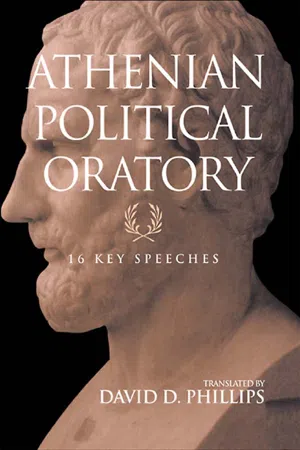
The celebrated orators and speeches of ancient Athens have been read and enjoyed for thousands of years. Focusing on the works of three of the greatest orators in history-Demosthenes, Lysias, and Hypereides-this collection of speeches is an indispensable source for anyone interested in classical civilization and literature, political science and rhetoric. Each of the three sections-The Thirty Tyrants, Philip and Athens, and Athens Under Alexander-includes an introduction providing an historical overview of the period and each speech is preceded by its own brief introduction. Rendered in lively, readable prose, the translations capture the energy, vigor and power of the originals.
PART ONE: THE THIRTY TYRANTS
Multiple ancient authors provide us with evidence for the regime of the Thirty Tyrants and its aftermath. Lysias, a prosperous Athenian metic,1 was present when the Thirty came to power but soon fled to save his life (Lysias 12.8ff.). Xenophon, a moderate oligarch who remained in Athens throughout the reign of the Thirty, treats the period in Book 2, Chapters 3 and 4 of his Hellenica, a history of Greece from 411 to 362. The pseudo-Aristotelian Constitution of Athens (abbreviated Ath. Pol.) covers the Thirty in Chapters 34 through 41. The later narratives of the Thirty in Diodorus (14.3–6, 32–33) and Justin (Epitome 5.8–10) both derive ultimately from the fourth-century historian Ephorus, whose work survives only in fragments.
The aforementioned sources are in agreement regarding most events of the reign of the Thirty, but their chronology is not always consistent. The execution of Theramenes, for example, occurs before the seizure of Phyle in Xenophon, Diodorus, and Justin but after it in the Ath. Pol. The Spartan garrison arrives at Athens earlier in Xenophon, Diodorus, and Justin and later in Lysias (12.59) and the Ath. Pol. The sketch of the reign of the Thirty Tyrants that follows thus represents only one possible reconstruction of the order of events.
Establishment of the Thirty
In the spring of 404, Athens surrendered to Sparta, ending the Peloponnesian War (431–404). An oligarchic conspiracy had been brewing in Athens during the final days of the war, and when the war ended, the oligarchs sent for the Spartan admiral Lysander. Lysander intimidated the Athenian Assembly into passing a decree moved by one of the conspirators, Dracontides of Aphidna (Lysias 12.72ff.). The Dracontides decree entrusted power to a board of thirty men who were to revise and codify the laws of Athens. The Thirty Tyrants (as they are now called) included Dracontides; Eratosthenes, the defendant in Lysias 12; Critias, a student of Socrates and relative of Plato; and Theramenes, who had played a crucial role in the earlier oligarchic Revolution of 411. The names of all thirty are given by Xenophon (Hellenica 2.3.2).
Appointment of Magistrates
Once they were established, the Thirty secured their hold on power by appointing magistrates friendly to their regime. At the turn of the new year in midsummer 404 (see General Introduction, p. 10, The Athenian Calendar) they swore in a Council of 500 stacked with their supporters. Under the Thirty the Council of 500 functioned as a court of law (Lysias 13.36), displacing the democratic system of jury-courts (dikastêria). The Thirty also chose the Eleven, who were in charge of the state prison and supervised executions. In addition, the tyrants created a board of Ten to govern the Peiraeus and established a corps of 300 attendants called “whip-bearers” (mastigophoroi: Ath. Pol. 35.1).
Legal Reforms
The Thirty delayed the wholesale revision of the Athenian constitution but did enact some legal reforms. They annulled the laws of Ephialtes and Archestratus concerning the Council of the Areopagus. While we cannot identify Archestratus or the laws ascribed to him, Ephialtes had carried legislation in 462/1 that had the effect of substantially curtailing the powers of the Areopagus. By repealing Ephialtes’ laws, the Thirty theoretically returned to the Areopagus all its former privileges. The Thirty may have intended to restore real power to the Areopagus; however, during their brief eight-month reign it was the Council of 500, not the Areopagus, whose influence expanded.
The Thirty also repealed some of the laws enacted by Solon in 594/3. According to Ath. Pol. 35.2, the Thirty rescinded ambiguous statutes, thus lessening the influence of the democratic jury-courts. A prominent example was Solon’s testamentary law, which rendered a will invalid if the testator was insane, senile, drugged, diseased, coerced, bound, or under the influence of a woman (Apollodorus= [Demosthenes] 46 2 Against Stephanus 14; cf. Hypereides 3 Against Athenogenes 17). These statutory obstacles had made it easy to challenge a will and had produced a number of frivolous lawsuits. By repealing this law and removing the obstacles, the Thirty intended to reduce drastically the number of inheritance cases.
Attack on Sycophants; Execution of the Generals and Taxiarchs
At the beginning of their reign, the Thirty targeted sycophants (Lysias 12.5; Xenophon, Hellenica 2.3.12; see General Introduction, pp. 6–7). Sycophants were generally viewed as a blight on society, and the majority of Athenians approved of the crackdown on sycophancy. The Thirty also took steps to eliminate the opposition to their nascent regime. Shortly before they came to power, an informer named Agoratus had denounced several generals and taxiarchs (tribal hoplite commanders) who were prominent and vocal democrats. The Thirty had these men tried by the Council of 500, convicted, and executed (see Lysias 13).
Reign of Terror
The popularity of the Thirty did not last long. To secure their regime, they invited their Spartan allies to garrison the Acropolis; Sparta sent Callibius as harmost (garrison commander) with 700 troops. In need of funds, the Thirty began to trump up charges against wealthy Athenians—at first metics, then citizens as well. Lysias and his brother Polemarchus were among the victims of this scheme (Lysias 12.6ff.). Declaring the targeted individuals to be enemies of the state, the Thirty executed some and exiled others, and confiscated their property. During their eight months in power, the Thirty sentenced 1,500 Athenians to death (Ath. Pol. 35.4; Aeschines 3 Against Ctesiphon 235; Isocrates 7 Areopagiticus 67, 20 Against Lochites 11).
Theramenes vs. Critias
The bloody policies of the Thirty alienated many Athenians and brought about a schism within their own ranks. The extreme oligarchs were led by Critias, the moderates by Theramenes, the most vocal opponent of the tyrants’ violent methods. Theramenes objected on both moral and political grounds: he condemned the practice of killing men in order to seize their assets, and he advocated a government that distributed power among a greater number of Athenians.
Seeing the people rallying in support of Theramenes, Critias and the rest of the Thirty attempted to appease him by proposing a list of 3,000 Athenian “gentlemen” (kaloi k’agathoi) who would have a share in governing the city. Theramenes, however, was not satisfied, since in his opinion the number of “gentlemen” was greater than 3,000. The Thirty delayed publication of the list, and when it was published, they disarmed all Athenians whose names were not on it (Ath. Pol. 36–37.1; Lysias 12.40, 95; Xenophon, Hellenica 2.3.20).2 Further, a law was passed whereby the 3,000 could only be put to death by vote of the Council of 500, while those outside the list could be executed by decree of the Thirty alone (Xenophon, Hellenica 2.3.51).
Execution of Theramenes
The conflict between Critias and Theramenes came to a head at a meeting of the Council of 500. Critias accused Theramenes as an enemy of the regime; Theramenes’ defense won the applause of the councillors. Realizing that the Council would acquit Theramenes, Critias consulted with the rest of the Thirty, struck Theramenes’ name from the list of the 3,000, and condemned him to death. Theramenes was dragged off by the Eleven and forced to drink the fatal hemlock. His last words were a toast to his enemy: “Here’s to the fair Critias!” (Xenophon, Hellenica 2.3.23–56).
Resistance under Thrasybulus; Phyle
Soon after the execution of Theramenes, the Thirty took an additional step to consolidate their regime, expelling from the city of Athens all who were not on the list of the Three Thousand. Many exiled Athenians fled to the neighboring cities of Thebes and Megara, which disobeyed a Spartan directive against accepting Athenian refugees. Among these exiles, resistance to the Thirty arose under the leadership of Thrasybulus, who marched across the border from Boeotia with seventy men and occupied the fortress of Phyle (Lysias 12.52; cf. 13.77–79). The Thirty attempted to dislodge the rebels from Phyle but failed and were forced to retreat to Athens.
Occupation of Eleusis and Salamis
Sensing a growing threat to their security, the Thirty decided to seize the town of Eleusis, in western Attica, as a possible refuge. On the pretext of conducting a census for defense purposes, the Thirty summoned the Eleusinians for a review. The Eleusinians were placed under arrest by the cavalry, and the next day, at a meeting of the Three Thousand, the entire male population of Eleusis was sentenced to death (Xenophon, Hellenica 2.4.8–9; Lysias 12.52, 13.44). This allowed the Thirty to appropriate Eleusis for their own use. Similar measures were taken at Salamis (Lysias ibid.).
Battle of Munychia
In the meantime, emboldened by their success at Phyle, the resistance under Thrasybulus had increased in number from 70 to 1,000 men. The rebels marched on the Peiraeus and seized the hill of Munychia. Hence the democratic rebels are often referred to as “the men of the Peiraeus,” while the oligarchic supporters of the Thirty (that is, the Three Thousand) are called “the men of the city” (Lysias 12.92–98). At Munychia the democrats defeated the oligarchs in battle, and Critias, the leader of the Thirty, was killed.
Ouster of the Thirty
The day after the battle of Munychia, the Three Thousand held a meeting at which they deposed the Thirty. Most of the tyrants retired to their stronghold at Eleusis. The Thirty were replaced by a new board of Ten3 made up of opponents of the dead Critias (Lysias 12.54–57). The appointment of enemies of Critias suggests that these Ten were chosen with an eye toward reconciliation with the men of the Peiraeus; if so, the plan backfired, for, rather than coming to terms, the Ten continued to fight the rebels.
Amnesty of 403
Finally, a settlement between the oligarchs and democrats was brokered by Sparta. The first term of the settlement was an amnesty which historians call the Amnesty of 403. This was a blanket pardon for acts committed during the reign of the Thirty with stated exceptions. The Thirty, the Eleven, the Ten in charge of the Peiraeus, and the Ten who replaced the Thirty were not included in the Amnesty unless they passed a hearing to review their conduct in office. Homicide committed with one’s own hand was not covered by the Amnesty (Ath. Pol. 31.5). However, conspiracy to commit homicide—for example, procuring a persons execution by informing against him—was covered by the Amnesty (Isocrates 18 Against Callimachus 20).
All Athenians swore an oath of reconciliation, which included the clause “I will not bear malice for past wrongs against any citizen except the Thirty and the Eleven, nor against any of these who is willing to give an account of his conduct in the office he held” (Andocides 1 On the Mysteries 90). While Xenophon states (Hellenica 2.4.43) that the Athenians abided by their oaths, Lysias 13 and 16 provide a more pessimistic account of the diligence with which the Amnesty was enforced.
Separation of Eleusis from Athens
The second term of reconciliation was the official separation of Eleusis from Athens. Any man of the city who so wished was allowed to move to Eleusis, as most of the Thirty had already done. Residents of Eleusis were barred from holding political office at Athens, and travel between Eleusis and Athens was forbidden, except during the festival of the Eleusinian Mysteries, celebrated annually in honor of the goddesses Demeter and Persephone. This arrangement would last until 401/0, when Athens reabsorbed Eleusis by force of arms and thus reunited Attica.
Restoration of Democracy
With peace concluded on these terms between the democrats of the Peiraeus and the oligarchs of the city, Athens reverted to a democratic constitution, which remained in effect (with occasional alterations) throughout the Classical period.
1 LYSIAS 12: Against Eratosthenes
Introduction
Soon after the Thirty Tyrants came to power, two of their number, Theognis and Peison, suggested to their colleagues that some metics were opposed to the new government and that this provided an opportunity to seize their assets. The Thirty chose ten targets, including Lysias and his brother Polemarchus (§§6–7). Lysias was arrested but managed to escape his captors by a combination of bribery and sheer luck (§§8–17). Polemarchus, however, was apprehended by the tyrant Eratosthenes and forced to commit suicide by drinking hemlock (§17).
After the restoration of the democracy, Eratosthenes submitted to a review of his conduct in office (euthynai) in order to qualify for the Amnesty of 403 (Part One, The Thirty Tyrants, p. 20). Lysias prosecuted him for the killing of Polemarchus and sought the death penalty (§37). The outcome of the trial is unknown.
In his introduction (§§1–3), Lysias mentions the enormity of the crimes committed by the Thirty, identifies his anger with that felt by the jurors, and expresses the fear that his speech will not do justice to himself and his brother’s memory. The narration occupies §§4–25. Here Lysias tells of his family’s arrival in Athens (§4) and the brutal treatment they suffered at the hands of the Thirty (§§5–21); he concludes the section by confronting Eratosthenes with the illegal arrest and execution of Polemarchus (§§22–25).
The longest part of the speech consists of proofs (§§26–80). Lysias first refutes Eratosthenes’ defense that he opposed the Thirty’s plan to arrest metics and was only acting under orders (§§26–34). He then appeals to the jury to set an example by punishing Eratosthenes and asks for the death penalty, referring to the many heinous acts of Eratosthenes and the Thirty (§§35–42). Sections 43 to 61 summarize the actions of Eratosthenes during the reign of the Thirty. Lysias then digresses to attack another former tyrant, Theramenes. Expecting Eratosthenes to align himself with the moderate Theramenes in order to deflect the jury’s hostility, he portrays Theramenes in the worst possible light (§§62–78). The proof section concludes (§§79–80) with an appeal to the jury to punish the Thirty.
In his lengthy conclusion (§§81–100) Lysias meditates upon a fitting penalty for the Thirty (§§81–84) and attacks Eratosthenes’ advocates (synêgoroi: General Introduction, p. 6) and witnesses (§§85–91). He addresses separately the men of the city (§§92–94) and the men of the Peiraeus (§§95–98), and then appeals to the entire jury to avenge the victims of the Thirty (§§99–100).
Against Eratosthenes
[1] It is not commencing my prosecution that I find difficult, men of the jury, but bringing an end to my speech. The deeds committed by my adversaries are so enormous and so numerous that, even if I were to lie, I could not bring accusations more terrible than those before you, nor, if I wanted to tell the truth, could I tell the whole truth: either the prosecutor would have to give up or time would run out. [2] I think that we will experience the opposite of what we have experienced previously. In the past, you see, prosecutors had to disclose any existing enmity toward their defendants; but in this case we have to ask the defendants1 what enmity they felt toward the city which gave them the audacity to commit such crimes against it.
I say this not because I do not carry my own enmity and misfortune, but because all of us possess reasons for anger in great abundance, for our own sakes or for the city’s. [3] So I, men of the jury, who have never conducted my own or anyone else’s business in public, now stand compelled by what has happened to prosecute this man. As a result, I have frequently fallen into deep despair, fearing that, due to my inexperience, I would conduct this prosecution on behalf of my brother and myself in an unworthy and incapable manner. Nonetheless, I will attempt to instruct you from the beginning in as few words as I can.
[4] My father Cephalus was persuaded by Pericles to move to this country. He lived here for thirty years, and neither he nor we were ever involved in a lawsuit against anyone as prosecutor or defendant; we conducted ourselves under the democracy in such a way as neither to offend against others nor to be wronged by them. [5] But when the Thirty, those depraved sycophants, came to power, they claimed that the city had to be cleansed of unjust men and the remaining citizens had to turn themselves to virtue and justice. That is what they said, but they did not venture to do it, as I will endeavor to recount, speaking first about my own ...
Table of contents
- COVER PAGE
- TITLE PAGE
- COPYRIGHT PAGE
- PREFACE
- GENERAL INTRODUCTION
- PART ONE: THE THIRTY TYRANTS
- 1 LYSIAS 12: AGAINST ERATOSTHENES
- 2 LYSIAS 13: AGAINST AGORATUS
- 3 LYSIAS 16: FOR MANTITHEUS
- PART TWO: PHILIP AND ATHENS
- 4 DEMOSTHENES 4: FIRST PHILIPPIC
- 5 DEMOSTHENES 1: FIRST OLYNTHIAC
- 6 DEMOSTHENES 2: SECOND OLYNTHIAC
- 7 DEMOSTHENES 3: THIRD OLYNTHIAC
- 8 DEMOSTHENES 5: ON THE PEACE
- 9 DEMOSTHENES 6: SECOND PHILIPPIC
- 10 HEGESIPPUS= [DEMOSTHENES] 7: ON HALONNESUS
- 11 DEMOSTHENES 8: ON THE CHERSONESE
- 12 DEMOSTHENES 9: THIRD PHILIPPIC
- 13 PHILIP=[DEMOSTHENES] 12: LETTER OF PHILIP
- PART THREE: ATHENS UNDER ALEXANDER
- 14 HYPEREIDES 1: FOR LYCOPHRON
- 15 HYPEREIDES 4: FOR EUXENIPPUS
- 16 HYPEREIDES 5: AGAINST DEMOSTHENES
- NOTES
- BIBLIOGRAPHY
Trusted by 375,005 students
Access to over 1.5 million titles for a fair monthly price.
Study more efficiently using our study tools.
Frequently asked questions
Yes, you can cancel anytime from the Subscription tab in your account settings on the Perlego website. Your subscription will stay active until the end of your current billing period. Learn how to cancel your subscription
No, books cannot be downloaded as external files, such as PDFs, for use outside of Perlego. However, you can download books within the Perlego app for offline reading on mobile or tablet. Learn how to download books offline
We are an online textbook subscription service, where you can get access to an entire online library for less than the price of a single book per month. With over 1.5 million books across 990+ topics, we’ve got you covered! Learn about our mission
Look out for the read-aloud symbol on your next book to see if you can listen to it. The read-aloud tool reads text aloud for you, highlighting the text as it is being read. You can pause it, speed it up and slow it down. Learn more about Read Aloud
Yes! You can use the Perlego app on both iOS and Android devices to read anytime, anywhere — even offline. Perfect for commutes or when you’re on the go.
Please note we cannot support devices running on iOS 13 and Android 7 or earlier. Learn more about using the app
Please note we cannot support devices running on iOS 13 and Android 7 or earlier. Learn more about using the app
Yes, you can access Athenian Political Oratory by David Phillips in PDF and/or ePUB format, as well as other popular books in History & Ancient History. We have over 1.5 million books available in our catalogue for you to explore.