Recent years have witnessed a burgeoning interest in the study of everyday life within the social sciences and humanities. In Critiques of Everyday Life Michael Gardiner proposes that there exists a counter-tradition within everyday life theorising. This counter-tradition has sought not merely to describe lived experience, but to transform it by elevating our understanding of the everyday to the status of a critical knowledge.
In his analysis Gardiner engages with the work of a number of significant theorists and approaches that have been marginalized by mainstream academe, including:
*The French tradition of everyday life theorising, from the surrealists to Henri Lefebvre, and from the Situationist International to Michel de Certeau
*Agnes Heller and the relationship between the everyday, rationality and ethics
*Carnival, prosaics and intersubjectivity in the work of Mikhail Bakhtin
*Dorothy E. Smith's feminist perspective on everyday life.
Critiques of Everyday Life demonstrates the importance of an alternative, multidisciplinary everyday life paradigm and offers a myriad of new possibilities for critical social and cultural theorising and empirical research.
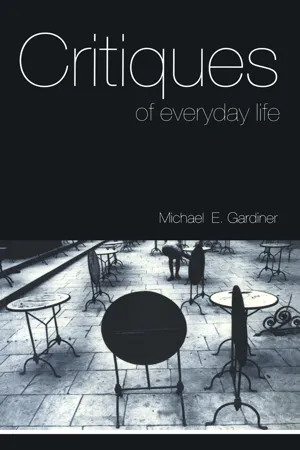
- 256 pages
- English
- ePUB (mobile friendly)
- Available on iOS & Android
eBook - ePub
About this book
Information
1
INTRODUCTION
The everyday is platitude (what lags and falls back, the residual life with which our trash cans and cemeteries are filled: scrap and refuse); but this banality is also what is most important, if it brings us back to existence in its very spontaneity and as it is lived – in the moment when, lived, it escapes every speculative formulation, perhaps all coherence, all regularity. Now we evoke the poetry of Chekhov or even Kafka, and affirm the depth of the superficial, the tragedy of nullity. Always the two sides meet (the amorphous, the stagnant) and the inexhaustible, irrecusable, always unfinished daily that which escapes forms or structures (particularly those of political society: bureaucracy, the wheels of government, parties). And that there may be a certain relation of identity between these two opposites is shown by the slight displacement of emphasis that permits passage from one to the other, as when the spontaneous, the informal – that is, what escapes forms – becomes the amorphous and when, perhaps, the stagnant merges with the current of life, which is also the movement of society.
Maurice Blanchot
When referring to the phenomenon of everyday life, the great French sociologist and philosopher Henri Lefebvre was fond of mentioning G. W. F. Hegel’s maxim ‘The familiar is not necessarily the known’. By invoking this cryptic phrase, Lefebvre was striving to put his finger on something that, partly by virtue of its very pervasiveness in our lives, remains one of the most overlooked and misunderstood aspects of social existence. Although he was convinced that critical sociological analysis could shed considerable light on the nature of the everyday and highlight the central role it plays in the social world, Lefebvre was equally certain that there would always remain something fundamentally mysterious and obscure about its workings. Mysterious, yet at the same time substantial and fecund, everyday life is the crucial foundation upon which the so-called ‘higher’ activities of human beings, including abstract cognition and practical objectifications, are necessarily premised. Accordingly, we must be concerned with redeeming its hidden and oft-suppressed potentials. Rather than compare moments of human creativity to lofty mountain-tops and equate everyday life with plains or marshes, Lefebvre submits that a far better metaphor is to construe the everyday as fertile humus, which is a source of life-enhancing power as we walk over it unnoticed. ‘A landscape without flowers or magnificent woods may be depressing for the passer-by’, he writes, ‘but flowers and trees should not make us forget the earth beneath, which has a secret life and a richness of its own’ (1991a: 87).
This is a book about theories of everyday life, the largely taken-for-granted world that remains clandestine, yet constitutes what Lefebvre calls the ‘common ground’ or ‘connective tissue’ of all conceivable human thoughts and activities. It is the crucial medium through which we enter into a transformative praxis with nature, learn about comradeship and love, acquire and develop communicative competence, formulate and realize pragmatically normative conceptions, feel myriad desires, pains and exaltations, and eventually expire. In short, the everyday is where we develop our manifold capacities, both in an individual and collective sense, and become fully integrated and truly human persons. However, I should make it clear that this is not another primer on mainstream sociologies of everyday life, of which there are many (Douglas et al. 1980; Karp and Yoels 1986). Nor is it a substantive study of particular aspects of daily life in contemporary society. Rather, my goal is different, and perhaps more theoretically ambitious: to uncover and explicate a ‘subterranean’ tradition – or better, a counter-tradition – of thinking about everyday life, one that has been largely ignored or marginalized in the social science literature, at least within the Anglo-American academic world.
It is apparent that the last couple of decades have witnessed a burgeoning interest in the sphere of everyday life, as marked by numerous lines of inquiry established by cultural studies, feminism, media studies and postmodernism. Indeed, we can talk about something of an epistemic shift in this area. Yet there have been few concerted attempts to survey, in a systematic and synoptical fashion, the theories that have underpinned such developments. In general terms, such a counter-tradition evinces a pronounced hostility towards abstract social theorizing (ranging from Saussurean-inspired structuralism to economistic Marxism and Parsonian-style functionalism), and a concomitant stress on the quotidian or non-formalized aspects of social interaction, what Michel Maffesoli (1990) has termed ‘sociality’.1 As such, the theorists and approaches discussed here are concerned with a number of interlocking phenomena that have generally been sidelined within mainstream twentieth-century social theory, such as human affect and emotions, bodily experience and practical knowledges, the role played by ‘lived’ time and space in the constitution of social experience, language and intersubjectivity, and interpersonal ethics. Such theories have also, as Kaplan and Ross characterize it, been preoccupied with elevating ‘lived experience to the status of a critical concept – not merely in order to describe lived experience, but in order to change it’ (1987: 1). The perspectives examined here lie on the cusp between a phenomenology that takes the ‘fine grain’ of everyday life seriously as an integral starting-point of inquiry, and an analysis of wider social and historical developments motivated ultimately by what Jürgen Habermas calls an ‘emancipatory interest’.2 Such a critical approach to the theorization of everyday life strives to overcome the pervasive dichotomy in social science between the objectivism of structuralist approaches and the subjectivistic tendencies of more conventional interpretive theories. Within the context of the present study, I have chosen to focus on the following thinkers and traditions, which I have organized as discrete chapters in roughly chronological order: Dada and Surrealism, Mikhail Bakhtin, Henri Lefebvre, the Situationist International (concentrating on Guy Debord and Raoul Vaneigem), Agnes Heller, Michel de Certeau, and Dorothy E. Smith.3
In this introduction, I wish to pursue two major objectives: first, to distinguish the counter-tradition discussed here from such established approaches as ethnomethodology or phenomenology, as well as those more recent theories that gesture towards the problematic of everyday life, especially cultural studies and postmodernism; and secondly, to tease out some of the common threads that link each of the thinkers and traditions outlined in particular chapters. As to the first of these objectives, we can say that, historically speaking, there have been two central impulses within modernist sociology, stretching from its roots in eighteenth-century social philosophy through the classical period of the nineteenth-century to the post war era: the ‘system’ perspective on the one hand, and a ‘micro’-oriented, interpretive approach on the other (Swingewood 1991). For many decades, the system perspective held sway: the central idea here is that culture and society operate as overarching, objective systems that function to integrate the individual into the whole, a perspective exemplified by Comte, Dürkheim, Parsons, and orthodox Marxism. According to this view, social actors are effectively ‘cultural dopes’, to use Harold Garfinkel’s term, who internalize passively extant social roles and behavioural norms (whether consensual or a reflection of class-specific interests), thus acting to reproduce, in a largely automatic and unwitting fashion, social structures and institutions. By the end of the nineteenth century, however, a reaction against the system perspective began to gather force, and with it the realization that the human sciences could not be satisfied with the construction of abstract, general principles about how social structures functioned to maintain society as a quasi-organic whole. Accordingly, European Geistewissenschaften thinkers like Wilhelm Dilthey, Heinrich Rickert and Max Weber, as well as American pragmatists like George Herbert Mead, claimed that it was not enough simply to describe the functioning of a structure, system or institution. One must also have an interpretive understanding of the latter’s uses, of how human beings develop an ‘insider’s knowledge’ of particular social processes and utilize this understanding so as to act in a voluntaristic and creative fashion. The symbolic and intersubjective meanings that people utilize reflexively to comprehend themselves and their world cannot be brushed aside in the quest for a scientific sociology. As such, the social sciences had to come to grips with the contextual aspects of everyday experience vis-à-vis the actor’s own subjective viewpoint.
In the postwar period, the impact of this interpretive turn was reflected in the emergence of a wide variety of microsociologies, including ethnomethodology, symbolic interactionism, the phenomenology of Alfred Schütz and Berger and Luckmann, and Erving Goffman’s ‘dramaturgy’. All of these are, without a doubt, important contributions to the study of everyday life, and their influence remains palpable (Adler and Adler 1987). However, from the perspective of the present study, they are deficient in several crucial respects. First, such approaches can be located firmly within the familiar metatheoretical and epistemological assumptions of academic social science. Although they rail against macrosociology for ignoring the specificities of everyday life and the complex meanings that adhere to the most apparently ‘trivial’ of human activities, none of them really seek to abandon the pretence to objectivity, scholarly detachment and non-partisanship that has served to legitimate the social sciences for the last 150 years. Although they do focus on the practical accomplishments of skilled social actors in the course of their day-to-day lives, these perspectives tend to reinforce, rather than subvert, the pervasive dichotomy between specialized and non-specialized knowledges, thereby bolstering the authorial power of what André Gorz (1993) calls the ‘expertocracy’.4 Secondly, although such approaches assert that the starting-point of valid sociological knowledge must begin with daily life and its contextual or ‘indexical’ meanings, the everyday is generally perceived as a relatively homogeneous and undifferentiated set of attitudes, practices and cognitive structures. For Schütz et al., everyday life exists as a paramount reality’, a pre-constituted world that is necessarily taken-for-granted and viewed as a quasi-natural, unalterable horizon of action by lay members. Everyday life, in this view, corresponds to a stable order that gives social actors what Anthony Giddens (1984) has termed ‘ontological security’, through the provision of appropriate roles and typified behaviour patterns. Although it is possible to step back from the everyday lifeworld and describe it in more precise, scientific terms, what Schütz refers to as ‘second-order’ accounts, this level of analysis remains the prerogative of trained social scientists, involving the transcription of mundane practices and knowledges into a more organized, systematic and implicitly superior discursive form (Smith 1987). Hence, the everyday world constitutes an overarching, conformist reality that is transmitted to succeeding generations via the acquisition of language-skills and behavioural norms. The concept of ‘everyday life’ remains a purely descriptive or analytical concept. Questions about intersubjective ethics or the ideological structuring of everyday consciousness, for instance, do not figure prominently, insofar as actors are held simply to engage in routines and justify them performatively in an a posteriori manner.
The formalistic character of this viewpoint is somewhat ironic, given that interpretive sociologies have tried to claim a fidelity to the concrete particularities of social situations and practices. As Alvin Gouldner (1975) has observed, these approaches have generally been ethnographic, empiricist, and covertly positivist in their orientation, despite frequent protestations to the contrary. They do not view the everyday lifeworld as a particularly ‘deep’ or complex phenomenon in an ontological or hermeneutical sense. Thus, everyday life is construed as an eternal and unsurpassable feature of the social world. Although there might be minor role confusions or value-conflicts, it remains a non-contradictory and essentially unproblematical component of social existence. By contrast, for the theorists discussed in this book, everyday life does have a history, one that is intimately bound up with the dynamics of modernity (and, some would argue, postmodernity). Hence, it is riven with numerous contradictions and marked by a considerable degree of internal complexity (Crook 1998). It must be acknowledged that everyday life incorporates a form of ‘depth’ reflexivity, which is necessary if we are to account for the remarkable ability that human beings display in adapting to new situations and coping with ongoing existential challenges, as well as to explain the enormous cross-cultural and historical variability that daily life manifests. This reflexivity displays both discursive and pre-discursive, embodied qualities, as well as unconscious elements, as Pierre Bourdieu, Anthony Giddens and others have pointed out. Although everyday life can display routinized, static and unreflexive characteristics, it is also capable of a surprising dynamism and moments of penetrating insight and boundless creativity. The everyday is, as Maffesoli puts it, ‘polydimensional’: fluid, ambivalent and labile. Perhaps we could say that one of the primary goals of the theorists discussed here is to problematize everyday life, to expose its contradictions and tease out its hidden potentialities, and to raise our understanding of the prosaic to the level of critical knowledge. Whereas for mainstream interpretive approaches the everyday is the realm of the ordinary, the alternative pursued here is to treat it as a domain that is potentially ex/raordinary.5 The ordinary can become extraordinary not by eclipsing the everyday, or imagining we can arbitrarily leap beyond it to some ‘higher’ level of cognition or action, but by fully appropriating and activating the possibilities that lie hidden, and typically repressed, within it. That everyday life is not as impoverished or habit-bound as conventional social science (of both a macro- and microsociological persuasion) usually assumes is a point that is made forcefully in the following passage from John O’Neill’s The Poverty of Postmodernism:
It cannot be sufficiently stressed that the common-sense world is not a reified and unreflexive praxis. It is full of art and humour, it is explored in literature, art, song, film and comic strips. Common-sense knowledge is far from being a poor version of science. It is self-critical and, above all, capable of dealing with the contradictions and paradoxes of social life that otherwise drive sociologists off into Utopias, anachronisms, and nostalgias that make ordinary people suspicious of the intellectuals grasp of reality. We ought to reject the social science stereotype of the rigidity of custom, habit and instinct in human affairs.
(1995: 172)
This brings me to my final point regarding mainstream interpretive sociology: that in developing a critical knowledge of everyday life, we must go beyond merely describing the pragmatic activities of social agents within particular social settings. Everyday life cannot be understood in a sui generis sense, because we are compelled to relate it analytically to wider sociohistorical developments. We cannot be satisfied with a surface account of ordinary social practices and modes of consciousness, because to do so would remain at the level of what Karel Kosík (1976) calls the ‘pseudo-concrete’. That is, we must also be concerned to analyse the asymmetrical power relations that exist between a given bureaucratic or institutional system and its users (Warf 1986). The key argument here is that, as Jürgen Habermas (1983, 1987) has frequently pointed out, in the context of modernity systems are dominated by a technocratic or productivist logic. The overriding criterion of success within such systems is their efficient, utilitarian operation, rather than the satisfaction of non-instrumentalized needs as expressed by particular individuals and communities. It is to this technocratic rationality that the ‘non-logical logics’ of everyday life are generally contrasted and opposed by the theorists examined in this book. Such a focus on ingrained power imbalances also raises the possibility that ideological factors can play a significant role in structuring our ‘common-sense’ view of the world, and that lay members’ accounts of their situation are often partial and circumscribed, if not ‘false’ in some narrowly epistemological sense, as implied by certain Marxian theories of ideology.6 Social agents are not ‘cultural dopes’, but nor are their thoughts and actions fully transparent to them. As Bourdieu cogently notes, whilst people’s everyday interpretation of their social world has considerable validity that must be recognized and accorded legitimacy, at the same time we should not succumb to ‘the illusion of immediate knowledge’ (Bourdieu et al. 1991: 250; also Watier 1989). Critical reason and structural analysis therefore have a crucial role to play in exposing such patterns of ideological determination and enhancing what Melvin Pollner (1991) has called a ‘radical reflexivity’, whereby people can develop a heightened understanding of their circumstances and use this comprehension as the basis of conscious action designed to alter repressive social conditions.
Thus far, I have been concerned to contrast the critical approach to the study of everyday life with mainstream microsociological theories. The differences are, I think, fairly straightforward. However, the situation becomes somewhat more complex if we consider two more recent approaches that, in certain respects, also set out to challenge the received epistemological assumptions and rigid disciplinary boundaries enforced by modernist social science: namely, cultural studies and postmodernism. With respect to the former, it is clear that some notion of ‘everyday life’ has been a central, even foundational concept in its development, from its origins in the work of Richard Hoggart, E. P. Thompson and Raymond Williams in the 1950s, to the more formal establishment of British cultural studies (the so-called ‘Birmingham School’) in the 1970s and its more recent extension to Australia, North America, and beyond (Johnson 1986/7). Indeed, many of the figures discussed in this are often cited as key theoretical influences within cultural studies. However, Laurie Langbauer (1992: 47) makes the valuable point that although crucial to the vocabulary and general sensibility of the cultural studies paradigm, everyday life is ‘so taken for granted by it, that it is almost never defined’, much less examined systematically. Cultural studies has, moreover, become increasingly amorphous and diffuse in recent years, and has lost much of the critical and politically engaged character that it displayed in its original incarnation. The result is a distressing tendency that Meagan Morris (1988) has described as the ‘banalization’ of cultural studies, whereby the critique of consumer capitalism and socioeconomic inequities has been supplanted by a vague, depoliticized populism. Increasingly, the ‘everyday’ is evoked in a gestural sense as a bulwark of creativity and resistance, regardless of the question of asymmetries of power, class relations, or increasingly globalized market forces (McChesney 1996; McRobbie 1991).
This brings me to the relationship between critical theories of everyday life and postmodernism, which is a complex issue. Admittedly, there are many similarities: both camps excoriate abstract reason, and acknowledge that human life exhibits many non-rational tendencies, embodied desires and poetical qualities that cannot be captured in the reductive explanatory models favoured by positivist social science; they equally privilege marginalized, ‘unofficial’ and de-centred spaces and practices over centralized, bureaucratic systems, and seek to give a voice to the silenced; both are critical of the myriad dualisms (mind/matter, ...
Table of contents
- Cover
- Half Title
- Title Page
- Copyright Page
- Dedication
- Table of Contents
- Acknowledgements
- 1 Introduction
- 2 Dada and Surrealism: poetics of everyday life
- 3 Bakhtin's prosaic imagination
- 4 Henri Lefebvre: philosopher of the ordinary
- 5 The Situationist International: revolution at the service of poetry
- 6 Agnes Heller: rationality, ethics and everyday life
- 7 Michel de Certeau: the cunning of unreason
- 8 Dorothy E. Smith: a sociology for people
- 9 Conclusion
- Notes
- References
- Index
Trusted by 375,005 students
Access to over 1.5 million titles for a fair monthly price.
Study more efficiently using our study tools.
Frequently asked questions
Yes, you can cancel anytime from the Subscription tab in your account settings on the Perlego website. Your subscription will stay active until the end of your current billing period. Learn how to cancel your subscription
No, books cannot be downloaded as external files, such as PDFs, for use outside of Perlego. However, you can download books within the Perlego app for offline reading on mobile or tablet. Learn how to download books offline
Perlego offers two plans: Essential and Complete
- Essential is ideal for learners and professionals who enjoy exploring a wide range of subjects. Access the Essential Library with 800,000+ trusted titles and best-sellers across business, personal growth, and the humanities. Includes unlimited reading time and Standard Read Aloud voice.
- Complete: Perfect for advanced learners and researchers needing full, unrestricted access. Unlock 1.5M+ books across hundreds of subjects, including academic and specialized titles. The Complete Plan also includes advanced features like Premium Read Aloud and Research Assistant.
We are an online textbook subscription service, where you can get access to an entire online library for less than the price of a single book per month. With over 1.5 million books across 990+ topics, we’ve got you covered! Learn about our mission
Look out for the read-aloud symbol on your next book to see if you can listen to it. The read-aloud tool reads text aloud for you, highlighting the text as it is being read. You can pause it, speed it up and slow it down. Learn more about Read Aloud
Yes! You can use the Perlego app on both iOS and Android devices to read anytime, anywhere — even offline. Perfect for commutes or when you’re on the go.
Please note we cannot support devices running on iOS 13 and Android 7 or earlier. Learn more about using the app
Please note we cannot support devices running on iOS 13 and Android 7 or earlier. Learn more about using the app
Yes, you can access Critiques of Everyday Life by Michael Gardiner in PDF and/or ePUB format, as well as other popular books in Ciencias sociales & Teoría de la crítica literaria. We have over 1.5 million books available in our catalogue for you to explore.