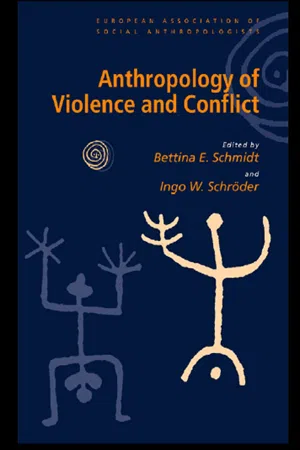
Anthropology of Violence has only recently developed into a field of research in its own right and as such it is still fairly fragmented. Anthropology of Violence and Conflict seeks to redress this fragmentation and develop a method of cross-cultural analysis. The study of important conflicts, such as wars in Sarajevo, Albania and Sri Lanka as well as numerous less publicised conflicts, all aim to create a theory of violence as cross-culturally applicable as possible. Most importantly this volume uses the anthropology of violence as a tool to help in the possible prevention of violence and conflict in the world today.
- 240 pages
- English
- ePUB (mobile friendly)
- Available on iOS & Android
eBook - ePub
Anthropology of Violence and Conflict
About this book
Information
Chapter 1
Introduction
Violent imaginaries and violent practices
Ingo W. Schröder and Bettina E. Schmidt
Almost one hundred years ago Georg Simmel published his seminal study of the fight (Simmel 1908). With this work he was the first to transcend the confines of evolutionist thinking about violence that had viewed intergroup conflict mainly as an instrument of evolutionary selection. From the evolutionist perspective, war was something that had developed along with the rest of the cultural inventory from unregulated primordial aggressiveness ‘in the depths of mankind’1 to modern, mechanised warfare as described by Clausewitz. Simmel looks at violence as a synchronic event, as a type of social relations between individuals and collectivities that serves specific ends at intergroup as well as intragroup levels. With this functional approach he set the stage for the modern anthropological study of violent confrontations that views them as social action relative to the interests and convictions of conscious actors.
While this basic assumption continues to be held in common by social scientists researching conflict, war and violence,2 the field has become increasingly fragmented, particularly in the 1980s. Today, three main approaches can be distinguished:
- the operational approach, focusing on the etics of antagonism, in particular on the measurable material and political causes of conflict;
- the cognitive approach, focusing on the emics of the cultural construction of war in a given society;
- the experiential approach that looks at violence as not necessarily confined to situations of intergroup conflict but as something related to individual subjectivity, something that structures people's everyday lives, even in the absence of an actual state of war.
These are ideal types, of course, and there is hardly any study that does not contain elements of all three, but a tendency can be observed in each of them to pull away in a different direction from the basic consensus on the social nature of violence.
The aims of this introduction are two-fold: first, we discuss the dichotomy of practice and imaginary that is, in our view, crucial to the understanding of violence as a total social fact and which runs as a common thread through the book. Second, we want to elaborate on the three above-mentioned facets of violence. Not only is each of these indicative of a different research perspective, but all of them together make up the whole spectrum of violence as it presents itself to anthropological analysis. Also, we will reflect upon the value of different theoretical approaches that have been brought to bear on the subject by different authors. Just as the various foci on the substance of violence have served to expand the notion of its phenomenological complexity, so the multiple theoretical approaches represented in this collection demonstrate that violence can, and in fact should, be viewed from a variety of angles. While not claiming to reintegrate the field of violence research, we believe the focus on the imaginary–practice dialectic outlined in this introduction presents a fruitful approach to violence as a multifaceted, yet ultimately comparable phenomenon all over the world.
This introduction should be read in concert with Bowman's chapter that approaches the subject from yet another slightly different angle, focusing on the socially constructive qualities of violence.
Violent practice
From Simmel's time to the present, the anthropological notion of conflict has usually been derived from the biological concept of competition. In its most succinct form, a definition of competition reads as follows: ‘Competition occurs when two or more individuals, populations, or species simultaneously use a resource that is actually or potentially limiting’ (Spielmann 1991: 17).3 Violence results from competition neither automatically nor inevitably. As a large body of research from biological anthropology demonstrates, there are numerous non-violent avenues to conflict solution (relocation, exchange, territoriality). In fact, conflicts are much more often settled by preventive or compensatory strategies than by violent confrontation. They may not be as immediately effective as violence, but they are also much less costly and entail a much lower risk of wasting lives or energy (cf. Albers 1993; Jochim 1981). Under specific circumstances, however, none of these options may be feasible. This is where violence can prove a highly efficient way to influence the competition's outcome in favour of one's own group. Violence, in other words, has been shown to confer clear adaptive benefits to the successful party, be they short-term (replenishing the resource base) or long-term (sustaining a given population level through time). It has been argued (cf.Abbink, this volume pp. 123–42) that these advantages of the application of violence as a long-term strategy have been instrumental in shaping a group's psychological proneness to the use of force in the evolutionary process.
By linking violent acts to a basic state of conflict we are making three implicit but important statements about their social ramifications:
- Violence is never completely idiosyncratic. It always expresses some kind of relationship with another party and violent acts do not target anybody at random (although the individual victim is likely to be chosen as representative of some larger category).
- Violence is never completely sense- or meaningless to the actor. It may seem senseless, but it is certainly not meaningless to victim or observer. As social action, it can never be completely dissociated from instrumental rationality.
- Violence is never a totally isolated act. It is – however remotely – related to a competitive relationship and thus the product of a historical process that may extend far back in time and that adds by virtue of this capacity many vicissitudes to the analysis of the conflictive trajectory.
As the several caveats implicit in the above suggest, however, violence is more than just instrumental behaviour. As historically situated practice, it is informed by material constraints and incentives as well as by historical structures and by the cultural representation of these two sets of conditions.
But what, then, is violence? It is the assertion of power or, to paraphrase David Riches’ important discussion of the subject, an act of physical hurt deemed legitimate by the performer and by (some) witnesses (Riches 1986: 8). Since the violent act is relatively easily performed and, at the same time highly visible and concrete, it is a very efficient way of transforming the social environment and staging an ideological message before a public audience (1986: 11). The great advantage of Riches’ definition lies in its abstractness which allows for cross-cultural comparability, and in its addressing the essential ambivalence of violence as instrumental and expressive action.
Even if violence can ultimately be traced to a condition of conflict, not all competition must be solved by violent means. If violence is resorted to or not has little to do with human nature and is only in rare instances enforced by structural factors that make all non-violent avenues of conflict solution impracticable. It has everything to do with cultural factors. Conflicts are mediated by a society's cultural perception that gives specific meaning to the situation, evaluating it on the basis of the experience of past conflicts, stored as objectified knowledge in a group's social memory. How this process of social legitimation of violence is accomplished will be discussed below; let us first consider the important subject of power. At some point, conflicts can no longer be avoided or negotiated, but escalate to a long-term antagonistic relationship – a condition usually termed war by anthropologists. The concept of war describes a state of confrontation in which the possibility of violence is always present and deemed legitimate by the perpetrating party, and in which actual violent encounters occur on a regular basis. It also means a relationship of political collectivities above the family level, ranging from bands or segmentary lineages to states (or even multiple-state alliances). In none of these collectivities, even in the most ‘egalitarian’ band societies, is the decision to go to war reached unanimously by all group members. It is made by those who hold power in the society. As R. Brian Ferguson puts it, ‘wars occur when those who make the decision to fight estimate that it is in their material interests to do so’ (Ferguson 1990: 30).
The élite's interests are usually encoded in a moral idiom relating the imminent violent confrontation to anything from revenge obligations to religious imperatives, ‘traditional’ animosity or ‘the good of the nation’. The ways and means by which this moral idiom is inculcated upon the minds of those who actually march into battle varies greatly between bands and states, of course. The important point remains, however, that while conflicts are caused by structural conditions like the unequal access to resources, population shifts or external pressures, wars do not automatically result from them. Wars are made by people who can be supposed to have based their decisions on some sort of rational evaluation.4 More particularly, wars are made by those individuals, groups or classes that have the power successfully to represent violence as the appropriate course of action in a given situation. But war as a long-term period of antagonistic practice and ideology could not be sustained if only a small élite were to profit from it. Violence can prove a successful strategy for many different kinds of perpetrators.
‘War is like a delicious piece of cake’, writes the Croatian novelist Dubravka Ugrešić, ‘that everybody wants a piece of: politicians, criminals and speculators, profiteers and murderers, sadists and masochists, the faithful and the charitable, historians and philosophers, and journalists’ (Ugrešić 1995: 126; translation by IWS).
Georg Elwert (1997, 1998, 1999) has proposed the term ‘markets of violence’ to describe those arenas of long-term violent interaction, unrestrained by overarching power structures and mitigating norms, where several rational actors employ violence as a strategy to bargain for power and material benefits.5 In this view, war is a game played by strategically planning leaders or élites in which those who actually commit acts of violence are no more than pawns who – at least momentarily – forgo detached refletion in favour of highly emotionally charged action. Still, at both levels, motivation follows a specific cultural grammar that defines the value and relative importance of material and social benefits (honour, prestige). This cultural grammar gives a more permanent meaning to the violent confrontation and thereby offers an additional motivational framework that holds out incentives beyond the individual actor's immediate interests. With all these rational considerations involved in the decision to use violence, once unleashed it still has a strong tendency to generate its own dynamic. Military confrontations are governed by their own logic of short-term tactical or strategic imperatives that are likely to be completely unrelated to the original causes of the conflict. The detailed descriptive analysis of how decision-making processes evolve, which cultural models are employed to assess a situation as calling for violent action and what kinds of social relations are invoked in order to reach a conclusion among the power-holding élite that is making the decision has been much neglected in anthropological research on war.
One additional feature of violence that needs to be mentioned is its performative quality. Violence without an audience will still leave people dead, but is socially meaningless. Violent acts are efficient because of their staging of power and legitimacy, probably even more so than due to their actual physical results. In other words, war as a long-term process only now and then culminates in real acts of violence, and both parties include lots of individuals who are not confronted with real violence at all, but violence as performance extends its efficacy over space and time and gets its message across clearly to the large majority of people who are not physically affected by it. Also, its performative quality makes violence an everyday experience (with all the consequences to society) without anybody actually experiencing physical hurt every day.
The symbolic dimension of violence, on the other hand, may also backfire against its perpetrators and make it contestable on a discursive level, not as a physical but as a performative act. As Peteet's (1994) research on the Israeli–Palestinian conflict has shown, the experience of violence can be framed quite differently by the victims and perpetrators. The victims can take the opportunity to subvert the dominant group's intention to intimidate them through the use of violence by attaching a cultural meaning of their own to the suffering (in this case, as a male rite de passage), a meaning that allows them to reclaim agency and political identity. This case reminds us that, even in a situation of clearly uneven distribution of power, violence must not automatically be considered the most efficient strategy of conflict resolution. It is a complex social phenomenon that under certain circumstances may not be a good strategic choice at all.
Comparing violence
Violence is never so specific and culturally bounded that it cannot be compared. There is a long tradition in anthropology of linking types of collective violence to types of society and arranging them on an evolutionary scale (cf. Otterbein 1994; Reyna 1994). Riches’ definition lends itself very well to broad comparisons on a functional level. Violence is a basic form of social action that occurs under concrete conditions, targets concrete victims, creates concrete settings and produces concrete results. All of these dimensions are clearly accessible to comparative analysis. More specifically, violence can be compared in relation to its causes, the event itself and its results.
Causes: as already mentioned, violence results from confrontations caused by the competition over (social and/or material) resources. Part of this antagonistic relationship can be explained historically, but in order to persist to the present day there must also be more recent incentives for perpetuating the conflict. The causes are generally accessible to historical and ethnographic research.
Events: violent acts are highly visible and usually take place in a public arena, which makes it easy to document or reconstruct their processual aspects. Moreover, long-term confrontations explode in violent clashes that can be described and analysed as events, forms of social action clearly marked off in space and time from everyday practice or, in other words, as a ‘ramified sequence of occurrences that is recognised as notable by contemporaries and that results in a durable transformation of structures’ (Sewell 1996: 844).6 Events take place in well-defined locales and within a recognisable time-span. Due to these features they can be easily inscribed in any form of cultural archive and are easily recalled and recreated. Unlike perpetually culturally mediated everyday practice, events stand out because of their historical qualities of notability and transform-ativity as uniquely suited for comparison across time and cultural boundaries.
By focusing on events as categories of analysis we do not follow the current postmodernist shift in anthropological research on violence. Many recent studies (cf. Daniel 1996; de Silva 1995; Feldman 1991; Nordstrom 1997; Nordstrom and Robben 1995; Poole 1994) privilege ‘experience’ as the most authentic form of knowledge and have abandoned an analytical approach in favour of a subjectivist focus on the impact violence has on the everyday life of individuals (including the researchers themselves). While we d...
Table of contents
- Cover Page
- Title Page
- Copyright Page
- European Association of Social Anthropologists
- Figures
- Contributors
- Acknowledgements
- Chapter 1: Introduction
- Chapter 2: The violence in identity1
- Violence as everyday practice and imagination
- Violence and conflict
- Violence in war
Trusted by 375,005 students
Access to over 1.5 million titles for a fair monthly price.
Study more efficiently using our study tools.
Frequently asked questions
Yes, you can cancel anytime from the Subscription tab in your account settings on the Perlego website. Your subscription will stay active until the end of your current billing period. Learn how to cancel your subscription
No, books cannot be downloaded as external files, such as PDFs, for use outside of Perlego. However, you can download books within the Perlego app for offline reading on mobile or tablet. Learn how to download books offline
Perlego offers two plans: Essential and Complete
- Essential is ideal for learners and professionals who enjoy exploring a wide range of subjects. Access the Essential Library with 800,000+ trusted titles and best-sellers across business, personal growth, and the humanities. Includes unlimited reading time and Standard Read Aloud voice.
- Complete: Perfect for advanced learners and researchers needing full, unrestricted access. Unlock 1.5M+ books across hundreds of subjects, including academic and specialized titles. The Complete Plan also includes advanced features like Premium Read Aloud and Research Assistant.
We are an online textbook subscription service, where you can get access to an entire online library for less than the price of a single book per month. With over 1.5 million books across 990+ topics, we’ve got you covered! Learn about our mission
Look out for the read-aloud symbol on your next book to see if you can listen to it. The read-aloud tool reads text aloud for you, highlighting the text as it is being read. You can pause it, speed it up and slow it down. Learn more about Read Aloud
Yes! You can use the Perlego app on both iOS and Android devices to read anytime, anywhere — even offline. Perfect for commutes or when you’re on the go.
Please note we cannot support devices running on iOS 13 and Android 7 or earlier. Learn more about using the app
Please note we cannot support devices running on iOS 13 and Android 7 or earlier. Learn more about using the app
Yes, you can access Anthropology of Violence and Conflict by Bettina Schmidt,Ingo Schroeder in PDF and/or ePUB format, as well as other popular books in Social Sciences & Anthropology. We have over 1.5 million books available in our catalogue for you to explore.