![]()
Part I
Assessing the solar opportunity
When you begin to look at the opportunities solar offers for your property portfolio, there is often a moment when the stream of solar company solicitations and news becomes overwhelming. In one moment you hear that solar is the way of the future; later on the same day you read that solar is a costly vision that has little place in the real world. I am not surprised when I talk to industry colleagues and hear comments like this:
• “I want to be clear on what it takes to deploy a quality solar project.”
• “I want to understand the difference between what solar companies are offering.”
• “I want to know how to quantify the value solar creates for my business or property type.”
• “I want to know where to find resources and support.”
This is what often happens: A commercial property professional decides to take a look at one or two properties with a single solar company that proposes one type of solar contract. If an agreement doesn’t come together at that moment in time, the decision is made that solar is just not a good fit for their portfolio or business.
But these same people would not decide to enter a new real estate market, attempt unsuccessfully to buy one building, and then give up and leave the market. They would have a long-term strategy and a systematic approach to build an understanding of the market, target properties, and position themselves to capture the greatest value over time. The pursuit of value from solar projects requires much the same approach. Market knowledge, clarity around your goals, and the ability to capitalize on changes in the market over time can help effectively mitigate solar risks while maximizing value.
With this in mind, Part I of the handbook introduces the knowledge that is essential to understanding how solar projects create value for commercial properties. This information allows you to identify the components of value that solar projects create that are most relevant to your goals and operational needs.
You will learn the four key components that must be in place from a financial and functional standpoint for solar projects to be viable. Building on the four components, you will learn how to conduct due diligence within your real estate portfolio to identify the properties that will be the best candidates for solar projects. This will enable you to target the markets and properties that will be the best candidates for solar and that create the most value for you.
![]()
Chapter 1
Key terms used by the solar industry
Chapter summary
• Understanding solar terms and phrases makes your conversations with solar companies and service providers more productive and reduces the potential for confusion.
• Knowing the language of the solar industry makes it easier to analyze your options and determine where the most value exists.
Each industry has its own language, and the solar industry is no different. The solar industry has numerous terms that allow you to understand information and communicate effectively with solar service providers. Many of these terms may already be familiar to you. Following is a highly abridged summary of key words and phrases that explain the most relevant terms you are likely to encounter. Rather than being overly technical, the terms are described in a practical and comparative way so you can understand what the equipment is and understand it in context.
Alternating current, abbreviated as “AC,” is the form of electricity used by buildings and the utility grid. The direct current output of solar arrays is converted to AC before being delivered to the building or utility grid.
Balance of System, abbreviated as “BOS,” is the materials and equipment required to make a complete and functional PV facility, excluding the solar modules. This includes the racking system, ballast, wiring and conduit, conductors, electrical equipment, and the like. The term is commonly used in context as “balance of system components.”
A building-applied solar array is a PV system affixed to the building, such as the roof surface or a façade. A building-applied solar array can be removed without dismantling portions of the building.
A building-integrated solar array is a PV system permanently constructed as part of a standard building component such as curtain wall glazing, exterior cladding or roof membrane. A building-integrated solar array cannot be removed without dismantling portions of the building.
CdTe is the acronym for cadmium telluride, the elements that comprise the semiconductor used in certain types of thin-film PV cells.
CIGS (pronounced “siggs”) is the acronym for copper, indium, gallium, and selenide, the elements that comprise the semiconductor used in certain types of thin-film PV cells.
A curtain wall is a type of cladding system used widely for commercial buildings. A curtain wall consists of an aluminum or steel frame that is hung from the primary structure of the building. Curtain walls function as the exterior enclosure of the building and often contain glass within their frames that acts as windows. Metal, stone, or panels of other materials may also be used in a curtain wall frame. Solar modules can be designed to fit into a curtain wall frame.
Degradation of solar modules is the amount of performance lost in each year of operation. High-quality solar modules are generally warranted to retain 80 percent of their rated output after 25 years.
Direct current, abbreviated as “DC,” is the form of electricity produced by PV modules. Direct current electricity generally must be converted to alternating current before a building can use it, or before it can be sent back to the utility grid.
Disconnects are switches, also referred to as circuit breakers, that cut off power flowing through them in the event of a problem with the solar array. There is typically a disconnect on either side of the inverter. This allows the solar array to be isolated from the rest of the system for repair or diagnostics. Disconnects are also used to isolate the solar array from the building or utility grid if the electrical infrastructure of either one needs to be repaired.
An electrical enclosure is a dedicated space, usually outside on the ground or inside a building electrical room where the electricity-handling equipment for a solar facility is placed. This is where the inverter, transformer, disconnects, and metering equipment are typically located.
A feed-in tariff (FiT) is a term used by the energy industry to describe a fixed payment contract, typically between a power producer and a utility. The contract stipulates that the purchaser will pay the energy producer for each unit of energy that is generated and delivered to the grid. A FiT can be used for numerous sources of energy such as wind or biomass, not only solar. The price of a FiT varies based on location and regulatory policy, but FiTs are generally based on the cost of generation of each technology. FiT pricing is periodically adjusted by regulators to reflect changes in the cost of developing projects and generating electricity.
Flexible thin-film modules have an appearance that differs from what most people associate with traditional solar panels. They are a thin, flexible module about 16 inches wide and up to 20 feet long. The PV cells are laminated between sheets of durable plastic laminate atop a thin stainless steel backing. This type of module does not have any frame and does not require a separate support structure. It can be rolled out and affixed directly onto many different types of roof surfaces. This module generally has lower efficiency than traditional crystalline solar modules, but it is lightweight.
An inverter and transformer, along with other electrical components, turn raw electricity from solar modules into a form usable by the building or the utility grid. The inverter converts electricity from DC to AC. The electricity is then run through a transformer that adjusts the voltage to make it compatible with the building or the utility grid. Inverters come in several size categories, as shown in Table 1.1.
Irradiance is the amount of solar radiation striking the earth’s surface, measured in watts per square meter (W/m2).
Irradiation is the amount of solar radiation striking the earth’s surface for a given amount of time, measured in watt-hours per square meter (W-H/m2).
Kilowatts, abbreviated as “kW,” are a measure of electric power at any given instant. For example, a solar array could produce anywhere from zero kW at night time, to many thousands of kW at midday; 1 kW = 1,000 watts.
Table 1.1 Inverter comparison
| Type | Size | Location |
| Micro inverter | One per solar module | Attached to each solar module |
| String inverter | One per array (typically 50 kW or less each) | Attached in rows to a wall or other supporting surface |
| Central station inverter | One per project (typically from 100 kW to more than 1,000 kW) | Free-standing in an electrical enclosure |
Kilowatt-hours, abbreviated as “kWh,” are a measure of energy, calculated as power × time. For example, 1,000 kilowatts consumed during the course of two hours equals 2,000 kWh.
A megawatt, abbreviated as “MW,” is a measure of electrical power; 1 MW = 1,000,000 watts. The capacity of large solar arrays is often described in MW, such as “a 2 MW rooftop solar project.”
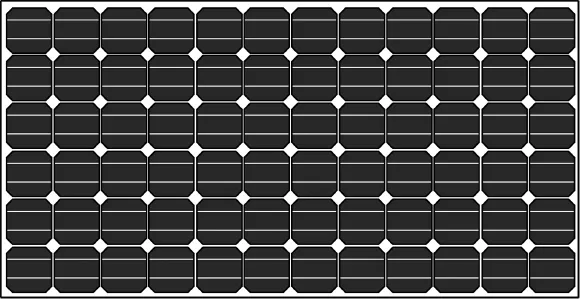
A solar module is an assembly of PV cells and a supporting structure that form a panel. Solar modules are commonly referred to as “solar panels.” Modules are usually rectangular, measuring about 2' × 6' on a side. These modules contain rows of PV cells sandwiched between sheets of plastic laminate and glass. A module has electrical connectors built into the side facing away from the sun to interconnect with other modules to form an array. Some modules have an aluminum frame around the perimeter of the module, while others do not.
Mono-crystalline solar cells describe a type of silicon semiconductor used to make solar modules. These types of cells tend to have a high efficiency. Mono-crystalline solar cells are dark blue or black in color and are made from highly refined silicon, an abundant natural material found in sand and quartz.
Figure 1.1 Solar module.
Note: This module is comprised of 72 photovoltaic cells.
The nameplate rating is the rated capacity of a solar array, calculated by summing the wattage of all solar modules in the array, typically expressed in kW. A solar array composed of 100 modules rated at 250 watts has a nameplate rating of 25 kW. See also rated system capacity:
100 modules × 250 watts = 25,000 watts, or 25 kW
Net metering is a regulatory policy that exists in most property markets. This policy is what enables property owners to connect their solar system to the utility grid. The term refers to the “net” amount of electricity that the utility charges each month once solar production is subtracted from the total metered consumption of energy from the grid.
Photovoltaic cells, abbreviated as “PV” and often referred to as solar cells, are the individual components in a solar module that generate electricity. Cells measure roughly six inches on a side, and are composed of semiconducting materials that generate DC electricity when struck by the sun. PV cells may be composed of silicon, as well as combinations of elements including CdTe, CIGS, as well as other compounds. PV cells are combined in a sheet to form a module.
Polycrystalline solar cells are a type of silicon semiconductor used to make solar modules. These types of cells tend to have a moderately high efficiency.
A power purchase agreement, abbreviated as “PPA,” is a long-term sales agreement between a producer of energy and a buyer of energy, where the producer agrees to sell the output of their solar array to the buyer at an agreed-upon price for a fixed period of time.
Racking is a support structure for the solar modules in an array. Racking holds the modules in a predetermined position facing the sun, while anchoring them to the building. This can be a permanently anchored system or a ballasted attachment, and it prevents the modules from moving out o...