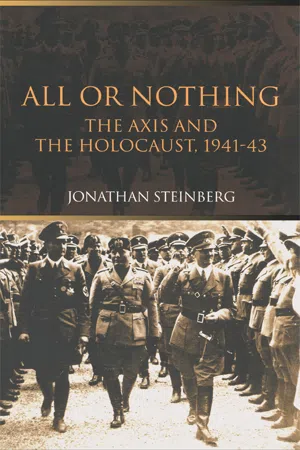
German and Italian fascist armies in the Second World War treated the Jews quite differently. Jews who fell into the hands of the German army ended up in concentration camps; none of those taken by the Italians suffered the same fate. Yet the protectors of the Jews were no philo-Semites, nor were they (often) great respecters of human life. Some of those same officers had sanctioned savage atrocities against Ethiopians and Arabs in the years before the war. Jonathan Steinberg uses this remarkable and poignant story to unravel the motives and forces underpinning both Fascism and Nazism. As a renowned historian of both Germany and Italy, he is uniquely placed to answer the underlying question; why?
- 364 pages
- English
- ePUB (mobile friendly)
- Available on iOS & Android
eBook - ePub
PART I
THE EVENTS
PHASE ONE UNSYSTEMATIC MURDER: WAR IN THE BALKANS April 1941 to June 1942
Germany invaded Poland on 1 September 1939 without consulting its Axis partner. Italy remained neutral. It was not an heroic posture and the Duce found the situation extremely embarrassing. The swift German victory over Poland turned embarrassment into humiliation. Germany needed no assistance from Italy and Europe no longer required the Duce’s mediation. As he said to his generals on 31 March 1940,
If the war continues, to think that Italy can remain outside it to the end is absurd and impossible… Italy cannot remain neutral for the whole duration of the war without resigning from its role, without disqualifying itself, without reducing itself to the level of Switzerland multiplied by ten.1
Precisely what Italy would do in the war had not been deeply considered. In August of 1939 Mussolini announced to his military chiefs that in the event of an Anglo-French attack on Italy, he would order a defensive position around metropolitan Italy tied to a double offensive: one ‘certain’ against Greece and one ‘probable’ against Yugoslavia. Fortunato Minniti in a recent article remarks mildly, ‘This orientation is difficult to interpret…you respond with an offensive approach but the offensive is directed against third countries and not against the aggressors.’2
Italy was unprepared for war. Colonel Antonio Gandin attended the military parade on 9 May 1939, the birthday of the Empire, and went back to his office deeply depressed:
infantry: of four grenadier and infantry regiments only one (81st) has the complete new equipment…
motorized infantry: one regiment with automobiles for infantry of the new type, one with vehicles of the old type… artillery: practically all old material…. In conclusion it is easy to sum up: prevalence of antiquated equipment, shortage of new material.3 Italian war preparations amounted to bluff and bluster. Mussolini talked about ‘eight million bayonets’. Ciano recorded in his diary on 29 April 1939, after a Council of Ministers:
The military make great play with a lot of names. They multiply the number of divisions, but in reality these are so small that they scarcely have more than the strength of regiments. The ammunition depots are short of ammunition. Artillery is out-moded. Our anti-aircraft and anti-tank weapons are altogether lacking. There has been a good deal of bluffing in the military sphere, and even the Duce himself has been deceived—a tragic bluff. We will not talk about the question of the Air Force. Valle states that there are 3,006 first-line planes, while the Navy information service says there are only 982.4
Three days before the Italians declare d w ar on Fra nce and Bri in the intoxication of the German victories of April and May 1940, a senior general, Quirino Armellino, recorded his sense of foreboding:
So we are about to be thrown into a war with the hope that it could finish tomorrow with a victorious peace but could also be long and hard—in an incredible, terrible situation which could end by submerging us all entirely. If the history of this is ever done, our successors will see the card that we are playing and judge us harshly.5
Strategic thinking had not advanced much beyond general gloom by April 1940. Italy was still not prepared for war . The Chief of the General Staff reckoned that Italy had reached about 40 per cent of its wartime requirements but Mussolini was becoming impatient. During 1939 and 1940 the Duce had managed to achieve complete command over the Italian armed forces and by May 1940 had established a command structure ‘on the German model (alien, however, to Italian traditions)’.6 Mussolini, as First Marshal of the Empire, commanded the Royal Italian armed forces as delegate of the King and used a Chief of the General Staff, who coordinated the staffs of the three services, to do so. Mussolini stood to Badoglio and his successors as Hitler did to Keitel.
Mussolini stood to Badoglio and his successors as Hitler did to Keitel. On 11 April, Marshall Badoglio put the position to Mussolini quite clearly:
Our forces, even if the preparation were complete, would always be inadequate for a decisive impact in any sector whatever… unless a ponderous German action had really so prostrated the adversary’s forces to justify any audacity. Such a decision, it is clear, is reserved to you, Duce. We carry out your orders.7
By the end of May, the enemy seemed prostrate enough for Mussolini to add a kick or two. In a series of lightning strikes unparalleled in the history of warfare, the Wehrmacht had overrun Denmark, Norway, Holland, Belgium and Luxemburg and broken through the impregnable French defences. Mussolini decided to act before the Germans won the war without any Italian participation. On 29 May 1940 the Duce explained to his senior generals ‘the geometric logic’ which revealed to him, the great strategist, that ‘we absolutely cannot avoid war’.8 Renzo De Felice, Mussolini’s biographer, writes: ‘Nobody made objections. A very brief discussion followed the words of the Duce but limited entirely to a few technical aspects.’9
Italy entered the Second World War without clear objectives, without adequate preparation and without honour. On 10 June 1940 Italy declared war on the Allies, an act which the French President, Paul Reynaud, described in a broadcast as ‘a stab in the back’ and others in even less complimentary similes. The fortnight of hostilities added to Italian embarrassment. Against a French Army which the Germans had defeated and demoralized, the Italian armed forces got nowhere. The French held the frontier along the Alps and the Riviera and even threatened to break the Italian lines. The official German history of the Second World War describes the two weeks of fighting on the Alpine front as ‘a dèbâcle’. The figures of dead and wounded speak for themselves: the Italians: 631 dead, 2,631 wounded, 616 missing and 2,151 victims of frostbite; the French: 32 dead, 42 wounded and 150 missing.10 In spite of that, Hitler—and not for the last time—covered the shame of his ally and granted the Italians a status in the armistice negotiations to which their military accomplishments had not entitled them.
Hitler also conceded substantial chunks of the globe to his Axis partner with the generosity of the gambler who has just won a jackpot. When Ciano visited Berlin in early July the Führer told him, as Ciano reported, ‘Everything which concerns the Mediterranean, that includes the Adriatic, is a purely Italian question into which he [Hitler] does not intend to involve himself, approving a priori whatever decision and whatever action could be accomplished by the Duce.’11
In July 1940 generous impulses could be indulged. A complete German victory seemed near. No sensible British government would carry on the fight after the fall of France. It cost little to concede spheres of influence to Italy which would fall to the Axis in any case. On the other hand, Hitler had a shrewd idea of Italian strength and a week after Ciano returned from Berlin he declined ‘in a definite and courteous way the offer to send an Italian expeditionary force’ for the invasion of Britain. The Duce was ‘very much annoyed’ but could do nothing.12
The summer and early autumn of 1940 was a difficult time of waiting for both dictators. In spite of constant hectoring the Italian forces in North Africa made slow progress on the route to the Suez Canal. Russian troop movements alarmed Hitler and the Battle of Britain began slowly and perceptibly to turn against the Luftwaffe. The German naval attaché in Rome reported to Berlin that the Italian navy showed lack of offensive spirit, and the early engagements against the
Royal Navy had not encouraged it to develop any. On 19 September 1940 the German Foreign Minister, Joachim von Ribbentrop, visited Rome and told Mussolini that Greece and Yugoslavia remained ‘exclusively Italian interests’. In return Mussolini promised von Ribbentrop that ‘militarily he would not undertake anything for the time being’.13 At a meeting between the Führer and the Duce at the Brenner Pass on 4 October, the Germans offered the Italians armoured units for the attack on Egypt. Badoglio replied evasively. He wanted to reserve that theatre for an exclusively Italian triumph on the banks of the Nile.14
On 6 October, Mussolini ordered the demobilization of 600,000 out of the 1, 100,000 who had been called to the colours.15 On 15 October, while the army was disbanding its units, Mussolini announced to his supreme army commanders and his commanding generals in Italian-occupied Albania his intention to attack Greece. The official minutes of the meeting at Palazzo Venezia read as follows:
The purpose of this meeting is to define the means of the action—in its general character—which I have decided to initiate against Greece… Having defined the question thus, I have stabilized the date which in my view must not be delayed even by an hour: that is, the 26th of this month.16
Mussolini left his generals less than two weeks to prepare an operation in mountainous, difficult terrain, at the wrong time of year, with no secure means of transportation, with port facilities inadequate to the number of men, horses and guns soon to pass through them, with notional forces of 70,000 men to the supposed 30,000 of the Greeks, and with the army at home demobilizing . No military operation has ever been more absurdly conceived and disastrously executed than the Italian attack on Greece. The generals at the meeting who knew the truth said nothing and those who talked could no longer tell truth from rhetoric. There was no opposition, no strategic planning and, above all, no German help. Mussolini intended to have his revenge. This time it would be Hitler who read of Mussolini’s bold stroke in the newspapers.
The result was chaos. A typical experience was that of the crack Alpine division ‘Pusteria’ which was hastily ordered to join the 9th Army in Albania on 16 October. It finally got there on 24 November, and was assigned to the 11th Army under General Geloso. On 2 December 1940, Geloso reported to General Soddu, Vice Chief of the General Staff, that the ‘Pusteria’ had,
lacked its commanding officer and the entire headquarters staff, the greater part of the baggage train and pack animals, all its supporting services…and by a true miracle of manoeuvre on the part of the few vehicles available had been put into the line anyway.17
In the four and a half months which followed the attack on Greece at the end of October the Italians eventually deployed over 300,000 men and succeeded—just —in not losing the Albanian territory from which they launched the attack. The Greeks, inferior in numbers and equipment, fought the Italian army to a bloody standstill and inflicted deep wounds on the national psyche. The Royal Navy inflicted real wounds on the Italian capital ships, sinking the Littorio, Duilio and Cavour while they were riding at anchor at Taranto on the night of 11 November, and on 9 December the British counter-attacked at Sidiel-Barrani, which began a headlong retreat by Marshal l Graziani African army.
Mussolini reacted to the defeats hysterically and issued an ‘order’ on 10 November that every Greek city with more than 10,000 residents be razed to the ground.18 This was the first of a series of violent orders born of frustration which turned the Balkans into a bloody nightmare. Both German and Italian forces issued such orders. The difference between them was that the Germans carried theirs out.
Next he fired everybody he could think of in the first instance of what came to be known as ‘Changing the Guard’ and finally he lost his nerve completely. His only hope was to beg Hitler for help. ‘There’s nothing to be done here. It’s grotesque and absurd, but that’s the way it is.’19
Hitler had ‘raged’ when he heard the news of the Italian attack on Greece and announced that he had now ‘lost any desire for further military cooperation’.20 Grand Admiral Raeder saw Hitler a week later and told his staff that ‘on no occasion was authorization for such an independent action given to the Duce by the Führer’.21 Goebbels was utterly disgusted by the spectacle . ‘Our Allies are turning tail and running. A shameful sight. The English are crowing with triumph.’22
As Hitler and the German army watched the Italians flounder in the mountains of Albania their sentiments changed from contempt to alarm. Neither the German nor the Italian High Commands gave any serious thought to the geographical implications of Italy’s declaration of war in June 1940. Before 1939 the Axis partnership existed on paper and in speeches from balconies. No combined operations were ever planned. Only one serious meeting of staffs took place: on 19 March 1940, at the Brenner Pass. General Enno von Rintelen, German military attaché in Rome from 1936 to 1943, explained to his American captors after the war:
[The Germans] had apparently not fully taken into account that by Italy’s entry into the war, the entire Mediterranean area would automatically become involved in the war and thus the theater of war greatly extended…. Significant for this is the fact that Italy en...
Table of contents
- COVER PAGE
- TITLE PAGE
- COPYRIGHT PAGE
- ALL OR NOTHING
- ILLUSTRATIONS
- MAPS AND DOCUMENTS
- ACKNOWLEDGEMENTS
- ABBREVIATIONS
- INTRODUCTION
- THE PROBLEM
- PART I: THE EVENTS
- PART II: EXPLANATIONS
- CONCLUSION
- BIBLIOGRAPHY OF WORKS SINCE 1990
- SOURCES AND BIBLIOGRAPHY
- HOLOCAUST CHRONOLOGY EVOLUTION OF POLICY From 30 January 1939 to 8 September 1943
- NOTES
Trusted by 375,005 students
Access to over 1.5 million titles for a fair monthly price.
Study more efficiently using our study tools.
Frequently asked questions
Yes, you can cancel anytime from the Subscription tab in your account settings on the Perlego website. Your subscription will stay active until the end of your current billing period. Learn how to cancel your subscription
No, books cannot be downloaded as external files, such as PDFs, for use outside of Perlego. However, you can download books within the Perlego app for offline reading on mobile or tablet. Learn how to download books offline
Perlego offers two plans: Essential and Complete
- Essential is ideal for learners and professionals who enjoy exploring a wide range of subjects. Access the Essential Library with 800,000+ trusted titles and best-sellers across business, personal growth, and the humanities. Includes unlimited reading time and Standard Read Aloud voice.
- Complete: Perfect for advanced learners and researchers needing full, unrestricted access. Unlock 1.5M+ books across hundreds of subjects, including academic and specialized titles. The Complete Plan also includes advanced features like Premium Read Aloud and Research Assistant.
We are an online textbook subscription service, where you can get access to an entire online library for less than the price of a single book per month. With over 1.5 million books across 990+ topics, we’ve got you covered! Learn about our mission
Look out for the read-aloud symbol on your next book to see if you can listen to it. The read-aloud tool reads text aloud for you, highlighting the text as it is being read. You can pause it, speed it up and slow it down. Learn more about Read Aloud
Yes! You can use the Perlego app on both iOS and Android devices to read anytime, anywhere — even offline. Perfect for commutes or when you’re on the go.
Please note we cannot support devices running on iOS 13 and Android 7 or earlier. Learn more about using the app
Please note we cannot support devices running on iOS 13 and Android 7 or earlier. Learn more about using the app
Yes, you can access All or Nothing by Jonathan Steinberg in PDF and/or ePUB format, as well as other popular books in History & 20th Century History. We have over 1.5 million books available in our catalogue for you to explore.