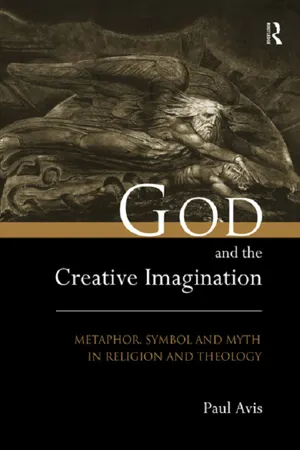
'A mere metaphor', 'only symbolic', 'just a myth' - these tell tale phrases reveal how figurative language has been cheapened and devalued in our modern and postmodern culture. In God and the Creative Imagination, Paul Avis argues the contrary: we see that actually, metaphor, symbol and myth, are the key to a real knowledge of God and the sacred. Avis examines what he calls an alternative tradition, stemming from the Romantic poets Blake, Wordsworth and Keats and drawing on the thought of Cleridge and Newman, and experience in both modern philosophy and science.
God and the Creative Imagination intriguingly draws on a number of non-theological disciplines, from literature to philosophy of science, to show us that God is appropriately likened to an artist or poet and that the greatest truths are expressed in an imaginative form.
Anyone wishing to further their understanding of God, belief and the imagination will find this an inspiring work.
eBook - ePub
God and the Creative Imagination
Metaphor, Symbol and Myth in Religion and Theology
- 208 pages
- English
- ePUB (mobile friendly)
- Available on iOS & Android
eBook - ePub
About this book
Information
1
Speaking of God in the language of the imagination
My thesis in this book is that Christianity lives supremely from the imagination. My central claim is that the role of the imagination is crucial to understanding the true nature of Christianity. Unless we attempt to do full justice to the part played by the imagination, we cannot understand the Christian faith and we cannot ourselves truly believe. My argument is perhaps parallel to H.U.Von Balthasar’s massive, extended and sustained advocacy of the place of beauty in the theological realm. There is, he argues, a need for spiritual perception of the form of beauty that is perfectly expressed in Jesus Christ (Von Balthasar, 1982–9, vol. 1). The present study is a sustained attempt to take the imagination or spiritual vision into account when considering Christianity, or (to put it another way) to evaluate Christianity—its scriptures, doctrines, faith and liturgy—in the light of imagination.
I set out to ask: given the imaginative provenance of the Christian faith, how can it also be true? I aim to show that Christianity is indeed true—that its revelation is real, that its central doctrines are informative, that belief in its object is well placed and that its worship is in touch with reality. So my thesis embraces four critical areas of concern: biblical revelation, Christian doctrine, religious belief and divine worship.
Biblical revelation
My starting point is the conviction that divine revelation is given above all (though certainly not exclusively) in modes that are addressed to the human imagination, rather than to any other faculty (such as the analytical reason or the moral conscience). But let no one accuse me of reducing divine revelation to mere human religious consciousness or projection. There is admirable precedent for my claim. As St Augustine saw, God is a poet and speaks to the world in metaphors, symbols and parables. The supreme revelation is the ‘form’ (as Von Balthasar would say) of Jesus Christ—the whole pattern of divine truth embodied in an historical person and shining out through him into human history. Blake said that ‘the Whole Bible is fill’d with Imagination and Visions’ (Ackroyd, 1995, p.27).
Austin Farrer, in his outstanding Bampton Lectures The Glass of Vision (1948), claimed that the revelatory character of the Bible resided in certain dominant images which lay at the centre of the teaching of Jesus: kingdom of God, Son of Man, restored Israel, suffering servant, sacrifice, covenant and so on. For Farrer, revelation was conveyed through the imagination of the Apostles and the Bible was the product of inspired imagining similar to poetic inspiration. ‘Divine truth is supernaturally communicated to men in an act of inspired thinking which falls into the shape of certain images’ (Farrer, 1948, p.57). It is the images that lend vitality and dynamism to the Bible, and determine its form and content. The inspired mind of the Apostles, Farrer claims, ‘is a process of images which live as it were by their own life and impose themselves with authority’ (ibid., p.113). Farrer’s theory, in the form in which he states it at least, has not found acceptance, but it has the heart of the matter in it. If—as I hope to show—all insight is given through metaphorical perception, if the deepest truths are conveyed in symbols and if those symbols drive the narrative identity of the community when they are constellated in myth, it would be astounding if this were not true of biblical metaphors, symbols and myths, handed on by the biblical community—Israel and the Church.
That is not how the majority of Christians today—especially Bible-loving conservative evangelicals—see the scriptures: they tend to view them as a system of factual, descriptive propositions, bearing divine authority, to be taken at face value and as literally as possible. Conservative evangelicals remain uneasy about approaches to biblical interpretation that play down the imperative of factual accuracy and dwell on the import of such figurative genres as metaphor, symbol and myth. Like the true fundamentalist, the conservative evangelical believes that the Bible makes explicit claims for itself and sets forth divine revelation accordingly in factual statements or propositions. He is uncomfortable with the notion that scripture reveals the truth of God indirectly, obliquely, through images and similitudes, and in a manner constrained by its historical and cultural context. Augustine’s hint that God communicates with us in a poetic mode and Blake’s tenet that Jesus and the Apostles were artists would seem to conservative evangelicals to make divine revelation rest on the shifting sands of subjective, arrogant human subjectivity. A recent major study concludes that an obsession with factual accuracy, a penchant for literal interpretation and a predictable tendency to arrive at maximally conservative conclusions—whatever arguments are considered along the way—mark (and mar) the conservative evangelical approach to biblical interpretation and serve to stake out common ground with fundamentalism (Harris, 1998).
Literal interpretations of the most patently figurative parts of scripture are relinquished by conservative evangelicals long after they have ceased to be tenable and not without a violent struggle. For conservative evangelicals, Genesis 1 was first history, then a sequence of geological epochs, before being reluctantly accepted as myth. Mark Noll’s The Scandal of the Evangelical Mind (1994) traces the sorry tale of the corruption of sober, scholarly evangelical thinking in the nineteenth century by fundamentalism, resistance to evolution, distortions of geology and ultimately full-blown creationism. The virginal conception of Jesus in Matthew and Luke is interpreted as literal biology by some evangelical theologians, even when it is admitted that that stance creates insuperable problems from the point of view of genetics and is in any case not helpful in defending the doctrine of the incarnation, namely the assumption of complete humanity by the Logos. The conflicting presentation of the resurrection appearances in the Gospels (exacerbated by the lack of any resurrection appearances at all in the original ending of Mark) still gives scope for the ingenuity of the harmonisers.
This literalistic approach is defensive and impossible to sustain indefinitely. Perhaps that is why there are so many ‘post-conservative evangelicals’; possibly it accounts for the fact that a number of prominent liberal theologians originally came from the conservative evangelical stable. The deeper study of biblical images, parables and symbolic narrative, at which the early Fathers excelled and which Barth and Von Balthasar have revived, is more commensurate with the character of divine revelation. Blake’s dictum that the whole Bible is filled with imagination and visions needs only to be thought about in order to carry conviction. The question of the metaphorical, symbolic and mythic complexion of the biblical revelation will be taken up in Chapter 5.
Christian doctrine
My second claim is that Christian doctrines (though ultimately derived from divine revelation) are the high expression of human imaginative insight. Because God is a poet, as Augustine suggests, and communicates with us in the imaginative mode, our most appropriate response is also in that mode. Theology does its work in the realm of analogy. Doctrines as the authoritative ultimate outcome of theology—privileged theology, we might say—are equally stated by means of analogy. There is no escape from analogical theology. Our task, therefore, in this section will be to try to show that there is a connection, a continuity, between metaphor and analogy—so that analogy is seen as an unravelling of primal metaphors, a spelling out of the similes that are compressed in metaphors. As Farrer asserts, analogy ‘is only another name for sober and appropriate images’ and all our significant thinking about ultimate, unique meanings, whether in metaphysics or theology, is ‘irreducible analogizing’ (Farrer, 1948, pp.71, 74).
Doctrines are elicited from the Church as it comes under the sway of the pattern or form of revelation. The Church sees or perceives (or thinks it does) the import of revelation and articulates that perception in the most strenuous act of God-given reason. That act of reason is filled with ethical and aesthetic perception. The doctrines of the creed (to use Oliver Quick’s phrase) are not divinely revealed in prepositional form. As William Temple famously said, there are no revealed truths but there are truths of revelation. Divine revelation and human discovery are correlative terms not because revelation is not real or because the Bible is not full of it, but precisely because of the nature of revelation and its reception. It can only be given in the medium of the imagination and can only be appropriated in the same way.
That does not mean that doctrines are a matter of individual preference—every man his own magisterium—nor does it make them frivolous and ephemeral. Doctrines are weighty matters and carry the authority of the Church that teaches them. But, because the Church is not generally infallible, doctrines are not irreformable. In practice, the symbols are permanent but the way they are interpreted is constantly evolving. No one in their right mind wants to ‘monkey with the creed’ (in Hilaire Belloc’s immortal phrase), but it is simply the case that the profoundly symbolic character of revelation constantly generates new insights in response to the contemplation of faith.
The contribution that metaphor, symbol and myth make to Christian doctrine—together with their refined, sophisticated and critical development into analogy—will be explored in Chapter 6.
Religious belief
My third contention is that the act and attitude of faith is born from the imagination. Faith sees the form or pattern of divine revelation as a whole. It sees it embedded in the literary genres of the Bible. It sees it radiating supremely from Jesus Christ as he lies in the manger of the scriptures (as Luther put it). It hears and heeds the witness of the Church in its teaching. It is seized by the truth of the central Christian doctrines of creation, the fallen human condition, atonement, salvation and sanctification in the Church, and the accomplishing of all this through the triune nature of God. The meaning of these doctrines is grasped by the believer through an act of imaginative assent. Faith is not only convinced that the gospel of Christ is worthy of credence and is no illusion, it is also drawn by the perfection of its form: it sees it as supremely beautiful, attractive and desirable. I wish to draw attention to the aesthetic dimension in faith. The imaginative-aesthetic dimension of faith and assent will be pursued in Chapter 7.
Divine worship
Finally, I want to argue that the answer that we make together to God-in-revelation—that is to say, in the Church’s worship—is also enacted in the mode of imaginative expression. The touchstone of liturgy is its imaginative adequacy. In its heights and depths, its profundity and simplicity, liturgy must be commensurate with our most treasured moments of knowing that we are in touch with a reality that is unconditional, infinite and eternal—and, moreover, is the source of our deepest well-being. Human religious experience typically speaks of such moments in metaphor, symbol and myth. Liturgy needs to acknowledge this.
When we worship through the Church’s liturgy we know whether or not we have a deep sense of satisfaction, contentment and fulfilment that the liturgy is doing its job—performing effectively. Not only should it be adequate to express our most significant intuitions—our deepest hopes, aspirations and longings—but it should transcend them, poor and unworthy as they are, and impart to us a sense of being gathered up into an action and an event that is infinitely greater than ourselves—in fact into the timeless prayer of the Church, with ‘angels and archangels and all the company of heaven’ surrounding us as we pray (BCP service of Holy Communion). When the liturgy fails to be such a vehicle we experience frustration and feel short-changed. The liturgy has failed the test of imaginative adequacy. The truth of the imagination in liturgy will concern us in Chapter 8.
So when I say that the Christian faith lives from the imagination, I mean that Christianity is a faith that subsists in the symbolic realm and is appropriated through imaginative indwelling. All the vital practical expressions of Christian existence bear witness to this fact. Prayer, liturgy and theology, as well as the Bible, speak the language of the imagination and articulate their truths in metaphor, symbol or myth. Whether we consider the nature of divine revelation found in scripture, the way that it is interpreted in doctrines and assented to in faith, or the response that it draws forth from the believer in worship—the centrality of imagination is clear. Now the characteristic expressions of imagination are comprised in the three figurative genres of metaphor, symbol and myth. But these are the very substance of religious discourse. Our enquiry is generated by the question of how these can be the vehicles of true utterances about the sacred.
To claim that the Christian religion is best understood as the truth of imagination is totally different from saying that Christianity is an imaginary faith. The great reductionist thinkers of modernity—Feuerbach, Marx, Nietzsche and Freud—claimed that Christianity was an imaginary faith, in the sense that its beliefs were merely projections of unconscious psychological tensions or of social and economic conflicts. For these makers of the modern worldview, Christian beliefs were a world of illusion, created by compensatory wish-fulfilment. The persons of the Holy Trinity were imaginary beings; experience of the grace and presence of God was an imaginary psychological state; heaven and hell were imaginary places, and so on. For example, Friedrich Nietzsche claimed in The Anti-Christ that neither Christian morality nor Christian piety made contact with reality at any point. Imaginary, occult causes (God, spirit, soul) were supposed to produce imaginary effects (sin, redemption, forgiveness) within the framework of an imaginary purpose or teleology (kingdom of God, last judgement, eternal life) (Nietzsche, 1968, p.125; for further discussion, see Avis, 1995).
However, when I make the claim that Christianity lives from the imagination, that Christian beliefs are to be found embodied in metaphor, symbol and myth, and that the Christian faith can only be appropriated by a corresponding act of imaginative insight, I am asserting the opposite of the reductionist theses of Feuerbach, Marx and so on. I am defending the truth and reality of what the Christian faith postulates. The truth of Christian belief is not something that is purely immanent in and reducible to mundane, human and social factors, as the reductionists claimed; it infinitely transcends them—it remains ineffable. And because it transcends this-worldly factors, this truth and reality can only be grasped meaningfully in the realm of imagination which takes images of earth and uses them to evoke a realm beyond. The greatest truths can only be expressed in imaginative form—through images (metaphor, symbol, myth). We know the truth only through the imagination. Creative imagination, rather than some supposedly objective, rationally specifiable procedure that lies outside the domain of personal knowledge, is the key to knowing reality. The truth is contained in symbols and the symbols are materially embodied. That is, it seems to me, a corollary of the incarnational and sacramental character of Christianity.
John Keats wrote in 1817 at the age of twenty-two: ‘I am certain of nothing but of the holiness of the Heart’s affections and the truth of Imagination—What the imagination seizes as Beauty must be truth’ (Keats, 1954, p.48). We know the truth through the whole person. As Newman wrote autobiographically, ‘it is the concrete being that reasons…the whole man moves’ (Newman, 1959, p.225). In his sustained reflections on how we know the truth in the Grammar of Assent (Newman, 1903), with its concept of the illative (truth-seeking, truth-sensing, truth-seizing) sense, Newman gave a central place to the imaginative grasp of the truth. Unlike Keats, Newman—an ascetic—could not fully trust himself to beauty. As Vargish has pointed out, there is a dichotomy in Newman’s thought between truth as beauty to be enjoyed and truth as power to be obeyed. ‘In Newman’s epistemology the perception of beauty and the realization of religious truth are disparate intellectual actions’ (Vargish, 1970, p.156). But imagination is for Newman, just as for Keats, the power that kindles insight into reality. ‘Real assent’ (or, as Newman had called it in an early draft, ‘imaginative assent’) is ‘more vivid and forcible’ than notional assent. ‘Real apprehension …excites and stimulates the affections and passions, by bringing facts home to them as motive causes’ (Newman, 1903, pp.9f., 12). Whether as beauty (for Keats) or as moral claim (for Newman), the tru...
Table of contents
- Cover
- Title
- Copyright
- Contents
- Preface
- List of abbreviations
- PART I
- PART II
- PART III
- PART IV
- Bibliography
- Index of Names
- Subject Index
Trusted by 375,005 students
Access to over 1.5 million titles for a fair monthly price.
Study more efficiently using our study tools.
Frequently asked questions
Yes, you can cancel anytime from the Subscription tab in your account settings on the Perlego website. Your subscription will stay active until the end of your current billing period. Learn how to cancel your subscription
No, books cannot be downloaded as external files, such as PDFs, for use outside of Perlego. However, you can download books within the Perlego app for offline reading on mobile or tablet. Learn how to download books offline
Perlego offers two plans: Essential and Complete
- Essential is ideal for learners and professionals who enjoy exploring a wide range of subjects. Access the Essential Library with 800,000+ trusted titles and best-sellers across business, personal growth, and the humanities. Includes unlimited reading time and Standard Read Aloud voice.
- Complete: Perfect for advanced learners and researchers needing full, unrestricted access. Unlock 1.5M+ books across hundreds of subjects, including academic and specialized titles. The Complete Plan also includes advanced features like Premium Read Aloud and Research Assistant.
We are an online textbook subscription service, where you can get access to an entire online library for less than the price of a single book per month. With over 1.5 million books across 990+ topics, we’ve got you covered! Learn about our mission
Look out for the read-aloud symbol on your next book to see if you can listen to it. The read-aloud tool reads text aloud for you, highlighting the text as it is being read. You can pause it, speed it up and slow it down. Learn more about Read Aloud
Yes! You can use the Perlego app on both iOS and Android devices to read anytime, anywhere — even offline. Perfect for commutes or when you’re on the go.
Please note we cannot support devices running on iOS 13 and Android 7 or earlier. Learn more about using the app
Please note we cannot support devices running on iOS 13 and Android 7 or earlier. Learn more about using the app
Yes, you can access God and the Creative Imagination by Paul Avis in PDF and/or ePUB format, as well as other popular books in Theology & Religion & Christian Theology. We have over 1.5 million books available in our catalogue for you to explore.