- 224 pages
- English
- ePUB (mobile friendly)
- Available on iOS & Android
eBook - ePub
About this book
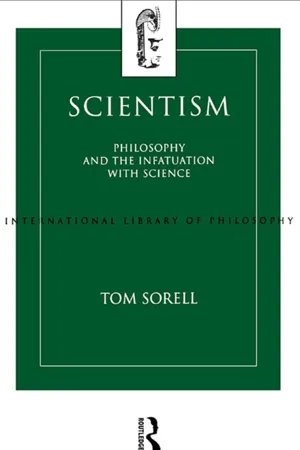
First Published in 2004. Scientism is the belief that science, especially natural science, is the most valuable part of our culture. Although not confined to philosophers, it is from Bacon and Descartes up to the naturalized epistemology of Quine that the clearest statements of the scientistic attitude are to be found. This book shows how Western philosophy has been dominated by an identification with the aims of science and the rationality of its methods. This has resulted in attempts to either dismiss the unscientific or to put it on a scientific footing. The author criticizes this scientific view of philosophy, wishing not to devalue science but to increase the value placed on the arts and humanities. He insists that philosophy is not a science and condemns recent attempts in the name of naturalism to revive the project of a scientific philosophy.
Information
PREFACE
Scientism is a matter of putting too high a value on science in comparison with other branches of learning or culture. It is an occupational hazard in philosophy, for since the time of Descartes philosophers have not only been interested in the nature of science; they have often sided with science in its conflicts with religion, mysticism and even philosophy itself. In this book two forms of scientism in philosophy are criticized: one is relatively new and narrowly philosophical; the other is relatively old and much wider in scope. The new scientism is a reaction against those who write philosophy in ignorance of science, and who defer too much to prescientific intuition or common sense. It is also a reaction against the supposed metaphysical excesses of traditional philosophy, with its irreducible mental substances and events, its Platonic forms, and its transcendental egos. Philosophy in keeping with the new scientism only recognizes the existence of objects that science is already committed to, and it conveys a familiarity with the findings and habits of mind of practising physicists, biologists and psychologists. Sometimes it even reclassifies itself as a branch of science, as when epistemology is redefined as a chapter of psychology. I come to the new scientism at the end, in Chapters 6 and Chapters 7.
The rest of the book is devoted to the older scientism and the antidote to it. The older scientism insists on the need not only for philosophy, but for the whole of culture, to be led by science. This form of scientism has a history stretching back at least to the 1600s; in this century its spokesmen have included Carnap, Reichenbach, Neurath and other ‘scientific empiricists’. The first chapter tries to give an impression of scientism by describing scientific empiricism, in particular its programme for co-ordinating the social sciences, humanities and fine arts with the natural sciences. The second chapter suggests how some of the excesses of this programme are anticipated in classifications of learning and science in writers as early as Bacon and Descartes, and in their valuations of reason relative to other human faculties. Long before the scientific empiricists, philosophers in the seventeenth century exaggerated the value of science in the scheme of learning, and the value of theoretical reason in the scheme of human capacities. Chapters 3 suggests that a much better balance is struck in Kant's philosophy, where a respect for science is not taken to the extreme of scientism, and where the limits of theoretical reason are as well advertised as its possibilities. Chapters 4 and Chapters 5 defend Kant’s idea that the arts and sciences can each promote human improvement, and that they can do so harmoniously, rather than as competing sectors of the ‘two cultures’.
The book concentrates on scientism in philosophy, but it does not deny that scientistic ways of thinking are to be found elsewhere, e.g. in business or politics or science itself, often in forms that have had a greater impact than any of the philosophical varieties. However, for reasons that I very briefly indicate in the first chapter, I am less keen to criticize these forms of scientism than the philosophical ones. It is possible that my emphasis will deter non-philosophers, but I hope not. I have tried to write for a wide audience. People who are new to philosophy should be able to cope with most of the book, and sections that contain technicalities—at the end of Chapters 6 and the beginning of Chapters 7—are preceded and followed by more straightforward material.
A few friends read the book in draft and offered encouragement and advice: I should like to thank Stuart Brown, Nick Furbank and Vicent Raga. I was also helped by a seminar audience at the London School of Economics in October 1989 and by the opportunity to give two special lectures on scientism at University College, London in February 1990.
Material in the concluding section of Chapters 5 is drawn from ‘The World from its Own Point of View’, in A.Malachowski (ed.), Reading Rorty (Oxford: Blackwell, 1990). Almost half of Chapters 7 was previously published. as ‘Values and Secondary Qualities’ in Ratio 27 (1985), 178–88.
1 Scientism and ‘Scientific Empiricism’
DOI: 10.4324/9780203426975-1
What is Scientism?
Scientism is the belief that science, especially natural science, is much the most valuable part of human learning—much the most valuable part because it is much the most authoritative, or serious, or beneficial. Other beliefs related to this one may also be regarded as scientistic, e.g. the belief that science is the only valuable part of human learning, or the view that it is always good for subjects that do not belong to science to be placed on a scientific footing. When, as has happened frequently since the seventeenth century, philosophers claim to have made morals, or history, or politics, or aesthetics, or the study of the human mind into a science, they take it for granted that for a subject to become a science is for it to go up in the world.1 The idea that the acquisition of scientific status is always desirable seems to be mistaken: it exaggerates the value of science. But this and other scientistic ideas, I am going to argue, are not properly rebutted by attempts to denigrate science or to expose as empty its supposed pretensions. A framework is needed that enables one to recognize the considerable value of science alongside the considerable value of many other parts of learning. Fortunately, a framework of this kind exists, though not in an entirely satisfactory form. Kant has a theory about the arts, sciences and religion that implies that all are means of developing a moral culture. The theory sometimes looks scientistic itself, but I offer an interpretation that dispels this impression and then a defence of the general approach in the face of some influential theories opposed to it.
I will mainly be concerned with scientism in philosophy.2 I do not consider at any length the enthusiasm for science among scientists, or among politicians or journalists or people in business, though it can hardly be doubted that, until recently, scientistic beliefs have been strongly held in these circles and indeed throughout society, not only in the West but in the Soviet bloc, not only in the industrialized world but also in the developing countries. In the 1960s, for example, Jawaharlal Nehru, the first prime minister of independent India, wrote that
It is science alone that can solve the problems of hunger and poverty, of insanitation and illiteracy, of superstition and deadening custom and tradition, of vast resources running to waste, of a rich country inhabited by starving people.... Who indeed could afford to ignore science today? At every turn we seek its aid.... The future belongs to science and to those who make friends with science.3
Views like Nehru's were once quite widely held, and, along with professions of faith in the ‘scientific’ political economy of Marx, they were perhaps typical of the scientism of politicians in the 1950s and 1960s. Other kinds of scientism were current at about the same time. In 1957 Anatole Rapaport suggested that on account of the values embodied in scientific practice—values such as tolerance, love of truth, co-operation and so on—scientific communities might be regarded as the prototype of moral communities.4 Much more recently scientism seems to have left its mark even on ostensibly anti-scientific movements. Consider the rhetoric of those American fundamentalists who have demanded equal time for the biblical account of creation when school biology lessons describe evolution according to Darwin. It seems significant that what the creationists are asking to be taught alongside Darwinism is something called ‘creation science’. The creationists agree with their opponents in using ‘science’ as an honorific term, and this is already scientistic or verging upon it. I am less keen to criticize scientism outside philosophy than scientism within philosophy, because it seems to me that outside philosophy scientism sometimes has the useful effect of bolstering up an appreciation of, and respect for, science in the face of antiscientific and pseudo-scientific ideas. A scientistic Darwinian, for example, still overvalues science, but if he manages to show to people who are sceptical that Darwinism is scientifically superior to creation science ,5 he is more likely to convert the sceptical to an acceptance of a branch of genuine science than to win them over to scientism. In this way scientism outside philosophy can reduce the influence of anti-science or pseudoscience.
Within philosophy, on the other hand, at any rate as it is now practised in the English-speaking world, and as it has been practised for the most part in Europe since the seventeenth century, the antiscientific attitude is that of a very small minority, and so the scientism that counteracts an anti-scientific attitude is out of its element. Hilary Putnam once said that all of the great philosophers who were interested in epistemology were philosophers of science in two senses of ‘of’.6 He meant that these philosophers were not only interested in the nature of science, but that they also set themselves up as spokesmen for science. The works that have come to be regarded as canonical in philosophy since Descartes are overwhelmingly the works of philosophers of science in the two senses of ‘of’. In this strongly pro-scientific atmosphere scientism cannot be justified in the way it can sometimes be justified outside philosophy.
SCIENTISM IN TWENTIETH-CENTURY PHILOSOPHY
In this century scientism in philosophy has already had one high point, and it may be enjoying a resurgence. A programme for the unity of science, originally conceived in Vienna in the 1920s, was a vehicle for scientistic writing for the next thirty years. Much more recently a kind of scientism has become discernible in arguments for certain research programmes in the philosophy of mind and epistemology. For example, Patricia Churchland has written that ‘there are remarkable new developments in cognitive neurobiology which encourage us to think that a new and encompassing paradigm [in epistemology] is emerging’ .7 Note the ‘encompassing’. Churchland does not say, as members of the Vienna Circle did, that older forms of epistemology are suspect because they contain metaphysical statements that fail a test of verifiability. Her complaint is that the older forms of epistemology incorporate a worn-out paradigm. Thus, even if everything said by the traditional epistemologists makes sense, it is not any longer fruitful to carry on as they did. It is time for philosophical questions to catch up with the age of neuroscience and raise the questions that this age enables us to ask. Not ‘How is it possible for us to represent reality?’ or ‘How is it that we can represent the external world of objects of space and time, of motion and colour?’ but rather ‘How does the brain work?’8 Churchland seems to stand in a long line of philosophers who have urged the transformation of a branch of philosophy into a branch of natural science. And hers is not the only scientistic voice now audible. There are others who, for different reasons, have advocated a naturalization of ethics and a recognition of its basis in biology. As with earlier forms of scientism there is more to be said against the new versions than in their favour. Fruitfulness in philosophy is probably not the same as fruitfulness in other subjects, and redefinitions of questions that seem to produce it had better not discard live problems with dead ones. In particular, they had better not write off as dead questions those that are merely old. The questions that Churchland thinks have been superseded seem to me to be old and difficult rather than lifeless.
I shall return to the new scientism much later, preferring to begin with the form that was influential earlier in this century. This is the scientism whose spokesmen included Carnap, Reichenbach and Neurath, philosophers who believed that no field of enquiry was out of bounds to the positive sciences or unable to benefit from their methods. When I mention spokesmen of the earlier scientism I do not have in mind members of the Vienna Circle alone, or even adherents of logical positivism. Carnap has used the term ‘scientific empiricism’ for a wider movement of people9 united in a sympathy for the empiricism of Hume and Mill, an admiration for the scientific method of nineteenth-century physics, and a willingness to apply, for the purposes of unifying both the laws and the language of different sciences, methods of logical analysis pioneered by Frege, Russell, Wittgenstein and others. Some of the views of the scientific empiricists make a good introduction to scientism in general. For one thing, they introduce a number of definite, mutually supporting, claims about science some of which are jointly sufficient for scientism.
Five theses of scientific empiricism
At least five claims about science seem to be characteristic of the scientific empiricists: (1) science is unified; (2) there are no limits to science; (3) science has been enormously successful at prediction, explanation and control; (4) the methods of science confer objectivity on scientific results; and (5) science has been beneficial for human beings.
The concept of science employed by these theses may be briefly indicated.10 Science is a conjunction of well-confirmed scientific theories, and scientific theories, however disparate their subject matter, may be viewed as partially interpreted logical calculi. The calculi contain axioms and postulates from which observational truths are supposed to be derived. Taken together, the calculi of the different sciences add up to the body of truths of science (‘a body of ordered knowledge’—Carnap). As for the means of reaching these truths, they vary. In the case of laws, including postulates, the truths can be abstracted from model experimental situations, while other truths are derived by pure deduction from the axioms and postulates. Turning to individual theories, each has two fundamentally different types of vocabulary—observational and theoretical—in addition to the strictly logical apparatus of the truth-functors, quantifiers, individual variables, individual constants and identity. The laws of a theory are assumed to be statable in theoretical and logical vocabulary alone. With the ‘theoretical postulates’ and ‘correspondence rules’ of the theory, as well as statements of initial conditions, the laws imply the truth of certain sentences in observational terms whose referents are specified either as physical objects or as sense-data. When some of the implied observation statements are discovered to be true, the theory is (partially) confirmed. ‘Correspondence rules’ either define or explicate theoretical vocabulary in terms of observational vocabulary, or indicate how theoretical statements of the theory can be applied to the phenomena in order to be experimentally tested. The ‘theoretical postulates’ typically serve to introduce whatever mathematical content is used by the theory proper to mathematize the data.
- Against the background of this view, which used to be called the ‘Received View’ of scientific theory,11 the thesis that science is unified may be understood to be concerned with both the laws and the theoretical terms of different sciences. Among other things, the thesis holds that the laws of one theory can turn out to be logically derived from the laws of another, or that the theoretical terms of one theory can turn out to be definable in the terms of another. Examples of these derivations and definitional reductions are generally taken from physics, but the thesis we are considering is intended to apply outside the natural sciences as well, e.g. in anthropology and sociology. In the German-speaking world at the turn of the century there was a widespread acceptance of a categorical difference between the human sciences and the natural sciences. Scientific empiricism denied that there was any such difference. There was supposed to be no ultimate dualism of natural and social science or of natural and human science.12 According to Neurath there did not even have to be a dualism of the sciences and the humanities if a model of the unity of science was adopted such as that of the encyclopaedia.13
- There are no limits to science. Here Carnap's formulation in section 180 of the Aufbau may be used. Although the
A broadly similar account is given by von Mises: ‘There is no field…into which scientific research can never carry any light; there are no “eternally unexplainable” areas.’15 In Carnap's case at least, the claim about the limitlessness of scientific knowledge may be seen as a reflection of the meaning-empiricism of many in the unity of science movement. If intelligible questions are limited to those that some experience could provide an answer to, and if intelligible answers are drawn from the class of intelligible statements, in their turn identified with the class of scientific statements, in their turn identified with those that could be discovered by experience to be true or false, then by definition all intelligible answers to questions are scientific, since meaningful statements are scientific ones. (2) is sometimes also supported by a kind of induction: the previously intractable questions of the non-sciences have always given way to answers from the sciences; so perhaps the current and future questions will do so as well.total range of life still has many other dimensions outside of science,...within its dimension, science meets no barrier…When we say that scientific knowledge is unlimited, we mean: there is no question whose answer is in principle unattainableby science14. - Science has been enormously successful at prediction, explanation and control. Carnap's account 16 suggests that advances in physics from the mid-nineteenth century to the early yea...
Table of contents
- Cover
- Half-Title Page
- Series Page
- Title Page
- Copyright Page
- Dedication
- Table of Contents
- Preface
- Conclusion
- Notes
- Bibliography
- Index
Trusted by 375,005 students
Access to over 1.5 million titles for a fair monthly price.
Study more efficiently using our study tools.
Frequently asked questions
Yes, you can cancel anytime from the Subscription tab in your account settings on the Perlego website. Your subscription will stay active until the end of your current billing period. Learn how to cancel your subscription
No, books cannot be downloaded as external files, such as PDFs, for use outside of Perlego. However, you can download books within the Perlego app for offline reading on mobile or tablet. Learn how to download books offline
Perlego offers two plans: Essential and Complete
- Essential is ideal for learners and professionals who enjoy exploring a wide range of subjects. Access the Essential Library with 800,000+ trusted titles and best-sellers across business, personal growth, and the humanities. Includes unlimited reading time and Standard Read Aloud voice.
- Complete: Perfect for advanced learners and researchers needing full, unrestricted access. Unlock 1.5M+ books across hundreds of subjects, including academic and specialized titles. The Complete Plan also includes advanced features like Premium Read Aloud and Research Assistant.
We are an online textbook subscription service, where you can get access to an entire online library for less than the price of a single book per month. With over 1.5 million books across 990+ topics, we’ve got you covered! Learn about our mission
Look out for the read-aloud symbol on your next book to see if you can listen to it. The read-aloud tool reads text aloud for you, highlighting the text as it is being read. You can pause it, speed it up and slow it down. Learn more about Read Aloud
Yes! You can use the Perlego app on both iOS and Android devices to read anytime, anywhere — even offline. Perfect for commutes or when you’re on the go.
Please note we cannot support devices running on iOS 13 and Android 7 or earlier. Learn more about using the app
Please note we cannot support devices running on iOS 13 and Android 7 or earlier. Learn more about using the app
Yes, you can access Scientism by Tom Sorell in PDF and/or ePUB format, as well as other popular books in Philosophy & Epistemology in Philosophy. We have over 1.5 million books available in our catalogue for you to explore.