- 63 pages
- English
- ePUB (mobile friendly)
- Available on iOS & Android
eBook - ePub
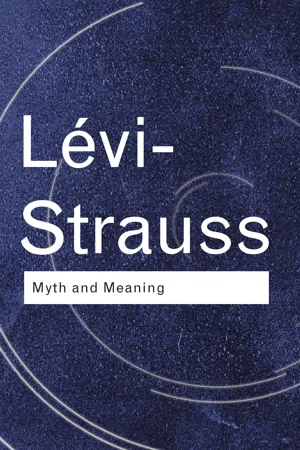
Myth and Meaning
About this book
In addresses written for a wide general audience, one of the twentieth century's most prominent thinkers, Claude Lévi-Strauss, here offers the insights of a lifetime on the crucial questions of human existence. Responding to questions as varied as 'Can there be meaning in chaos?', 'What can science learn from myth?' and 'What is structuralism?', Lévi-Strauss presents, in clear, precise language, essential guidance for those who want to learn more about the potential of the human mind.
Information
1
The Meeting of Myth and Science
Let me start with a personal confession. There is a magazine which I read faithfully each month from the first line to the last, even though I don’t understand all of it; it is the Scientific American. I am extremely eager to be as informed as possible of everything that takes place in modern science and its new developments. My position in relation to science is thus not a negative one.
Secondly, I think there are some things we have lost, and we should try perhaps to regain them, because I am not sure that in the kind of world in which we are living and with the kind of scientific thinking we are bound to follow, we can regain these things exactly as if they had never been lost; but we can try to become aware of their existence and their importance.
In the third place, my feeling is that modern science is not at all moving away from these lost things, but that more and more it is attempting to reintegrate them in the field of scientific explanation. The real gap, the real separation between science and what we might as well call mythical thought for the sake of finding a convenient name, although it is not exactly that—the real separation occurred in the seventeenth and the eighteenth century. At that time, with Bacon, Descartes, Newton, and the others, it was necessary for science to build itself up against the old generations of mythical and mystical thought, and it was thought that science could only exist by turning its back upon the world of the senses, the world we see, smell, taste, and perceive; the sensory was a delusive world, whereas the real world was a world of mathematical properties which could only be grasped by the intellect and which was entirely at odds with the false testimony of the senses. This was probably a necessary move, for experience shows us that thanks to this separation—this schism if you like—scientific thought was able to constitute itself.
Now, my impression (and, of course, I do not talk as a scientist—I am not a physicist, I am not a biologist, I am not a chemist) is that contemporary science is tending to overcome this gap, and that more and more the sense data are being reintegrated into scientific explanation as something which has a meaning, which has a truth, and which can be explained.
Take, for instance, the world of smells. We were accustomed to think that this was entirely subjective, outside the world of science. Now the chemists are able to tell us that each smell or each taste has a certain chemical composition and to give us the reasons why subjectively some smells or some tastes feel to us as having something in common and some others seem widely different.
Let’s take another example. There was in philosophy from the time of the Greeks to the eighteenth and even the nineteenth century—and there still is to some extent—a tremendous discussion about the origin of mathematical ideas—the idea of the line, the idea of the circle, the idea of the triangle. There were, in the main, two classical theories: one of the mind as a tabula rasa, with nothing in it in the beginning; everything comes to it from experience. It is from seeing a lot of round objects, none of which were perfectly round, that we are able nevertheless to abstract the idea of the circle. The second classical theory goes back to Plato, who claimed that such ideas of the circle, of the triangle, of the line, are perfect, innate in the mind, and it is because they are given to the mind that we are able to project them, so to speak, on reality, although reality never offers us a perfect circle or a perfect triangle.
Now, contemporary researchers on the neurophysiology of vision teach us that the nervous cells in the retina and the other apparatus behind the retina are specialized: some cells are sensitive only to straight direction, in the vertical sense, others in the horizontal, others in the oblique, some of them to the relationship between the background and the central figures, and the like. So—and I simplify very much because it is too complicated for me to explain this in English—this whole problem of experience versus mind seems to have a solution in the structure of the nervous system, not in the structure of the mind or in experience, but somewhere between mind and experience in the way our nervous system is built and in the way it mediates between mind and experience.
Probably there is something deep in my own mind, which makes it likely that I always was what is now being called a structuralist. My mother told me that, when I was about two years old and still unable to read, of course, I claimed that actually I was able to read. And when I was asked why, I said that when I looked at the signboards on shops—for instance, boulanger (baker) or boucher (butcher)—I was able to read something because what was obviously similar, from a graphic point of view, in the writing could not mean anything other than ‘bou,’ the same first syllable of boucher and boulanger. Probably there is nothing more than that in the structuralist approach; it is the quest for the invariant, or for the invariant elements among superficial differences.
Throughout my life, this search was probably a predominant interest of mine. When I was a child, for a while my main interest was geology. The problem in geology is also to try to understand what is invariant in the tremendous diversity of landscapes, that is, to be able to reduce a landscape to a finite number of geological layers and of geological operations. Later as an adolescent, I spent a great part of my leisure time drawing costumes and sets for opera. The problem there is exactly the same—to try to express in one language, that is, the language of graphic arts and painting, something which also exists in music and in the libretto; that is, to try to reach the invariant property of a very complex set of codes (the musical code, the literary code, the artistic code). The problem is to find what is common to all of them. It’s a problem, one might say, of translation, of translating what is expressed in one language—or one code, if you prefer, but language is sufficient—into expression in a different language.
Structuralism, or whatever goes under that name, has been considered as something completely new and at the time revolutionary; this, I think, is doubly false. In the first place, even in the field of the humanities, it is not new at all; we can follow very well this trend of thought from the Renaissance to the nineteenth century and to the present time. But it is also wrong for another reason: what we call structuralism in the field of linguistics, or anthropology, or the like, is nothing other than a very pale and faint imitation of what the ‘hard sciences,’ as I think you call them in English, have been doing all the time.
Science has only two ways of proceeding: it is either reductionist or structuralist. It is reductionist when it is possible to find out that very complex phenomena on one level can be reduced to simpler phenomena on other levels. For instance, there is a lot in life which can be reduced to physico-chemical processes, which explain a part but not all. And when we are confronted with phenomena too complex to be reduced to phenomena of a lower order, then we can only approach them by looking to their relationships, that is, by trying to understand what kind of original system they make up. This is exactly what we have been trying to do in linguistics, in anthropology, and in different fields.
It is true—and let’s personalize nature for the sake of the argument—that Nature has only a limited number of procedures at her disposal and that the kinds of procedure which Nature uses at one level of reality are bound to reappear at different levels. The genetic code is a very good example; it is well known that, when the biologists and the geneticists had the problem of describing what they had discovered, they could do nothing better than borrow the language of linguistics and to speak of words, of phrase, of ...
Table of contents
- Cover
- Title
- Copyright
- CONTENTS
- THE 1977 MASSEY LECTURES
- An Introduction
- 1 The Meeting of Myth and Science
- 2 ‘Primitive’ Thinking and the ‘Civilized’ Mind
- 3 Harelips and Twins: the Splitting of a Myth
- 4 When Myth Becomes History
- 5 Myth and Music
Trusted by 375,005 students
Access to over 1.5 million titles for a fair monthly price.
Study more efficiently using our study tools.
Frequently asked questions
Yes, you can cancel anytime from the Subscription tab in your account settings on the Perlego website. Your subscription will stay active until the end of your current billing period. Learn how to cancel your subscription
No, books cannot be downloaded as external files, such as PDFs, for use outside of Perlego. However, you can download books within the Perlego app for offline reading on mobile or tablet. Learn how to download books offline
Perlego offers two plans: Essential and Complete
- Essential is ideal for learners and professionals who enjoy exploring a wide range of subjects. Access the Essential Library with 800,000+ trusted titles and best-sellers across business, personal growth, and the humanities. Includes unlimited reading time and Standard Read Aloud voice.
- Complete: Perfect for advanced learners and researchers needing full, unrestricted access. Unlock 1.5M+ books across hundreds of subjects, including academic and specialized titles. The Complete Plan also includes advanced features like Premium Read Aloud and Research Assistant.
We are an online textbook subscription service, where you can get access to an entire online library for less than the price of a single book per month. With over 1.5 million books across 990+ topics, we’ve got you covered! Learn about our mission
Look out for the read-aloud symbol on your next book to see if you can listen to it. The read-aloud tool reads text aloud for you, highlighting the text as it is being read. You can pause it, speed it up and slow it down. Learn more about Read Aloud
Yes! You can use the Perlego app on both iOS and Android devices to read anytime, anywhere — even offline. Perfect for commutes or when you’re on the go.
Please note we cannot support devices running on iOS 13 and Android 7 or earlier. Learn more about using the app
Please note we cannot support devices running on iOS 13 and Android 7 or earlier. Learn more about using the app
Yes, you can access Myth and Meaning by Claude Lévi-Strauss in PDF and/or ePUB format, as well as other popular books in Social Sciences & Anthropology. We have over 1.5 million books available in our catalogue for you to explore.