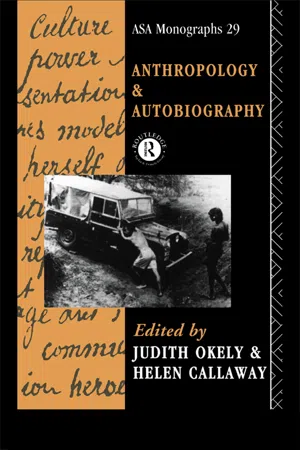
Anthropological writings by anthropologists in the field have long been a valuable tool to the profession. But until now, the theoretical implications of its use have not been fully explored. Anthropology and Autobiography provides unique insights into the fieldwork, autobiographical materials and/or textual critiques of anthropologists, many of whose ethnographies are already familiar. It considers the role of the anthropologist as fieldworker and writer, examining the ways in which nationality, age, gender, and personal history influence the anthropologist's behavior towards the individuals he is observing. This volume also contributes to debates about reflexivity and the political responsibility of the anthropologist, who, as a participant, has traditionally made only stylized appearances in the academic text. The contributors examine their work among peoples in Africa, Japan, the Caribbean, Greece, Shetland, England, indigenous Australia, Indonesia, and Sri Lanka. Autobiography is developed alongside political, intellectual, and historical changes. The anthropologists confront and examine issues of racism, reciprocity and friendships. Anthropology and Autobiography will appeal to anthropologists and social scientists interested in ethnographic approaches, the self, reflexivity, qualitative methodology, and the production of texts.
- 268 pages
- English
- ePUB (mobile friendly)
- Available on iOS & Android
eBook - ePub
Anthropology and Autobiography
About this book
Information
Chapter 1
Anthropology and autobiography Participatory experience and embodied knowledge
Judith Okely
This collection is not concerned with the autobiographies of individual academics who happen to be anthropologists. It asks questions about the links between the anthropologist's experience of fieldwork, other cultures, other notions of autobiography and ultimately the written text. Autobiography for its own sake is increasingly recognised by the literary canon as a genre (Olney 1980) and, together with individual biographies, is being used within history (Bertaux 1981; Vincent 1981; Bland and John 1990). Doubtless anthropologists could make innovative contributions in those domains. Within the discipline of anthropology, there is further scope for its insertion. Here the anthropologist's past is relevant only in so far as it relates to the anthropological enterprise, which includes the choice of area and study, the experience of fieldwork, analysis and writing.
In the early 1970s, Scholte saw reflexivity as a critical, emancipatory exercise which liberated anthropology from any vestige of a value-free scientism:
Fieldwork and subsequent analysis constitute a unified praxis…the ethnographic situation is defined not only by the native society in question, but also by the ethnological tradition ‘in the head’ of the ethnographer. Once he is actually in the field, the native's presuppositions also became operative, and the entire situation turns into complex intercultural mediation and a dynamic interpersonal experience. (1974:438)
Scholte did not specify how this ‘interpersonal experience’ should be written up, but his advocacy of a reflexive approach can be seen as a necessary preliminary to the inclusion of the anthropologist in the analysis. In this volume, Kirsten Hastrup draws attention to the peculiar reality in the field. ‘It is not the unmediated world of the “others” but the world between ourselves and the others.’
While reflexivity or some autobiographical mode may have been incorporated within specific interest groups elsewhere, there is considerable reluctance to consider autobiography as a serious intellectual issue within British anthropology. In a pioneering paper, David Pocock (1973) suggested a reflexive examination of anthropologists’ texts in the light of their biography. He gave examples from his own work. The details remain unpublished, although the notion of a personal anthropology is used imaginatively in an introduction to the discipline (1975). Fifteen years since Pocock's paper, Ernest Gellner has written against a reflexivity of the mildest, least personal form found in Geertz's Works and Lives (1988):
My own advice to anthropology departments is that this volume be kept in a locked cupboard, with the key in the possession of the head of department, and that students be lent it only when a strong case is made out by their tutors. (1988:26)
A popular put down is that reflexivity or autobiography is ‘mere navel gazing’, as if anthropology could ever involve only the practitioner. The concern for an autobiographical element in anthropology is to work through the specificity of the anthropologist's self in order to contextualise and transcend it. In other instances autobiography or reflexivity in anthropology has been pejoratively labelled ‘narcissism’ (Llobera 1987:118). This use of the classical Greek myth is even more confused. Self-adoration is quite different from self-awareness and a critical scrutiny of the self. Indeed those who protect the self from scrutiny could as well be labelled self-satisfied and arrogant in presuming their presence and relations with others to be unproblematic. Reflexivity is incorrectly confused with self-adoration (Babcock 1980).
A fundamental aspect of anthropology concerns the relationships between cultures or groups. The autobiography of the fieldworker anthropologist is neither in a cultural vacuum, nor confined to the anthropologist's own culture, but is instead placed in a cross-cultural encounter. Fieldwork practice is always concerned with relationships (cf. Campbell 1989). The anthropologist has to form long-term links with others across the cultural divide, however problematic. All of the contributors to this volume, in so far as they write of themselves, consider the self in terms of their relations with others. The autobiographical experience of fieldwork requires the deconstruction of those relationships with the rigour demanded elsewhere in the discipline. There have indeed been poor autobiographies by anthropologists who have perhaps believed that the genre is more exhibitory than exploratory, especially where ‘the other’ is used as a trigger for the writer's fantasies. Where the encounter is exoticised, the autobiographical account merely embodies at an individual level the discredited practice of fictionalising the other in order to affirm western dominance.
In promoting dialogical modes, Clifford retains a defensive and pejorative view of autobiography; the former ‘are not in principle autobiographical; they need not lead to hyper self-consciousness or self-absorption’ (1986a: 15). While recognising the validity of ‘acute political and epistemological self-consciousness’, he is obliged to reassure the reader that this is not ‘self-absorption’ (ibid.: 7). The ‘armchair’ anthropologist, as sedentary and solitary researcher, has tended to interpret anthropological autobiography in this way. By contrast, the autobiography of fieldwork is about lived interactions, participatory experience and embodied knowledge; whose aspects ethnographers have not fully theorised.
Recent developments of the ‘production of texts by means of texts, rather than by means of fieldwork’ (Fardon 1990:5) and a near exclusive focus on the writing as activity risks diverting attention from fieldwork as experience. Geertz (1988) has, for example, reduced fieldwork to an instrumental account. As Carrithers has noted: ‘on Geertz's showing, research seems only a frustrating and solipsistic appendage of the supreme act itself, writing’ (1988:20). The new emphasis on fieldwork as writing sees the encounter and experience as unproblematic. When Fabian (1988) cleverly distinguishes fieldwork as ‘writing down’ from the construction of a monograph as ‘writing up’, there is none the less a danger of simplification.
In an extreme stance, fieldwork has been downgraded to the mechanical collection of ethnography which is contrasted with the superior invention of theory (Friedman 1988). Anyone apparently, can do ethnography, it is for the desk-bound theoreticians to interpret it. This brahminical division assumes that the field experience is separable from theory, that the enterprise of inquiry is discontinuous from its results (Rabinow 1977). Participant observation textbooks which reduce fieldwork to a set of laboratory procedures rest on the same assumptions. Before the textual critics, fieldwork was also considered theoretically unproblematic by much of the academy. Its peculiarity, drama, fear and wonder were neither to be contemplated nor fully explored in print. Neophytes were simply to get on with the job with tight-lipped discipline (cf. Kenna). Veracity was confirmed by faith in what Fardon calls ‘experiential positivism’ (1990:3). Here, positivism destroys the notion of experience which I wish to evoke. The experience of fieldwork is totalising and draws on the whole being. It has not been theorised because it has been trivialised as the ‘collection of data’ by a dehumanised machine. Autobiography dismantles the positivist machine.
An interest in the autobiographical dimension of the anthropological encounter has been conflated with a suggestion that ethnography has no other reality than a literary make-believe (e.g. Gellner 1988). Yet, as Smith argues, the autobiographical contract is not as fluid as that which binds the fiction writer and the reader:
In autobiography the reader recognises the inevitability of unreliability but suppresses the recognition in a tenacious effort to expect ‘truth’ of some kind. The nature of that truth is best understood as the struggle of a historical rather than a fictional person to come to terms with her own past. (1987:46)
Another confusion is that between textual concerns and an apolitical dilletantism. Scholte came to regret a fusion between literary ‘scholarly gentlemen’ and reflexivity (1987). Yet a reflexivity which excludes the political is itself unreflective. A critique of the anthropologist as ‘innocent’ author can be extended to the anthropologist as participant, collaborator or, in some cases, activist (Huizer 1979). The existing and future personal narratives of anthropologists in the field can be examined not only for stylistic tropes and their final textual construction, but also as a record of the experience, the political encounter and its historical context (see Huizer and Mannheim 1979; Okely 1987). In this way the anthropologist as future author is made self-conscious, critical and reflexive about the encounter and its possible power relations (Street 1990).
Postmodernism which challenges master narratives and total systems has itself been understood as an extreme form of relativism where, in an atmosphere of valueless cynicism, anything goes. The disintegration of totalities, however, can be differentially interpreted as the unleashing of the full range of creative possibilities (Nicholson 1990). The cultural past can also be re-examined. Alternative paradigms have always existed at the margins; in this case, autobiographical texts which defied the master canon. Postmodernism may have created a climate where different autobiographies elicit new interest, but the former did not create the latter.
Hesitations about incorporating and expanding the idea of autobiography into anthropology rest on very western, ethnocentric traditions. Autobiography, as a genre, has come to be associated with a ‘repertoire of conventions’ (Dodd 1986: 3). The tradition has been constructed by ‘inclusion, exclusion and transformation’ (ibid.: 6). This is not to deny that autobiography can ever be more than a construction (Spencer, Kenna, Rapport, this volume), but the specific criteria for its acceptance within a genre has been confined to the Eurocentric and literary canon. The western origin of the form is St Augustine with other major examples from Rousseau and J.S.Mill. A ‘Great Man’ tradition which speaks of individual linear progress and power has defined what constitutes a meaningful life (Juhasz 1980:221). While there will have been historical fluctuations in the tradition, western writers have worked within and against it. Dodd suggests:
vocation…is central not only to St Augustine's Confessions, but to Victorian autobiography…the point of closure…is vocation, the resolution of self-determination. (1986:5)
Other forms of autobiography are marginalised or excluded. Working-class autobiographies have tended to be excluded from the literary genre and ‘bequeathed to social historians’ (Dodd 1986:7). Autobiographies from seemingly vocationless women have been judged neither culturally nor aesthetically significant by earlier normative criteria (Smith 1987:8). Women have ‘internalised a picture of themselves that precluded the kind of self attention which would generate autobiography’ as recognised by the canon (Kolodny 1980:241). There is another non-literary category by politicians which is explicitly addressed to political historians, but is still a message of individual public success.
What has been labelled the ‘confessional’, as opposed to St Augustine's or even Rousseau's, is not included as part of the genre (ibid.: 240), and implies a series of indiscretions which give the lie to prevailing assumptions and dominant ideals. The confessional has also come to be regarded as concerned only with salacious indiscretions. Instead, in the context of anthropological fieldwork, it could be an attempt to analyse the actual research process in place of an idealised, scientised presentation. The confessional also implies loss of control. This again defies a carefully constructed tradition in which ‘Omissions and deletions have constituted the very art of the form’ (ibid.: 240) and where ‘detachment’ is ‘a prescription that comes…out of the entire accepted canon of western autobiographical writing’ (ibid.: 239). A genre of autobiography has focused on a constructed public self with the private made separate and discussed in terms of its threat to the public persona. Alternatively, the private is confronted only to be highly controlled and rationalised, as for example Rousseau's confessions about auto-eroticism (Derrida 1967/76).
The linear public progress established within the dominant western tradition has emphasised the individual as all-powerful isolate. Edward Said has voiced regret over an increasing interest in autobiography precisely because the subject is presented as outside time and context (1982:17). But as Dodd argues, Said has ‘confused autobiographies and the Autobiography constructed by the Tradition’ (1986:11). Similarly, anthropologists who are reluctant to consider autobiography may be reacting to the carefully constructed tradition which sees autobiography as ‘egoistic’. Raymond Firth's controlled, near invisible insertion of personal narrative as part of his ‘background to anthropological work’ in Tikopia is followed by an apology for a:
somewhat egoistical recital not because I think that anthropology should be made light reading…but because some account of the relations of the anthropologist to his people is relevant to the nature of the results. (1936/65: 10)
Firth thus has to overcome several western associations with autobiography - that it risks being ‘light’ or trivial and that it is self-inflating. The western tradition both defines autobiography as egoism and in turn demands it.
Anthropologists have inserted the ‘I’ only at key junctures in ethnographic monographs in order, it is argued, to give authority to the text (Clifford 1986b; Pratt 1986; Rosaldo 1986). Otherwise they produced accounts from which the self had been sanitised. To establish authority, it seems, requires only the briefest of appearances. The ‘I’ is the ego trip, and in ‘arrival’ accounts emerges not so much from the practice of fieldwork, but more from writing traditions in western culture (ibid.). That the anthropologist soon disappears from the text is, as I have argued above, consistent with the belief that autobiography is no more than the affirmation of individual power or confessional self-absorption.
The western tradition of autobiography has been most clearly articulated by Gusdorf, writing in the 1950s, and validated by Olney (1980:8–9). Gusdorf either ignores non-western autobiographies or dismisses them as ‘a cultural transplant’ (Stanford Friedman 1988:35). Autobiography is associated with western individualism and, according to Gusdorf:
is not to be found outside of our cultural area;…it expresses a concern peculiar to Western man, a concern that has been of good use in his systematic conquest of the universe. (1956/80:29)
Gusdorf asserted that autobiography does not develop in cultures where the individual:
does not feel himself to exist outside of others, and still less against others, but very much with others in an interdependent existence that asserts its rhythms everywhere in the community. (1956/80:29–30)
Gusdorf's definitions of the genre, effectively the Great White Man tradition, drew upon pre-existing western assumptions both about autobiography and about other cultures. Despite their rejection of the monolithic stereotypes of nonwestern cultures, western anthropologists have not escaped these assumptions.
A corollary of the autobiographical tradition which emphasises individualistic and public linear development, is a clear demarcation between the autobiography and the diary. The latter is the place for the personal, if not the secret. A diary is also the ‘classic articulation of dailiness’ (Juhasz 1980:334). Gender differences noted in women's autobiographies carry aspects otherwise consigned to diaries. Juhasz...
Table of contents
- COVER PAGE
- TITLE PAGE
- COPYRIGHT PAGE
- ANTHROPOLOGY AND AUTOBIOGRAPHY
- ILLUSTRATIONS
- CONTRIBUTORS
- PREFACE
- CHAPTER 1: ANTHROPOLOGY AND AUTOBIOGRAPHY PARTICIPATORY EXPERIENCE AND EMBODIED KNOWLEDGE
- CHAPTER 2: ETHNOGRAPHY AND EXPERIENCE GENDER IMPLICATIONS IN FIELDWORK AND TEXTS
- CHAPTER 3: AUTOMYTHOLOGIES AND THE RECONSTRUCTION OF AGEING
- CHAPTER 4: SPIRITS AND SEX A SWAHILI INFORMANT AND HIS DIARY
- CHAPTER 5: PUTTING OUT THE LIFE FROM BIOGRAPHY TO IDEOLOGY AMONG THE EARTH PEOPLE
- CHAPTER 6: RACISM, TERROR AND THE PRODUCTION OF AUSTRALIAN AUTO/BIOGRAPHIES
- CHAPTER 7: WRITING ETHNOGRAPHY STATE OF THE ART
- CHAPTER 8: AUTOBIOGRAPHY, ANTHROPOLOGY AND THE EXPERIENCE OF INDONESIA
- CHAPTER 9: CHANGING PLACES AND ALTERED PERSPECTIVES RESEARCH ON A GREEK ISLAND IN THE 1960S AND IN THE 1980S
- CHAPTER 10: THE PARADOX OF FRIENDSHIP IN THE FIELD ANALYSIS OF A LONG-TERM ANGLO—JAPANESE RELATIONSHIP1
- CHAPTER 11: ALI AND ME AN ESSAY IN STREET-CORNER ANTHROPOLOGY
- CHAPTER 12: FROM AFFECT TO ANALYSIS THE BIOGRAPHY OF AN INTERACTION IN AN ENGLISH VILLAGE
- CHAPTER 13: TENSE IN ETHNOGRAPHY SOME PRACTICAL CONSIDERATIONS
- CHAPTER 14: SELF-CONSCIOUS ANTHROPOLOGY1
Trusted by 375,005 students
Access to over 1.5 million titles for a fair monthly price.
Study more efficiently using our study tools.
Frequently asked questions
Yes, you can cancel anytime from the Subscription tab in your account settings on the Perlego website. Your subscription will stay active until the end of your current billing period. Learn how to cancel your subscription
No, books cannot be downloaded as external files, such as PDFs, for use outside of Perlego. However, you can download books within the Perlego app for offline reading on mobile or tablet. Learn how to download books offline
Perlego offers two plans: Essential and Complete
- Essential is ideal for learners and professionals who enjoy exploring a wide range of subjects. Access the Essential Library with 800,000+ trusted titles and best-sellers across business, personal growth, and the humanities. Includes unlimited reading time and Standard Read Aloud voice.
- Complete: Perfect for advanced learners and researchers needing full, unrestricted access. Unlock 1.5M+ books across hundreds of subjects, including academic and specialized titles. The Complete Plan also includes advanced features like Premium Read Aloud and Research Assistant.
We are an online textbook subscription service, where you can get access to an entire online library for less than the price of a single book per month. With over 1.5 million books across 990+ topics, we’ve got you covered! Learn about our mission
Look out for the read-aloud symbol on your next book to see if you can listen to it. The read-aloud tool reads text aloud for you, highlighting the text as it is being read. You can pause it, speed it up and slow it down. Learn more about Read Aloud
Yes! You can use the Perlego app on both iOS and Android devices to read anytime, anywhere — even offline. Perfect for commutes or when you’re on the go.
Please note we cannot support devices running on iOS 13 and Android 7 or earlier. Learn more about using the app
Please note we cannot support devices running on iOS 13 and Android 7 or earlier. Learn more about using the app
Yes, you can access Anthropology and Autobiography by Judith Okely,Helen Callaway in PDF and/or ePUB format, as well as other popular books in Social Sciences & Anthropology. We have over 1.5 million books available in our catalogue for you to explore.