- 272 pages
- English
- ePUB (mobile friendly)
- Available on iOS & Android
eBook - ePub
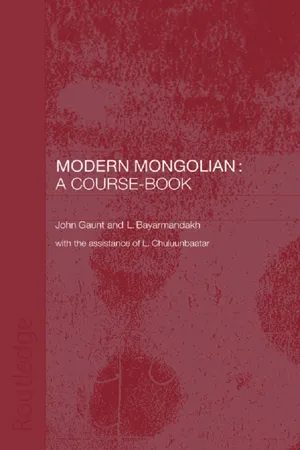
Modern Mongolian: A Course-Book
About this book
This complete guide to the Mongolian language provides a basic knowledge of all Mongolian noun inflexions and the basic and most important verbal inflections, and the uses of these. Grammatical concepts are introduced at the beginning of each chapter and discussed, with further examples, in a grammar section. Each chapter is accompanied by a list of new vocabulary items. A complete vocabulary list, English-Mongolian and Mongolian-English, is given at the end of the book, as is a list of all the Mongolian terminations, inflexions and stems that appear in the book.
Information
CHAPTER ONE
TEXT
Cyrillic
Caйн бaйнa yy? Би бaгш. Би aнгли xүн. Энэ xүн миний найз. Tэp бac aнгли xүн. Tэp oюyтан. Tэp caйн oюyтан. Tэp мoнгoл хэл cypнa.
Энэ мaнaй бaйp. Энэ миний өpөө. Mиний өpөө тoм, дyлaaxaн, цэвэрхэн. Mиний өpөөний xaнa шap. Tэp цoнx бaйнa. Гaдaa тoм мoд бaйнa. Tэp мoд нoгooн бaйнa. Mиний мaшин бac бaйнa. Mиний мaшин xap, бac жижиг. Tэp жижиг xap мaшин миний мaшин.
Өнөөдөp би caйxaн нoм aвнa. Өнөө opoй энэ нoмыг yншинa. Mapгaaш би шинэ кино үзнэ. Tэp кино caйxaн aнгли кино.
Roman script
Saim-bainuu? Bi bagsh. Bi anggli hüng. En xüng minii naiz. Ter bas anggli hüng. Ter oyuutang. Ter saing oyuutang. Ter monggol hel suran.
En manai bair. En minii öröö. Minii öröö tom, dulaahang, tseverheng. Minii öröönii han shar. Ter tsongh bain. Gadaa tom mod bain. Ter mod nogoong bain. Minii mashin bas bain. Minii mashin har, bas jijig. Ter xar, jijig mashin minii mashin.
Önöödör bi saihang nom avan. Önöö oroi en nomig ungshin. Margaash bi shin kino üzen. Ter kino saihang anggli kino.
VOCABULARY
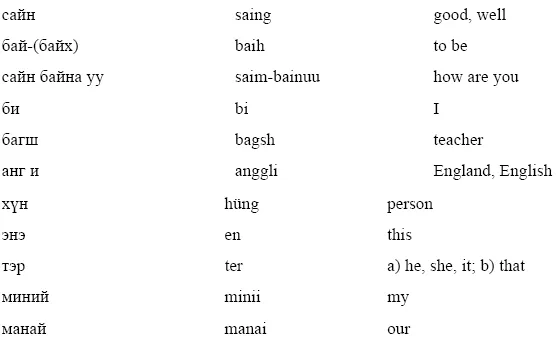
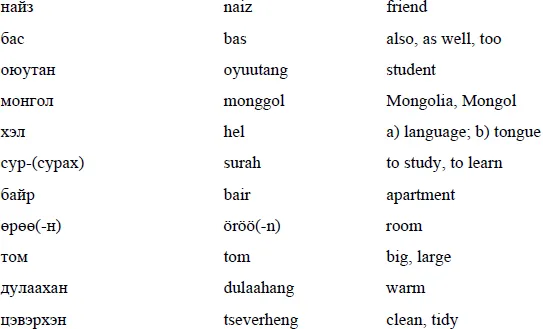
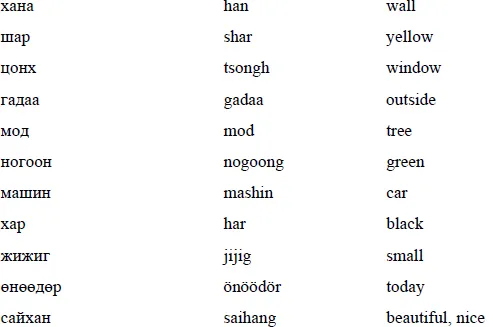
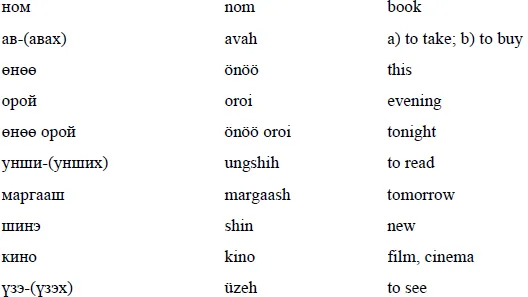
GRAMMAR
1) Vowel harmony
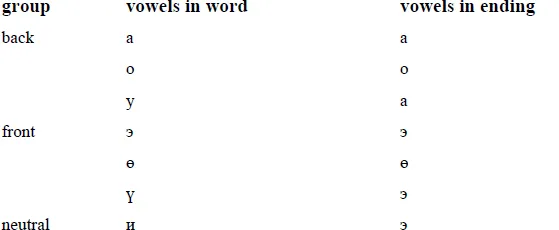
Looking at the text and the vocabulary you may notice that Mongolian words contain vowels of either one of two groups. The rule which governs this is called vowel harmony and applies to all words except recent foreign loan words. The two groups are a, o and y (a, o and u—called back or “male” vowels); and э, ө and ү (e, ö and ü—called front or “female” vowels). The “i” sounds (и and й) are neutral, as are the soft sign (ь) and hard sign (ъ) and can appear in any word. “ы” is only used in certain endings on certain back vowel words.
Apart from recent loan words, any word cannot contain vowels from both front and back groups. The ending on a verb or noun must be in harmony with those in the word itself. This may sound complicated but is not, and in fact makes the inflection of any one word much easier to formulate than in many languages. The following table gives possibilities for the vowel content of a word and the vowels in the inflection:
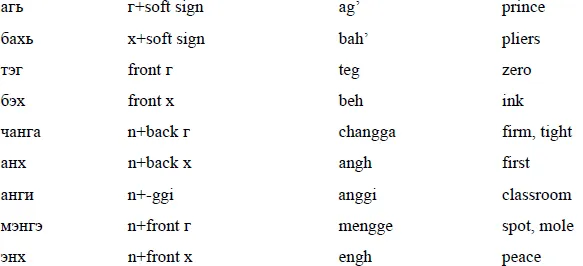
Basically the vowel harmony affects only the the vowels, but there are two consonants in the alphabet where the pronunciation is changed by the vowel harmony. These are the “г” and “x”. All other consonants remain unaffected. The pronunciation of these letters changes in the following way. In back vowel words, the “x” is pronounced in the back of the throat and has a very guttural sound, rather like the “ch” in Scottish “loch”. In front vowel words, the “x” is pronounced more at the front of the throat, at the back of the mouth, and is not so abrasive. The “г” in back vowel words is also in the back of the throat and guttural, sharper than the “x”. The “г” in front vowel words is more like the English “g”. A final “r”, in either front or back vowel words, is pronounced almost as English “g” or “k”. In back vowel words with a “г” followed by a final vowel, this vowel is virtually unpronounced and serves only to gutturalise the sound of the “г”. A back vowel word with a “г” followed by an “и” or a soft sign (ь) has this “г” pronounced as for front vowel words. Listen to the tape and compare the pronunciations of the following words:

2) The present/future tense of verbs
The principle of vowel harmony is shown in the inflection of verbs to form what in Mongolian covers the present and future tenses.
Verbs come in two parts: a stem and an ending. Thus бaй/x—to be; cyp/ax—to study; үзэ/x—to see. After the stroke is the ending, in this case the infinitive or dictionary form, before it the stem, to which tense endings are added. Note that the infinitive ending usually consists of a vowel and a “x”. Which vowel it is to be depends on the vowels in the stem. Some verbs have infinitive endings in “-иx”, such as “yншиx”—to read.
You will see from the vocabulary list that verbs are given twice, with the stem followed by a hyphen and with the full form in brackets below. There is some debate between scholars as to which is a correct “infinitive”. In the vocabulary lists in this book both will be given, to be as correct as possible and to make things easier for the learner who may be used to seeing French or German verbs given in dictionaries in their full infinitive form.
The ending for the present/future tense consists of “-на4”. The figure 4 shows that this vowel can change four times, according to the vowel harmony. Dep...
Table of contents
- Cover
- Halftitle
- Title
- Copyright
- Contents
- Preface
- The Mongolian Alphabet
- Chapter One
- Chapter Two
- Chapter Three
- Chapter Four
- Chapter Five
- Chapter Six
- Chapter Seven
- Chapter Eight
- Chapter Nine
- Chapter Ten
- Chapter Eleven
- Chapter Twelve
- Chapter Thirteen
- Chapter Fourteen
- Index of Mongolian inflexions
- Mongolian-English vocabulary
- English-Mongolian vocabulary
- Keys to Drills and Exercises
Trusted by 375,005 students
Access to over 1.5 million titles for a fair monthly price.
Study more efficiently using our study tools.
Frequently asked questions
Yes, you can cancel anytime from the Subscription tab in your account settings on the Perlego website. Your subscription will stay active until the end of your current billing period. Learn how to cancel your subscription
No, books cannot be downloaded as external files, such as PDFs, for use outside of Perlego. However, you can download books within the Perlego app for offline reading on mobile or tablet. Learn how to download books offline
Perlego offers two plans: Essential and Complete
- Essential is ideal for learners and professionals who enjoy exploring a wide range of subjects. Access the Essential Library with 800,000+ trusted titles and best-sellers across business, personal growth, and the humanities. Includes unlimited reading time and Standard Read Aloud voice.
- Complete: Perfect for advanced learners and researchers needing full, unrestricted access. Unlock 1.5M+ books across hundreds of subjects, including academic and specialized titles. The Complete Plan also includes advanced features like Premium Read Aloud and Research Assistant.
We are an online textbook subscription service, where you can get access to an entire online library for less than the price of a single book per month. With over 1.5 million books across 990+ topics, we’ve got you covered! Learn about our mission
Look out for the read-aloud symbol on your next book to see if you can listen to it. The read-aloud tool reads text aloud for you, highlighting the text as it is being read. You can pause it, speed it up and slow it down. Learn more about Read Aloud
Yes! You can use the Perlego app on both iOS and Android devices to read anytime, anywhere — even offline. Perfect for commutes or when you’re on the go.
Please note we cannot support devices running on iOS 13 and Android 7 or earlier. Learn more about using the app
Please note we cannot support devices running on iOS 13 and Android 7 or earlier. Learn more about using the app
Yes, you can access Modern Mongolian: A Course-Book by John Gaunt in PDF and/or ePUB format, as well as other popular books in Social Sciences & Regional Studies. We have over 1.5 million books available in our catalogue for you to explore.