![]()
chapter
one | |
| | AN INTRODUCTION TO MARKETING COMMUNICATION |
LEARNING POINTS
Careful study of this chapter will help you to:
• adopt a particular conception of the role of communication in marketing
• understand marketing communication as the mode of managing exchange
• critically engage with the questions of what and why, before limiting your thinking by asking how
The sign brings customers
(The Fortune-Tellers, Fable 15)
INTRODUCTION
As far back as 1954, Peter Drucker said that any business has two basic requirements: marketing and innovation. Marketing assumes the task of guaranteeing the conditions of communication and information that allow demand for need fulfilment to be met through production of goods and services. Managers have long realized that it is as important to organize the demand as it is to organize the supply. Thus, straight away we can see the significance of managed communication – exchange relationships are needed and ideas must be generated and deployed. Ultimately, it is customers (buyers and users) who determine the nature of the businesses that can operate.
Integrated marketing actions, when applied to meeting the needs of consumers and buyers, can generate profits and other corporate results through customer satisfaction. This matching of corporate and customer interests requires the parties to communicate. This communication can be spontaneous and ad hoc, but experience shows that careful management of marketing communication can add value for all involved.
Since the rise of consumer marketing in the USA in the 1950s, there has been a shift from personal relationships with customers to mediated actions directed towards consumers. Recent developments in information and communication technologies, and market conditions, have spurred a further shift, back to dealing with relationships again. With the emergence of new forms of mass communication and information, it is time to bring the marketing communication knowledge-base up to date.
We must beware of a contradiction in traditional discussions. Do we view consumers as sovereign, or as easily manipulated, seduced, and outwitted? This is an important question, for it locates our stance on communication as either a transportation tool or a participatory human experience.
The advent of electronic media produces situations that cannot be adequately explained by conventional marketing theory. Some of the answer lies in adopting up-to-date communication theory, something that has not happened yet in even the most recent textbooks on marketing communications.
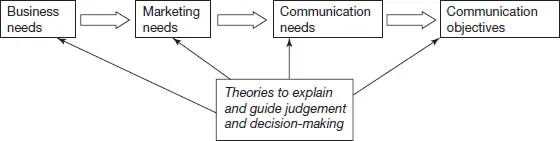
We can benefit from systematic study of marketing communication, as this helps guide judgement and decision-making. The logic begins with the needs of providers and consumers, to guide marketing interventions. In turn, communication needs can then be established, and these will indicate suitable communication objectives (Figure 1.1).
Figure 1.1 What to study for marketing communication management
THE MARKETING TASK
The term ‘marketing’ is not a modern invention, it has been in use in the English language for some considerable time. Webster's Dictionary of 1880 gave a meaning as ‘the act of purchasing in a market’. Interestingly, this is consistent with the idea that both producer and consumer can be a marketer!
Profit is made from people, not products
(Anon)
The idea of ‘marketing’ first appeared in the economics literature at the end of the nineteenth century and was developed as ‘merchandising and selling’ in the scientific management of Frederick Winslow Taylor (Taylor, 1929). The concept became widely applied in the middle of the twentieth century. Promotional communication gained emphasis with the emergence, initially in the USA, of national product brands with widespread distribution.
In 1931 the American Association of Marketing and Advertising Professors issued an official definition:
all the business activities implicated in the flow of goods and service from producer to consumer, with the sole exception of activities that imply a change of form.
(Mattelart, 1996: 292, emphasis added)
This offers a historical insight that can be of great help to us in better understanding the communicative role of marketing. Marketing – as a managerial discipline for organizing demand and supply – was preceded by advertising by at least 100 years (see chapter thirteen for a brief historical account).
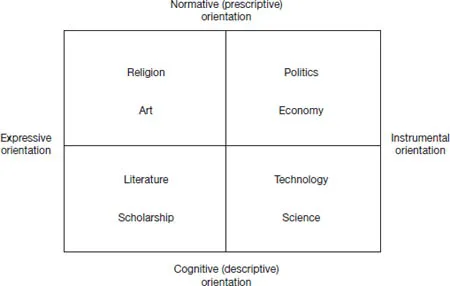
The management practice of marketing has emerged as a coordinating function (discipline) that acts as a bridge between the needs of the provider (to stay in business and to prosper), and the needs of buyers and consumers (for access to desirable value-for-money products), and other stakeholders in a society that has normative, expressive, cognitive, as well as instrumental institutions (see Figure 1.2).
Figure 1.2 The place of marketing in societal culture: the cultural value system
Source: Rosengren, 1999, Figure 3.1
Thus, while management and the management of marketing have an instrumental character, they cannot be properly understood as standing divorced from other ways of living.
MARKETING, CONSUMPTION, AND COMMUNICATION
Consumerism is the production, distribution, desiring, obtaining, owning, and using of symbolic products. Consumption does not only satisfy material longing for food and wealth. Symbols are manipulated for a host of reasons. For the person, consuming constructs identity, the self, and relationships with others (see Box 1.1). For society, consumption sustains the continuing existence of institutions, groups, and other such structures.
BOX 1.1 A WORKING DEFINITION OF MARKETING
Marketing is concerned with creating and sustaining mutually satisfying exchanges of value between producer/servers and their customers. It has both a managerial orientation and an organizational/social function.
Certain conditions are necessary for an exchange to take place. Each party must:
• have something valued by the other
• be capable of communicating about the offering
• be capable of making the offering available
• believe that it is appropriate or desirable to trade with the other party
• value the offered benefits sufficiently to offset the efforts and risks involved in the exchange.
Marketing communication is like a coin – it has two sides:
1 The offer (expression): One part of marketing communication is concerned with effectively and efficiently providing information about the business and the products to chosen customer groups. But in isolation, ...