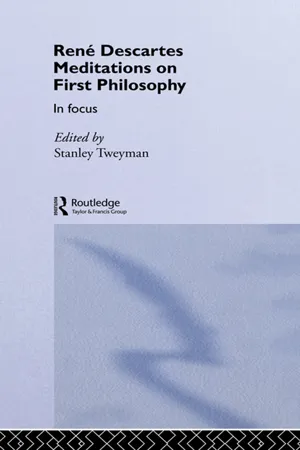
This volume presents the excellent and popular translation by Haldane and Ross of Descartes' Meditations on First Philosophy, an introduction by Stanley Tweyman which explores the relevance of Descartes' Regulae and his method of analysis in the Meditations, and six articles which indicate the diversity of scholarly opinion on the topic of method in Descartes' philosopy.
- 232 pages
- English
- ePUB (mobile friendly)
- Available on iOS & Android
eBook - ePub
Rene Descartes' Meditations on First Philosophy in Focus
About this book
Information
Excerpt from Replies to Objections II
Further, in the matter of the counsel you give me about propounding my arguments in geometrical fashion, in order that the reader may perceive them as it were with a single glance,1 it is worth while setting forth here the extent to which I have followed this method and that to which I intend in future to follow it. Now there are two things that I distinguish in the geometrical mode of writing, viz. the order and the method of proof.
The order consists merely in putting forward those things first that should be known without the aid of what comes subsequently, and arranging all other matters so that their proof depends solely on what precedes them. I certainly tried to follow this order as accurately as possible in my Meditations; and it was through keeping to this that I treated of the distinction between the mind and the body, not in the second Meditation, but finally in the sixth, and deliberately and consciously omitted much, because it required an explanation of much else besides.
Further, the method of proof is two-fold, one being analytic, the other synthetic.
Analysis shows the true way by which a thing was methodically discovered and derived, as it were effect from cause,2 so that, if the reader care to follow it and give sufficient attention to everything, he understands the matter no less perfectly and makes it as much his own as if he had himself discovered it. But it contains nothing to incite belief in an inattentive or hostile reader; for if the very least thing brought forward escapes his notice, the necessity of the conclusions is lost; and on many matters which, nevertheless, should be specially noted, it often scarcely touches, because they are clear to anyone who gives sufficient attention to them.
Synthesis contrariwise employs an opposite procedure, one in which the search goes as it were from effect to cause3 (though often here the proof itself is from cause to effect to a greater extent than in the former case). It does indeed clearly demonstrate its conclusions, and it employs a long series of definitions, postulates, axioms, theorems and problems, so that if one of the conclusions that follow is denied, it may at once be shown to be contained in what has gone before. Thus the reader, however hostile and obstinate, is compelled to render his assent. Yet this method is not so satisfactory as the other and does not equally well content the eager learner, because it does not show the way in which the matter taught was discovered.
It was this synthesis alone that the ancient Geometers employed in their writings, not because they were wholly ignorant of the analytic method, but, in my opinion, because they set so high a value on it that they wished to keep it to themselves as an important secret.
But I have used in my Meditations only analysis, which is the best and truest method of teaching. On the other hand synthesis, doubtless the method you here ask me to use, though it very suitably finds a place after analysis in the domain of geometry, nevertheless cannot so conveniently be applied to these metaphysical matters we are discussing.
For there is this difference between the two cases, viz. that the primary notions that are the presuppositions of geometrical proofs harmonize with the use of our senses, and are readily granted by all. Hence, no difficulty is involved in this case, except in the proper deduction of the consequences. But this may be performed by people of all sorts, even by the inattentive, if only they remember what has gone before; and the minute subdivisions of propositions is designed for the purpose of rendering citation easy and thus making people recollect even against their will.
On the contrary, nothing in metaphysics causes more trouble than the making the perception of its primary notions clear and distinct. For, though in their own nature they are as intelligible as, or even more intelligible than those the geometricians study, yet being contradicted by the many preconceptions of our senses to which we have since our earliest years been accustomed, they cannot be perfectly apprehended except by those who give strenuous attention and study to them, and withdraw their minds as far as possible from matters corporeal. Hence if they alone were brought forward it would be easy for anyone with a zeal for contradiction to deny them.
This is why my writing took the form of Meditations rather than that of Philosophical Disputations or the theorems and problems of a geometer; so that hence I might by this very fact testify that I had no dealings except with those who will not shrink from joining me in giving the matter attentive care and meditation. For from the very fact that anyone girds himself up for an attack upon the truth, he makes himself less capable of perceiving the truth itself, since he withdraws his mind from the consideration of those reasons that tend to convince him of it, in order to discover others that have the opposite effect.
But perhaps some one will here raise the objection, that, while indeed a man ought not to seek for hostile arguments when he knows that it is the truth that is set before him, yet, so long as this is in doubt, it is right that he should fully explore all the arguments on either side, in order to find out which are the stronger. According to this objection it is unfair of me to want to have the truth of my contentions admitted before they have been fully scrutinised, while prohibiting any consideration of those reasonings that oppose them.
This would certainly be a just criticism if any of the matters in which I desire attention and absence of hostility in my reader were capable of withdrawing him from the consideration of any others in which there was the least hope of finding greater truth than in mine. But consider that in what I bring forward you find the most extreme doubt about all matters, and that there is nothing I more strongly urge than that every single thing should be most carefully examined and that nothing should be admitted but what has been rendered so clear and distinct to our scrutiny that we cannot withhold our assent from it. Consider too that, on the other hand, there is nothing else from which I wish to divert the minds of my readers, save beliefs which they have never properly examined and which are derived from no sound reasoning, but from the senses alone. Therefore I hardly think that anyone will believe that there is much risk in confining his attention to my statement of the case; the danger will be no more than that of turning his gaze away from it towards other things which in some measure conflict with it and only darken counsel (i.e. to the prejudices of the senses).
Hence, in the first place, I rightly require singular attention on the part of my readers and have specially selected the style of writing which I thought would best secure it and which, I am convinced, will bring my readers more profit than they would acquire if I had used the synthetic method, one which would have made them appear to have learned more than they really had. But besides this I deem it quite fair to ignore wholly and to despise as of no account the criticisms of those who refuse to accompany me in my Meditations and cling to their preconceived opinions.
But I know how difficult it will be, even for one who does attend and seriously attempt to discover the truth, to have before his mind the entire bulk of what is contained in my Meditations, and at the same time to have distinct knowledge of each part of the argument; and yet, in my opinion, one who is to reap the full benefit from my work must know it both as a whole and in detail.
1 Cf. Obj. II. sub fin.
2 tanquam a priori.
3 tanquam a posteriori quaesitam.
Descartes’ Use of “Demonstration” and “Deduction”
Descartes notoriously claims that his physics is constructed with the clarity of a mathematical demonstration. For example, the final article of Book II of the Principles (in which he had discussed the basic laws of nature) contains the following description of the proposed development of Cartesian physics in the remainder of the treatise: “I claim…to admit that nothing concerning them (the divisions, shapes and motions of particles) is true which cannot be so evidently deduced (deducatur) from those common notions, whose truth we cannot doubt, that it could be considered a mathematical demonstration (demonstratione)” (ATVIII–1, 79).1 The last page of the Principles (in the French version) reminds the reader that he has indeed accomplished what he planned: “I think that one should also recognize that I have proved (prouvé) all the things I wrote by means of a mathematical demonstration (par demonstration Mathematique), at least the more general” (ATIX–2, 325).
If one approaches texts like these with our present understanding of mathematic proof, it is difficult to make any sense of Descartes’ remarks. For the two books of the Principles which intervene between the quoted comments are a tissue of hypotheses, guesses, experimental findings, models and analogies for natural phenomena, descriptions of explananda, etc.; in short, anything but mathematical proofs. One standard resolution of this anomaly is to suggest that Descartes vainly attempted to reduce physics to mathematics and that his failure was inevitable from the outset. Unable to accept the obvious discrepancy between the ideal of a mathematical physics and the complex of untested or poorly confirmed hypotheses which he constructs in the Principles, Descartes is said to stubbornly misdescribe the results of his scientific investigations.2
Another equally plausible interpretation of Descartes’ position is suggested in what follows. If Descartes says that he is going to provide a mathematical demonstration of his physics and if, when he concludes the work, he claims to have realized his objective, then probably what he means by “mathematical demonstration” is the kind of inquiry which is contained between the initial plan and the consequent characterization of his achievement. To investigate this possibility it is necessary to look more closely at Descartes’ language and at the contexts in which he discusses demonstrations or proofs. The two key terms for this inquiry, both used in the first quotation above, are “demonstration” and “deduction.” In Sections I and II below, I examine alternative readings of each term in Cartesian usage, beginning with the first. The available evidence shows that neither term, in Descartes’ language, has the more precise sense which it has since acquired in philosophical literature. In the third section I examine Descartes’ supposed adoption of pure mathematics as an ideal method for all investigations, and suggest that Descartes simply reflects the standard classification of physics as a branch of applied mathematics. I conclude that Descartes’ use of such words as “deduction,” “demonstration” and “mathematical” is best understood in terms of the ordinary usage of his time. A “mathematical demonstration,” in the context of the Principles, is nothing more than a clearly articulated and appropriately corroborated argument.
I
Descartes uses the Latin demonstrare and the French word démontrer with approximately the same degree of ambiguity as the English verb “to show.” Further specification of the meaning of “demonstration” depends on explicit comments by the author, on a closer scrutiny of the context or on a comparison of the French and Latin versions of the same text. The following comments use all three approaches whenever they are available.
In Part VI of the Discourse there is a well-known passage in which Descartes speaks of demonstrating (démontrer) the principles of his science by the conclusions which are derived from them and vice-versa. This is not a circular procedure, he contends, because
since experience makes most of these effects very certain, the causes from which I deduce (déduire) them serve less to prove them (prouver) than to explain (expliquer) them; but, on the contrary, it is the causes which are proved (prouver) by the effects.
(AT VI, 76)
This indicates that although the effects are deduced from the causes, the latter are proved by the former. It is evident to the contemporary reader that Descartes meant that the causes explain the effects, and the effects confirm the (hypothetical) causes. This clarification of his methodology was apparently insufficient for his readers, and he returns to the same problem again in a letter to Morin, July 13, 1638: “There is a great difference between proving (prouver) and explaining (expliquer)…one can use the word demonstrate (démontrer) to signify one or the other, at least if one takes the word in its ordinary usage” (AM II, 311).
Descartes seems to have been clear on the distinction between an explanation and a corroborating argument. Both procedures are similar in that, assuming certain antecedents, one derives consequences from them by means of what Descartes calls a “deduction.” The logical structure of this kind of inference will be examined in more detail below. For Descartes, the argument from antecedent to consequent or vice-versa may be called a “demonstration.”
There is a wide variety of Cartesian texts which illustrate Descartes’ ambiguous use of the word “demonstration.” The “confirmation” sense of “demonstration” is often expressed by the word prouver. Thus, in the Passions of the Soul he suggests that the brain can cause muscular reactions without any involvement of the soul, and he “proves” this hypothesis by our experience of reflex actions (“ce que je prouveray seulement icy par un example”: XI, 338). A similar example is found in the Description of the Human Body (XI, 226), and in the Principles, IX–2, 146 and 270 (“j’ay prouvé”). In none of these proofs does one find anything more than corroborating evidence for an hypothesis. One of the Latin equivalents of prouver, probare, is closer to our sense of confirmation and this is found in the Principles (AT VIII–1, 81), the Discourse (AT VI, 582), and in Descartes’ notes on anatomy (AT XI, 587): “Adeo ut probem.”
This apparent uniformity in the use of “prove” is complicated by other examples where it is difficult to decide whether Descartes means “to confirm” or “to explain.” This is particularly noticeable when, in the development of a physical theory, Descartes mentions phenomena which are compatible with the theory in question. It is only in the vaguest sense that one could claim that such a theory explains the phenomenon, or that the observation of the phenomenon confirms the theory. It looks as if Descartes simply incorporates a reference to some observed results into the development of a wide ranging hypothesis, and then refers, in retrospect, to a “proof.” For example, in the Meteorology, the roundness of rain-drops is said to have been proved (prouvé: AT VI, 325. Cf. ibid., 280), and in two instances in the Principles (AT IX–2, 146, 298) what is “proved” in the French version is said to be shown (ostensum) in the Latin original (AT VIII–1, 13...
Table of contents
- Cover Page
- Half Title page
- Title Page
- Copyright Page
- Contents
- Preface
- Acknowledgements
- Introduction
- Meditations On First Philosophy
- Letter of Dedication
- Preface to the Reader
- Synopsis of the Six Following Meditations
- I Of the things which may be brought within the sphere of the doubtful
- II Of the nature of the human mind; and that it is more easily known than the body
- III Of God: that He exists
- IV Of the true and the false
- V Of the essence of material things, and, again, of God, that He exists
- VI Of the existence of material things, and of the real distinction between the soul and body of man
- Excerpt From Replies To Objections II
- descartes' Use Of “Demonstration” And “Deduction”
- A Discourse On Descartes' Method
- A Point Of Order: Analysis, Synthesis, And Descartes' Principles
- Professor Cottingham And Descartes' Methods Of Analysis And Synthesis
- Analysis In The Meditations: The Quest For Clear And Distinct Ideas
- The Ontological Proof Within The Order Of Reasons
- Selected bibliography
- Selected index
Trusted by 375,005 students
Access to over 1.5 million titles for a fair monthly price.
Study more efficiently using our study tools.
Frequently asked questions
Yes, you can cancel anytime from the Subscription tab in your account settings on the Perlego website. Your subscription will stay active until the end of your current billing period. Learn how to cancel your subscription
No, books cannot be downloaded as external files, such as PDFs, for use outside of Perlego. However, you can download books within the Perlego app for offline reading on mobile or tablet. Learn how to download books offline
We are an online textbook subscription service, where you can get access to an entire online library for less than the price of a single book per month. With over 1.5 million books across 990+ topics, we’ve got you covered! Learn about our mission
Look out for the read-aloud symbol on your next book to see if you can listen to it. The read-aloud tool reads text aloud for you, highlighting the text as it is being read. You can pause it, speed it up and slow it down. Learn more about Read Aloud
Yes! You can use the Perlego app on both iOS and Android devices to read anytime, anywhere — even offline. Perfect for commutes or when you’re on the go.
Please note we cannot support devices running on iOS 13 and Android 7 or earlier. Learn more about using the app
Please note we cannot support devices running on iOS 13 and Android 7 or earlier. Learn more about using the app
Yes, you can access Rene Descartes' Meditations on First Philosophy in Focus by Stanley Tweyman in PDF and/or ePUB format, as well as other popular books in Philosophy & Epistemology in Philosophy. We have over 1.5 million books available in our catalogue for you to explore.