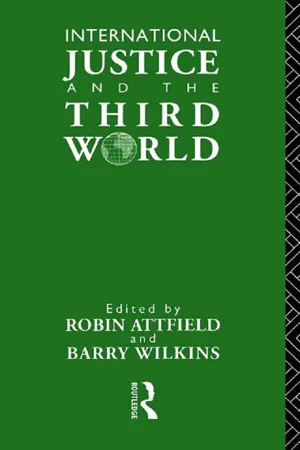
International Justice and the Third World vindicates belief in global or universal justice, and explores both liberal and Marxist grounds for such belief. It also investigates the presuppositions of belief in development, and relates it to sustainability, to environmentalism, and to the obligation to cancel Third World debt.
eBook - ePub
International Justice and the Third World
Studies in the Philosophy of Development
- 224 pages
- English
- ePUB (mobile friendly)
- Available on iOS & Android
eBook - ePub
International Justice and the Third World
Studies in the Philosophy of Development
About this book
Information
Chapter 1
Global justice, capitalism and the Third World
ABSTRACT: Reflecting on the North-South dialogue, I consider questions of global justice. I argue that questions of global justice are just as genuine as questions of domestic justice. A too-narrow construal of the circumstances of justice leads to an arbitrary forestalling of questions of global justice. It isn't that we stand in conditions of reciprocal advantage that is crucial but that we stand in conditions of moral reciprocity. I first set out concerning the conditions in the North and the South and the relations between them something of the facts in the case coupled with some interpretative sociology. Such investigations show massive disparities of wealth and condition between North and South and further show that these disparities have been exacerbated by the interventionist policies of the west. I then, while remaining mindful of the strains of commitment, argue that justice requires extensive redistribution between North and South but that this can be done without at all impoverishing the North, though to do so would indeed involve a radical reordering of the socio-economic system of the North.
SOME FACTS ABOUT FAMINE
Let us start with some stark empirical realities. Approximately 10,000 people starve every day. There was a severe drought last year (1983) in Africa and about 20 million people, spread through eighteen countries, face severe shortages of food: shortages that will in some instances bring on starvation and in others, for very many people, will bring about debilitating malnutrition—a malnutrition that sometimes will permanently and seriously damage them. The Brandt Report of 1980 estimates that 800 million people cannot afford an adequate diet. This means that millions are constantly hungry, that millions suffer from deficiency diseases and from infections that they could resist with a more adequate diet. Approximately 15 million children die each year from the combined effects of malnutrition and infection. In some areas of the world half the children born will die before their fifth birthday. Life for not a few of us in the industrially developed world is indeed, in various ways, grim. But our level of deprivation hardly begins to approximate to the level of poverty and utter misery that nearly 40 per cent of the people in the Third World face.
As Robert McNamara, who is surely no spokesman for the left, put it, there are these masses of ‘severely deprived human beings struggling to survive in a set of squalid and degraded circumstances almost beyond the power of sophisticated imaginations and privileged circumstances to conceive’.1 Human misery is very much concentrated in the southern hemisphere (hereafter ‘the South’) and by any reasonable standard of justice there is a global imbalance of the benefits and burdens of life— the resources available to people—that calls for an extensive redistribution of resources from the industrial countries of the northern hemisphere (‘the North’) to the South.
This, of course, assumes that there is something properly called global justice and this, in certain quarters, will be resisted as a mirage or as being an incoherent conception. We can properly speak of justice within a society with a common labour market, but we cannot speak of justice for the world community as a whole. We cannot say, some claim, of the world community as a whole that it is just or unjust. Justice is only possible, the claim goes, where there are common bonds of reciprocity. There are no such bonds between a Taude of Highland New Guinea and a farmer in Manitoba. In general there are no such bonds between people at great distances from each other and with no cultural ties, so, given what justice is, we cannot correctly speak of global justice. I think this is a mistaken way of construing things and I shall return to it in a moment.
The call for a massive redistribution of resources also assumes, what neo-Malthusians will not grant, namely that we can carry this out without still greater harm resulting.2 Part of the demand for the redistribution of resources is in the redistribution of food and in the resources (including the technology and the technological know-how) to realize agricultural potential. Neo-Malthusians believe that this redistribution, at least for the worst-off parts of the Third World, is suicidal.
It is a moral truism, but for all of that true, that it would be better, if no greater harm would follow from our achieving it, if we had a world in which no one starved and no one suffered from malnutrition. But, some neo-Malthusians argue, greater harm would in fact follow if starvation were prevented in the really desperate parts of the world, for with the world's extensive population-explosion resulting from improved medicine and the like, the earth, if population growth is not severely checked, will exceed its carrying capacity. An analogy is made with a lifeboat. Suppose the sea is full of desperate swimmers and the only available lifeboat can only take on a certain number. It has, after all, a very definite carrying capacity. If too many are taken on the lifeboat it will swamp and everyone will drown. So the thing is not to go beyond the maximum carrying capacity of the lifeboat.
We are, neo-Malthusians claim, in a similar position vis-à-vis the earth. It is like a lifeboat and if the population goes out of control and gets too large in relation to the carrying capacity of the earth there will be mass starvation and an unsettlement bringing on a suffering vastly exceeding the already terrible suffering that is upon us. Sometimes our choices are between evils and, where this is so, the rational and morally appropriate choice is to choose the lesser evil. It may be true that we may never do evil that good may come, but faced with the choice between two certain evils we should choose the lesser evil. Better four dead than twenty. But, some neo-Malthusians claim, vis-à-vis famine relief, this is just the terrible situation we are in.
Parts of the earth have already, they claim, exceeded their carrying capacity. The population there is too great for the region to yield enough food for its expanding population. Yet it is in the poorer parts of the world that the population continues to swell and, it is terrible but still necessary to recognize, it is the above horrendous situation that we are facing in many parts of the world.
Neo-Malthusians maintain that if we do not check this population explosion in a rather drastic way the whole earth will in time be in the desperate position of the Sahel. Redistributive reform is soft-hearted and soft-headed, encouraging the poor to increase their numbers and with that to increase the sum total of misery in the world.
I shall talk about neo-Malthusianism first and then, after I have considered the International Food Order, turn to a consideration of whether we have a coherent conception of global justice. Neo-Malthusianism, I shall argue, is a pseudo-realism making dramatics out of a severe and tragic morality of triage when the facts in the case will not rationally warrant such dramatics—will not warrant in these circumstances a morality of triage.
In the first place, while lifeboats have a determinate carrying capacity, we have no clear conception of what this means with respect to the earth. What population density makes for commodious living is very subjective indeed; technological innovations continually improve crop yield and could do so even more adequately if more scientific effort were set in that direction.
Second, for the foreseeable future we have plenty of available fertile land and the agricultural potential adequately to feed a very much larger world population than we actually have.3 Less than half of the available fertile land of the world is being used for any type of food production. In Africa, for example, as everyone knows, there are severe famine conditions and radical underdevelopment, but African agriculture has been declining for the last twenty years.4 Farmers are paid as little as possible; masses of people have gone into the large urban centres where industrialization is going on. Domestic food production is falling while a lot of food is imported at prices that a very large number of people in the Third World cannot afford to pay. Yet Africa has half the unused farm land in the world. If it were only utilized, Africa could readily feed itself and be a large exporter of food.5 The principal problem is not overpopulation or even drought but man-made problems, problems on which I will elaborate in a moment when I discuss the Postwar International Food Order.
Third, the land that is used is very frequently used in incredibly inefficient ways. The latifundia system in Latin America is a case in point.6 In Latin America as a whole, and by conservative estimates, landless families form 40 per cent of all farm families. One per cent of all farm families control, again by conservative estimates, 50 per cent of all farm land. This landed elite has incredible power in Latin America and they use this power to keep the peasantry poor, disorganized and dependent. The latifundia system is an autocratic system, but—and this is what is most relevant for our purposes—it is also a very inefficient system of agricultural production. The landowner, not infrequently through his farm manager, has firm control over the running of the farm and over the destinies of his farm labourers. The latifundios are very large estates and the land on them is underworked. Much of it is used for pasture. Only 4 per cent of all the land in large estates is actually in crops. There is more fallow land, that is land not even used for pasture but held idle, than there is land in crops. If the latifundia land were redistributed to peasants and they were allowed to work it intensively and particularly if they formed into peasant co-operatives, the food production would be increased enormously. Again, it isn't the lack of land or the size of the population that is the problem but the way the land is used.
Fourth, there is the problem of cash crops: crops such as peanuts, strawberries, bananas, mangoes, artichokes, and the like. Key farm land, once used by local residents for subsistence farming, is now used for these cash crops, driving subsistence farmers off the best land into increasingly marginal land and, in many instances, forcing them to purchase food at very high prices, prices they often cannot afford to pay. The result has been increasing malnutrition and starvation and impoverishment. Previously in New Guinea most of the tribal peoples had a reasonably adequate diet. Now, with the incursion of the multinationals and the introduction of cash crops, severe malnutrition is rife. The good land is used for cash crops and the farming for local consumption is on the marginal land. Mexican peasants, to take another example, did reasonably well on a staple diet of corn and beans. With the advent of multinational food producers, they became a rural, but typically underemployed, proletariat, in one not atypical instance, planting, harvesting and processing in freezing plants strawberries for export and importing food to replace the staple food they had previously grown themselves.7 The catch was that the food they purchased was typically less nutritious and was at prices they could hardly afford. Again, in those Mexican communities malnutrition is rife but the principal cause here, just as in New Guinea, is in the socio-economic system and not in droughts or population explosion.
In fine, against neo-Malthusians, it is not the case that the basic cause of famine is the failure of the food supply relative to the population. Rather the basic cause of famine is poverty and certain economic policies. People who are not poor are not hungry. We look at North-South imbalance and it is plain as anything can be that this is the result of the workings of the world economic system and a clear indicator of that is the food economy. A stark difference between North and South is in the vast malnutrition and starvation which are principally a phenomenon of the South. But these famine conditions result from the working of the economic system in allocating the ability of people to acquire goods.8 As Amartya Sen has shown for the great Bengal famine of 1943–4, a famine in which around 3 million people died, it was not the result of any crop failure or population explosion.9 In 1942 there had been an extraordinary harvest but the 1943 crop was only somewhat lower and was in fact higher than the crop of 1941 which was not a famine year. Sen's figures show that the 1943 crop was only 10 per cent less than the average of the five preceding years. Yet 1943 was a famine year of gigantic proportions. Why? The answer lies in people's economic position.10 People have entitlements to a range of goods that they can acquire. Whether they have such entitlements, whether they can command the goods they need, depends on the workings of the economic system. Given—to take a current (1983) example—the minimum wage in Brazil (something for which approximately a third of the workforce labours), if that situation persists, many workers will not have the entitlement to the food they need to survive. In fact, right now a day's wage enables them only to command a kilo of beans. They can, that is, only purchase a kilo of beans for a day's work at the minimum wage. So people in such circumstances, understandably, reasonably and indeed rightly, take considerable risks to loot supermarkets and the like. People starve when their entitlements are not sufficiently large to buy the food necessary to keep them alive. That, to return to Sen's example of the great famine in Bengal, is precisely what happened in Bengal in 1943–4 and is happening again in Brazil and, with greater severity, in a not inconsiderable number of other places.
The food available to people is a matter of income distribution and that, in the capitalist system, is fundamentally rooted in their ability to provide services that people in the economy are willing to pay for. In poorer countries for many people about two-thirds of their total income goes for expenditures on food. Where there is some rapid industrialization newly employed workers are likely, with increased entitlements, to spend more on food. This, under a capitalist system, will force food prices up and it is very likely as a result that the entitlements of very poor agricultural labourers—labourers who own no land and have only their labour power to sell—will fall, until, even with a constant supply of food in their environment, they will no longer be able to purchase food to meet their minimum needs. Where people are on the margin of sustainable life, a famine may be created by such an increase of demand with little or no decline in the food supply.11 What we need to recognize is that hunger, malnutrition and famine are fundamentally questions of distribution of income and the entitlements to food. And here, of course, we have plainly questions of justice and, I shall argue below, questions of global justice. But in trying to achieve a moral assessment of what should be done in the face of such extensive starvation and malnutrition, neo-Malthusian accounts are very wide of the mark, principally because of their failure to understand what causes and sustains such misery.
THE POLITICS OF FOOD
In order to make more perspicuous my discussion of global justice and to make even clearer why we should not regard the starvation and malnutrition facing the South as a matter of actual food shortages caused by or at least exacerbated by population explosion, I want to do a bit of political sociology and describe—an interpretative description if you like—the rise and fall of the Postwar International Food Order.12 Since the early 1970s the perception of scarcity and disaster because of that scarcity has been a popular refrain of much of our discussion of the world food economy. But this, as I in effect indicated in the previous section, is more ideology than fact. To understand what is going on, we need to come to understand the political economy of food as it was developed after the Second World War in the capitalist world. The capitalist world, after the last great war, went from the gold standard to the dollar standard with the United States clearly becoming the preponderant world power. In the 1950s and 1960s, the American state, reflecting plainly the interests of its capitalists, developed a policy of food aid to Third World countries. These were countries which were often trying rapidly to industrialize. This food aid, at one and the same time, provided a lot of cheap food for their new and very inexpensive industrial labour force and a respite for the American farmers with their, relative to the market, overproduction. (We must remember that since the Roosevelt years the farmers had come to be a powerful lobby.) But it should also be noted that this food aid programme helped turn self-sufficient agrarian countries into economically dependent countries dependent on food aid. It led to a commodification of food and to placing structurally these Third World countries in the commodity exchange system of the capitalist or...
Table of contents
- Front Cover
- International Justice and the Third World
- Title Page
- Copyright
- Contents
- Acknowledgements
- List of contributors
- Introduction
- 1 Global justice, capitalism and the Third World
- 2 World poverty, justice and equality
- 3 Justice, gender and international boundaries
- 4 Marxism and universalism: group interests or a shared world?
- 5 Sustainability and the right to development
- 6 Is there a conflict between environmental protection and the development of the Third World?
- 7 Development and environmentalism
- 8 Debt and underdevelopment: the case for cancelling Third World debts
- Bibliography
- Index
Trusted by 375,005 students
Access to over 1.5 million titles for a fair monthly price.
Study more efficiently using our study tools.
Frequently asked questions
Yes, you can cancel anytime from the Subscription tab in your account settings on the Perlego website. Your subscription will stay active until the end of your current billing period. Learn how to cancel your subscription
No, books cannot be downloaded as external files, such as PDFs, for use outside of Perlego. However, you can download books within the Perlego app for offline reading on mobile or tablet. Learn how to download books offline
Perlego offers two plans: Essential and Complete
- Essential is ideal for learners and professionals who enjoy exploring a wide range of subjects. Access the Essential Library with 800,000+ trusted titles and best-sellers across business, personal growth, and the humanities. Includes unlimited reading time and Standard Read Aloud voice.
- Complete: Perfect for advanced learners and researchers needing full, unrestricted access. Unlock 1.5M+ books across hundreds of subjects, including academic and specialized titles. The Complete Plan also includes advanced features like Premium Read Aloud and Research Assistant.
We are an online textbook subscription service, where you can get access to an entire online library for less than the price of a single book per month. With over 1.5 million books across 990+ topics, we’ve got you covered! Learn about our mission
Look out for the read-aloud symbol on your next book to see if you can listen to it. The read-aloud tool reads text aloud for you, highlighting the text as it is being read. You can pause it, speed it up and slow it down. Learn more about Read Aloud
Yes! You can use the Perlego app on both iOS and Android devices to read anytime, anywhere — even offline. Perfect for commutes or when you’re on the go.
Please note we cannot support devices running on iOS 13 and Android 7 or earlier. Learn more about using the app
Please note we cannot support devices running on iOS 13 and Android 7 or earlier. Learn more about using the app
Yes, you can access International Justice and the Third World by Robin Attfield,Barry Wilkins in PDF and/or ePUB format, as well as other popular books in Philosophy & Ethics & Moral Philosophy. We have over 1.5 million books available in our catalogue for you to explore.