There are complex interrelationships between trade, aid and development, and with the move to a greater integration of economies throughout the world, trade has become a vital factor in the economic, social and political development of Third World nations.
Trade, Aid and Global Interdependence presents a concise analysis of this vast topic. Trade is introduced as a concept and as an activity; aid and global interdependence are then described in the context of trade in practice. This discussion of the world's shifting patterns of trade is illustrated with case studies from Asia, Africa and Central and Latin America.
- 180 pages
- English
- ePUB (mobile friendly)
- Available on iOS & Android
eBook - ePub
Trade, Aid and Global Interdependence
About this book
1
Trade, aid and global
interdependence
Introduction
Many countries seek to gain a foothold in global markets to sell goods in order to earn income. This income will help maintain a standard of living and a lifestyle which is compatible with the country’s development and status. Developing countries also attempt to do the same by trading in global markets to produce the income that pays for development. But, for some, trade alone sometimes fails to produce enough to ensure growth and progress. Some developing countries therefore turn to international aid in one form or another – even the successful ones need to look for particular forms of aid – to help pay for very large projects. Together, trade and aid suggest the growing interdependence of countries – between the rich and poor, the developed and developing and the newly independent and sovereign states. This global interdependency is a significant feature of the 1990s given the breakdown of physical, cultural and ideological barriers since the Second World War. The removal of the Berlin Wall, the disintegration of the Soviet Union, the eradication of apartheid in South Africa are all signs of a change in thinking, in attitudes and in living in a world society. This book examines trade, aid and global interdependence and its implications for developing countries.
To trade is to exchange – goods for goods, money for goods and goods for money. But before trade takes place there is a need to assemble the goods from where they are produced and processed to points of sale where the exchange takes place. After the exchange, the goods are either further processed or consumed directly. Trade therefore may be thought of as the flow of goods and services over space. Also trade causes a division of labour as well as determining where goods are produced and where goods are consumed. Trade thus promotes the locational specialization of an economic activity. This is because an activity will not take place in a local area if it does not enjoy some sort of an advantage. Economists call this ‘comparative advantage’, an advantage brought about by endowments of superior land, skilled labour, abundant capital resources and skilled managers. With trade, therefore, specialization, the division of labour and comparative advantage are important elements for earning income, for growth and development and for maintaining a certain lifestyle.
Thus, in order to understand the broader issues of trade, aid and global interdependence, it is necessary to examine each of these issues separately. By doing so, the interlinkages between the issues may be shown and the broader complexities of interdependence may be obtained. This chapter, first, discusses trade from the point of view of its main determinants, the spatial patterns that the flow of trade produces and the different theories of international trade which have been used to explain trade flow. Second, because trade takes place in a world with complex interrelationships, there is a need to consider past colonial linkages as well as the so-called North-South dependency relationships and that of unequal exchange. These relationships have emerged from the ideas involving the ‘new international division of labour’ (NIDL) and the ‘New International Economic Order’ (NIEO) – ideas arising from the need to restructure to redefine and reorganize international trade relations. Third, the context of regional integration, regional markets and trading blocs suggest the need to consider the role of the General Agreement on Tariffs and Trade (GATT) and the role of multinational corporations (MNCs) in global integration, in technology transfer and in their impact on the environment. An outline of the overall structure of this book concludes this introduction.
Trade is more than …
Trade is more than the mere exchange of goods and services. In the modern world, trade more often than not sows the seeds for growth and development. Here we refer to growth as additions to general well-being whereas development is the improvement in the general welfare and quality of life. Trade also provides the knowledge and experience that makes development possible. In turn, trade produces the capital goods that are indispensable for economic growth. Trade also brings together the know-how as the means and vehicle for the dissemination of technical knowledge and transmission of innovations. Along with the goods and services come the skills, managerial talents and entrepreneurship. Trade is also responsible for the transfer of capital from developed to developing countries, although invariably giving rise to some form of dependency relationships. Free trade in a liberal trading world can guarantee competition and avoid monopolies. If trade is truly free, there should be an optimal use of the world resources deriving from greater efficiency, internal and external economies of scale and thus smaller resource use per unit of output. Economies of scale include the reduction of unit production costs, the accumulation of reserves and operating on the principle of multiple and bulk purchases. Production is integrated both vertically and horizontally thereby enabling economies of scale to take place. Also production may be linked in marketing: backwards in buying the raw materials and forwards in selling the finished products.
For many countries international trade has been the principal link between nations. International trade has provided a powerful mechanism for the transmission of economic growth and the possibility of development. International trade is the principal means of extending markets beyond a nation’s borders, thereby allowing greater specialization in production, enhanced effectiveness in use of scarce resources, the expansion of national income, the capacity to accumulate wealth and foster growth of the economy. Domestic welfare and economic growth can be unlimited where free trade is permitted between nations. Opportunities for more efficient production and greater output from each unit of resource may result from trade.
Trade activity is often facilitated by efficient modes of transport and is independent of political divisions. The sale of raw materials such as iron ore, or the import of finished products all depend on an efficient set of integrated transport systems. Such a demand for transport depends on two components – the demand to move a particular volume of goods and the distance over which it is carried. Except for bulk freight such as crude oil, coal and grain which use bulk carriers, internationally standard containers are now used to move goods quickly and with little loss through theft and breakage. Systems of transport therefore play an important role in fashioning the geography of the world by influencing the distribution of agriculture, the location of industries and the pattern of human settlements and work (see Plates 1.1–1.3).
Plate 1.1 Trade and transport. Trade activity at a container port in Port Klang, Malaysia. The movement of goods in containers has many advantages over conventional methods including speed and efficiency and minimal losses through theft and breakages
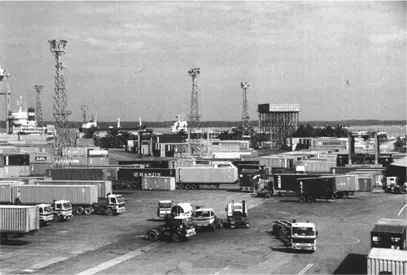
Photo: G. Cho
Plate 1.2 Containerization – a major development in the transport of goods permits quick loading and unloading. Containers are all of an internationally agreed size
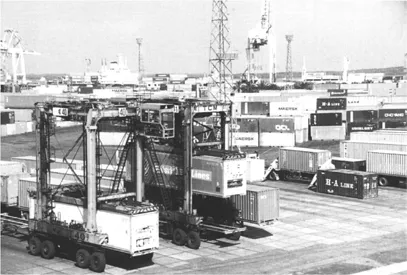
Photo: G. Cho
Plate 1.3 Iron ore carrier leaving Hammersley Iron wharf at Dampier, Western Australia. The export of raw natural resources facilitates secondary and final processing at points of consumption. Supertankers can be loaded and unloaded quickly
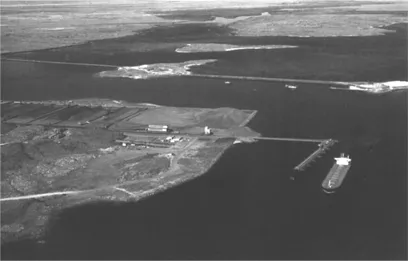
Photo: Australian Department of Foreign Affairs and Trade
International trade is thus seen here as the exchange of goods and services between distinct and separate political units. Such trade is also particularly amenable to control and taxation that yield revenues. Also by judicious regulation, trade directly influences the nature and extent of economic activity and indirectly the patterns of specialization within the nation and elsewhere. Curbs on international trade may result from the need to exclude prohibited goods such as drugs and other contraband. On the other hand, on economic grounds controls may be in the form of ‘mercantilism’ – the attitude that money is the only form of wealth, and the desire to either protect a nation’s industries or to exert the power of the state in the marketplace.
Apart from government interference, a barrier to effective international trade is the geographical factor of distance. Two nations may be better off trading with an intervening country – the so-called intervening opportunity – if the friction of distance places too great a cost on the final product. The factors which influence and affect international trade thus include the physical and economic endowments and characteristics of trading nations, distance between countries, the political element, population and human resources and the stage of development of nations.
For a long time, the economist Ragnar Nurske’s idea that trade can act as an ‘engine of growth’ for developing countries held sway. The idea was that the growth of developing countries was largely determined by external conditions. Economic growth was linked, on the one hand, by exports as well as imports of investment goods, and on the other, to the growth and prosperity of developed countries. Historically this explanation was plausible while many developed European nations depended on their colonies for raw materials for use in domestic industries. Economic expansion of developed countries also produced growth in developing countries. By the twentieth century, with independence and the emancipation of colonies, the engine of growth explanation became less tenable. Moreover, a fall in demand for raw materials and deteriorating terms of trade had made the idea even less convincing. A diversification of exports from developing countries coupled with the authority of the marketplace and price mechanism has undermined any support for the engine of growth idea. The contribution of agriculture to the gross domestic product (GDP) of growing Asian and Pacific countries has fallen dramatically, for example, in Thailand, where the contribution of agriculture fell from 32 per cent in 1965 to 15 per cent in 1989, while in Korea the corresponding figures are 38 per cent and 10 per cent and for Papua New Guinea are 42 per cent and 28 per cent over the same period.
The reciprocal relationship between trade and the location of economic activities explains the volume, direction and composition of trade between two areas. This also directly reflects the location of particular types of production and the markets for such goods. In this view, trade is seen primarily as a means of increasing economic welfare (that is, development) by facilitating specialization which in turn increases the efficiency of resource use. Trade is also a powerful mechanism for economic growth. In recent times, however, a worsening of the terms of trade for primary commodities has meant that trade has become unreliable as a source of growth. Moreover, international trade is often cited as one of the principal factors promoting the emergence of a hierarchically organized world system that is divided into a core, periphery and semi-periphery. To avoid such a world system, a shift from the mere palliative of import substituting industrialization (ISI) to one of integration with the global economy, including the absence of import protection and trade barriers of any description, is taking place. The import substitution approach ensured that domestic industries could grow, the nation would conserve scarce foreign capital within the country, decrease external dependencies and strengthen nationhood. But this approach meant a highly protected local market with resources allocated to protect infant industries – a theme discussed in Chapter 2.
International trade theories
Theories of international trade in general emphasize the salient elements of a complex system. The emphasis is on general rather than particular trade flows. The twin questions of what are the determinants of trade and what are the spatial patterns of trade suggest the need to examine various theories of international trade in order to obtain some answers.
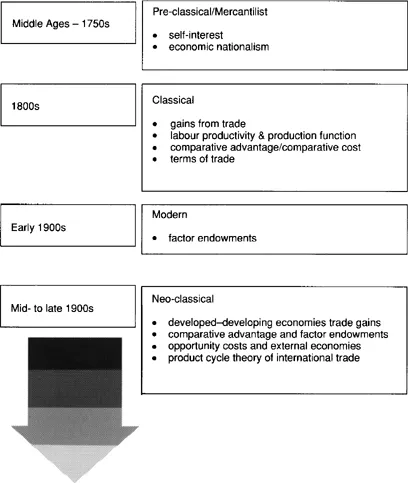
The development of international trade theory has undergone four distinct phases. The first phase is the pre-classical or mercantilist following the Middle Ages till the 1750s or so. This was followed by the classical phase, lasting for about 150 years and coincident with the Industrial Revolution in Europe; then came the modern or contemporary trade theory and finally the neo-classical phase. An understanding of these four phases will permit a better explanation of trade policies adopted by different countries. (See Figure 1.1 for a synoptic view of the four phases.)
Figure 1.1 Summary of international trade theories
Pre-classical or mercantilist phase
Trade theory during the mercantilist period may be interpreted more as a set of policies of self-interest and economic nationalism rather than anything else. The features of such policies included favourable balance of trade with more exports than imports, the emphasis on foreign trade with manufactured goods rather than agricultural produce, and the use of controls and force to implement these policies.
Classical phase
Economists such as Adam Smith and David Ricardo emphasized gains from trade. The premise was that free trade was beneficial to all trading partners and that the amount of goods to be traded depended on relative price levels. Trade resulted in increasingly specialized production. The price charged for any good depended on the units of labour used. A country will export those products for which labour productivity is high. Such productivity was dependent upon natural conditions in various countries so that labour in one country may be more productive in certain goods than in another. The economic concept to describe these differences is known as the production function which is assumed to vary between nations. Labour was completely mobile within a country but immobile between countries. Note that the cost of transport is not considered. The emphasis on one factor of production – labour – ignores the importance of other factors of production. The core of the theory of comparative costs is that trade occurs because comparative costs differ among countries. Comparative costs are defined here as the ratio of the production costs of the commodity distinguished in terms of the quantities of inputs.
David Ricardo’s theory is based on comparative advantage or cost. That is, even though a country may have an absolute advantage over others in the production of every good, it would be in the interests of itself and other nations to specialize in producing and exporting those commodities in which it has a comparative cost advantage and importing those goods in which it has a comparative cost disadvantage. While the theory suggests reasons for the direction of trade flows it does not explain the actual amount of the final price. In international trade this is known as the terms of trade, that is, the ratio of the value of exports to imports relative to a base reference shown as a percentage figure.
Developing countries are particularly susceptible to poor terms of trade. This is because comparative costs are largely determined by the natural endowment of a country. Primary produce comes under this category. Also called Ricardo goods, the demand for and trade in primary commodities are dependent on global economic activity. Developing countries have particular difficulty in catching up with the developed world because the terms of trade are consistently working to their disadvantage. Moreover, technical change in the developed world has increased the number of substitutes available thus further reducing the demand for and price of raw materials originating from developing countries.
Today we observe a change in comparative advantage from purely geographical determinants to one of technical determinants. This change favours countries whose institutional structures and capital availability are adaptive to technical innovations. MNCs complicate the picture by controlling the export of primary commodities from developing countries. MNCs may remit income earned by such exports, thus reducing the capital available for internal industrial expansion within the developing country. An inequality in income distribution will witness the import of luxury goods to satisfy the demands of the wealthy groups, thus damaging the delicate balance of payments of the developing country. Finally, the reliance on primary products with low elasticity of demand, that is, any increase in price of the produce will result in the substitution of natural material for synthetic and industrially produced products, will affect the terms of trade.
Modern trade theory
Modern trade theory attempts to deal with the complexities of real-world international trade. This follows the abandonment of the labour theory of value in favour of including other factors of production such as land, capital and entrepreneurial skills. So differences in ‘factor endowments’ may determine the nature of trading relations between countries. Depending on the abundance or scarcity of factors of production, each country produced trading goods for which there was a natural advantage to do so. The starting premises for this theory are, first, countries differ in their factor endowments and, second, commodities differ in the combination of fa...
Table of contents
- Cover
- Halftitle
- Title
- Copyright
- Contents
- List of Plates
- List of Figures
- List of Tables
- Acknowledgements
- List of Abbreviations
- 1. Trade, aid and global interdependence
- 2. Trade and development
- 3. Aid and development
- 4. Countertrade and technology transfer
- 5. Global trade reform
- Review questions, references and further reading
- Index
Trusted by 375,005 students
Access to over 1.5 million titles for a fair monthly price.
Study more efficiently using our study tools.
Frequently asked questions
Yes, you can cancel anytime from the Subscription tab in your account settings on the Perlego website. Your subscription will stay active until the end of your current billing period. Learn how to cancel your subscription
No, books cannot be downloaded as external files, such as PDFs, for use outside of Perlego. However, you can download books within the Perlego app for offline reading on mobile or tablet. Learn how to download books offline
Perlego offers two plans: Essential and Complete
- Essential is ideal for learners and professionals who enjoy exploring a wide range of subjects. Access the Essential Library with 800,000+ trusted titles and best-sellers across business, personal growth, and the humanities. Includes unlimited reading time and Standard Read Aloud voice.
- Complete: Perfect for advanced learners and researchers needing full, unrestricted access. Unlock 1.5M+ books across hundreds of subjects, including academic and specialized titles. The Complete Plan also includes advanced features like Premium Read Aloud and Research Assistant.
We are an online textbook subscription service, where you can get access to an entire online library for less than the price of a single book per month. With over 1.5 million books across 990+ topics, we’ve got you covered! Learn about our mission
Look out for the read-aloud symbol on your next book to see if you can listen to it. The read-aloud tool reads text aloud for you, highlighting the text as it is being read. You can pause it, speed it up and slow it down. Learn more about Read Aloud
Yes! You can use the Perlego app on both iOS and Android devices to read anytime, anywhere — even offline. Perfect for commutes or when you’re on the go.
Please note we cannot support devices running on iOS 13 and Android 7 or earlier. Learn more about using the app
Please note we cannot support devices running on iOS 13 and Android 7 or earlier. Learn more about using the app
Yes, you can access Trade, Aid and Global Interdependence by George Cho in PDF and/or ePUB format, as well as other popular books in Economics & Business General. We have over 1.5 million books available in our catalogue for you to explore.