- 240 pages
- English
- ePUB (mobile friendly)
- Available on iOS & Android
eBook - ePub
About this book
Some 12 years into the epidemic, with an effective preventive vaccine or therapy against HIV disease still to be found, this book reflects on the contributions of social and behavioural research to the development of interventions for prevention. After over a decade's work documenting HIV and AIDS-related knowledge, attitudes and behaviour, social researchers have begun to focus more clearly on perceptions of sexual safety and risk, and the factors that contribute to these. The issues addressed by the book were examined during three major conferences in 1994: the annual conference of the British Sociological Association, the 2nd International Conference on the BioPsychoSocial Aspects of AIDS and the Xth International Conference on AIDS. The book brings together key papers presented at each of these conferences, documenting issues of focal concern to social researchers, policy makers and health educators in the mid-1990s.
Information
Chapter 1: Reputedly Effective Risk Reduction strategies and Gay Men
Marie-Ange Schiltz and Philippe Adam
The outbreak of AIDS has overwhelmed the entire gay world. The initial drop in the frequency of ‘casual’ sexual encounters, first observed in France in our second study in 1986 (Pollak and Schiltz, 1987), has been followed by the development of various strategies that enable gay men to continue to have this kind of sexual activity. Although the prevention message directed at gay men in France has frequently emphasized ‘completely safe sex’—the systematic protection of all practices with all partners1—there is evidence to suggest that condom use and, in general, ‘safer sex’ are adopted to varying degrees. Our work also points to the diversity of AIDS prevention strategies used by gay men that go beyond simple condom use. These different options, whose underlying logic and efficacy need to be better understood, appear to be correlated with the social position of gay men in society as a whole as well as within the gay world itself.
For several reasons, our evaluation of these adaptations seeks to distance itself from public health debates that are pervaded by the notion of relapse (Ekstrand et al., 1989). This concept, lacking in nuance to begin with, validates behaviours that are believed to constitute effective risk reduction practices and, conversely, condemns behaviour statistically linked to a return to risk practices. It appears, however, that any rigid distinction between ‘safe’ and ‘unsafe’ is over-simplified, whether it concerns groups of individuals confronted by the risk of AIDS, or time periods in the sexual career of an individual. This chapter analyses the ways in which gay and bisexual men who claim to have adapted their lifestyle to the risk of AIDS (and who are generally considered as practising HIV prevention), nevertheless report risking infection at least once during the year by not using a condom with a partner of unknown or different HIV status. Given the implications of this phenomenon for AIDS prevention, it is important for the social sciences to take it into account. and, moreover, to try to explain it.
Until now, research on the factors influencing preventive behaviour has limited itself to studies of the adoption of condom use and the rules of ‘safer sex’. The absence of a link between information about AIDS and preventive behaviour was an early finding in this field (Pollak et al.,1989). Furthermore, Michael Pollak pointed out in the early years of our studies that certain factors were highly correlated with the adoption of ‘safer sex’ by gay men; namely, personal proximity to the epidemic, elevated social and professional status coupled with a social acceptance of being homosexual, and a high degree of integration within the gay community (Pollak and Schiltz, 1987; Pollak, 1992). Recent French research on the general population also suggests that a prior awareness of risk is necessary for condom use (Spira et al., 1993).
The major difficulty encountered in studying this question arises from the fact that even though much research tries to identify causal factors leading either to the adoption of preventive behaviour or to risk taking, social and psychological factors influence behaviour with respect to health and illness in a way that is frequently complex and unclear (Adam and Herzlich, 1994). A unified understanding of this problem thus remains to be developed, though attempts have been made to do this: Calvez, for example, has applied a culturalist approach to the problem of coping with risk (Douglas and Calvez, 1990). Likewise, the idea of there having been a ‘rationalization’ of sexuality underpins the work of Pollak from the end of the 1970s (Béjin and Pollak, 1977), an idea that the threat of AIDS has considerably redefined.
Not only are the factors leading to the adoption of preventive behaviour complex, but also the social sciences are relatively ill-equipped to explain risk taking by individuals who simultaneously claim to have adopted an effective strategy against the epidemic. This chapter is an initial attempt to explore these issues. In order to do so, we first sought to find out how gay men described the risks they took. The central question is thus: when an individual adopts a strategy of risk management, what happens to his awareness of risk? Depending on the strategy taken, a significant gap may exist between an individual’s perception of risk and the actual risk as described by epidemiological criteria. Starting from our observation that risk assessment is highly subjective, we examine the effect that the belief in certain strategies can have on the individuals who follow them.
Specifically, we have chosen those individuals who have practiced unprotected anal intercourse with their non-regular sexual partners. We then examine their risk-management strategies to determine if they have under or over-declared their risk taking. Indeed, putting a risk management strategy into practice is not merely a method of reducing exposure to infection, it also strongly influences the way that a person perceives his exposure to AIDS. This influence, which we will analyse in detail, can be much stronger when a discourse validating certain feelings or certain forms of behaviour, including ‘safer sex’, accentuates its effects. In an effort to control AIDS, it is imperative to control the potential effects of any kind of overly categorical social discourse. Before developing these different points, we will briefly describe the study and the methodology adopted.
Procedure and Methodology
This study constitutes one of the elements of the research programme established by Michael Pollak. It analyses findings from a questionnaire survey conducted every year since 1985 in the gay press. The questionnaire is concerned primarily with sexuality, and oriented to the specific issue of AIDS. In addition to questions on sociodemographic characteristics (age, marital status, place of residence, profession, level of education), other questions establish the nature of respondents’ social relations and whether they are more homosexual or more heterosexual. The principal objective of the survey is to identify the changes that the AIDS has brought about in the sexual life and social lives of those surveyed. The survey also identifies the behaviour and attitudes of the respondents vis-à-vis their health, with particular attention to HIV status. Finally, several questions access opinions about the status of gay and bisexual men and the social repercussions of the epidemic.
Using the gay press to collect data is not a neutral technique to adopt. In addition, having to return the questionnaire by post tends to bias the sample towards the most motivated respondents. Nevertheless, this mechanism (which constitutes a methodological and financial compromise), has permitted us to recruit rapidly and repeatedly a large number of respondents. The following analysis has been carried out using the 1991 and 1993 surveys in which 2000 and 3300 gay men, respectively, participated.
Although such a study cannot claim to be representative, the likely biases can be identified. First, we can compare the socio-demographic characteristics of those surveyed with statistics about single men in the same age group collected from the national census (Pollak et al., 1986). This comparison indicates that our samples under-represent working-class individuals with limited education and over-represent university-educated professionals. As far as geographical distribution is concerned, our samples accurately represent the reference population with a slight over-representation of the Paris metropolitan area and also of areas containing fewer than 20,000 inhabitants. Thus, our study attracts not only those who are likely to be the most open about their homosexuality, but also those individuals living in smaller towns and in villages, who are more or less isolated from the rest of the gay world.
Government statistical indicators are not, however, the only ones that structure the gay population. Respondents’ age at first sexual experience is also an indicator of potential bias in the sample. For the generation of men aged 25–45 years, our statistics coincide exactly with findings from the Analyse des Comportements Sexuels en France (ACSF) (Bozon, 1993); a nationwide study with a representative sample of 20, 055 men and women. On the other hand, the youngest and the oldest members of our sample are sexually more precocious than their counterparts in the general population. Our method of recruiting is probably the cause of this difference. By using the gay press, we tend to select respondents whose sexuality plays an important role in their lives. This overselection of the most sexually active men is that much greater as it concerns men at the beginning and end of their sexual career; precisely those age groups where the proportion of sexually inactive men is the highest.
Other indicators can also be taken into account. Relatively limited participation in gay and AIDS organizations shows that our sample is not limited to a core group of activists. Finally, in comparison with other studies using quota and snowball sampling techniques (Pollak and Schiltz, 1991), our respondents report a lower degree of acceptance of homosexuality, both by themselves and by others. The anonymity of the questionnaire and the absence of a face-to-face interview enable us to collect information from people who might ordinarily refuse to discuss their sexual preferences. Overall, it appears, as in other European studies (Bochow et al., 1994), that a study using the gay press allows the description of the behaviour not only of the most socially and sexually active men, but also of bisexual and homosexual men who are reputedly more difficult to reach. Even though these latter groups constitute a minority within our sample, our study enables us to form hypotheses about them and to compare them to other groups of gay men. Hence, our goal is not to try to establish precise statistics concerning sexual behaviour. On the contrary, thanks to the large number of respondents, we can distinguish different groups of gay and bisexual men, each with different sexual practices and social characteristics. Our analysis is thus concerned with comparison between these groups. This kind of comparison also permits us to avoid the unanswerable question of whether those surveyed are in fact truthfully reporting their sexual practices.
Another distinctive feature of the study is the fact that the survey is conducted annually, thereby enabling the study of changes in behaviour. In order to make comparisons between different years, we have to be certain of the sociodemographic stability of our samples. Between 1985 and 1992, the magazine Gai Pied published the questionnaire and, as a result, the population remained extremely stable.2 The disappearance of Gai Pied in 1993 forced us to modify the means of distribution. Since then, we have included the questionnaires in six gay magazines (All Man, La Lettre de Gai Pied, Illico, Honcho, Lettres Gay, Rebel). The choice of these periodicals originally reflected a desire to renew and enlarge the group participating in the survey. In 1993, this renewal was accomplished: 58.3 per cent of those responding did so for the first time (as opposed to 45.5 per cent in 1991). Although one would have expected considerable discontinuity in the 1993 sample, the socio-demographics of those surveyed in 1993 are entirely comparable with the characteristics of the preceding surveys, except that the 1993 population is younger, as was hoped (the average age of the sample declined from 34.9 years in 1991 to 33.4 years in 1993). This stability is probably due to the fact that Gai Pied itself had a diverse but progressively ageing readership. Thanks to the stability of the sociodemographic structure, this annual cycle of observations provides an overview of changes in sexual behaviour since our first study 10 years ago (Pollak and Schiltz, 1991; Schiltz, 1993).
Strategies of Adaptation
In order to evaluate gay men’s reactions to the AIDS epidemic, we began by asking if they had ever taken precautions to prevent infection since its beginning. In 1985, only 44 per cent of those surveyed declared that they had taken preventive measures to avoid HIV infection; by 1988, however, this rate had levelled off at over 80 per cent. To this group of men who have modified their behaviour—the vast majority of the respondents—we must add in 1993 the 11.1 per cent who declare that they have always practised a form of ‘safer sex’. This group generally consists of young men who began their sexual life after condom use had become more or less the norm. In 1993, the increase in the percentage of those who are ‘already safe’ is also due, at least in part, to a sample which is simply younger. Thus, with the exception of a small minority (3.8 per cent) who declare that they have not modified their sexual behavior in spite of the risk taken —whether it be by choice or because of the difficulties inherent in such a change —the risk of AIDS is now widely taken into account by gay men. The question is then: how exactly have gay men modified their behaviour?3
Condom Use
Condom use reflects a major adaptation to the risk of AIDS among gay men. Since 1989, condom use has stabilized at a high level, with three-quarters of those surveyed describing themselves as users (see Table 1.1). Statistics concerning overall condom use mask variations in use that depend both on the type of sexual practices and on the nature of the sexual partner. With casual or non-regular partners, prudence is the rule. Not only do dangerous sexual practices tend to be generally excluded, but when practised they are more protected. This is as true for fellatio as it is for anal penetration.
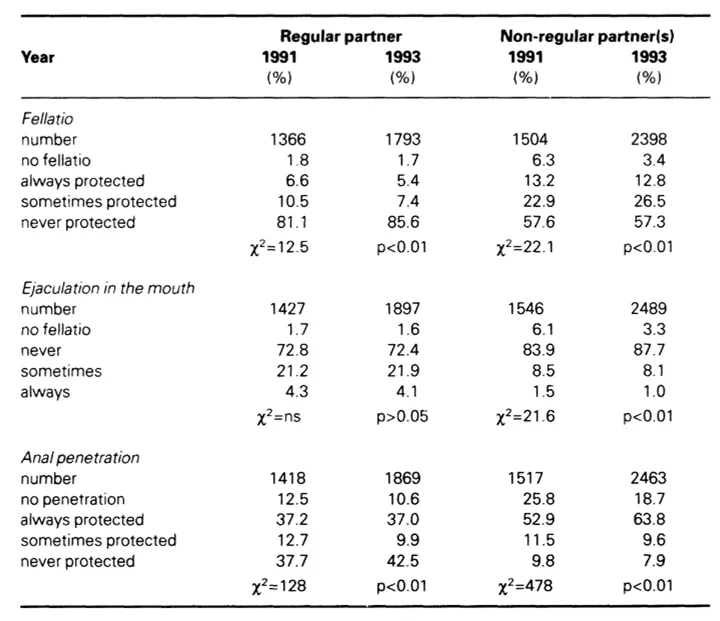
Although only a minority of those surveyed use condoms for fellatio,5 the percentages increase slightly for non-regular partners: more than a third of those surveyed use a condom ‘sometimes’ or ‘always’ for oral-genital contact. Likewise, fellatio without ejaculation is becoming more common. With casual partners, 83.9 per cent of those surveyed in 1991 and 87.7 per cent in 1993 systematically avoid receiving semen in the mouth.
We note not only that 25.8 per cent in 1991 and 18.7 per cent in 1993 of the respondents avoided anal penetration altogether, but those continuing to practice it protect themselves more (see Table 1.2). Thus in 1993, 81.5 per cent of those responding have either abandoned penetration (18.7 per cent) or use condoms during every act with a casual partner (63.8 per cent). The global figure falls to 47.6 per cent in relationships with a regular partner. Between 1991 and 1993 we note that the difference in protection with non-regular and with regular partners becomes more pronounced. The preceding description shows that there exists a diversity of condom use. It is important not only to understand the logic behind these variations, but also to recognize that condom use is not the only risk management strategy adopted.
Table 1.1Condom use4

Table 1.2 Nature and protection of sexual practices
In order to examine these other strategies, we asked respondents to characterize the behaviour they had adopted for coping with the risk of AIDS by choosing from among a number of possibilities.6 Although a small number of men indicated no chosen method of prevention,7 the responses of...
Table of contents
- Cover Page
- Title Page
- Copyright Page
- Social Aspects of AIDS
- Preface
- Chapter 1: Reputedly Effective Risk Reduction Strategies and Gay Men
- Chapter 2: HIV-Related Discrimination in Medical Teaching Texts
- Chapter 3: Travel, Sexual Behaviour and Gay Men
- Chapter 4 Sexual Behaviour in Gay Men: Towards a Sociology of Risk
- Chapter 5: Framing Difference: Sexuality, AIDS and Organization
- Chapter 6: Towards Effective Intervention: Evaluating HIV Prevention and Sexual Health Education Interventions
- Chapter 7: Communities, Governments and AIDS: Making Partnerships Work
- Chapter 8: Socially Apart Youth: Priorities for HIV Prevention
- Chapter 9 Theorizing and Researching ‘Risk’: Notes on the Social Relations of Risk in Heroin Users’ Lifestyles
- Chapter 10 Sex, Love and Seropositivity: Balancing the Risks
- Chapter 11: One of us, one of them, or one of those? The Construction of Identity and Sexuality in Relation to HIV/AIDS
- Chapter 12: Sexuality, Identity and Community—Reflections on the MESMAC Project
- Chapter 13: Discourses of Power and Empowerment in the Fight against HIV/AIDS in Africa
- Notes on Contributors
Trusted by 375,005 students
Access to over 1.5 million titles for a fair monthly price.
Study more efficiently using our study tools.
Frequently asked questions
Yes, you can cancel anytime from the Subscription tab in your account settings on the Perlego website. Your subscription will stay active until the end of your current billing period. Learn how to cancel your subscription
No, books cannot be downloaded as external files, such as PDFs, for use outside of Perlego. However, you can download books within the Perlego app for offline reading on mobile or tablet. Learn how to download books offline
Perlego offers two plans: Essential and Complete
- Essential is ideal for learners and professionals who enjoy exploring a wide range of subjects. Access the Essential Library with 800,000+ trusted titles and best-sellers across business, personal growth, and the humanities. Includes unlimited reading time and Standard Read Aloud voice.
- Complete: Perfect for advanced learners and researchers needing full, unrestricted access. Unlock 1.5M+ books across hundreds of subjects, including academic and specialized titles. The Complete Plan also includes advanced features like Premium Read Aloud and Research Assistant.
We are an online textbook subscription service, where you can get access to an entire online library for less than the price of a single book per month. With over 1.5 million books across 990+ topics, we’ve got you covered! Learn about our mission
Look out for the read-aloud symbol on your next book to see if you can listen to it. The read-aloud tool reads text aloud for you, highlighting the text as it is being read. You can pause it, speed it up and slow it down. Learn more about Read Aloud
Yes! You can use the Perlego app on both iOS and Android devices to read anytime, anywhere — even offline. Perfect for commutes or when you’re on the go.
Please note we cannot support devices running on iOS 13 and Android 7 or earlier. Learn more about using the app
Please note we cannot support devices running on iOS 13 and Android 7 or earlier. Learn more about using the app
Yes, you can access Aids by Peter Aggleton,Peter Davies,Graham Hart in PDF and/or ePUB format, as well as other popular books in Sozialwissenschaften & AIDS & HIV. We have over 1.5 million books available in our catalogue for you to explore.