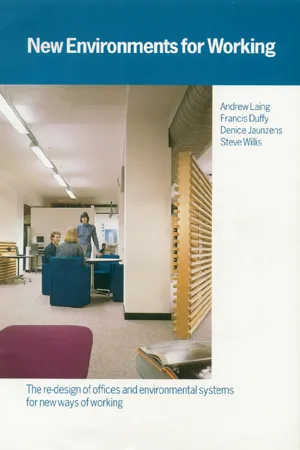
The workplace is changing radically, yet the building designs and environmental systems for conventional offices fail to support the more fluid use of space and time practised by these new kinds of office work. Prepared by the team who wrote The Responsible Workplace in 1992, this book is based on a major research project undertaken by DEGW and the BRE. It identifies the key organizational changes, patterns of work, work settings and types of space layouts and it will help specifiers and users of environmental systems understand what products will be suitable for innovative ways of office working.
- 172 pages
- English
- ePUB (mobile friendly)
- Available on iOS & Android
eBook - ePub
New Environments for Working
About this book
Information
Part 1: Overview
Chapter 1 Objectives
Chapter 2 Methods of research
Chapter 3 Conclusions
1 Objectives
This book contains the findings of New Environments for Working: a study of the implications of modern working practices for the specification and performance of building form and environmental systems. Our aim in this book is to present ideas for what could be done to improve the functionality of office buildings in the light of changing worker and organisational demands.
During the 1990s there have been many changes in the design and use of office buildings. Information Technology is introducing more irregular and intermittent working hours, and other practices that have transformed the daily use of the office. For some office workers the distinction between home and the workplace is no longer quite so clear as it used to be. They have become more demanding and their needs have become less predictable.
Most office design, especially of the lighting and ventilation systems, has been based upon grossly oversimplified notions of what goes on in the office. It has only recently become possible to measure easily where and when various office activities are actually carried out. These measurements show surprising findings regarding how often, and for what length of time, some work stations are left completely unattended.
No single office task now seems predominant: neither reading, telephone work, writing nor computer work. More time is typically spent away from the workplace. This is often in one-to-one meetings, and in activities which are highly interactive and mobile. As organisations begin to use IT to reorganise their use of office space and their working hours, new working patterns will become more common.
Most people regard office buildings and their environmental systems as more permanent entities than the organisational structures themselves. Despite the volatility of today’s working patterns, however, office building design generally remains conservative. This situation cannot be allowed to last. Office buildings can inhibit organisational change, and once clients and users recognise this danger, they will insist on changes in the design of their buildings.
Our main objective in the New Environments for Working study was to explore these scenarios of probable change, and to determine the kinds of environmental and management systems in buildings that would satisfy these changing user demands.
In broader terms, we consider how environmental systems in office buildings need to relate to today’s newer, more complex and more flexible working practices, organisational shape and performance. We believe that office environments must adapt to increasingly ‘fluid’ working practices (ie people whose working methods differ from ‘traditional’ practice; for example, operating to different hours and over a range of locations within the office building). This is increasingly matched, at both corporate and individual level, by an increasing demand for the reduction of energy waste and pollution—problems now associated with the over-servicing of office buildings.
In this study, we look at how environmental services can best respond to these emerging demands. We have synchronised the new forms of working with the new patterns of space and time use in the office, and the design of office buildings and office environmental services, by considering the following questions:
• What are the most effective and energy efficient ways of accommodating emerging working practices?
• What impact will these trends have on product development needs for HVAC systems?
• What implications will such trends have for the design of:
– lighting systems?
– the ‘scenery’, settings and furnishings of the office workplace?
– the base building itself?
2 Methods of research
2.1 Four phases of research
The NEW study followed four phases of research. Phases 1–3 were carried out between October 1994 and March 1996. Phase 4 took place over the spring and summer of 1996.
Phase 1
During Phase 1, we created a number of models of office organisations representing the relationships between work patterns, use of space and buildings, and demands for environmental systems. Organisations were modelled as occupiers of typical kinds of buildings commonly found in the UK. A range of environmental systems was then evaluated against sets of performance requirements associated with these different patterns of work. A survey of leading services consultants was undertaken to evaluate the perceived effectiveness of a range of HVAC systems.
Phase 2
We carried out case studies of actual office organisations and contemporary office technologies to learn, from real examples, how the varied patterns of work are related to the use of space and their demand for environmental services. Following a widespread international literature search we identified eight organisations from the model of organisational behaviour developed in Phase 1. These were chosen to represent the full range of work patterns, rather than to illustrate any particular building type or environmental servicing technology.
The selection of the case studies was therefore driven by the priority of understanding the work process and the organisational ‘demand’ for space, technology, environmental servicing systems and buildings. As these organisations are based in the UK, Germany, Netherlands and the USA, they provide an interesting international cross-section of office accommodation and technical solutions.
A further four UK case studies focused on the performance of a range of innovative environmental systems and evaluated how well they could perform against the expected organisational demands.
Phase 3
Using the case studies and models from the first two phases, we developed a series of product directions and design implications for the re-design of environmental services, office buildings and interiors.
Johnson Controls (a project sponsor) developed a software-based model of the life-cycle cost profiles of different key combinations of organisational types and quality of fit-out solutions.
Finally, a consideration of the dynamics of these patterns of change in organisational structure led the project to specify strategic product directions or design implications for office buildings, HVAC and lighting systems, and the layout and furnishings of the workplace environment.
Phase 4
This final phase involved the controlled dissemination of the research findings. Over the spring and summer of 1996 a series of seminars were held with interested parties from industry—architects, interior designers, developers, letting agents, building services engineers, manufacturers, and facilities managers—to discuss and review a summary of the key findings. This feedback phase was again supported by the Department of the Environment, Transport and the Regions’s Partners in Technology programme.
Background to the research programme
Our research approach draws on a long tradition of user-focused research at DEGW and BRE by concentrating on how people (collectively rather than as individual users) use space over time. We found that we were best able to understand users’ demands and requirements by focusing on the social reality of the groups and organisations of which they form an active part. Individual office users are regarded in representative groups: as members of socially interacting institutions which have identifiable directions, motivations, and interests. In this way, we have defined the richer image of the complex, collective entity of the corporate organisation.
Before we could begin to design the office environment for such user groups, our first task had to be to understand and evaluate their needs. The starting point was the recognition that organisations are driven to respond to an increasingly turbulent business environment. They must respond to the competitive market, often undergoing rapid change and even conflict, as part of their way of handling economic survival and the support of their most vital resource: their own human capital.
Designers must somehow take into account this complex and dynamic picture. This can only be achieved successfully through a rigorous understanding of how an organisation’s business process can be translated into requirements for environmental and spatial solutions that are based clearly on defined patterns of use over time.
The research problem is therefore how to understand and model the relationships between the social structure and technology of office organisations. From this we can move to look at how the quality and nature of the spatial environment can be maintained throughout any changes in these relationships.
DEGW has for many years specialised in the systematic modelling of user requirements and in using these models to evaluate the performance of buildings. The method has always been typological. In the 1980s, DEGW and others undertook the pioneering ORBIT (Organisational Research, Buildings and Information Technology) studies which plotted the impact of IT on the nature of the office work process, and on the design of the office building. Following this, building appraisal techniques were developed for measuring, benchmarking and planning the new wave of large offices being built in the City of London. One example of this is the planning of the building types used in the landmark Broadgate development in the City of London.
In the 1990s this approach was developed through two major projects. ‘The Responsible Workplace’ study (coordinated jointly by DEGW and BRE) investigated the new concerns of office users and highlighted demands for office buildings that would add value to organisational performance, whilst minimising occupancy costs and environmental impacts (Duffy, Laing and Crisp, 1993).
Simultaneously DEGW and Teknibank completed the ‘Intelligent Building in Europe’ study that established a new way of conceptualising building intelligence focused on user needs, rather than on the conventional technical evaluation of building performance. This de...
Table of contents
- Cover
- Title
- Copyright
- Contents
- Sponsors of the research
- List of contributors
- Acknowledgements
- Foreword
- Introduction
- Part 1: Overview
- Part 2: A new research approach
- Part 3: Affinities between work patterns, building types and environmental systems
- Part 4: Case studies
- Part 5: Product directions and design implications
- Bibliography and appendices
- Index
Trusted by 375,005 students
Access to over 1.5 million titles for a fair monthly price.
Study more efficiently using our study tools.
Frequently asked questions
Yes, you can cancel anytime from the Subscription tab in your account settings on the Perlego website. Your subscription will stay active until the end of your current billing period. Learn how to cancel your subscription
No, books cannot be downloaded as external files, such as PDFs, for use outside of Perlego. However, you can download books within the Perlego app for offline reading on mobile or tablet. Learn how to download books offline
Perlego offers two plans: Essential and Complete
- Essential is ideal for learners and professionals who enjoy exploring a wide range of subjects. Access the Essential Library with 800,000+ trusted titles and best-sellers across business, personal growth, and the humanities. Includes unlimited reading time and Standard Read Aloud voice.
- Complete: Perfect for advanced learners and researchers needing full, unrestricted access. Unlock 1.5M+ books across hundreds of subjects, including academic and specialized titles. The Complete Plan also includes advanced features like Premium Read Aloud and Research Assistant.
We are an online textbook subscription service, where you can get access to an entire online library for less than the price of a single book per month. With over 1.5 million books across 990+ topics, we’ve got you covered! Learn about our mission
Look out for the read-aloud symbol on your next book to see if you can listen to it. The read-aloud tool reads text aloud for you, highlighting the text as it is being read. You can pause it, speed it up and slow it down. Learn more about Read Aloud
Yes! You can use the Perlego app on both iOS and Android devices to read anytime, anywhere — even offline. Perfect for commutes or when you’re on the go.
Please note we cannot support devices running on iOS 13 and Android 7 or earlier. Learn more about using the app
Please note we cannot support devices running on iOS 13 and Android 7 or earlier. Learn more about using the app
Yes, you can access New Environments for Working by Francis Duffy,Denice Jaunzens,Andrew Laing,Stephen Willis in PDF and/or ePUB format, as well as other popular books in Architecture & Architecture General. We have over 1.5 million books available in our catalogue for you to explore.