- 200 pages
- English
- ePUB (mobile friendly)
- Available on iOS & Android
eBook - ePub
About this book
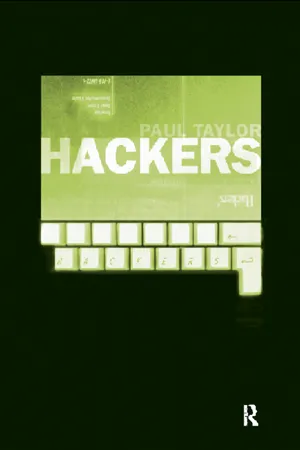
The practice of computer hacking is increasingly being viewed as a major security dilemma in Western societies, by governments and security experts alike.
Using a wealth of material taken from interviews with a wide range of interested parties such as computer scientists, security experts and hackers themselves, Paul Taylor provides a uniquely revealing and richly sourced account of the debates that surround this controversial practice. By doing so, he reveals the dangers inherent in the extremes of conciliation and antagonism with which society reacts to hacking and argues that a new middle way must be found if we are to make the most of society's high-tech meddlers.
Information
1
Them and us
The hack
It is an interesting fact that most scientific research and speculation on deviance concerns itself with the people who break rules rather than with those who make and enforce them. If we are to achieve a full understanding of deviant behavior, we must get these two possible foci of inquiry into balance. We must see deviance, and the outsiders who personify the abstract conception, as a consequence of a process of interaction between people, some of whom in the service of their own interests make and enforce rules which catch others who, in the service of their own interests, have committed acts which are labelled deviant.… It is, of course, possible to see the situation from both sides. But it cannot be done simultaneously. That is, we cannot construct a description of a situation or process that in some way fuses the perceptions and interpretations made by both parties involved in a process of deviance. We cannot describe a ‘higher reality’ that makes sense of both sets of views. We can describe the perspectives of one group and see how they mesh or fail to mesh with the perspectives of the other group: the perspectives of rule-breakers as they meet and conflict with the perspectives of those who enforce the rules, and vice versa. But we cannot understand the situation or process without giving full weight to the differences between the perspectives of the two groups involved.
(Becker 1963:163, 173)
The key focus of this work is not just the computer underground in isolation, but rather upon the them and us conflictory relationship that exists between the computer security industry and the computer underground. In order to understand a social group labelled as deviant one needs to pay due attention to its ongoing interaction with those labelling it and not just attempt to research the group being labelled as deviant:
We can construct workable definitions either of particular actions people might commit or of particular categories of deviance as the world (especially, but not only, the authorities) defines them. But we cannot make the two coincide completely, because they do not do so empirically. They belong to two distinct, though overlapping, systems of collective action. One consists of the people who co-operate to produce that act in question. The other consists of the people who cooperate in the drama of morality by which ‘wrongdoing’ is discovered and dealt with, whether that procedure is formal or quite informal.
(Becker 1963:185)
It is this conflict between the computer underground and those opposing groups who seek to stigmatise it as deviant that makes hackers an intriguing exemplar of how social practices dynamically emerge within technological environments.
The contested term
In its original technological sense, the word ‘hacker’, coined at MIT in the 1960s, simply connoted a computer virtuoso. That’s still the meaning enshrined in the 1994 edition of the New Hacker’s Dictionary, which defines such a person as someone ‘who enjoys exploring the details of programmable systems and how to stretch their capabilities; one who programs enthusiastically, even obsessively’.
(Roush 1995:1)
The word hack doesn’t really have 69 different meanings.… In fact, hack has only one meaning, an extremely subtle and profound one which defies articulation. Which connotation is implied by a given use of the word depends in similarly profound ways on context.… Hacking might be characterized as ‘an appropriate application of ingenuity’. Whether the result is a quick-and-dirty patchwork job or a carefully crafted work of art, you have to admire the cleverness that went into it. An important secondary meaning of hack is ‘a creative practical joke’. This kind of hack is easier to explain to non-hackers than the programming kind. Of course, some hacks have both natures.1
Before looking in detail at the rhetorical conflicts that have occurred between hacking’s supporters and opponents, we turn to the act itself and the semantic debate that surrounds it. I seek to highlight the slippery nature of the term and emphasise that there is no one single, uncontested description of hacking. The fact it has disputed meanings and connotations for different groups is addressed in terms of group boundary formation within computing. I trace the evolution in the meaning of the term and show it to be part of a complex social process in which certain computer users have become marginalised within the wider computing community. Whether such marginalisation is justified or not is perhaps a moot point given the potentially serious implications it may have for the computers that now saturate our society, an issue I will return to in the concluding chapter. The meaning of the term, hacking, has gone through several changes from its original dictionary definition: of ‘cut or chop roughly; mangle: cut (one’s way) through thick foliage etc.: manage, cope with’: to its present definition of: ‘gain unauthorised access (to data in a computer)’ [The Concise Oxford Dictionary, eighth edition]. It has also evolved from the MIT days of the 1950s onwards when it was first used in the context of computing. The phrase was originally used to denote the highly skilled but largely playful activity of academic computer programmers searching for the most elegant and concise programming solution to any given problem (Levy 1984). It has since been increasingly associated with its present-day connotation of illicit computer intrusion.
The origins of the phrase, hacking, relate to the problems encountered with programming the early cumbersome and huge computers such as the IBM 704, described by Levy as a ‘hulking giant’ (Levy 1984:25). These valve-based machines were notoriously unreliable, a factor that, combined with the relative immaturity of programming methods, led to solutions to any particular computing problem being rather haphazardly constructed (thus meeting the phrase’s first connotation of something being fashioned roughly: being hacked together). In addition, the baroque complexity and unmanageability of early software systems can also be associated with hacking’s connotations of ‘managing or coping with’ and ‘cutting through thick foliage’. The key themes from the various definitions of hacking relate to: exploration; obsession; and ingenuity/creativity. The potentially exploratory and obsessive elements of hacking are explored in the next chapter; at this point we will concentrate upon the ingenuity and creativity said to lie behind the bona fide hack.
The hack
Bobby was a cowboy, and ice was the nature of his game, ice from ICE, Intrusion Countermeasures Electronics. The matrix is an abstract representation of the relationship between data systems. Legitimate programmers jack themselves into their employers’ sector of the matrix and find themselves surrounded by bright geometries representing the corporate data. Towers and fields of it ranged in the colorless nonspace of the simulation matrix, the electronic consensus-hallucination that facilitates the handling and exchange of massive quantities of data. Legitimate programmers never see the walls of ice they work behind, the walls of shadow that screen their operations from others, from industrial-espionage artists and hustlers like Bobby Quine. Bobby was a cowboy. Bobby was a cracksman, a burglar, casing mankind’s extended electronic nervous system, rustling data and credit in the crowded matrix, monochrome nonspace where the only stars are dense concentrations of information.
(Gibson 1986b: 197)
The basis of hacking culture is unsurprisingly ‘the hack’. The hack did, and still does in various quarters, refer to the performing of a neat programming trick. Despite its present predominant connotations of illicit computer break-ins, within hacking circles it is more widely defined as an attempt to make use of any technology in an original, unorthodox and inventive way. The main bone of contention in these differing interpretations is the extent to which the ingenuity of the hack should be made subordinate to its legality. Whilst this debate will be pursued in depth later, the hack is initially presented here in its widest sense in order to assess any potential commonality that may exist between all its illegal, mischievous and legitimately ingenious forms.
Turkle (1984) provides a thorough delineation of the main elements of hacking. She conflates the wider definition of illicit hacking with the general mentality of those who hack in its sense of seeking to manipulate any technology for unorthodox means. She refers to the hack as being: ‘the holy grail. It is a concept which exists independently of the computer and can best be presented through an example using another technology complex enough to support its own version of hacking and hackers’ (Turkle 1984:232). The example she uses is that of phone-phreaking2 and one of its main adherents, John Draper, alias Captain Crunch3. The hack, in this instance, refers to such technological stunts as having two phones on a table; talking into one and hearing your voice in the other after a time-delay in which the original call has first been routed around the world.
Turkle interpreted this type of hack in the following manner:
Appreciating what made the call around the world a great hack is an exercise in hacker aesthetics. It has the quality of [a] magician’s gesture: a truly surprising result produced with ridiculously simple means. Equally important: Crunch had not simply stumbled on a curiosity. The trick worked because Crunch had acquired an impressive amount of expertise about the telephone system. That is what made the trick a great hack, otherwise it would have been a very minor one. Mastery is of the essence everywhere within hacker culture. Third, the expertise was acquired unofficially and at the expense of a big system. The hacker is a person outside the system who is never excluded by its rules.
(Turkle 1984:232)
The main characteristics of a hack are thus:
1 Simplicity: the act has to be simple but impressive.
2 Mastery: the act involves sophisticated technical knowledge.
3 Illicitness: the act is ‘against the rules’.
The ubiquitous hack and the kick
It is important to note that a key aspect of Turkle’s analysis is the notion that the essential attributes of a hack can be found in relation to artefacts other than computers. In keeping with the perspective of some hackers she highlights the eclectic pragmatism with which hackers characteristically approach all technologies. Hacking has traditionally involved such diverse activities as lock-picking and model-railway maintenance (and the accompanying tinkering with gadgetry that this involves).4 Hackers themselves express the wide range of their potential targets:
In my day to day life, I find myself hacking everything imaginable. I hack traffic lights, pay phones, answering machines, micro-wave ovens, VCR’s, you name it, without even thinking twice. To me hacking is just changing the conditions over and over again until there’s a different response. In today’s mechanical world, the opportunities for this kind of experimentation are endless.
(Kane 1989:67–9)
The heterogeneous range of technological targets considered ‘hackable’ is described by R., a Dutch hacker, who argued that hacking is not just about computer break-ins but should be defined so that it does not:
only pertain to computers but pertains to any field of technology. Like, if you haven’t got a kettle to boil water with and you use your coffee machine to boil water with, then that in my mind is a hack. Because you’re using the technology in a way that it’s not supposed to be used. Now that also pertains to telephones, if you’re going to use your telephone to do various things that aren’t supposed to be done with a telephone, then that’s a hack. If you are going to use your skills as a car mechanic to make your motor do things it’s not supposed to be doing, then that’s a hack. So, for me it’s not only computers it’s anything varying from locks, computers, telephones, magnetic cards, you name it.
(R., Utrecht interview)
Hackers’ brushes with the criminal system have led to vivid illustrations of the ubiquitous nature of their activity and the extent to which it consists of an ability to adapt to the circumstances one finds oneself in. There is, for example, Kevin Poulsen’s account of his time in prison:
‘I’ve learned a lot from my new neighbors’, Poulsen, the quintessential cyberpunk… who describes hacking as performance art, said from behind the glass of the maximum security visitor’s window. ‘Now I know how to light a cigarette from an outlet and how to make methamphetamine from chicken stock’.
(Fine 1995: website)
The phone network was the archetypal system for the early precursors of hackers, the phone-phreaks, the Internet providing the next complex technical system ripe for exploration. In addition to such examples of hands-on hacking, which involve ingenious manipulations of whatever artefacts are at hand, hacking can also refer more abstractly to the ‘system’ one is confronted with. A US hacker using the sobriquet, Agent Steal, for example, published an article from Federal Prison entitled: ‘Everything a hacker needs to know about getting busted by the feds’, the theme of which centres around the notion that the legal system, like any other system, is there to be hacked:
The criminal justice system is a game to be played, both by prosecution and defense. And if you have to be a player, you would be wise to learn the rules of engagement. The writer and contributors of this file have learned the hard way. As a result we turned our hacking skills during the times of our incarceration towards the study of criminal law and, ultimately, survival. Having filed our own motions, written our own briefs and endured life in prison, we now pass this knowledge back to the hacker community. Learn from our experiences…and our mistakes.
(Petersen 1997: website)
Two Dutch hackers, Rop Gongrijp5 and M.,6 in relating some of their activities illustrate how broad the desire to technologically explore can be. M. claimed to have physically explored the subterranean tunnels and elevator shafts of Amsterdam including Government nuclear fall-out shelters (Utrecht interview). Gongrijp, similarly, related how he had entered the out-of-bounds areas of buildings such as banks by pretending to accompany legitimate tour groups and then took the first opportunity to wander off on his own, assessing the security of the site and then somewhat cheekily informing the security staff of that assessment. The ‘technology’, which is the subject of their curiosity in these cases, simply being the architecture and security features of buildings that they found interesting. Gongrijp described in a further example of the heterogeneity of hacking, how ‘the Wageningen agricultural university a couple of years ago had a couple of students doing a project enhancing the genes of marijuana plants, to me that’s gene-hacking, it’s more than science, it’s just somebody gets a kick out of it’.7 He argued that hacking is a frame of mind, a sort of intellectual curiosity that attaches itself to more than just one type of technology or technological artefact: ‘for me a hacker is more all-round than to some people, I think a hacker is not a real hacker unless he has a basis in two or three skills, not just hacking Unix systems but also a little bit of something else, electronics, audio hacking or something general’ (Amsterdam interview).
This heterogeneity of hacking’s targets fuels the kick gained from satisfying the primary urge of technological curiosity:
in the early days of say the uses of electricity and how to generate it, were first developed, I think Tesla and all the people who were playing with it then were as much hackers as most computer hackers are now, they are playing on the frontier of technology and all those hefty experiments were not only done for science, they were done because they got a kick out of it.
(Gongrijp: Amsterdam interview)
The kick, thus gained, crucially depends upon an element of inventiveness that serves to distinguish ‘true’ hacks from those that could be labelled a...
Table of contents
- Cover
- Title
- Copyright
- Dedication
- Contents
- Preface
- Acknowledgements
- Introduction
- 1 Them and us: the hack
- 2 Hacking culture
- 3 The motivations of hackers
- 4 State of the industry
- 5 Them and us: the hawks and the doves
- 6 The professionalisation process
- 7 The construction of computer ethics
- 8 Conclusion
- Appendix: additional examples of media hype
- Notes
- Bibliography
- Index
Trusted by 375,005 students
Access to over 1.5 million titles for a fair monthly price.
Study more efficiently using our study tools.
Frequently asked questions
Yes, you can cancel anytime from the Subscription tab in your account settings on the Perlego website. Your subscription will stay active until the end of your current billing period. Learn how to cancel your subscription
No, books cannot be downloaded as external files, such as PDFs, for use outside of Perlego. However, you can download books within the Perlego app for offline reading on mobile or tablet. Learn how to download books offline
Perlego offers two plans: Essential and Complete
- Essential is ideal for learners and professionals who enjoy exploring a wide range of subjects. Access the Essential Library with 800,000+ trusted titles and best-sellers across business, personal growth, and the humanities. Includes unlimited reading time and Standard Read Aloud voice.
- Complete: Perfect for advanced learners and researchers needing full, unrestricted access. Unlock 1.5M+ books across hundreds of subjects, including academic and specialized titles. The Complete Plan also includes advanced features like Premium Read Aloud and Research Assistant.
We are an online textbook subscription service, where you can get access to an entire online library for less than the price of a single book per month. With over 1.5 million books across 990+ topics, we’ve got you covered! Learn about our mission
Look out for the read-aloud symbol on your next book to see if you can listen to it. The read-aloud tool reads text aloud for you, highlighting the text as it is being read. You can pause it, speed it up and slow it down. Learn more about Read Aloud
Yes! You can use the Perlego app on both iOS and Android devices to read anytime, anywhere — even offline. Perfect for commutes or when you’re on the go.
Please note we cannot support devices running on iOS 13 and Android 7 or earlier. Learn more about using the app
Please note we cannot support devices running on iOS 13 and Android 7 or earlier. Learn more about using the app
Yes, you can access Hackers by Paul Taylor in PDF and/or ePUB format, as well as other popular books in Social Sciences & Social Aspects in Computer Science. We have over 1.5 million books available in our catalogue for you to explore.