In Jane Austen and Representations of Regency England, Roger Sales looks at Jane Austen's entire oeuve, and views her historically as a Regency writer voicing concerns on the condition of England.
Examining Austen's literary works; her letters - in the context of those of other Regency women; as well as contemporary texts such as television adaptations of her work, Jane Austen and Representations of Regency England reconstructs the breadth of Jane Austen's writing. It also examines:
* her representations of dandyism and masculine identities
* the events of the Regency crisis of 1810-12
* the way in which Austen engaged in topical debates such as healthcare in both Emma and Persuasion.
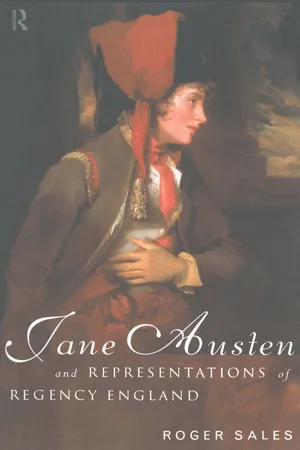
- 306 pages
- English
- ePUB (mobile friendly)
- Available on iOS & Android
eBook - ePub
Jane Austen and Representations of Regency England
About this book
Information
The Regency reproduced
1 Rewriting the Regency
FLEAS, NAKED CUPIDS AND BAD BREATH
Henrietta Keddie was an extremely prolific professional writer from Scotland who published under the name of Sarah Tytler. Her book on Austen, Jane Austen and Her Works, came out in 1880. The problem that she encountered when writing it is one which, in less exaggerated form, has beset many later writers. The only full version of Austen’s life that was in circulation when she wrote the more purely biographical parts of her book was one that was, in accordance with Victorian conventions, carefully policed by Austen’s family. Her difficulty was that she heard some voices in Austen’s novels and letters which she was politely, but firmly, told did not exist.
Austen’s brother, Henry, had published his ‘Biographical Notice’ in 1818 in the posthumous first edition of Northanger Abbey and Persuasion. It was a short, elegantly written account that emphasised his sister’s domesticity and piety. Any anxieties that might have been felt about the satirical nature of her writings were meant to be calmed by reassurances that, almost faultless herself, ‘she always sought in the fault of others, something to excuse, to forgive or forget’ (P, p. 31). Henry also gave his own impression of some of the Regency qualities of his sister’s writing when he drew attention to their charm, polish and finish. Austen’s nephew, the Reverend James Edward Austen-Leigh, continued to emphasise her domestic virtues in his much more substantial biographical notice, Memoir of Jane Austen, which was first published in 1870. Its popularity led to a second edition the following year and can be seen as launching the Austen industry.
Tytler certainly follows some of the guidelines that had been set out for her by Austen’s brother and nephew. She too represents Austen as a person who was content to be everything to her family and nothing to the world. She echoes Austen-Leigh’s praise for his aunt’s sewing:
She sewed and embroidered, as she did everything else, with exquisite finish. She was great in satin-stitch. She spent much of her time in sewing—not being above making her own clothes, as well as those of the poor.1
There are times, however, when this picture of domestic perfection is at odds with her own reading of the novels and the limited range of letters that were available to her. She finds a different kind of writer: proud, intolerant, impatient and cynical. She pictures Austen as being a ‘brilliant, rather hard girl’ and is sometimes unable to reconcile this view with the image of quiet docility that had been carefully cultivated by the family:
It would have been little short of a miracle if she could have conducted herself with such meekness, in her remote rural world, or during the visits she paid to the great English watering-place—while she was all the time laughing in her sleeve—so as not to provoke any suspicion of her satire, or any resentment of what might easily be held her presumption.2
The watering place referred to here is Bath. Tytler is unable at this particular point in her argument to make an act of faith and accept the gospel preached by Austen’s family. Meek and mild Austen becomes, albeit momentarily, satirical and presumptuous Austen.
One of the most disconcerting things about Austen-Leigh’s Memoir is that it actually provides a lot of the evidence that challenges his own cosy account of his sainted aunt. He quotes her businesslike correspondence over the dedication of Emma to the Prince Regent and yet still asserts that she was an unpresumptuous writer who only wrote to amuse herself and her family. He introduces extracts from Sanditon, an unfinished text that satirises the Regency culture of invalidism, while claiming that its author never meddled with medicine in her novels. He produces for the first time the whole of Lady Susan, an epistolary novella, without appearing to be at all troubled by the way in which its heroine might turn literary and social conventions upside down. Lady Susan Vernon is a powerful widow who enjoys having dominion over others. She achieves this by wearing one countenance, or face, in public while plotting in private to manipulate and manoeuvre everybody to her own advantage. As Patricia Meyer Spacks notes, she only uses fashionable theories about how women ought to conduct themselves as a mask.3 She does not expect men to be constant and demands the same privilege. She has no time for maternal feelings and her daughter, Frederica, is by turns sent away, confined and bullied. Although events do not go entirely according to her plans, she is not severely punished for all her disruptive finesses and masquerades.
Austen-Leigh does not register the subversive qualities of Lady Susan itself, although he raises the question of his aunt’s satire at a more general level. He reflects upon her dealings with her neighbours who, in his version of realism, are destined to become her characters:
She was as far as possible from being censorious or satirical. She never abused them or quizzed them—that was the word of the day; an ugly word, now obsolete; and the ugly practice which it expressed is much less prevalent now than it was then.
(M, p. 93)
A ‘quizz’ was either an eccentric person or an outlandish object. The habit of ‘quizzing’, perfected by both Regency dandies and high society hostesses, involved staring at people in a haughty way that was meant to make them feel utterly ridiculous. The repetition of ‘ugly’ in relation to a custom particularly associated with the Regency period hints that, behind the seemingly calm and emphatic reassurances to the contrary, Austen-Leigh may still have been worried by the possibility that his aunt had been infected by some of the practices of her age.
It can be argued that Austen-Leigh tries to allay such anxieties about his aunt’s Regency associations by transforming her into a Victorian proper lady. As Margaret Kirkham suggests, this can be clearly demonstrated by contrasting Cassandra Austen’s portrait of her sister with the one commissioned by Austen-Leigh for the Memoir. Although this second portrait is inspired by the earlier one, both the look and the colour scheme are much softer and smoother. Kirkham argues that what she calls the ‘received biography’ came into existence as an attempt to dissociate Austen from the kind of controversy that surrounded Mary Wollstonecraft’s writings after her death in 1797 and the publication of William Godwin’s biographical memoir in the following year.4 Jan Fergus draws attention to the ambiguous cultural status of most women writers at this time as a way of explaining, more generally, why Austen’s brother and nephew were so keen to deny that she had any professional aspirations as a writer. Only women who self-consciously presented themselves to the reading public as deserving cases for charity were authorised to write for money.5
Austen-Leigh’s written text offers a more complicated relationship between Victorian and Regency values than is apparent in his visual text. At one level, he nostalgically evokes a world that has been lost. The Victorian home is represented as being cluttered with furniture, technology and servants. It is contrasted with fond memories of simpler, more functional Regency interiors. The opposition to technology runs throughout the text. One of the reasons why Austen’s sewing is praised is because it is remembered as being almost as good as that produced by machines. Deborah Kaplan identifies an ‘antiquarian sensibility’ that pervades Austen-Leigh’s recollections.6 He paints a highly romanticised picture of cottage industries such as spinning, which are presented as having become the victims of industrialisation. This pastoral perspective is nevertheless at odds with the way in which he also declares his distaste for the Regency period and its ugly practices. This more critical perspective surfaces in relation to religion. It is claimed that neither Edmund Bertram in Mansfield Park nor Henry Tilney in Northanger Abbey ‘had adequate ideas of the duties of a parish minister’ (M, p. 154). This surprising judgement on Edmund is based on the conviction that he belonged to a world that was as yet still untouched by the religious revivals, High Church as well as Evangelical, that had shaped Victorian beliefs.
Austen-Leigh does not in fact reposition Austen by placing her in a Victorian home. He confines her to a Regency one, which he does his best to reassure readers was largely free from the coarseness that was still prevalent in this period. The closeness of her confinement obviously needs to be related as Fergus suggests to male anxieties about the status of the woman writer but, more specifically, it is part of Austen-Leigh’s attempt to protect her from the contaminating effects of Regency society. He almost hermetically seals her off from it. His version of realism is also designed to protect her from any accusations that she might really have been part of this ugly, coarse society: These writings are like photographs, in which no feature is softened; no ideal expression is introduced, all is the unadorned reflection of the natural object…’ (M, p. 153). Anything that is felt to be less than perfect in her writings can only be attributed to the imperfections of her period.
The Memoir voices some prejudices against Regency values, while leaving others unspoken. A sense of what really troubled Austen-Leigh about his aunt and her writings can be obtained by considering some of the silent alterations he made to them. It is only necessary to look briefly at three of the letters printed in chapter six to become familiar with the basic techniques that were employed in constructing the mythology. The chapter ends by appearing to quote the whole of a letter written by Austen to her sister Cassandra and dated 2 March 1814. It describes the last stage of a journey to London with Henry. Omissions nevertheless include: a level-headed description of financial transactions; the hope that somebody would not be ‘cruel enough to consent’ (L, p. 378) to an invitation to dinner and an inquiry as to whether Cassandra has had time to discover if there is anybody who is more boring than a certain Sarah Mitchell. Austen-Leigh is not just denying his aunt’s rationality and playfulness, but is also concerned to cover up what he takes to be her Regency coarseness. The full text should read: ‘Give my love to little Cassandra! I hope she found my Bed comfortable last night and has not filled it with fleas’ (L, p. 378). The Memoir removes the reference to the fleas.
A similar pattern emerges when the two versions of the preceding letter are briefly considered. This one, which also describes a journey to London with Henry, is dated 20 May 1813. Omissions include: Austen complaining to a tradesman about the quality of some currant bushes that had been purchased earlier; the fact that it was Henry rather than she who was fatigued by the journey; and some confidently given advice for one of her other brothers on the best roads to travel when coming to London. The editing denies her strength, both of purpose and of physique, as well as not allowing her to display knowledge of the world beyond home. The letter ends with an account of a call on Charlotte Craven, who was at school in London:
I was shewn upstairs into a drawing-room, where she came to me, and the appearance of the room so totally unschool-like, amused me very much; it was full of all the modern elegancies—& if it had not been for some naked Cupids over the Mantlepiece, which must be a fine study for Girls, one should never have smelt instruction.
(L, pp. 308–9)
The ‘naked Cupids’, together with the playful remarks about their educational role, are silently removed from the version of the letter that appears in the Memoir.
The final letter to be considered shows that Austen-Leigh was not just an editor who suppressed examples of what he considered to be Regency coarseness. He was also actively engaged in re-arranging his aunt’s writings. The letter that he purports to be printing is one that is dated 9 February 1813. His text starts with a heavily edited version of this particular letter and then material from an earlier one, dated 24 January 1813, is spliced into it. It continues to move freely between these two original Austen texts. This is an attempt to manufacture a letter that sticks as far as possible to a single theme, namely books. References to the writing, reading, publishing, discussing and lending of books are culled from the two original letters and then arranged in such a way that the ‘forgery’ passes for the genuine article. Austen-Leigh shows that he is worried that his aunt’s letters will be seen as being too gossipy and discursive. He believes, like Henry Tilney, that women’s letters do not contain enough full stops. He therefore imposes his own masculine definition of order and theme on what he takes to be the chaos of her writing.
Austen’s great-nephew, Lord Brabourne, consolidated the ‘received biography’ when he published two volumes of Letters of Jane Austen in 1884, dedicating them to Queen Victoria. The Dedication acknowledges the existence of ‘a very few omissions which appeared obviously desirable’ before going on to hope that the letters would ‘interest or amuse your Majesty’ (B, 1, p. v). Brabourne continues the praise for Austen’s domestic virtues: ‘In truth, the chief beauty of Jane Austen’s life really consisted in its being uneventful: it was emphatically a home life, and she the light and blessing of a home circle’ (B, 1, p. 5). Over-emphasis characterises his style. His purpose, as a member of the family, is to share his inside information with readers so that they can ‘feel at home’ (B, 1, p. 6) with the people who are discussed in the letters. He tells a few genial, clubland anecdotes which might have put a few readers at their ease. His antiquarian parade of the minute details of local and family history nevertheless has the effect of making Austen’s letters seem to be both difficult and remote. Mrs Humphrey Ward found the opening chapters ‘ponderous’ as they were full of ‘endless strings of names’.7
Brabourne, like Austen-Leigh, confronts the issue of satire by asserting that, if there are traces of it, then they must be essentially good-natured because his great-aunt was that kind of person:
Indeed, it should always be borne in mind during the perusal of these letters that, although, as I have before pointed out, a vein of good-natured satire might generally be found, alike in the letters and conversations of many of the Austen family, it always was good natured, and no malice ever lurked beneath. No one, I imagine, was in reality ever more kind-hearted and considerate of the feelings of others than Jane Austen, and certainly no one was ever better loved or more sorrowfully lamented by the relations whom she left behind her.
(B, 1, p.47)
The repetition of emphatic words such as ‘always’ and ‘ever’ is designed to suppress any opposition. Brabourne has more doubts about the spiritual messages of the writing. He admits that he is not able to consider the novels as being specifically ‘religious’ ones and yet is still confident that they can be read without too much harm. This is because:
There is a purity of thought as well as of style, an undercurrent of refinement, and an imperceptible suggestion of good which have not improbably had more salutary effects than any ‘religious’ novels that have ever been written.
(B, 1, p. 110)
An emphatic, patrician style is being used once again to close down discussion.
Brabourne can only maintain this image of the essentially ‘good-natured’ tone of the letters by tampering with the evidence. He plays down the conflicts that existed within Austen’s family by removing the passages that contained criticisms of particular individuals such as James Austen and Mrs Knight. He is generally squeamish over anatomical details and more specifically removes some of Austen’s angry comments on the way in which women were forced to breed incessantly. He is, like Austen-Leigh, troubled by Regency coarseness and edits out what he takes to be its worst excesses. Lady Susan O’Brien commented in 1818 on the way in which Regency frankness was already being replaced by a more euphemistic language:
No one can say ‘breeding’ or ‘with child’ or ‘lying in’, without being thought indelicate. ‘In the family way’ & ‘confinement’ have taken their place. ‘Cholic’ & ‘bowels’ are exploded words. ‘Stomach’ signifies everything.8
Brabourne imposes his own sense of delicacy on the letters.
Two examples will be sufficient to suggest the more general anxieties that Brabourne had, in private, about the coarseness of the letters. They both come from a letter dated 20 November 1800 where Austen provides Cassandra with an account of a ball at...
Table of contents
- Cover Page
- Half Title Page
- Title Page
- Copyright Page
- Dedication
- Contents
- Acknowledgements
- Textual note
- Introduction
- Part I The Regency reproduced
- Part II The Regency rediscovered
- Part III The political condition of Regency England
- Part IV The sick society Leisure and invalidism in the later writings
- Appendix: The plot of Lovers’ Vows
- Afterword: Austenmania
- Notes
- Select bibliography
- Index
Trusted by 375,005 students
Access to over 1.5 million titles for a fair monthly price.
Study more efficiently using our study tools.
Frequently asked questions
Yes, you can cancel anytime from the Subscription tab in your account settings on the Perlego website. Your subscription will stay active until the end of your current billing period. Learn how to cancel your subscription
No, books cannot be downloaded as external files, such as PDFs, for use outside of Perlego. However, you can download books within the Perlego app for offline reading on mobile or tablet. Learn how to download books offline
Perlego offers two plans: Essential and Complete
- Essential is ideal for learners and professionals who enjoy exploring a wide range of subjects. Access the Essential Library with 800,000+ trusted titles and best-sellers across business, personal growth, and the humanities. Includes unlimited reading time and Standard Read Aloud voice.
- Complete: Perfect for advanced learners and researchers needing full, unrestricted access. Unlock 1.5M+ books across hundreds of subjects, including academic and specialized titles. The Complete Plan also includes advanced features like Premium Read Aloud and Research Assistant.
We are an online textbook subscription service, where you can get access to an entire online library for less than the price of a single book per month. With over 1.5 million books across 990+ topics, we’ve got you covered! Learn about our mission
Look out for the read-aloud symbol on your next book to see if you can listen to it. The read-aloud tool reads text aloud for you, highlighting the text as it is being read. You can pause it, speed it up and slow it down. Learn more about Read Aloud
Yes! You can use the Perlego app on both iOS and Android devices to read anytime, anywhere — even offline. Perfect for commutes or when you’re on the go.
Please note we cannot support devices running on iOS 13 and Android 7 or earlier. Learn more about using the app
Please note we cannot support devices running on iOS 13 and Android 7 or earlier. Learn more about using the app
Yes, you can access Jane Austen and Representations of Regency England by Roger Sales in PDF and/or ePUB format, as well as other popular books in Literature & English Literary Criticism. We have over 1.5 million books available in our catalogue for you to explore.