![]()
The changing world in which we live
Dawn Forman
In this fast-paced, complex and ever competitive world people need different and more individualised ways of supporting their needs and helping organisations change and adapt to the increasing pressures and constraints. As such, many organisations are incorporating coaching as a key to helping their employees to both grow and develop new ways of working and to help them, as individuals and collectively in organizations as a whole, to cope with the considerable changes which are impacting upon them. In order to better understand why this may be the case we need to understand the factors affecting organisations and the changes in leadership which are being demanded.
Environmental influences
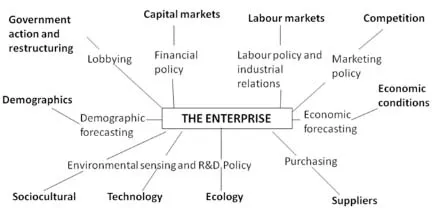
When organisations embark on strategic planning to position themselves for the future they often undertake an environmental analysis, which takes into account a whole variety of factors that could impact on the organisation to a greater or lesser extent. This is often known as a PEST analysis, as Political, Economic, Social and Technological influences are reviewed. Johnson, Scholes and Whittington (2006) take this a stage further by listing a range of wider environmental considerations, as shown in the adapted diagram (Figure 1.1).
Many organisations undertaking this review in current times indicate that prospects look pretty bleak. Indeed, the present climate has been described as a ‘perfect storm’ or
Figure 1.1 Examples of environmental influences (adapted from Johnson, Scholes and Whittington (2006)
considerable ‘climate change’, as there are a number of critical factors occurring at the same time.
With a perfect storm, the view would be that this difficult time will soon pass and we will then be able to return to our ‘normal’ way of working. This supposes that there is a ‘normal way of working’; however, even in less extreme times different individuals and external factors must always be considered and adapted to. The impact of the changes we are currently facing, however, is more far-reaching and we may never be able to return to what we used to describe as ‘normal’. Hence the term which will be used here is ‘significantclimate change’ rather than ‘a perfect storm’.
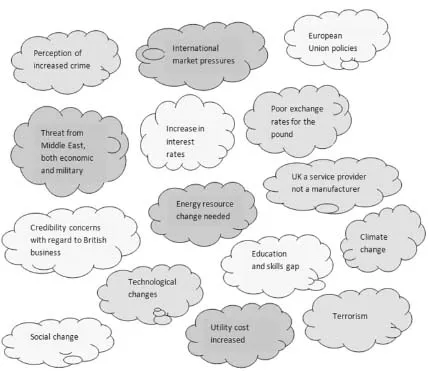
If we undertake what is traditionally known as a PEST or environmental analysis there are a number of challenging components that we can see need to be taken into account to a greater or lesser extent, depending on the particular context of the organisation. These are summarised in Figure 1.2
The number of clouds indicates the factors which need to be taken into account and therefore the considerable change environment in which all organisations within the UK are now working.
This can be seen as a very bleak prospect for organisations, and particularly the leaders of organisations, as they cope with a considerable downturn in the economy, and indeed in their business, with little prospect of the growth
Figure 1.2 Perfect storm or climate change
that they may have been used to over the past decade. Many leaders are not equipped with the skills to cope with this change in direction and are either having to re-skill or rethink their futures.
This in itself has caused an increase in the number of leaders who are now seeking to redevelop themselves through leadership programmes or, working with a coach to help them, through structured space and time to cope with and adapt to the change. Executive coaching has, therefore, seen an increase within this economic climate, either in helping leaders with the change they are personally undergoing, for instance if they are leaving their current post to retire or to take on a different post in a different organisation, or in helping leaders develop opportunities for themselves and their organisation in this climate of change.
In addition to looking at the focus for leaders, leaders in turn need to consider how the managers within their organizations are also coping with this considerable change. Again, coaching can provide an opportunity for those leaders and managers to reconsider their future, consider the alignment of their aspirations with those of the organisation, realize opportunities and build appropriate strategies to deal with the new needs and demands.
Transformational leadership
If organisations are to survive and thrive in this climate new skills need to be embedded, with the need for transformational rather than transactional capability. In this we have seen a resurgence of some old philosophies in terms of leadership skills and some emerging leadership philosophies. Perhaps the best-known authority with regard to the transformational change now being required of our organizations is Bass (1999). Bass identified four components for transformational leadership:
•Idealised leadership The ability to set a direction and articulate a vision providing a compelling and coherent view of the future.
•Inspirational motivation Providing a role model inspiring respect, trust, loyalty and confidence and igniting passion, pace and drive.
•Intellectual stimulation Providing stretching aspirations and targets for staff, encouraging them to think through problems and find solutions and alternative ways of working.
•Individualised consideration Treating everyone with respect and recognising differences in abilities, motivations and aspirations.
If we think of great leaders, those that have achieved transformational change, a name which is often brought to mind is Nelson Mandela.
Nelson Mandela is best known for his fight against apartheid, but when he emerged from prison and became president of South Africa he faced a different challenge in terms of his leadership skills. He needed to unite the country and ensure black and white worked together to make the country economically viable as a nation.
One tactic he used in creating a vision and inspiring motivation was to provide an achievable but stretching objective with a shared goal (Case Study 1.1; Carlin, 2007). Recognising how individual aspirations could be harnessed in order to achieve, he used a concept that the whole country would own. This was the challenge he gave to host the Rugby World Cup, believing in what it would bring in practice and also what it would symbolise as a way of coming together across the country and the black and white divide.
Case Study 1.1 How Nelson Mandela won the Rugby World Cup
It was a Herculean political challenge but in the Rugby World Cup, to be played in South Africa a year after he came to power, Mandela saw an opportunity not to be missed.
The African National Congress had spent years using rugby as a stick with which to beat white people (talk to any prominent Afrikaner from those days and they will tell you how much the international rugby boycott hurt). Mandela said: ‘Why not use it now as a carrot? Why not use the Springbok team to unite the most divided nation on earth around a common goal?’
So, barely a month after he had taken office, he invited François Pienaar, the Springbok captain, for tea at his office in Pretoria. He wooed him instantly: ‘I felt like a wide-eyed kid listening to an old man telling stories’, Pienaar told me, and without the big blond son of apartheid quite knowing it yet, Mandela recruited him to the new South Africa cause.
Mandela's challenges not only lay on the white side of the apartheid fence. He had to do some tough political persuasion among his own black supporters too.They had been brought up to detest rugby. Next to the old anthem and the old flag, there existed no more repellent symbol of apartheid than the green Springbok shirt. That was why the blacks-only pens at rugby stadiums were always full on international match days, cheering the Springboks' opponents.
But Mandela set himself the mission of converting black South Africans to the perplexing notion that the ‘Boks belonged to all of us now’, as he put it to me. And this even though he knew that the team for the 1995 World Cup would be all white, with the possible exception of a ‘coloured’ wing called Chester Williams.
‘They booed me!’, Mandela recalled, chuckling only long after the event.‘My own people, they booed me when I stood before them, urging them to support the Springboks!’ But eventually, Mandela being a natural-born persuader and black South Africans an amazingly forgiving lot, he achieved his goal. Come the morning of the final, on 24 June 1995, black South Africans were as excited as their white compatriots, and as desperate to see the Amabokoboko (as the Sowetan newspaper dubbed the national team) win.
Pienaar and company deserved much of the credit for this. The clever, politically sharp CEO of the South African Rugby Union, Edward Griffiths, had come up with a slogan that was brilliant in its simplicity:‘One team, one country’.
Morné du Plessis, a former Springbok captain and now team manager, had worked hard to make the players see that they had a role to play in helping Mandela unite the country. It was du Plessis who arranged for the players to learn the old song of black resistance, now the new national anthem, Nkosi Sikelel' iAfrika (‘God Bless Africa’).At a choir session in Cape Town, the Springbok players belted out the black song with feeling, the vast second-row Boer Kobus Wiese leading the choral charge.
As the World Cup unfolded, following a great inaugural victory by South Africa over Australia, the players, as well as the white fans, were struck by the growing enthusiasm of the hitherto rugby-illiterate black population. The sight of those vast Boers singing their song at the start of each game and then winning it was a combination increasingly difficult for black South Africans to resist.This in turn nourished the Afrikaners' budding sense of new South African fellow feeling.
Mandela's coup de grâce, which ensured the final submission of white South Africa to his charms, came minutes before the final itself, when the old terrorist-in-chief went on to the pitch to shake hands with the players, dressed in the colours of the ancient enemy — the green Springbok shirt. For a moment, Ellis Park Stadium, 95 per cent white on the day, stood in dumb, disbelieving silence.Then someone took up a cry that others followed, ending in a thunderin...