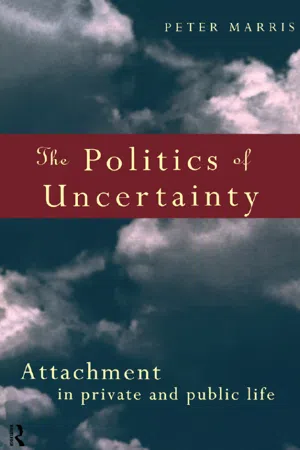
In The Politics of Uncertainty Peter Marris examines one of the most crucial and least studied aspects of social relationships: how we manage uncertainty, from the child's struggle for secure attachment to the competitive strategies of multinational corporations. Using a powerful synthesis of social and psychological theory, he shows how strategies of competition interact with the individual's sense of personal agency to place the heaviest burden of uncertainty on those with the fewest social and economic resources. He argues that these strategies maximize uncertainty for everyone by undermining the reciprocity essential to successful economic and social relationships.
At a time when global economic reorganisation is undermining security of employment, The Politics of Uncertainty makes a convincing case for strategies of co-operation at both personal and political levels to ensure our economic and social survival in the twenty-first century.
- 208 pages
- English
- ePUB (mobile friendly)
- Available on iOS & Android
eBook - ePub
About this book
Information
Part I
Meaning, attachment, and predictability
Chapter 1
The uncertainties of everyday life
We deal with uncertainties every day of our lives. They range from inconsequential questions, such as ‘Should I take a rain-coat?’ to questions which may be deeply troubling: ‘Will the plant close?’ ‘What will the biopsy show?’ Some will resolve themselves in hours or days, while others—like the ambivalence at the heart of a relationship—may never be resolved. All of them, trivial or profound, brief or unending, require us to act when we cannot predict what the outcome will be: and this is always uncomfortable.
Most of what we do and think about has, for its context, a future for which we are preparing—laying plans, foreseeing dangers, setting purposes. All this activity presupposes that what we do now will make a difference, perhaps a vital difference, to our well-being later. So it is bothersome, often worrying and sometimes acutely distressing to have to choose our actions when we are unsure what will help or harm us, or simply waste our energies. Even if it does not matter much, whether one takes a raincoat or not, there is still a decision to be made, an action to be taken, that will turn out to have been right or wrong. And even if, in a sense, there is nothing someone can do but wait for the results of a biopsy, in the intervening days he or she may feel impelled to confront the possibility of ill health, pain, even death, because that mental preparation is a vital defence against being overwhelmed and disabled by the grief of losing the future in which so many plans and hopes had been invested. How we conceive our power to influence the course of events varies from person to person, from situation to situation and from one culture to another. But so long as we believe that what we do now can influence what is going to happen or how we cope with it, uncertainty is always troubling: and a large part of the way we deal with life is concerned with getting the better of that trouble.
Because uncertainty so often arises from not knowing enough to predict what will happen, searching for more information or deeper understanding is one of the most powerful ways of containing it. But where to look, and what to look for, will be determined by a complex interweaving of cultural and personal assumptions. Questions of fact may turn into questions about the authority that certifies facts; choosing can lead to questions about the motives for making a choice. We may be uncertain about the natural world, or the behaviour of other people, their feelings and intentions, or uncertain about our own feelings and intentions: and these uncertainties interact with each other, so that our strategies for containing them may shift back and forth, within the framework of constantly evolving assumptions about ourselves, the people around us and the world in which we live.
Consider the kinds of uncertainty someone might encounter in the course of a day. First, there are the uncertainties, like choosing between healthy and unhealthy foods in the supermarket, where we may use public knowledge to decide. We can read the information printed on the labels, and although we may not understand all its implications, it provides a basis for resolving our uncertainty, because we can set this information in a context of knowledge about nutrition and health. We set it, too, in a context of assumptions about the way law and government enforcement will have ensured that the information is true. So even this simple question of choice, trivial enough in itself, calls up at least two highly elaborated systems of knowledge, about how the human body works and how government regulates commerce, which are vital to the way we conceive and trust in the predictability of life.
But this kind of knowledge is often mediated by, and resonates with other more personal systems of knowledge. Suppose I am concerned with someone who is sick, and for whose care I feel responsible. The same kind of knowledge of the human body and the regulation of medical practice still underlies how I interpret what I learn about the sickness and its possible outcomes. But now I may also wonder, ‘How competent are the doctors?’ and all my own experience of being medically treated begins to shade my judgement. Or I wonder, ‘How reliable is the sick person’s own report?’ and my sense of them as characteristically stoical or complaining, anxious or calm, begins to affect how I interpret the situation. At the same time, I am also wondering how the outcome may affect my own life, calling into question my plans and testing my sense of responsibility. With that may come anger, irritation, or guilt, bringing up unresolved tensions in our relationship. Coping with the uncertainties of sickness involves ambiguities of feelings and relationships, as well as all the uncertainties of medical knowledge and practice, and each will react upon the others.
Then there are the uncertainties of intimate relationships: the unresponsiveness of a lover, the irritability of a child or the coldness of a friend, when a familiar pattern of interaction is unexpectedly broken. Here, too, public knowledge may sometimes help, as therapy or advice, but the kind of knowledge we bring to them is characteristically far more personal and interactive. We try to bring the relationship back into a predictable pattern, asking for or giving reassurance, offering rewards or punishments, using strategies we began to learn in our infancy, some of them so ingrained, so routinized and unselfconscious that we rarely examine them. These techniques represent what will be seen as part of our personality—a predictable pattern of response—but they are essentially a kind of knowledge, interacting with all the other kinds of knowledge which make up our struggle to overcome uncertainty. When they fail us, we may be overwhelmed by anxiety, paralysed by indecision or fear, scarcely able to leave the house or get out of bed, and our condition may be labelled agoraphobia or depression—a disease of the mind. But the uncertainties are none the less real, and our ability to cope with them depends as much on our circumstances as on the resilience of our personality.
The anxieties of everyday life stem from the social constructions into which we have to fit as fundamentally as from the way we perceive and understand events, and each reacts upon the other. Taking care of someone’s health very likely will involve a series of specialists, organized in a hierarchy, each involving tests, reports, technical information. The power of the system to treat and reassure depends on this highly differentiated, intellectually specialized strategy for resolving uncertainties, adding its own burden— indeterminate waits for appointment or treatment, inadequate, hard to interpret or seemingly evasive information, and breakdowns in co-ordination. Its expertness implies a corresponding yielding of control which can leave the patient feeling frighteningly dependent—in the hands of strangers, not knowing what is going on, scarcely confident even of the right to ask.
We tend to interpret the uncertainties of everyday life in terms of our self-doubts, rather than the social structures which condition them. We imagine that if we were cleverer, more educated, less shy, or more attractive, we would be as secure and confident as other people appear to be; and because each of us is hiding this sense of personal inadequacy, we are slow to discover how pervasively our culture induces these feelings. So, for instance, many women bringing up children in a big city, in a social class where husbands are not used to being emotionally intimate, are overwhelmed by feelings of helplessness and despair when things go wrong; but each will probably believe that this is her personal failing, her ‘depression’—for which her doctor may be treating her— unaware of how common her experience is.1 This tendency to blame oneself for the world’s ills is itself a strategy for mastering uncertainty. To change one’s own behaviour, to learn to fit in better, is less daunting and more immediately practical than to reform the structure of social relationships: and to mistrust oneself is less frightening than to see clearly how dangerously untrustworthy the societies we inhabit may be.
Consider now a chain of events that could have been told thousands of times over, in one form or another, this past decade. One Friday, a middle-aged worker picks up a letter with his pay cheque. The letter informs him that the plant in which he has worked for the past eighteen years—the plant which for sixty years has been the reason for the town in which he lives—will be closing indefinitely in a month’s time. In that moment, all the rumours and false hopes of the past few months gather into a hard knot of fear which he can feel in his stomach. In four weeks he will be out of a job—the job which has defined his friends, his neighbourhood, the value of his experience and his position amongst his peers for so long that he has forgotten how to think of himself in any other terms.
In the months which follow he will write many letters, attend many interviews, go to counselling sessions and group meetings. He will set out with the understanding that neither he nor his workmates are to blame for their situation. He is intelligent, healthy and reliable, willing to turn his hand to new kinds of work. But as time goes by he begins to realize that at fifty-two, in the depressed economy of his home town, he is not of interest to employers. He could move to another part of the country, but what about his wife’s job—the only income they now have – and the daunting cost of a home in a more prosperous region? What happens next depends on family support, the jobs available, savings, mortgages, ill health or accidents, the confidence or discouragement he has grown into. He may find another job, less well-paid, probably, and make the best of it, more cynical now and less trusting of the future; or scrape by on intermittent work, unemployment benefit, other household income, adapting to continual insecurity as best he can. For some men the strain will bring about bitterness and self-blame, heavy drinking or impotence, and the break up of their marriage.2 And there are chains of circumstance which lead to the most acute loss of security of all: homelessness.
‘Well, for me it started when I lost my job’, recalls a man interviewed in a recent American study of homeless people.
I was working for a realty company as an assistant manager, and they sold the building. They fired everyone who was working for the company, and I was out of work…. I drew my unemployment, had odd jobs in between time. And then [my wife] lost her job because she became pregnant, and it’s just been a continuous downhill run for us. We depleted our savings. Then we had to move out of the apartment because the new management wanted to renovate, so everyone was given eviction notices. And things just kind of went sour all at once…. So what we tried to do was move in with some other people, and that was the biggest mistake I ever made…. I’ve tried it with three different friends, and none of them worked.3
First the job goes, then the savings go,‘Then’, as a woman interviewed in the same study put it, ‘just a chain of circumstances. I broke my leg…the car broke down…the one [child] that was 22; got involved in drugs…. And we got an eviction notice, naturally….’4 Once one is homeless, the situation is hard to retrieve. Without a network of friends, a system of support, even a patch of ground on which to rest and store belongings, life shrinks to an endless wandering in search of bare necessities—warmth, water, food, a place to defecate. ‘One of the basic fundamentals of life is having a roof over your head, no matter what. So there’s panic and fear, a sense of disbelief. It just doesn’t seem possible, yet there you are dealing with it. A nightmare!’5
Most people who lose their jobs do not suffer such an extreme disintegration of their place in society. But these accounts illustrate, by their accumulation of misfortunes, a process which is fundamental to the management of uncertainty: the use of power and resources to displace the costs of uncertainties onto others weaker than oneself. Some homeless people may be addicted, or mentally ill, but that does not explain their situation: most addicts or mentally afflicted are not abandoned to the streets.6 What happens to the homeless does not stem primarily from their own failure to deal with misfortune, but from the strategies of others more powerful. Employers respond to the uncertainties of a changing economy by a radical restructuring of production. To minimize protests and disruptions which might interfere with their plans, they give their workers the least possible notice of their intentions. Banks and landlords protect their investment in the housing market by demands which progressively exclude those without reliable resources. Even social agencies and shelters may ultimately reject them, to protect themselves from being overwhelmed by the crushing burden of accumulated helplessness they represent. In a larger sense, society as a whole protects itself from the deeply troubling insecurities realized in their fate. They belong nowhere, and no one accepts responsibility for what becomes of them. Their existence itself can be challenged, because their number has no certainty. They have virtually no right to be anywhere. In thought as well as practice, the cumulative effect of the way employers, housing providers, agents of social services, town governments, even friends and former spouses deal with uncertainty marginalizes the most vulnerable, excluding them from the resources that might enable them, in thought as well as practice, to recover their place.
The fate of the homeless is a dramatically visible outcome of a process which pervades society. All our actions depend on reducing uncertainty to a residue of unknowns within a context of predictable relationships, so that we can find ways to evade, resolve or plan contingently around whatever remains unsure. As we evolve these strategies of containment, individually and in the organizations of which we are part, we both compete and collaborate. So we create for each other the conditions in which everyone must find a sense of their own power and freedom sufficient to make life seem manageable. The most intimate, personal understandings which guide our actions, and the strategies of governments and international agencies, are connected through this chain of constraints and freedoms, rationalizations and projections, evasions and exclusions which determine where the burdens of uncertainty will come to rest.
The chapters which follow set out, then, to explore how we manage uncertainty, from its most personal aspects to issues of social policy, uncovering the way each level acts and reacts upon the others. The next three chapters outline the premises of the argument I want to make: first, that managing uncertainty crucially involves meanings; second, that meanings are more accessible, as the organizing elements of human life than the individual self; and third, that the meanings we make evolve largely out of the attachment relationship between parent and child. From this we can see how attachment and meaning inform our struggle to create an orderly and predictable world. The second part of the book is concerned with the way this struggle shapes, and is shaped by, the distribution of power.
Chapter 2
Uncertainty and the construction of meaning
The uncertainties against which we try to protect ourselves—such as illness, losing someone we love, being thrown out of work—seem to be in the nature of life: we try to understand them and take what precautions we can. But uncertainty is created by our own preconceptions, as well as given, because events only appear as uncertain in some context of purposes, and expectations of orderliness. What constitutes uncertainty depends on what we want to be able to predict, what we can predict, and what we might be able to do about it. A purely random event like the spin of a roulette wheel is passionately uncertain to the gambler, but predictable over the long run to the owner of the casino: while a disinterested observer might not even notice how the wheel spun. It is not just that we ignore uncertainties which are irrelevant; or that what is uncertain from one point of view becomes predictable from another. When events are entirely beyond our control we no longer face the responsibility of acting, with all its anxieties. We may then think of the outcome as our fate—something that was bound to happen because we could do nothing about it. Uncertainty depends on the possibilities of action as well as the meaning of events. As Mary Douglas and Aaron Wildavsky write,
Once the idea is accepted that people select their awareness of certain dangers to conform with a specific way of life, it follows that people who adhere to different forms of social organization are disposed to take (and avoid) different kinds of risk…. Questions about acceptable levels of risk can never be answered just by explaining how nature and technology interact. What needs to be explained is how people agree to ignore most of the potential dangers that surround them and interact so as to concentrate only on selected aspects.1
Consider earthquakes, for instance, as natural events whose dangerous uncertainty seems at first sight as real and independent of what we choose to make of them as anything could be. Yet as a newcomer to Los Angeles in the 1970s, where the probability of a major earthquake within the next twenty years was very high indeed, I was surprised to find that people scarcely thought about earthquakes at all, although an earthquake severe enough to cause local damage and loss of life had occurred only a few years before. There are codes intended to ensure that buildings will be earthquake proof, but many work or live in buildings which do not conform to them. There are precautions which everyone is advised to take, but they are little emphasized. The danger is ignored, I think, because so long as people cannot guess more exactly when or where earthquakes will happen, there does not seem to be much purpose in thinking about them.
Attempting to predict them has, too, very different consequences according to the society in which the prediction is made, because predictions can create their own uncertainties.
In western societies, studies on the unfavorable as well as the propitious consequences of prediction have been made. For example, if the time of a large damaging earthquake in California were accurately predicted a year or so ahead of time and continuously updated, casualties and even property damage resulting from the earthquake might be much reduced; but the communities in the meizoseismal region might suffer social disruption and decline in the local economy.2
What would become of the real estate market, business growth, jobs, if earthquakes were to be forecast? Predicting an earthquake could arguably cause more damage and deaths, from economic disruption and congested traffic, than the earthquake itself. A California seismologist put this dilemma to a group of colleagues: his data suggested an earthquake would occur in a particular town within the next day or two. Should he warn the mayor? If he did not, and there were a major earthquake, he would have it on his conscience that he might have saved injuries and even lives; if he did, and nothing happened, not only would he be professionally discredited, but he might even be sued by angry townsfolk for causing disruption and loss of business. He decided not to give any warning. Luckily for him, the earthquake happened, measurably enough to save his reputation and weakly enough to save his conscience.
In China, where school children are encouraged to look out for earthquake signs, the uncertainties are different. The houses are more fragile, but the effect of prediction on markets is not an issue. At least once, in February 1975, in the Manchurian province of Liaoning, an official earthquake warning saved many lives.
Most of the population had left their houses, big animals had been moved out of their stables, trucks and cars did not remain in their garages, important objects were not in their warehouses. Therefore, despite the collapse of most of the houses and structures during the big shock, losses of human and animal lives were greatly reduced. Within the most destructive area, in some portions more than 90 percent of the houses collapsed, but many agricultural production brigades did not suffer even a single casualty.3
In China, I suggest, earthquakes are a more conscious uncertainty than in California, because there are fewer inhibitions to making use of the very fallible methods of prediction available. Even the very destructive earthquake that struck Los Angeles in 1994 is unlikely to make earthquakes a more conscious part of the uncertainties of everyday life, as time passes, because the only way of responding actively to the threat (apart from some routine precautions, which most ignore) depends on prediction, and the risks of publicizing predictions are unacceptable.
We perceive uncertainty, then, in situations which lie between two extremes of determinacy. At one extreme, we are so confident of our predictions we no longer experience doubt at all; at the other, what will happen is so absolutely unpredictable it can only be treated fatalistically. Between this inevitability and this certainty, uncertainty evolves its meaning, in the context of understandings and possibilities of action by which it has been acknowledged.
We do not simply perceive uncertainties and try to deal with them. The way we understand the world, our purpose in it and our power to control our own destiny, leads us to them. The structures of meaning which make the world orderly and predictable also define the significant uncertainties—the events which are troubling to the structures themselves, and which these seek to master. To begin with, therefore, I want to trace the management of uncertainty through the behaviour of meanings, and I want to explore, particularly, two aspects of meanings. They have some of the properties of living organisms: although they could not survive apart from the human beings in which they are embodied, they are self-regulating systems. And meanings are not confined to the person who expresses them: they are socially as much as individually embodied.
‘Life is essentially auto regulation’, Jean Piaget has written.4 In biological terms, every living thing is a self-regulating organization, seeking to sustain itself in balance with its environment. It adapts by assimilating the environment and accommodating to it: it incorporates elements of its surroundings and in doing so, modifies its own organization. ‘All development is an organization and all organization a development.’5 Life is constantly changing so as to remain the same.
In Biology and Knowledge, from which I have drawn these principles of adaptation, Piaget describes the structure of thought as the distinctively human form of this selfregulative organization. Thought, like other capacities of...
Table of contents
- Cover Page
- The Politics of Uncertainty
- Title Page
- Copyright Page
- Preface
- Introduction
- Part I: Meaning, attachment, and predictability
- Part II: Controlling uncertainty
- Notes
Trusted by 375,005 students
Access to over 1.5 million titles for a fair monthly price.
Study more efficiently using our study tools.
Frequently asked questions
Yes, you can cancel anytime from the Subscription tab in your account settings on the Perlego website. Your subscription will stay active until the end of your current billing period. Learn how to cancel your subscription
No, books cannot be downloaded as external files, such as PDFs, for use outside of Perlego. However, you can download books within the Perlego app for offline reading on mobile or tablet. Learn how to download books offline
Perlego offers two plans: Essential and Complete
- Essential is ideal for learners and professionals who enjoy exploring a wide range of subjects. Access the Essential Library with 800,000+ trusted titles and best-sellers across business, personal growth, and the humanities. Includes unlimited reading time and Standard Read Aloud voice.
- Complete: Perfect for advanced learners and researchers needing full, unrestricted access. Unlock 1.5M+ books across hundreds of subjects, including academic and specialized titles. The Complete Plan also includes advanced features like Premium Read Aloud and Research Assistant.
We are an online textbook subscription service, where you can get access to an entire online library for less than the price of a single book per month. With over 1.5 million books across 990+ topics, we’ve got you covered! Learn about our mission
Look out for the read-aloud symbol on your next book to see if you can listen to it. The read-aloud tool reads text aloud for you, highlighting the text as it is being read. You can pause it, speed it up and slow it down. Learn more about Read Aloud
Yes! You can use the Perlego app on both iOS and Android devices to read anytime, anywhere — even offline. Perfect for commutes or when you’re on the go.
Please note we cannot support devices running on iOS 13 and Android 7 or earlier. Learn more about using the app
Please note we cannot support devices running on iOS 13 and Android 7 or earlier. Learn more about using the app
Yes, you can access The Politics of Uncertainty by Peter Marris in PDF and/or ePUB format, as well as other popular books in Social Sciences & History & Theory in Psychology. We have over 1.5 million books available in our catalogue for you to explore.