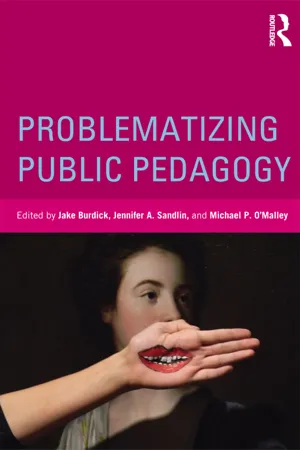
The term 'public pedagogy' is given a variety of definitions and meanings by those who employ it. It is often used without adequately explicating its meaning, its context, or its location within differing and contested articulations of the construct. Problematizing Public Pedagogy brings together renowned and emerging scholars in the field of education to provide a theoretical, methodological, ethical, and practical ground from which other scholars and activists can explore these forms of education. At the same time it increases the viability of the concept of public pedagogy itself. Beyond adding a multifaceted set of critical lenses to the genre of public pedagogy inquiry and theorizing, this volume adds nuance to the broader field of education research overall.
eBook - ePub
Problematizing Public Pedagogy
- 212 pages
- English
- ePUB (mobile friendly)
- Available on iOS & Android
eBook - ePub
Problematizing Public Pedagogy
About this book
Information
1
BREAKING WITHOUT FIXING
Inhabiting Aporia
Different kinds of questions imply different kinds of aporias.1 A question is the mediator between what we know and what we do not know; we need to know enough to know how to ask a question, but not know enough that the answer is interesting and important to us. A question resides in the space between knowledge and ignorance.
(Burbules, 2000, p. 183)
There are cracks in what we do. Our work, painstakingly developed and vociferously argued, has its dirty secrets, its threads that, once pulled, might lay bare all that we’ve forgotten, hidden, or failed to work through. As Springgay (this volume) writes, “it crumbles and is lost.” Our work is a trick of the academic light: bolstering publishing records and verifying findings so that our ideas can defy their own gravities and our very lives can be validated. Particularly within curriculum studies, a discipline that frequently locates itself on the knife’s edge of political relevance and budget considerations, there is a pervasive, naked desire to produce and to do so in short order. This is not to say that productivity is without merit. We simply want to say that breathless running in the dark courts harm. We write eloquent, finished prose about the Saidian amateur (Said, 1994), but we seldom perform this voice, enact this identity—at least not when others are looking. It is under these sentiments that we began work on this collection—the realization that, after editing, reading, writing, speaking, and embodying the work of public pedagogy for the past six years, we are comfortable to finally admit that we are amateurs. That is, we are ready to see how this genre of educational research cracks under the pressure of deliberative theorization, research, and enactment, and we are ready to reinvent our work to ensure that these fissures are openings to better work, better research, and ultimately better educational lives.
Garrison (2004) writes, “no one grows who would remain secure, no one grows without loss, and some will be slain. When we prune plants for their growth, we in fact injure them, sometimes fatally” (p. 94). And this is the situation in which we must work—in a moment within U.S. education that Pinar (2011) has compared to the portentous days before the rise of the Third Reich, committed educational researchers and scholars must find the capacity and the humility in their work to bend, to break, to surrender the comfort of the known, to be intellectually slain, if our ethical obligation is still entrenched in the possibility of a more just world. In short, we hope to problematize public pedagogy so that future research might maintain and expand the tremendous potential we feel the concept holds. Keeping with Garrison’s metaphor, it is our hope to find public pedagogy’s fecundity by culling its overgrown edges, and if we cannot, to accept that it was never truly alive in the first place.
Reading Public Pedagogy as a Fragile Text
Public pedagogy has been largely constructed as a concept focusing on various forms, processes, and sites of education and learning occurring beyond or outside of formal schooling. It involves learning in institutions such as museums, zoos, and libraries; in informal educational sites such as popular culture, media, commercial spaces, and the Internet; and through figures and sites of activism, including public intellectuals and grassroots social movements (Sandlin, O’Malley, & Burdick, 2011; Sandlin, Schultz, & Burdick, 2010). Public pedagogy theorizing and research has been largely undergirded by the contributions of cultural studies and aesthetic approaches to examining learning in the public sphere. As we have described in our prior writing, the literature emphasizes both the socially reproductive and the resistant dimensions of these various pedagogical sites. The term itself is given a variety of definitions and meanings by those who employ it, with educational scholars most frequently situating the pedagogical in feminist, critical, cultural, performative, and/or activist dimensions. Some strands of public pedagogy inquiry also seek to broaden and deinstitutionalize conceptualizations of teaching, learning, and curriculum across the discipline of education, even taking these criticisms to explore posthuman formations (see Burdick & Sandlin, 2013).
Scholarship focused on public pedagogy has proliferated in the past decade (Burdick & Sandlin, 2013; Sandlin, O’Malley, & Burdick, 2011). However, despite this influx of scholarship, this book was born of our consternation with the widespread practice of authors often citing the term without adequately explicating its meaning, context, or location within differing and contested articulations of the construct. This dynamic enhances conceptual confusion and prevents distinct theorizations from informing, extending, or challenging one another. We thus suggest that the term public pedagogy has been used in mythologizing and “totalizing” ways (Savage, 2010, p. 103), diminishing its usefulness as a sensitizing concept for researchers interested in learning and education outside of schools and recasting it as a fragile container meant to hold far too many ideas. To articulate public pedagogy as a construct capable of informing ongoing educational research, we feel that educational researchers should carefully specify the theoretical underpinnings of public pedagogy in any scholarship that deploys the concept; ought to explore definitional issues such as why this concept is called public pedagogy and not public curriculum, particularly in light of curriculum studies’ establishment as a field of research; should engage in more discussion of methodological and ethical issues in researching public pedagogy (Burdick & Sandlin, 2010); and should engage in more empirical research focusing on the process of public pedagogy (Burdick & Sandlin, 2013) and the experience of the learner (Sandlin, O’Malley, & Burdick, 2011).
Following the Burbules (2000) quote we used to open this chapter, this is the moment to ask new questions, ones that open the disquieting, yet productive, space of aporia—the intersection between meaning and unmeaning, of possibility (Ellsworth, 2005) that comes to us in the moment of intellectual, emotional, and moral discomfort (Boler, 1999). As such, we have structured this book along the three enactments of public pedagogy that remain balefully unquestioned in the literature: framing, exploring the problematics of public pedagogy’s definition, theorization, and historicity; studying, emphasizing the ways in which our research simultaneously illuminates and obfuscates the object of inquiry; and enacting, taking up the ways in which we view and engage with our own pedagogical acts outside of institutional spaces. Using these concepts as a loose architecture, we invited renowned and emerging scholars in the field of education to take up these issues, responding to a sequence of prompts we developed from our work on trying to understand public pedagogy (Burdick & Sandlin, 2013; Sandlin, O’Malley, & Burdick, 2011; Sandlin, Schultz, & Burdick, 2010). These prompts and the categories to which they respond, although certainly not exhaustively inclusive or mutually exclusive, underscore the fundamental issues we have found in the literature and discourse on public pedagogy. They are openings to questions, taken up by the authors herein, and hopefully extended to scholars interested in forwarding this work.
Furthermore, each of these sections is introduced and closed by images and writing that we have termed aporias. From its early use in classical Western philosophy and logic, an aporia signifies an expression of doubt or confusion, a moment of lostness, the discomfort, apprehension, and paralysis associated with not knowing (Burbules, 2000). However, the term is recovered by Derrida, who insists that the impossibility signaled by the aporetic state is actually a condition of radical possibility, one on which the systems of the possible fall apart and can be rethought from ontological ground. As Raffoul (2008) notes, for Derrida “an aporia will thus not be synonymous with closure but will instead represent a limit through which something announces itself in an affirmative fashion. The aporetic is affirmative, constitutive” (p. 272). From this point, Derrida constructs his understanding of ethics as impossible, yet as being the condition of its own existence—that the impossibility of responding fully ethically to the Other provides us the pathway to consider ethics in the first place. To this end he claims that “the impossibility of finding one’s way is the condition of ethics” (Derrida, as cited in Raffoul, 2008, p. 290)—a sentiment echoed in the work of Lather (2007). We install these aporetic moments within the text as a means of simultaneously inviting the possibility of our chapter authors’ work and contributions as well as suggesting that each of these contributions cannot completely fulfill the promise of either fully problematizing public pedagogy or proving a response to its troubled, fractured state. The goal of this text, as such, is the maintenance of instability as we push this work forward—the persistent knowledge that what we do is always already in deep need of revision, alongside the equally pressing need to continue anyhow.
Definitional Fractures: Framing Public Pedagogy
Within our reviews of the literature (Burdick & Sandlin, 2013; Sandlin, O’Malley, & Burdick, 2011), we found an overwhelming absence of definitive and/or clear understandings of the term public pedagogy, either in terms of theorizations or empirical accounts. We argue that
across the literature, authors frequently claim that a specific cultural item or process under investigation is a form or site of public pedagogy, yet many do so without the use of theoretical frameworks to describe how or why these pedagogies were being enacted. Scholars who are clear about their theoretical framings draw from a wide variety of theoretical work, including cultural studies, a/r/t/ography, post-colonialism, queer theory, and many others. (Sandlin, O’Malley, & Burdick, 2011, p. 359)
Within the literature, examples of clearly espoused and operationalized theoretical framings include Ellsworth’s (2005) operationalization of Winnicott’s theory of transitional space; Denzin’s (2003a, 2003b) development of the performative nature of critical public pedagogies via Garoian and Gaudelius’s theories of critical performance studies as well as Boal’s theater of the oppressed; Giroux’s (2000, 2001) consistent assertion of the usefulness of cultural studies as a heuristic for both political and pedagogical constructs; and Dentith and Brady’s (1999; Brady, 2006) work that integrates feminist and cultural studies thought in an exploration of collectivist practices of educative resistance. Thus, as a critical feature of the framing section of this collection, we recruited authors who we felt would explore the extant theoretical underpinnings within the literature as well as the possibilities opened via other theoretical traditions’ intersection with public pedagogy. For the authors whom we targeted to write to the framing section, we constructed a series of prompts that articulated both our findings within the literature and our desires to see a concerted expansion of theorizing around these educational forms. Our prompts for this section included the following:
1. How can/does the theoretical tradition you use in your work illuminate the understanding of public pedagogy, including the very conceptualizations of the terms public and pedagogy?
2. What is the nature of the pedagogical? What is “pedagogical” about “public pedagogy”?
3. What makes public forms of education either curricular or pedagogical in nature? How do we operationalize these differences?
Our goal in developing the framing section as such was twofold: to create the foundation for more robust inquiry into forms of education that exist beyond institutional space as well as to engage theory as a means for de/re/constructing the commonsensical imaginary around educational forms/phenomena/ephemera. As a means of expanding the total universe of discourse on and around education, we feel that rigorous engagement with theoretical constructs allows us to rethink the borders, architectures, and sensate projects of educational thought, and to do so toward productive, generative, and critical ends. Put differently, we implored our authors to take seriously the possibility of what Lewis and Kahn (2010) term “education out of bounds,” out of the frameworks that metonymically reduce all forms of learning to the grammars of schooling. Using a posthuman framework to explore the possibilities of the fantastical and the monstrous, Lewis and Kahn suggest that it is within the excesses of cultural meaning, particularly those that disrupt and distress the concepts of human and education, that we might find critical, ultimately ethical modes of being, learning, and teaching. In their words,
the uncanny is not a state of recognition but is rather a dwelling in the suspension of recognition, belonging, and common sense when confronted with the extimate.… It is the surplus common that exists in excess of the political or economic community. Because there is no position outside the monstrous (outside of the real subsumption of society and ecology by capitalism) we cannot find a “safe” location that legislates judgments from the position of authoritative knowledge or inherited/pre-organized values, and in this sense, we must struggle to reclaim the monster from within the monster as a form of uncanny dwelling. (Lewis & Kahn, 2010, p. 12)
In line with this thought, it is our hope that the framing section of this book invites readers to consider the monstrous nature of public pedagogy—the uncanny space, here opened via theoretical explication, that punctures our arbitrary yet ubiquitous reduction of education to schools.
Epistemic Fractures: Studying and Unlearning
This is not to say, however, that our call for theoretical engagement with public pedagogy is, in any way, a disavowal of the materiality of social lives and the educational prospects of actual people. Instead, prompted again by our review of the literature (Sandlin, O’Malley, & Burdick, 2011), we also submit this text as a call for an enhanced engagement with empirical and postempirical research, especially that which locates cultural meanings in the time/space of what Jackson and Mazzei (2012) refer to as the “threshold”—the portal that mitigates interstices of theory and data. The literature we reviewed was frequently and troublingly void of studies that deal with “how these educational sites and practices actually work to teach the public and how the intended educational meanings of public pedagogies are internalized, reconfigured, and mobilized by public citizens” (Sandlin, O’Malley, & Burdick, 2011, p. 159, italics in original) Accordingly, within our literature review we argued that “more work needs to be conducted investigating how the various sites, spaces, products, and places identified as public pedagogy actually operate as pedagogy, especially work stemming from or with the individuals who create, enact, and/or embody these pedagogies” (Sandlin, O’Malley, & Burdick, 2011, p. 159, italics in original). We began to address the absence of knowledge around the mechanisms and processes within public pedagogy in our subsequent literature review (Burdick & Sandlin, 2013), finding distinct understandings of these workings that owed to rationalist, aesthetic, and posthuman conceptualizations of subjectivity and learning. However, in conducting this second, more contemporary review, we again began to feel the gravity of ubiquitous notions of education as well as the frail nature of public pedagogy as a conceptual category. In short, our questions seem to only beget more questions, and this book is no different.
We also wanted scholars within this text to level critical focus on “the methodological issues inherent in dislocating educational research from its primary and historical site of practice” (Sandlin, O’Malley, & Burdick, 2011, p. 362). Within our literature review, we found that articles centered on public pedagogy have taken up methodological issues only within the past few years, and this work is scant at best (see, e.g., Burdick & Sandlin, 2010; Savage, 2010). Traditional approaches to educational research share an interest with public pedagogy inquiry in developing expanded understandings of education...
Table of contents
- Cover
- Half Title
- Title Page
- Copyright Page
- Dedication
- Table of Contents
- Foreword, William Ayers
- Preface
- Acknowledgements
- 1 Breaking Without Fixing: Inhabiting Aporia
- PART I Framing: First Aporetic Turn: A Frame
- PART II Studying: Second Aporetic Turn: A Study
- PART III Enacting: Third Aporetic Turn: An Enactment
- Contributors
- Index
Trusted by 375,005 students
Access to over 1.5 million titles for a fair monthly price.
Study more efficiently using our study tools.
Frequently asked questions
Yes, you can cancel anytime from the Subscription tab in your account settings on the Perlego website. Your subscription will stay active until the end of your current billing period. Learn how to cancel your subscription
No, books cannot be downloaded as external files, such as PDFs, for use outside of Perlego. However, you can download books within the Perlego app for offline reading on mobile or tablet. Learn how to download books offline
Perlego offers two plans: Essential and Complete
- Essential is ideal for learners and professionals who enjoy exploring a wide range of subjects. Access the Essential Library with 800,000+ trusted titles and best-sellers across business, personal growth, and the humanities. Includes unlimited reading time and Standard Read Aloud voice.
- Complete: Perfect for advanced learners and researchers needing full, unrestricted access. Unlock 1.5M+ books across hundreds of subjects, including academic and specialized titles. The Complete Plan also includes advanced features like Premium Read Aloud and Research Assistant.
We are an online textbook subscription service, where you can get access to an entire online library for less than the price of a single book per month. With over 1.5 million books across 990+ topics, we’ve got you covered! Learn about our mission
Look out for the read-aloud symbol on your next book to see if you can listen to it. The read-aloud tool reads text aloud for you, highlighting the text as it is being read. You can pause it, speed it up and slow it down. Learn more about Read Aloud
Yes! You can use the Perlego app on both iOS and Android devices to read anytime, anywhere — even offline. Perfect for commutes or when you’re on the go.
Please note we cannot support devices running on iOS 13 and Android 7 or earlier. Learn more about using the app
Please note we cannot support devices running on iOS 13 and Android 7 or earlier. Learn more about using the app
Yes, you can access Problematizing Public Pedagogy by Jake Burdick, Jennifer A. Sandlin, Michael P. O'Malley, Jake Burdick,Jennifer A. Sandlin,Michael P. O'Malley in PDF and/or ePUB format, as well as other popular books in Education & Education General. We have over 1.5 million books available in our catalogue for you to explore.