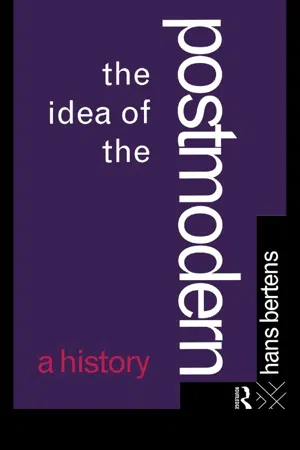
At last! Everything you ever wanted to know about postmodernism but were afraid to ask.
Hans Bertens' Postmodernism is the first introductory overview of postmodernism to succeed in providing a witty and accessible guide for the bemused student. In clear and straightforward but always elegant prose, Bertens sets out the interdisciplinary aspects, the critical debates and the key theorists of postmodernism. He also explains, in thoughtful and illuminating language, the relationship between postmodernism and poststructuralism, and that between modernism and postmodernism.
An enjoyable and indispensible text for today's student.
- 296 pages
- English
- ePUB (mobile friendly)
- Available on iOS & Android
eBook - ePub
About this book
Information
Part I
POSTMODERNISMS
1
INTRODUCTION
Postmodernism is an exasperating term, and so are postmodern, postmodernist, postmodernity, and whatever else one might come across in the way of derivation. In the avalanche of articles and books that have made use of the term since the late 1950s, postmodernism has been applied at different levels of conceptual abstraction to a wide range of objects and phenomena in what we used to call reality. Postmodernism, then, is several things at once. It refers, first of all, to a complex of anti-modernist artistic strategies which emerged in the 1950s and developed momentum in the course of the 1960s. However, because it was used for diametrically opposed practices in different artistic disciplines, the term was deeply problematical almost right from the start.
Let me offer an example. Clement Greenberg, for more than thirty years easily the most influential art critic on the American scene, defined modernism in terms of a wholly autonomous aesthetic, of a radically anti-representational self-reflexivity. For Greenberg, modernism implied first of all that each artistic discipline sought to free itself from all extraneous influence. Modernist painting had thus purged itself of narrative—the presentation of biblical, classical, historical, and other such scenes—which belonged to the literary sphere, and had turned to a necessarily self-reflexive exploration of that which could be said to be specific to painting alone: its formal possibilities. From this anti-representational, formalist point of view, postmodernism gives up on this project of self-discovery and is a (cowardly) return to pictorial narrative, to representational practices. Architectural postmodernism has clear affinities with this. For Robert Venturi, Denise Scott Brown, Charles Jencks and other theorists, modernist architecture is the purist self-referential architecture of the Bauhaus-Mies van der Rohe, Gropius, and others—and of the corporate architecture of the postwar International Style. Postmodern architecture turns away from this self- absorbed and technocratic purism and turns to the vernacular and to history, thus reintroducing the humanizing narrative element that had been banned by the Bauhaus group and its corporate offshoots.
However, for many of the American literary critics that bring the term postmodernism into circulation in the 1960s and early 1970s, postmodernism is the move away from narrative, from representation. For them, postmodernism is the turn towards self-reflexiveness in the so-called metafiction of the period, as practiced, for instance, by Samuel Beckett, Vladimir Nabokov, John Barth, Donald Barthelme, the Surfictionists, the nouveau romanciers, and a host of other writers. For them this particular form of postmodernism rediscovers and radicalizes the self-reflexive moment in an otherwise representational modernism (the self-reflexivity of the later Joyce, especially of Finnegans Wake, of the experiments of Raymond Roussel and others). Seen from this perspective, postmodernism is a move towards radical aesthetic autonomy, towards pure formalism.
The other arts further complicate the picture. Sally Banes tells us that in dance criticism the term postmodern has been applied both to an early movement toward functionality, purity, and self-reflexivity (‘analytic postmodern dance’; Banes 1985:81) and to a later ‘rekindling of interest in narrative structures’ (91). Film presents its own specific problems—of periodization, for instance. Maureen Turim’s persuasive periodization of the early history of film—primitive (1895–1906), early classical (1906–25), and classical (1925–55)—coincides largely with literary modernism, whereas her modernist (1955–75) and ‘potentially’ postmodernist (1975–present) periods coincide with the postmodern period in most of the other arts (Turim 1991). There is, moreover, the intermittent presence of avant-gardist film which in its ‘anti-structural’ manifestations of the later 1970s and 1980s—which reintroduce ‘cultural content’—is Noël Carroll’s ‘likeliest nominee for the title postmodern film’ (Carroll 1985:103).
In photography, however, ‘content’ is associated with realism and modernism, and the pendulum swings the other way again. For Douglas Crimp, Abigail Solomon-Godeau and other theorists, writing in the late 1970s and early 1980s, it is the fiercely anti-representational, anti-narrative, deconstructionist photography of Cindy Sherman, Sherry Levine, and Richard Prince that is postmodern, to the exclusion of everything else. Depending on the artistic discipline, then, postmodernism is either a radicalization of the self-reflexive moment within modernism, a turning away from narrative and representation, or an explicit return to narrative and representation. And sometimes it is both. Moreover, to make things worse, there are, as we will see, postmodernisms that do not fit this neat binary bill. Yet, there is a common denominator. In their own way, they all seek to transcend what they see as the self-imposed limitations of modernism, which in its search for autonomy and purity or for timeless, representational, truth has subjected experience to unacceptable intellectualizations and reductions. But at this level we again find complications. The attempt to transcend modernism follows two main strategies, which unfortunately do not coincide with the distinction that I have just made between a self-reflexive postmodernism and a postmodernism that reintroduces (some kind of) representation. Those who opt for the first strategy are content to question modernism’s premises and its procedures from within the realm of art. Those who wish to break more radically with modernism do not only attack modernist art, but seek to undermine the idea of art itself. For them the idea of art, that is, art-as-institution, is a typically modernist creation, built upon the principle of art’s self-sufficiency, its special—and separate—status within the larger world. But such an autonomy, these artists argue, is really a self-imposed exile; it means that art willingly accepts its impotence, that it accedes to its own neutralization and depoliticization.1
At a second level of conceptualization we find similar confusions. Here postmodernism has been defined as the ‘attitude’ of the 1960s counterculture, or, somewhat more restrictively, as the ‘new sensibility’ of the 1960s social and artistic avant-garde. This new sensibility is eclectic, it is radically democratic, and it rejects what it sees as the exclusivist and repressive character of liberal humanism and the institutions with which it identifies that humanism. Here the avant-garde attack on art-as-institution is broadened and raised to a socio-political level. Such an early politicized form of postmodernism was first identified in the mid-sixties by Leslie Fiedler and other critics who monitored the contemporary American scene.
In the course of the 1970s, postmodernism was gradually drawn into a poststructuralist orbit. In a first phase, it was primarily associated with the deconstructionist practices that took their inspiration from the poststructuralism of the later Roland Barthes and, more in particular, of Jacques Derrida. In its later stages, it drew on Michel Foucault, on Jacques Lacan’s revisions of Freud, and, occasionally, on the work of Gilles Deleuze and Félix Guattari. The translation of Jean-François Lyotard’s La Condition postmoderne (1984; original edition 1979), in which a prominent poststructuralist adopted the term postmodern, seemed to many to signal a fully-fledged merger between an originally American postmodernism and French poststructuralism. Like poststructuralism, this postmodernism rejects the empirical idea that language can represent reality, that the world is accessible to us through language because its objects are mirrored in the language that we use. From this empirical point of view, language is transparent, a window on the world, and knowledge arises out of our direct experience of reality, undistorted and not contaminated by language. Accepting Derrida’s exposure, and rejection, of the metaphysical premises—the transcendent signifier—upon which such empiricism is built, postmodernism gives up on language’s representational function and follows poststructuralism in the idea that language constitutes, rather than reflects, the world, and that knowledge is therefore always distorted by language, that is, by the historical circumstances and the specific environment in which it arises. Under the pressure of Derrida’s arguments, and of Lacan’s psychoanalysis, which sees the subject as constructed in language, the autonomous subject of modernity, objectively rational and self-determined, likewise gives way to a postmodern subject which is largely other-determined, that is, determined within and constituted by language.
One can, as I have suggested, distinguish two moments within this poststructuralist postmodernism. The first, which belongs to the later 1970s and the early 1980s, derives from Barthes and Derrida and is linguistic, that is, textual, in its orientation. The attack on foundationalist notions of language, representation, and the subject is combined with a strong emphasis on what in Derrida’s ‘Structure, sign, and play in the discourse of the human sciences’ (1970) had been called ‘freeplay’—the extension ad infinitum of the ‘interplay of signification’ in the absence of transcendent signifiers, of metaphysical meaning—and on intertextuality. This deconstructionist postmodernism saw the text, in the terms made famous by Roland Barthes’s ‘The death of the author’ of 1968, as ‘a multidimensional space in which a variety of writings, none of them original, blend and clash’; as ‘a tissue of quotations drawn from the innumerable centres of culture’ (Barthes 1977:146). Intent upon exposing the workings of language—and especially its failure to represent anything outside itself, in other words, its self-reflexivity— this Derridean postmodernism largely limited itself to texts and intertexts. In its firm belief that the attack on representation was in itself an important political act, it was content to celebrate the so-called death of the subject—and thus of the author—without realizing that the end of representation had paradoxically made questions of subjectivity and authorship (redefined in postmodern terms, that is, in terms of agency) all the more relevant. If representations do not and cannot represent the world, then inevitably all representations are political, in that they cannot help reflecting the ideological frameworks within which they arise. The end of representation thus leads us back to the question of authorship, to such political questions as ‘Whose history gets told? In whose name? For what purpose?’ (Marshall 1992:4). In the absence of transcendent truth it matters, more than ever, who is speaking (or writing), and why, and to whom. Deconstructionist postmodernism largely ignored these and other political questions that the demise of representation had given prominence to. As a result, with the increasing politicization of the debate on postmodernism in the early 1980s, its textual, self-reflexive, orientation rapidly lost its attraction.
The other moment within poststructuralist postmodernism derives from Foucault and, to a much lesser extent, Lacan. It belongs to the 1980s rather than to the 1970s, although it is difficult to pinpoint its appearance. Foucault’s influence materializes almost imperceptibly until it is suddenly very much there, like a fine drizzle that to your surprise has managed to get you thoroughly wet after an hour’s walk. Like the earlier deconstructionist postmodernism, this later poststructuralist postmodernism assumes a reality of textuality and signs, of representations that do not represent. Here, however, the emphasis is on the workings of power, and the constitution of the subject. From the perspective of this postmodernism, knowledge, which had once seemed neutral and objective to the positivists and politically emancipatory to the left, is inevitably bound up with power and thus suspect. Although it does not necessarily follow Foucault in his extreme epistemological skepticism, which virtually equates knowledge with power and thus reduces it to the effect of a social relation or structure, it fully accepts that knowledge, and language tout court, have become inseparable from power. This postmodernism interrogates the power that is inherent in the discourses that surround us—and that is continually reproduced by them—and interrogates the institutions that support those discourses and are, in turn, supported by them. It attempts to expose the politics that are at work in representations and to undo institutionalized hierarchies, and it works against the hegemony of any single discursive system—which would inevitably victimize other discourses—in its advocacy of difference, pluriformity, and multiplicity. Especially important are its interest in those who from the point of view of the liberal humanist subject (white, male, heterosexual, and rational) constitute the ‘Other’—the collective of those excluded from the privileges accorded by that subject to itself (women, people of color, non-heterosexuals, children)—and its interest in the role of representations in the constitution of ‘Otherness’. Drawing on the later Foucault’s interest in the subject, it more generally investigates the ways in which human beings are constituted—and reconstituted—by discourses, that is, by language, and recognize themselves as subjects. Some, especially British, theorists sought to supplement this with Louis Althusser’s analysis of ideology and its effects upon the subject. In the course of the 1980s this mostly Foucauldian postmodernism had a far-reaching democratizing influence within cultural institutions—and on the relations between them—and in the humanities at large (even if a new dogmatism followed on its heels). It is this 1980s redefinition of the postmodern that enabled the close links with feminism and multiculturalism that are now generally associated with postmodernism.
On this second level of conceptualization—postmodernism as a Weltanschauung—the term is also not without its problems. On the political left some commentators distinguish between a ‘good’ deconstructionism, which they refuse to call postmodern, and a ‘bad’ version, which they then contemptuously label ‘postmodern’. Christopher Norris, for instance, obviously convinced of the political correctness of Paul de Man, Derrida, and those deconstructionists who work in their spirit, chooses to see their work within a politically constructive framework, as engaged in the necessary process of erasing the old, harmful intellectual structures of liberal humanism in order to make room for new ones that will admit the light and fresh air of a revamped Enlightenment. Others, the postmodernists, from his point of view, are merely engaged in the wanton destruction of intellectual property without the ultimate aim of rebuilding on the scorched earth they leave in their wake. For Norris and a good many others on the left, postmodernism, rather idiosyncratically defined, is thus merely intellectual vandalism. There are, as I will argue below, good reasons to make a distinction between deconstructionism proper and postmodernism, but not along such evaluative lines.
In any case, no matter how one would want to draw such lines, in the later 1970s a broad complex of deconstructionist/poststructuralist practices became firmly associated with postmodernism. In some artistic disciplines, the new theoretical interest more or less absorbed the departures from modernism that had characterized the 1960s, leading to works of art in which artistic practice and theoretical argument became indistinguishable. On the theoretical level, these practices made themselves felt all over the humanities, first in the field of literary criticism, which had, after all, brought French theory to the US, and then in adjacent fields. Nowadays often called ‘theory’—although it goes against all theory in a more traditional, say Popperian, sense—it has in the course of the 1980s filtered into and affected a large number of disciplines, in which its intellectual premises are usually simply called postmodern or postmodernist. It is this recent wide proliferation of the postmodern, in ethnology, sociology, social geography, urban planning, economics, law, and so on, that is responsible for the ever more frequent use of its terminology outside its original core area, the humanities, and that has increasingly led people to speak of the postmodern world that we inhabit. But that merely adds to the confusion. It’s not the world that is postmodern, here, it is the perspective from which that world is seen that is postmodern. We are dealing here with a set of intellectual propositions that to some people make a lot more sense than they do to others. Although the omnipresence of the postmodern and its advocates would seem to suggest otherwise, not everybody subscribes to the view that language constitutes, rather than represents, reality; that the autonomous and stable subject of modernity has been replaced by a postmodern agent whose identity is largely other-determined and always in process; that meaning has become social and provisional; or that knowledge only counts as such within a given discursive formation, that is, a given power structure—to mention only some of the more familiar postmodern tenets.
I emphasize this because at again another conceptual level one can indeed speak of the postmodern world, or at least argue that the world as such has become postmodern, that is, entered a new historical era, that of postmodernity. Such arguments restrict themselves in practice to developments in the US, Western Europe, and some less prominent bulwarks of western capitalism such as Canada and Australia, and tacitly assume that the rest of the world will have to follow suit. To some critics postmodernity is still limited to certain areas of contemporary culture—usually to mass culture as mediated by television or to the more elitist yuppie life style promoted by designer magazines—or to ce...
Table of contents
- COVER PAGE
- TITLE PAGE
- COPYRIGHT PAGE
- ACKNOWLEDGMENTS
- PART I: POSTMODERNISMS
- PART II: …AND POSTMODERNITIES
- BIBLIOGRAPHY
Trusted by 375,005 students
Access to over 1.5 million titles for a fair monthly price.
Study more efficiently using our study tools.
Frequently asked questions
Yes, you can cancel anytime from the Subscription tab in your account settings on the Perlego website. Your subscription will stay active until the end of your current billing period. Learn how to cancel your subscription
No, books cannot be downloaded as external files, such as PDFs, for use outside of Perlego. However, you can download books within the Perlego app for offline reading on mobile or tablet. Learn how to download books offline
Perlego offers two plans: Essential and Complete
- Essential is ideal for learners and professionals who enjoy exploring a wide range of subjects. Access the Essential Library with 800,000+ trusted titles and best-sellers across business, personal growth, and the humanities. Includes unlimited reading time and Standard Read Aloud voice.
- Complete: Perfect for advanced learners and researchers needing full, unrestricted access. Unlock 1.5M+ books across hundreds of subjects, including academic and specialized titles. The Complete Plan also includes advanced features like Premium Read Aloud and Research Assistant.
We are an online textbook subscription service, where you can get access to an entire online library for less than the price of a single book per month. With over 1.5 million books across 990+ topics, we’ve got you covered! Learn about our mission
Look out for the read-aloud symbol on your next book to see if you can listen to it. The read-aloud tool reads text aloud for you, highlighting the text as it is being read. You can pause it, speed it up and slow it down. Learn more about Read Aloud
Yes! You can use the Perlego app on both iOS and Android devices to read anytime, anywhere — even offline. Perfect for commutes or when you’re on the go.
Please note we cannot support devices running on iOS 13 and Android 7 or earlier. Learn more about using the app
Please note we cannot support devices running on iOS 13 and Android 7 or earlier. Learn more about using the app
Yes, you can access The Idea of the Postmodern by Hans Bertens in PDF and/or ePUB format, as well as other popular books in Philosophy & Literary Criticism. We have over 1.5 million books available in our catalogue for you to explore.