eBook - ePub
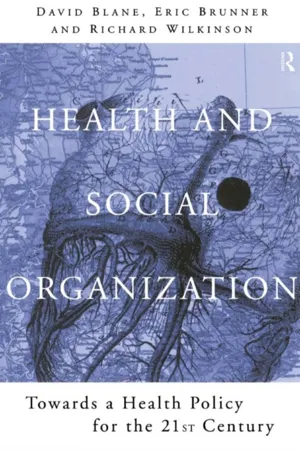
Health and Social Organization
Towards a Health Policy for the 21st Century
- 344 pages
- English
- ePUB (mobile friendly)
- Available on iOS & Android
eBook - ePub
Health and Social Organization
Towards a Health Policy for the 21st Century
About this book
There is widespread recognition that the most powerful determinants of health today are to be found in social, economic and cultural circumstances. These include: ecnomic growth, income distribution, consumption, work oganisation, unemployment and job insecurity, social and family structure, education and deprivation, and they are all aspects of 'social organisation'. In ^Health and Social Organisation leading British and North American researchers who bring together an invaluable collection of data on these issues, draw from the social sciences, epidemiology and biology.
Information
Chapter 1
The evolution of public health policy
An anglocentric view of the last fifty years
David Blane, Eric Brunner and Richard Wilkinson
The British and North American contributors to this volume share an approach to health and health policy which goes beyond medical care and individual behaviour. Each in their somewhat different ways regards the social structure as a major determinant of population health. This perspective has guided their research, which in many cases stretches back over several decades. Some of the contributors present a synthesis or overview of their research endeavours, while others report specific pieces of work. The thinking of all, however, has been shaped by post-war developments in public health research, so it is appropriate, by way of an introduction, to describe briefly the main features of this intellectual history. As the editors of the volume we are conscious that our introduction is anglocentric and may omit important details. Nevertheless we believe it provides a useful map of how we have come to understand that the social structure will be central to effective health policy in the twenty-first century.
PUBLIC HEALTH THROUGH MEDICAL TREATMENT?
At the end of the Second World War confidence in medical science had rarely been higher. It seemed obvious to contemporaries, if not to the public health profession, that the decline in infectious disease mortality owed much to the progress of medical science. Although the first sulphonamides had been developed before the war, it was the wartime mass production of penicillin which promised effective treatment for a host of infectious diseases that had been the scourge of previous generations. Similarly, although immunization against diphtheria had been available since the 1930s, wartime development of immunization raised the possibility of protecting whole populations against some diseases. Not only were these new forms of treatment and prevention effective but—and this was presumably important to policy-makers in countries, like Britain, where post-war circumstances were straitened—they were considered affordable.
It is understandable, given this background, that the provision of universally available medical care was seen as a vital part of policy for improving health standards throughout society. In many countries this development coincided with a political enthusiasm for social justice which had its roots in wartime experience and the desire not to return to prewar conditions. In Britain the National Health Service was established to provide free medical care for all, financed by central government revenues. Its founders expected that the population would become healthier as a result. They anticipated an early surge in demand, due to the backlog of untreated disease. Once it had been treated, however, they predicted a steady decline in the demand for medical care. Most commentators also assumed that social inequalities in health would be steadily eroded by this combination of medical science and egalitarian health care reform.
Prior to the establishment of the National Health Service health and welfare services directed towards much of the urban working class had been administratively intertwined. In 1948 almost 80 per cent of the country’s hospital beds were provided by municipal hospitals run by local government (Webster 1988). These hospitals had developed out of the provision made by the Poor Law Boards of Guardians to provide accommodation for the sick poor. This was the basis of what had been a wider integration. School medical inspections were combined with supplementary feeding, which had been introduced before the First World War. ‘By 1938 the School Medical Service was engaged in diverse activities, ranging from special schools, school meals and milk, physical education, to inspection and treatment of minor ailments.’ (Webster 1988:6). Similarly, antenatal and child welfare clinics were able to provide subsidized milk and health foods as well as medical care. The separation of the sick from welfare recipients could also appear arbitrary; ‘…of the 149,000 residents in Poor Law Institutions in England and Wales in 1939, nearly 60,000 (40 per cent) were classified as sick’ (Webster 1988:5).
In Britain as early as 1937 the independent research unit, Political and Economic Planning, had recommended that ‘Medical and allied services should be financially and administratively divorced from social insurance and the Poor Law, and unified into one national system providing services to the whole population on the basis of common citizenship.’ The decision to separate medical care, under the new National Health Service, from welfare and preventive services stemmed primarily from the desire to create a service for everyone which was not seen as an outgrowth of services to the poor. Despite usually being reformed in tandem and despite their additive impact on health, welfare and health systems became increasingly separated, administratively, professionally and intellectually.
Although the British National Health Service was innovative in the comprehensive free cover it provided to the whole population, as Beveridge pointed out, a number of other countries, including Denmark, France, Germany, Hungary, Romania, Norway, New Zealand and the Soviet Union had also taken important steps towards ensuring that the benefits of medical care were more widely applied.
HEALTH INEQUALITIES AND THE WELFARE STATE
Attempts to widen access to medical care were usually accompanied by other social reforms which might be expected to affect health. In Britain full employment policies and post-war developments in welfare provision, including house building programmes, income support and social insurance, were introduced around the same time as the National Health Service. In Canada a similar series of programmes were put in place between 1947 and 1971: universal, comprehensive, tax-funded medical care; a generous unemployment insurance scheme; the Canada Pension Plan; and the Canada Assistance Plan, which gave the country a welfare system more European than American in scope.
The expansion of the welfare state might have been expected to narrow social class differences in health, and when the 1951 decennial figures were released that is what they seemed to show had happened. So much so that the normal inverse mortality gradient had been replaced by a W-shaped distribution (Table 1.1, first row). Subsequently, however, these figures were ‘adjusted’ by the Registrar General. Paradoxically, his correction seems to have been prompted primarily by an assumption that the figures must be wrong because they did not show the usual inverse gradient between social position and mortality. With some justification he transferred ‘company directors’ (who may have included everyone from small self-employed tradesmen to large employers) from social class I to social class II. More fundamentally, and with no apparent justification, he weighted the 1951 occupations by their populations in the previous census in 1931. To show he was aware of the dubious method by which he had managed to produce the desired class gradient in mortality he said, ‘My colleague who did these sums for me, in letting me have these figures …added a comment which seems to me very apt: “Ain’t science wonderful!”’ (Logan 1959:20).
The adjusted figures (Table 1.1, second row), which show class differences in mortality widening rather than narrowing in 1951, became the ones normally quoted. A few years before Logan, in 1955, Illsley had published a paper which seemed to show that most of the social class differences in infant mortality were due to selective social mobility. Analyses from the Aberdeen Maternity and Neonatal Data Bank, set up in 1951, demonstrated that taller and presumably healthier mothers tended to marry upwards, while shorter ones married down. The implication was that social class mortality differentials were not primarily a reflection of the health effects of the different circumstances in which people currently lived. Thus Logan’s adjusted 1951
Table 1.1 Standardized mortality ratios for social classes, men aged 20–64 years, England and Wales, 1951
figures on social class mortality differentials gave the impression that the mortality differences were unresponsive to the provision of free medical care and the development of the welfare state, while selective social mobility seemed to provide some explanation of why they were not.
PREVENTION THROUGH THE MODIFICATION OF INDIVIDUAL BEHAVIOUR
What then appeared as the failure of social class mortality differences to respond to the expanding welfare provisions contributed to the belief that social policy was no longer such an important part of preventive health policy. Bartley traces the separation between epidemiology and social policy research to the 1950s. Using quotes from Titmuss, Morris and Heady, whose research had been at the forefront of the integrated approach, she argues that the ‘present health education philosophy can be traced in direct line of descent to the belief that pre-war poverty and inequality had been banished by the welfare state and new types of explanations were needed to account for the failure of class inequalities in health to diminish’ (Bartley 1985:290).
These tendencies were also strengthened by the growing prosperity of the immediate post-war decades. The third quarter of the twentieth century was a golden age for American and European capitalism. The almost continuous growth of real incomes, low unemployment and greater equity seemed to have banished the kind of poverty that might have harmed health. To many, the provision of food supplements, free school meals and milk seemed increasingly irrelevant and was gradually discontinued.
In this new world health became the almost exclusive province of medical science. Social policy was redirected to serve exclusively social objectives, and behavioural risks were investigated as a means of prevention. The rise in the number of deaths from lung cancer, which, in 1951, surpassed the number of deaths from tuberculosis, also called for a behavioural approach to prevention. In the same year Doll and Hill started their monumental study of the health effects of smoking among British doctors. By 1954 the link between smoking and lung cancer was clear. Interestingly, this was the rediscovery of an association first observed by medical scientists in 1930s Germany but submerged in the exigencies of war (Davey Smith et al. 1995).
Research proceeded over the next decade or two to lay the foundations of the behavioural approach to the prevention of degenerative diseases. The physical activity/inactivity hypothesis emerged from a large-scale study of men in a wide variety of occupations when it was found that postmen were protected from heart attacks in comparison with clerks and telephonists. Bus conductors running up and down stairs on double-decker buses were similarly protected in comparison with their drivers. The first Whitehall study of 17,000 civil servants, started in the late 1960s, was also used initially to explore behavioural risk factors. In 1970 Ancel Keys reported the first international correlations between heart disease mortality and fat consumption. These were among the first results to come from the Seven Countries study, a massive and continuing project to investigate the health effects of diet and other behavioural factors in America, Japan, Greece, Italy, former Yugoslavia, Holland and East Finland. Pilot trials began in 1957, and the full study a year later. Its aim was to ‘relate differences in incidence among cohorts to the average or general characteristics of the men in the cohorts, including their living habits’ (Keys 1980).
A few epidemiological studies continued to monitor the importance of structural and psychosocial as well as behavioural factors. The Alameda County study in northern California which followed residents between 1965 and 1974 was one of them. Based at Berkeley, this study showed that social support and material circumstances were associated with mortality risk (Berkman and Syme 1979). Another study at Berkeley showed that coronary risk rose with the level of acculturation among Japanese-Americans (Marmot and Syme 1976). In Britain the 1946 and 1958 birth cohort studies continued to study the impact of a wide range of social and economic variables and the Whitehall study was used increasingly to illuminate socioeconomic differences in health (Marmot et al. 1978).
THE BEHAVIOURAL IMPASSE
During the late 1970s several studies were established to quantify the health gains which result from changing the behaviours which earlier research had identified as hazardous. One of the most important was the 361,662-strong Multiple Risk Factor Intervention Trial (MRFIT) in the United States. The level of mortality improvement which would result from successful behavioural change was predicted and, on the basis of the best available knowledge and using unprecedented resources, a programme of behaviour change was launched. The results were disappointing. Sustained behavioural change proved difficult to achieve even among highly motivated high-risk individuals. Even where behaviour was successfully changed, the ensuing improvement in mortality proved smaller than predicted. In addition, the researchers came to realize that each individual adopting the desired behaviours would probably be quickly replaced by a new recruit to the health-damaging behaviours (see Chapter 2).
Results from the first Whitehall study in Britain were consistent with those from MRFIT. Both mortality risk and the prevalence of healthdamaging behaviours increased from the top to the bottom grades of the civil service hierarchy. However, grade differences in smoking, blood pressure, obesity and exercise were found to account for only a minority of the grade differences in mortality (Marmot et al. 1978). Serum cholesterol was found to predict future heart disease among individuals in the study, but mean cholesterol levels were found to be higher in the higher employment grades. Fat intake, which is merely one of the determinants of blood cholesterol, therefore did not appear to be part of the explanation of occupational differences in heart disease in these men. As well as being unexpectedly hard to change, behaviour seemed to have less effect on health than predicted. This may have been partly a consequence of inadequate measurement. Reliance on a single collection of self-reported smoking habits, for example, cannot hope to capture a precise estimate of a lifetime’s exposure. But the results of intervention studies were almost uniformly unimpressive.
In a discussion of the difficulties of using behaviour change as an approach to population health, Rose calculated that the advantages to the individual of various forms of behavioural change were very small (Rose 1981). He concluded that if Framingham men were to modify their diet enough to reduce their cholesterol levels by 10 per cent up to the age of 55, forty-nine out of fifty would eat differently every day for forty years without having avoided a heart attack by doing so. Similarly, to save the life of one male British doctor ‘399 would have worn a seat belt everyday for forty years without benefit to their survival.’ Elsewhere (Rose 1985) he states that even if people are in the lowest risk category for all the behavioural risk factors their most likely cause of death is still heart disease.
If the gains to individuals from prevention through behaviour change are so small even among the most important causes of death, they are likely to be even smaller in relation to the prevention of less common causes. Nor will more research into behavioural factors necessarily solve the problem: more money and effort has gone into research into the causes of heart disease than into any other illness.
Rather than being new, the attempt to improve health by changing individual behaviour can be seen as a development of earlier attempts to combat infectious disease through food hygiene and personal cleanliness. Indeed, in terms of sexually transmitted disease the continuity is clear. As a recipe for health the dos and don’ts of personal behaviour have a strong resonance with traditional morality: against drinking and smoking, in favour of sexual fidelity, and against sloth and gluttony.
The behavioural approach to prevention had other important ideological implications. By focusing attention on individual choices, this perspective left unchallenged the assumption that the post-war reforms had eliminated the structural causes of disease. ‘Victim-blaming’ implied that individuals freely chose these health-damaging behaviours, they could be held responsible for the consequent disease, and the health implications of forms of social and economic organization were hidden from view. The debate on the relationship between behavioural and structural factors in health has much in common with the agency/structure debate in sociology.
THE RETURN OF STRUCTURE
During the last decade or two there has been a growing interest in the preventive possibilities of the relationship between people’s health and features of the social and economic environment which are largely beyond the control of individuals. The shortcomings of over-reliance on behaviour change as an approach to prevention is only one of the factors behind this development.
The pressure to find some more effective approach to the prevention of chronic and degenerative disease was maintained by the tendency for the burden of illness to rise as the population ages. Because so much of this burden is now degenerative...
Table of contents
- Cover Page
- Title Page
- Copyright Page
- Figures
- Tables
- Contributors
- Preface
- Chapter 1
- Part I: The policy problem
- Part II: Environment and economic growth
- Part III: The family and life course
- Part IV: Work and the labour market
- Part V: Policy integration
Trusted by 375,005 students
Access to over 1.5 million titles for a fair monthly price.
Study more efficiently using our study tools.
Frequently asked questions
Yes, you can cancel anytime from the Subscription tab in your account settings on the Perlego website. Your subscription will stay active until the end of your current billing period. Learn how to cancel your subscription
No, books cannot be downloaded as external files, such as PDFs, for use outside of Perlego. However, you can download books within the Perlego app for offline reading on mobile or tablet. Learn how to download books offline
Perlego offers two plans: Essential and Complete
- Essential is ideal for learners and professionals who enjoy exploring a wide range of subjects. Access the Essential Library with 800,000+ trusted titles and best-sellers across business, personal growth, and the humanities. Includes unlimited reading time and Standard Read Aloud voice.
- Complete: Perfect for advanced learners and researchers needing full, unrestricted access. Unlock 1.5M+ books across hundreds of subjects, including academic and specialized titles. The Complete Plan also includes advanced features like Premium Read Aloud and Research Assistant.
We are an online textbook subscription service, where you can get access to an entire online library for less than the price of a single book per month. With over 1.5 million books across 990+ topics, we’ve got you covered! Learn about our mission
Look out for the read-aloud symbol on your next book to see if you can listen to it. The read-aloud tool reads text aloud for you, highlighting the text as it is being read. You can pause it, speed it up and slow it down. Learn more about Read Aloud
Yes! You can use the Perlego app on both iOS and Android devices to read anytime, anywhere — even offline. Perfect for commutes or when you’re on the go.
Please note we cannot support devices running on iOS 13 and Android 7 or earlier. Learn more about using the app
Please note we cannot support devices running on iOS 13 and Android 7 or earlier. Learn more about using the app
Yes, you can access Health and Social Organization by David Blane, Eric Brunner, Richard Wilkinson, David Blane,Eric Brunner,Richard Wilkinson in PDF and/or ePUB format, as well as other popular books in Medicina & Atención sanitaria. We have over 1.5 million books available in our catalogue for you to explore.