- 256 pages
- English
- ePUB (mobile friendly)
- Available on iOS & Android
eBook - ePub
Aesthetics
About this book
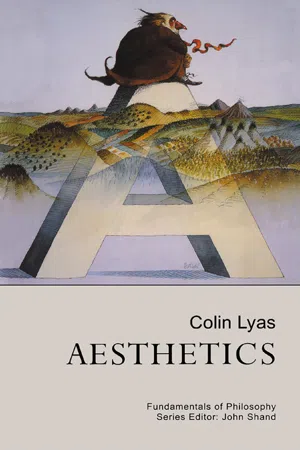
This book presents an up-to-date introduction to the subject that captures the excitement and passion of art itself. It opens by exploring why art is important to us and goes on to grip the reader with a discussion of all of the areas central to aesthetics: aesthetic experience, representation, expression, definition of art, evaluation, interpretation, structuralism and post-structuralism, truth and morality. It draws upon the great thinkers on art, Plato and Kant, Croce and Beardsley, including the most recent iconoclastic views of Barthes and Derrida.
Information
Chapter 1: Anglo-Kantian attitudes
Natural and man-made things, as we have seen, excite our attention. But then questions arise. Firstly, since not everything that attracts attention does so aesthetically (as when one’s attention is caught by a rustle in the grass when nervous about snakes), which attractions are aesthetic? A second question is why these attractions can be, and in what ways they can be, so powerful.
Which attractions are aesthetic?
Although this is a common question in introductions to aesthetics, I am uncertain about what is being asked when it arises.
Let us note first that our words reflect the various forms our evolution has taken. We did not first have certain experiences and then invent words with which to express them. Our words emerged as our lives developed, and emerged to express capacities acquired during that development. It was, for example, in the course of our development as colour-sighted beings that our colour language emerged. It is because we evolved as creatures who make mistakes that such words as “doubt”, “belief”, and “knowledge” gained their functions.
So it is with aesthetic terms. It is because we are struck by rainbows, entranced by fictions, moved by rhythms, unsettled by certain colour combinations, that we developed the words and behaviour that articulate aesthetic responses. As small children we simply marched up and down to music or turned from discordant colours. To develop aesthetically is, in part, to augment those responses with words and gestures that allow infinitely more complex and subtle ways of articulating our aesthetic reactions: words like “too”, “trite”, “garish”, “beautiful”, and countless others.
In knowing how to use that vocabulary, we show a knowledge of the attractions that are aesthetic. But what, then, in addition to that, does the philosopher want to know when asking what the characteristic features are of aesthetic responses? It cannot be how and why we evolved our capacities for aesthetic response. That is a question for evolutionary biology. It cannot be how to use aesthetic terms, for that is already mastered. It cannot be how to extend one’s capacities so that one can use these terms of paintings by Giotto as well as, or instead of, paintings by Holman Hunt. That is a matter for experience and for art historians and critics and not for philosophers to teach us. It cannot be whether we should respond to something aesthetically, as if we had any choice in the matter. And if the question is whether it is more worthwhile to enjoy a film than to play korfball or work in a hospice (granted that these are exclusive alternatives), that is not a question about the nature of aesthetic experience but about its ranking.
So what drives these philosophical questions about the defining characteristics of aesthetic experience?
Firstly, some philosophers have an impulse to classify things, apparently just for the sake of doing so, so as to report, for example, that aesthetic experiences, say, are the class of experiences marked off by these or those sorts of characteristics. Whether or not that motivation appeals will depend on whether one has that classificatory impulse. I don’t, but let that not stop anyone who does.
Secondly, some seem struck by the fact that we cannot always say whether a response is aesthetic. Being startled by a rustling in the grass seems clearly not to be aesthetic, whereas being stirred by the colours of a picture clearly is. But then I find myself stirred by the tilt of a retroussé nose. Is that aesthetic, too? My heart moves when I see eagles soar. Is that an aesthetic response? I am elated by the try scored by the Barbarians in 1973. Is that aesthetic? I look into the eyes of a bat and am stirred by its otherness. How aesthetic is that reaction? And then the hope might emerge that if we could distil the characteristic features of aesthetic response, we would be able to determine whether these cases are or are not aesthetic. But again I need to know why that question is a pressing one. Why is it important that I be able thus to classify my experiences?
A better reason is suggested by Kant, whose philosophical aesthetics will be more fully examined later in this chapter. Kant certainly sought the defining characteristics of the aesthetic, one being that aesthetic experience be “disinterested”. However, he did not leave the matter there. He also asked why disinterested experiences are so important to us. This suggests that a reason for enquiring into the defining qualities of aesthetic experience is that an answer might also solve the fundamental question of why art and nature can have such power over us.
We can find another good reason for seeking defining features of the aesthetic by following up the striking fact that we can use a word perfectly well and yet fall into confusion and error when asked to say what we are doing in using it. I can ask if you have the time, admire your mind, know where I left a book, believe that you are lying and yet, when asked what time, mind, knowledge and belief are, I can fall into confusion. So it is in aesthetics. We can delight at a sunset, gasp at the denouement of Seven, laugh at Bullets over Broadway and be moved to tears by the conclusion of Vanya on 42nd Street. But when asked what aesthetic response is, people say the daftest things. That would not concern me (I simply carry on laughing at Bullets over Broadway), save that those same people don’t leave it there. They have the temerity, on the basis of their mischaracterizations of aesthetic experience, to say how others should respond aesthetically. Others, taking this advice seriously, miss out on sources of enjoyment. For example, they are told (Bell 1920) that aesthetic responses should ignore representation. And so they miss the significance of the expressions in Rembrandt selfportraits. That impoverishes their response. So, one reason for involvement in discussions about the defining features of the aesthetic is to detect misleading characterizations.
I begin there, with a way of going wrong (and one with pernicious consequences) in characterizing the aesthetic and I take as my example the influential attempt to define the aesthetic in terms of something called the “aesthetic attitude”.
The aesthetic attitude
Consider the dangerous situation in which fog descends while I am sailing. The manuals indicate practical things to do when this happens, such as sounding audible warnings. But the captain finds me admiring how creamy the sea looks, how vaporously delicate the fog. He might justly say that I am taking an unduly aesthetic attitude. Consider, next, a man looking forward to an evening out with his wife at a performance of Othello. He comes home and finds a note reading “Have gone off with Gordon”. In a turmoil of rage and jealousy he still goes to the play and, at the moment when Desdemona is killed by the jealous Othello, applauds. Here one might say that his particular situation has prevented him from taking the proper aesthetic attitude.
These cases fuel the influential notion that the aesthetic involves putting “psychical distance” between oneself and the object to which one responds. In the fog, I responded aesthetically by distancing myself from practical action. At the play, the jealous man could not distance himself enough to respond aesthetically, no more than did those, possibly mythical, early cinema audiences who fired at the screen. So we have the claim that a certain stance defines the aesthetic. This is the so-called “aesthetic attitude”, which establishes “psychical distance” between viewer and work.
I object to this still popular account that it is feeble, that it gives no answer to the fundamental questions about the source of the power of art and the aesthetic, and that it results in damaging advice to would-be appreciators.
That the account is feeble is easily shown. It is true to say that we can switch our attention to the aesthetic aspects of our surroundings. Moreover, if I am in danger, it may, indeed, take a special effort to focus on the aesthetic aspects of my environment. This is because danger diverts me from paying attention to them. But when I do attend to them, I do not take up a special sort of attitude, as a sycophant might on meeting a princess. I simply attend, often with no sense of effort, to the aesthetic features of the situation. And the way I attend to them is no different from the way I attend to anything else. What makes my attention aesthetic, then, is what I attend to, not how I attend to it.
The account is equally feeble when applied to art rather than nature. My uncomfortable seat may interfere with my attention to music, my stiff neck may interfere with my efforts to view the architectural features of the Lloyd’s building, and my toothache with my attention to Trainspotting. But this is not because something called “distance” is lost. It is simply that my attention is distracted from the aesthetic aspects of those things and events to which I wish to give my undivided attention.
Drama and other fictions may seem to offer more scope to notions of distance. There is something not quite right about shooting at Dirty Harry, serving a vagrancy order on Estragon and Vladimir, applying for a job at the Rover’s Return, or writing to Dr Watson for some methadone. But if, as the case of the fog at sea was meant to show, distancing requires an effort of some sort, then fiction involves no distance. The notion that I spend my time at a play holding myself back from intervening is plain daft. I learn the notion of fiction as involving the logical impossibility of intervention and that is all there is to it.
The notion of distance is radically useless. The theory does not even say that to distance oneself is to have an aesthetic experience. It says no more than that certain things can interfere with enjoyment of the aesthetic properties of things. This explains nothing about the aesthetic. For until we know to what experience of the aesthetic distancing gives us access, we know nothing about the aesthetic. We are, to be sure, told that some experiences are aesthetic, for example, the delight we take in the visual qualities of fogs. But now we really are making noises in a vacuum. We already knew about the possibility of delight in the visual qualities of fogs. What we were expecting was some account of the central features of such experiences. Instead we get a recipe for obtaining them.
The other class of experiences that is mentioned as aesthetic is the experiences to be had by attending to fictions. The claim is that we need to put ourselves into a certain condition in order to have these experiences. But again we are not told what these experiences are nor why it is worthwhile putting oneself in the condition to have them. So we have been told nothing about what makes experiences aesthetic.
Edward Bullough, to whom talk about psychical distance is due, spoke of “the antinomy of distance”. He clearly saw that a play must engage and involve our sympathies. To that extent we can’t be totally distanced. Yet at the same time he noted that if we become too involved, as a jealous man might, we can lose the proper experience of the play. So he concluded that there were degrees of distance, the best approach being to get as involved as possible without finally losing the last bit of distance.
However, it is wrong to suppose that distance in the cinema or theatre, say, exists on a sliding scale, so that the loss of distance of the jealous man at a performance of Othello is further along the scale than the child who shouts “he’s behind you” or the cinemagoer who yelps with fear as the Blob approaches. This can be seen by considering our earlier example of the jealous man at the performance of Othello. If when he applauds the killing of Desdemona he believes that a real murder is taking place, he is simply unbalanced. Or if he is participating empathetically in the make-believe he is joining in the fiction. There are no degrees between these two alternatives. Note, too, that although in the second case, the jealous man has maintained distance, since he knows he is joining in a fiction, yet he still gets the play wrong, since to ally oneself with Othello is entirely to miss the valuation the play puts on that character. We cannot express that aesthetic error in terms of loss of distance, for the man has preserved that.
Accounts of fictional distance, moreover, entirely ignore problems to which I return in the next chapter. One is that it seems possible to become emotionally involved with fiction. But nothing in talk about the distance necessary to fiction tells us how we can become emotionally involved with things that don’t exist. If, having distanced myself, I simply know that no-one is really leaving anyone at the end of Casablanca, how can I be moved to real tears, any more than I can stay angry with you if I find that you didn’t, contrary to my belief, really insult me behind my back.
My final objection to the notion of distance is to the noxious effects on our dealings with art and the aesthetic, of the connotations that the term ingloriously trails. “Distance” suggests a non-involvement and cool detachment and is likely to encourage the notion that some sort of icy contemplation is de rigueur, so that (and the case of the fog at sea suggests this) one’s posture in front of art ought to be like that of a stiff upper lip at the funeral of a lover. This might appeal to someone suffering from emotional constipation but is no recipe for enjoying art.
As we have seen, Bullough did not rule out the possibility of emotional involvement with a work, though he gave no sensible account of what this involves. Would that some of his disciples had read him more carefully, especially the crazy individual who suggested that the necessity of distance for proper aesthetic response entailed that children shouldn’t clap their hands when asked to by Peter Pan, a recommendation that entirely overlooks the ways in which one is, from earliest childhood, actively involved with one’s fictional imaginings.
Talk of aesthetic distance from a work is of a piece with that whole tradition that makes aesthetic experience a matter of detachment and disinterestedness. The notion of detachment, I suspect, collapses to the notion of distance and is prey to its ills. But the notion of disinterestedness, which is also there in Bullough’s writing, inherits the thought of a formidably difficult philosopher, who for good or ill has towered over philosophical aesthetics, Immanuel Kant. To his vastly more demanding, and instructive, characterization of the aesthetic I now turn.
Kant’s project
It is not difficult to give enough of an idea of Kant’s general project to make sense of the place allotted to the investigation of the aesthetic in that project. Traditionally, Kant supposed, it was believed that an ordered world impinges upon our senses and that those senses convey a knowledge of that world into the mind. The world imposes its order on us. And now, just as Copernicus reversed the claim that the sun goes round the earth, so Kant reversed the claim that the world gives its order to the mind. The mind, rather, gives order to a world, which has no structure save what the mind gives it.
It is, I think, important, as we shall see when we come to talk of Kant’s aesthetics, to understand that one who thinks that the mind structures reality must start by accepting the world as it actually shows itself in our dealings with it. The world, as it is for us, cannot but have the structure that our mind has in fact imposed on it. (The fun starts when we imagine the possibility, as Kant did not, that different cultures might impose different structurings on the world, including some we find repugnant. Granted Kant’s view that there is no world independent of human structurings against which the correctness of this or that structuring can be checked, how are we going to object to the ways in which others structure their worlds?)
Given this account there are a number of questions that constitute the Kantian philosophical programme. One is: “What is the character of the structuring the mind has imposed?” Well, for example, we have so structured the world that we think of it as containing physical objects with spatio-temporal locations and which causally affect each other in law-like ways. Again, as we have structured the world, we think of it as containing moral agents, free to act in certain ways and having a duty to act in some of these ways. We think, too, that these agents have feelings, desires and inclinations. Finally, we have so structured things that we think of these agents as moved by the beautiful and the sublime in art and nature.
To appreciate the full flavour of Kantian philosophy, and its bearing on aesthetics, however, consider this: if we are to talk of the mind as structuring, then there must be two distinct things: something to which structure is to be given, and something that gives the structure. The latter is provisionally indicated in saying that the mind is what gives the structure. What receives the structure is less clear, but we can get by with the notion of our being bombarded by an inchoate welter of sensory stimuli to which the mind gives structure. William James spoke of the mind of the new-born as bombarded by what must seem to the infant a blooming, buzzing confusion. That is a way of grasping Kant’s initial notion.
Now we can ask some Kantian questions. Granted we know that the mind has given order to the world, we know what order it has given by seeing what order the world has. But we can also ask what structure the mind must have in order to make it possible for the stimuli that bombard it to have been structured in the way in which they have been. To give a simple example: the stimuli we receive have been organized so that we do not merely rece...
Table of contents
- Cover Page
- Fundamentals of Philosophy
- Title Page
- Copyright Page
- Preface
- Introduction: The Disconsolations of Philosophy
- Chapter 1: Anglo-Kantian Attitudes
- Chapter 2: Nature’s Mirror: Imitation, Representation and Imagination
- Chapter 3: Ne’er So Well Expressed (I)
- Chapter 4: Tales from the Vienna Woods: After Wittgenstein in Aesthetics
- Chapter 5: Ne’er So Well Expressed (II)
- Chapter 6: The Proof of the Pudding
- Chapter 7: The Empty Tomb and the Resurrection of the Artist
- Chapter 8: The Structures of the Self-Sufficient Word
- Chapter 9: Helen’s Beethoven: Truth and Morality
- Chapter 10: The Point of It All
- Envoi: The Rape of the Holy Mother
- References
Trusted by 375,005 students
Access to over 1.5 million titles for a fair monthly price.
Study more efficiently using our study tools.
Frequently asked questions
Yes, you can cancel anytime from the Subscription tab in your account settings on the Perlego website. Your subscription will stay active until the end of your current billing period. Learn how to cancel your subscription
No, books cannot be downloaded as external files, such as PDFs, for use outside of Perlego. However, you can download books within the Perlego app for offline reading on mobile or tablet. Learn how to download books offline
Perlego offers two plans: Essential and Complete
- Essential is ideal for learners and professionals who enjoy exploring a wide range of subjects. Access the Essential Library with 800,000+ trusted titles and best-sellers across business, personal growth, and the humanities. Includes unlimited reading time and Standard Read Aloud voice.
- Complete: Perfect for advanced learners and researchers needing full, unrestricted access. Unlock 1.5M+ books across hundreds of subjects, including academic and specialized titles. The Complete Plan also includes advanced features like Premium Read Aloud and Research Assistant.
We are an online textbook subscription service, where you can get access to an entire online library for less than the price of a single book per month. With over 1.5 million books across 990+ topics, we’ve got you covered! Learn about our mission
Look out for the read-aloud symbol on your next book to see if you can listen to it. The read-aloud tool reads text aloud for you, highlighting the text as it is being read. You can pause it, speed it up and slow it down. Learn more about Read Aloud
Yes! You can use the Perlego app on both iOS and Android devices to read anytime, anywhere — even offline. Perfect for commutes or when you’re on the go.
Please note we cannot support devices running on iOS 13 and Android 7 or earlier. Learn more about using the app
Please note we cannot support devices running on iOS 13 and Android 7 or earlier. Learn more about using the app
Yes, you can access Aesthetics by Dr Colin Lyas,Colin Lyas in PDF and/or ePUB format, as well as other popular books in Philosophy & Aesthetics in Philosophy. We have over 1.5 million books available in our catalogue for you to explore.