Rational Choice Theory is flourishing in sociology and is increasingly influential in other disciplines. Contributors to this volume are convinced that it provides an inadequate conceptualization of all aspects of decision making: of the individuals who make the decisions, of the process by which decisions get made and of the context within which decisions get made.
The ciritique focuses on the four assumptions which are the bedrock of rational choice:
rationality: the theory's definition of rationality is incomplete, and cannot satisfactorily incorporate norms and emotions
individualism: rational choice is based upon atomistic, individual decision makers and cannot account for decisions made by ;couples', 'groups' or other forms of collective action
process: the assumption of fixed, well-ordered preferences and 'perfect information' makes the theory inadequate for situations of change and uncertainty
aggregation: as methodological individualists, rational choice theorists can only view structure and culture as aggregates and cannot incorporate structural or cultural influences as emergent properties which have an effect upon decision making.
The critique is grounded in discussion of a wide range of social issues, including race, marriage, health and education.
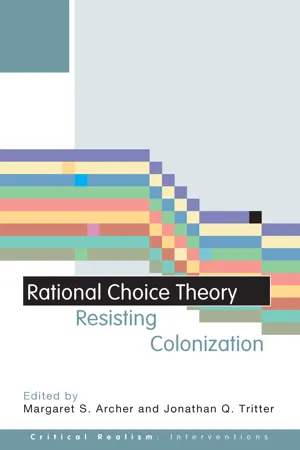
- 272 pages
- English
- ePUB (mobile friendly)
- Available on iOS & Android
eBook - ePub
About this book
Information
1 Introduction
Margaret S. Archer and Jonathan Q. Tritter
Rational choice could plausibly lay claim to being the grand theory of high modernity. Its metanarrative is fundamentally about the progressive rationalization of the West and then the rest of the world. Only insofar as global forces for disenchantment are massing can this theory take such giant imperialistic steps forward. Yet immediately we have to pause over cause and effect. Is it the case that the world is changing independently, in such a way that rational choice theory (henceforth RCT) is becoming increasingly appropriate for capturing its workings? Alternatively, is it rather the case that the growing influence of this approach in international economic and financial institutions, such as the OECD, the World Bank and the IMF, is now shaping larger tracts of the world in line with the theory?
This volume brings together a range of scholars who address different aspects of RCT. It has been spurred by a sense of the increasing influence of RCT upon explanations about society in a range of academic disciplines, and growth in its proclaimed relevance to local, national and global policy-making. RCT has underpinned the neoliberal reforms of the public sector in much of the Western industrialized world. With these reforms have come the rollback of the traditional social welfare state and withdrawal of its services.
The justification for applying RCT to policy-making continues to be the more efficient provision of services. This has resulted in the intended decline of expenditure by the public purse and instead cost-shifting to the grey sector. Thus the welfare services which we have come to expect as part of what is provided by the public sector are now increasingly dependent on altruistic acts of charity. The attraction of neoliberal reforms is readily apparent, but so are its problematic outcomes, and this is both the achievement and the threat of unquestioned application of rational choice theory.
The spread of neoliberalism raises the important question as to whether the progressive colonization of public policy by RCT is not in practice dependent upon it being supplemented by something antithetical to it, namely altruism and its practical outworkings — the voluntary creation of collective goods. Thus, for example, there has been an increase in the extent of services provided by charities and voluntary organizations that have become embedded in what was the public sector. In 1997–8 Health Authorities in England spent £500 million on services provided by the voluntary sector, 70 per cent of which was for the provision of residential care (CAF 2000). In Britain, Macmillan Cancer Relief provides a classic example of this phenomenon. By 1998 the charity had funded 1700 Macmillan nurses and 200 Macmillan doctors; these personnel, together with the charity's information service, had contact with over 200,000 new patients and their families. The charity provides funding for Macmillan nurses and their training and has financed the modernization and improvement of cancer wards and the building of hospices (Macmillan 2000). Thus the public provision of cancer care in Britain is dependent on healthcare professionals and clinical settings paid for by charitable donations and overseen by a voluntary organization. This shift in the nature of the funding and delivery of public services is increasingly apparent in Britain and around the world. But is it a consequence of changes in society which make RCT more readily applicable, or is it due to the colonizing of policy-making by economic theory?
If colonization is indeed the answer to reductions in public service provision, then a contradiction emerges. Such policies are ultimately reliant upon supplementation by the altruism of voluntary organizations. The ‘success’ of neoliberalism is thus parasitic upon forms of motivation which it cannot comprehend. In other words, the undergirding notion of instrumental rationality can neither embrace nor explain the altruism upon which it depends in practice; that is the expansion of the indispensable grey sector. This is because the attempts made by rational choice theorists to account for altruism all fundamentally result in defining it out of existence. Charitable impulses are simply how some individuals gain their satisfaction. Hence the pursuit of altruism becomes as selfish as that of any other preference. Do not ask for its wellsprings, for these are a matter of taste, like a preference for raspberries over strawberries, which is taken as given on the basic principle that de gustibus non est disputandum.
Yet we would question whether altruism does not indeed have its sources in human commitments to moral values which override selfish concerns. In this case, altruism remains authentic and the Macmillan Nurse or his/her sponsor cannot be clawed back into those with a simple personal taste for the seemingly altruistic. Yet, if it is the case that neoliberal colonization only ‘succeeds’ insofar as charitable impulses plug the gaps in the public provisions made, then we must seriously question the sheer technical efficiency by reference to which an RCT-based approach recommends itself to public policy-makers.
This question is particularly pertinent because rational choice is a maverick amongst grand theories. It has not attained its influence by projecting a vision of world history which wins ideological adherents through the power of its totalizing image. On the contrary, the impetus towards totalization advanced dramatically from exactly that moment when RCT shed its overt ideological baggage. Certainly, at its origins during the British and French Enlightenments, it was not lacking in ideologues of post-traditionalism — namely social contract theorists in politics, liberals in political economy and Utilitarians in public policy. Admittedly too, commentators have not ceased to note that there is rather more than an ‘elective affinity’ between philosophical individualism and the methodological individualism which forms the explanatory charter of rational choice theory, and that together these undergird and promote neoliberalism.
Nevertheless, the totalizing impulse gained ground, in Habermas's terms, precisely when RCT, as an empirical-analytical theory, gave up explicit ideological posturing and won out by naturalizing its framework of analysis. Its influence then expanded through serving the seemingly neutral interests of technical control. Over the last half century, rational choice theory has forged ahead on ‘purely’ instrumental grounds, by demonstrating its empirical successes in an increasing variety of fields. It has done this through the simple analytical manoeuvre of taking ‘instrumental rationality’ to be the dominant and universal mode of human decision-making. Because the theory is totally permissive about what substantive ends we may seek to pursue, and only offers to model how individuals maximize their net utilities within constraints of cost, time, information, effort, and so on, it recommends itself in wholly technical terms as proffering a powerful helping hand.
Paradoxically, this technical neutrality has accounted for its spread. The growing imperialism of RCT has rested upon its pragmatic appeal and not on its neoliberal allure. Yet there is no doubt that expansionism is prominent on the RCT agenda: the ‘economic approach’ only regards its pre-eminence in microeconomics as a showcase for successful techniques which can be generalized to other disciplines. Thus Gary Becker (1976:8) sets out his colonial mission: ‘I have come to the position that the economic approach is a comprehensive one that is applicable to all human behaviour.’
Undeniably, evangelization is going well, since we now encounter rational choice theories of religion itself. Obviously, ‘all of human behaviour’ embraces whatever chunks of it have been addressed by sociologists of different persuasions. The point therefore is that the whole field of sociology is seen as ripe for a take-over by RCT. The proffered framework and its techniques are not taken up merely by those who tackle micro, meso and macro social problems which respectively approximate most closely to consumer behaviour, the theory of the firm or market mechanisms.
Now it is very doubtful indeed whether sociology has ever had a dominant, let alone a single, paradigm, which is the first necessary premise for it fitting Kuhn's portrayal of paradigmatic shifts, held to be constitutive of revolutionary science. RCT, at least to those who share Becker's aspirations, bids to become such aparadigm. If so, then in Kuhnian terms it must demonstrate how it can cut a swathe through the accumulation of anomalies which dog current social theorizing. For those less than convinced by the Kuhnian model of theoretical transformations, then on Lakatos's version, a progressive rather than a degenerative research programme is one in which the former can explain all that the latter could, plus some more, which means that it can eliminate certain old anomalies by something better than ad hoc means. Now there is no doubt that current sociology has its central problems, and there is a surprising degree of consensus about what these are, as distinct from how to solve them. Thus contenders as different as social constructionists, structuration theorists and critical realists show considerable agreement over the ‘big three’: how to link, transcend or otherwise cope with the dichotomies represented by ‘subjectivism and objectivism’, ‘agency and structure’ and ‘synchrony and diachrony’.
If rational choice theorists are making a take-over bid, then a theory which claims to be applicable to ‘all of human behaviour’ cannot avoid taking on these major anomalies. The litmus test of its promise in sociology has to be its demonstrable superiority in confronting these central problems of social theory. Thus the book is divided into three parts which correspond to the three problems listed above. What we examine and query in each part is the adequacy of RCT in relation to the ‘big three’ problems. Since we are a diverse group of theorists with very varied substantive preoccupations, we are not defending or advancing any particular theoretical viewpoint, its derivative explanatory programme or associated practical social analyses. Instead, from our different affinities and interests, we simply set ourselves the common task of exploring the decision-making process. We are thus playing on rational choice terrainbecause we are drawing upon those parts of our work where in principle that theory should have most to contribute. The ball then is in the RCT court; what we want to know is what returns its defenders make. In particular we will have our eyes firmly fixed on their strategies for keeping the ball inplay rather than ending at the bottom of the net — three times over.
Rationality
Succinctly, the problem of ‘subjectivity and objectivity’ arises because of the ontological differences between the two main constituents of the social world. Many of the ‘agents’ properties and powers are subjective in nature and entail their capacity to entertain meanings and to act in relation to them, whilst the ‘parts ’, which constitute their structured environment, have objective properties and powers to constrain and enable action. Both therefore and necessarily have to feature in any account of action, such as decision-making. The problem consists in how to combine them. Human meanings need to be subjectively apprehended and hermeneutically understood, whereas environmental influences have to be objectively ascertained and causally explained. Attempts to by-pass the problem by construing all as meaningful (ethnomethodology) or everything as causal (behaviourism) have merely served to reinforce the indispensable contribution of the element which they suppress.
Therefore the rest of us, whatever our theoretical persuasions, confront the fact that there is an irreducible hermeneutic element, which means that our research cannot dispense with the meaning that actions have for the agent in question. Also there is an equally irreducible contextual element, whose consequence is that neither can any research dispense with objective features of the situations in which action takes place. There are various solutions on offer to this problem within sociology, but these will not detain us here, for our concern is to know what solution rational choice theorists bring to sociology and then to assess its adequacy.
In a nutshell, their solution consists in acknowledging agents' meaningful values and goals (aka ‘utilities’ and ‘preferences’), which they seek to maximize in the outside world, whose constitution attaches various ‘costs’ to their realization. The bridging concept which enables hermeneutics and causality to be linked is rationality. Thus, in Weberian terms, interpretative understanding consists in identifying the rational element in human action, which lies in agents' own reasons for what they do, and then considering the rational way to maximize their subjectively defined ends in the light of the objective constraints and enablements which they confront in the environment. Thus, as Hollis (1987: 7) summarizes the matter for RCT, the ‘category which lets us make most objective yet interpretative sense of social life is Rationality’.
The basic difficulty is that rationality immediately boils down to ‘instrumental rationality’. The reason for this is straightforward: ‘substantive rationality’ (Wertrationalität in Weber) is not a matter of cost-benefit analysis at all, for the pursuit of a value is oblivious to the costs involved or of any prospect of external success. It is in this sense that Weber (1964 [1947] : 11) wrote that ‘absolute values are always irrational’.1 Thus the adequacy of the RCT solution turns exclusively upon the validity of the proposition that all human agents, all of the time, are beings who work solely in terms of ‘instrumental rationality’. Supposedly they are eternal bargain-hunters in their environment, even though the specific bargains sought are subjectively defined and can consist of any goal which an individual seeks to maximize. Be these ends self-regarding or philanthropic, cost-benefit maximization means that individuals will never pay more than they need nor settle for less than they must.
There are three major objections to this model, which are explicated in Part I. As a bridging notion, the proposed solution to the problem of ‘subjectivity and objectivity’, namely ‘instrumental rationality’, is presumed to be a universal characterization of human action in its context. The force of Peter Wagner's contribution is to deny its universality and to point to the specificity of the socio-historical configurations whose objective properties underwrite the local and temporal salience of ‘instrumental rationality’. Only when profound social disruption occurs, especially when accompanied by extensive physical relocation, are thick collective registers of evaluation fragmented; then, by default, individuals with their self-defined instrumental rationality stand forth as the principal political actors, raising the new problem of how their activities sum in relation to the well-being of the body politic. America is presented as the exemplar, and consequently it is no surprise that this is the home-base of RCT. Yet necessarily this represents a radical challenge to the supposed universality of ‘instrumental rationality’.
What Wagner is stressing here is the existence of other social configurations in which ‘traditional action’ shades over into wertrational action, as Weber (1964 [1947] : 117) admits is the case, thus denying hegemony to the Zweckrationalität. Therefore, pure ‘instrumental rationality’ will rarely be found (unaccompanied by value commitments and emotionality), and even if it were, we would be justified in questioning its claim to be the universal exemplar of rational human action. This Archer does by querying whether all of our actions are means to some indefinitely deferred point at which we become ‘better off, or rather whether we agents do nothave ‘ultimate concerns’ (wertrational) which are simply expressive of who we are — a terminus rather than a stepping stone. Where ‘ultimate concerns’ are involved, cost-benefit analysis is inappropriate. In actions like supporting one's friends or loving one's partner and children, we are not seeking to maximize anything. These actions are about who we are and what we care about most. Williams’ chapter is complementary with this argument, because could we be said to care deeply about anything without having some emotional attachment to it? We could not properly say that anyone was devoted to his or her art, wife/ husband or career without the assumption that considerable affect is involved. Conversely, if ‘instrumental rationality’ is devoid of emotionality, then what supplies the ‘shoving power’ which motivates the maximizer? It would be a very odd kind of ‘preference’ whose maximization supposedly leaves us ‘better off, but whose attainment leaves us feeling we ‘couldn't care less’. Not even the miser contemplating his pile, with no intention of spending it, approximates to this state, since archetypically he is held to gloat over it.
Putting these contributions together, then, the objective environment cannot be reduced to the costs incurred in maximizing our independent and individual preferences, since the socio-historical context shapes preference formation itself (Wagner). Nor can our subjectivity be reduced to cost-benefit analysis, since as moral and affective beings we pursue other goals in other ways (Archer and Williams). In short, ‘instrumental rationality’ is not a bridge which can fully span the subjective and the objective domains, nor is it sufficiently broad to accommodate all the trafficking between these two domains. We conclude that the RCT concept of rationality is defective in itself and deficient as a solution to this first central problem of sociology.
Individuality
Even more succinctly, the problem of ‘structure and agency’ can be expressed as ‘the vexatious fact of society’ ; namely that agents are ultimately responsible for the formation and transformation of society, but they are themselves partly formed and transformed in the process of shaping society. How do we disentangle this intertwining? On the one hand, the properties and powers of people are very different from those of structure (thus a person can be cowardly, which an institution cannot be, but an organization may be centralized, whilst an individual cannot be). This difference in properties and powers could well be the basis for distinguishing between structure and agency. However, what makes for the problem is that structures and agents are interdependent, yet their properties are irreducible to one another, so some means has to be found for theorizing their mutual influence and interplay.
To maintain that reductionism is not a solution is to reflect upon the long-drawn...
Table of contents
- Cover
- Half Title
- Full Title
- Copyright
- Contents
- List of illustrations
- Notes on contributors
- 1 Introduction
- PART I Rationality
- PART II Individualism
- PART III Temporality
- Conclusion
- Bibliography
- Name Index
- Subject Index
Trusted by 375,005 students
Access to over 1.5 million titles for a fair monthly price.
Study more efficiently using our study tools.
Frequently asked questions
Yes, you can cancel anytime from the Subscription tab in your account settings on the Perlego website. Your subscription will stay active until the end of your current billing period. Learn how to cancel your subscription
No, books cannot be downloaded as external files, such as PDFs, for use outside of Perlego. However, you can download books within the Perlego app for offline reading on mobile or tablet. Learn how to download books offline
Perlego offers two plans: Essential and Complete
- Essential is ideal for learners and professionals who enjoy exploring a wide range of subjects. Access the Essential Library with 800,000+ trusted titles and best-sellers across business, personal growth, and the humanities. Includes unlimited reading time and Standard Read Aloud voice.
- Complete: Perfect for advanced learners and researchers needing full, unrestricted access. Unlock 1.5M+ books across hundreds of subjects, including academic and specialized titles. The Complete Plan also includes advanced features like Premium Read Aloud and Research Assistant.
We are an online textbook subscription service, where you can get access to an entire online library for less than the price of a single book per month. With over 1.5 million books across 990+ topics, we’ve got you covered! Learn about our mission
Look out for the read-aloud symbol on your next book to see if you can listen to it. The read-aloud tool reads text aloud for you, highlighting the text as it is being read. You can pause it, speed it up and slow it down. Learn more about Read Aloud
Yes! You can use the Perlego app on both iOS and Android devices to read anytime, anywhere — even offline. Perfect for commutes or when you’re on the go.
Please note we cannot support devices running on iOS 13 and Android 7 or earlier. Learn more about using the app
Please note we cannot support devices running on iOS 13 and Android 7 or earlier. Learn more about using the app
Yes, you can access Rational Choice Theory by Margaret S. Archer,Jonathan Q. Tritter in PDF and/or ePUB format, as well as other popular books in Social Sciences & Social Theory. We have over 1.5 million books available in our catalogue for you to explore.