This edited collection is about the application of English grammar and specialises in 'functional' and'corpus' approaches, approaches which are increasingly recognised as providing significant insights into English language in action. It aims to stimulate interest and understanding of grammar as an applied tool not just for grammarians or language learners, but for all those interested in how language is organized to shape our view of events in the world.
As the chapters in this book show, functional and corpus approaches allow us to make observations that would not be amenable through more traditional forms of grammatical analysis. They also illustrate how researchers can fruitfully bring together corpus and functional approaches to reveal how grammar and lexis create and transmit values, identities and ideologies. Research in Critical Discourse Analysis (CDA) has a long tradition of drawing on functional grammar but has only relatively recently begun to draw on corpus linguistics. As such, the book is unusual in presenting work on CDA which draws on corpus linguistics. But not only that, it is also unique in presenting work in CDA which brings together the methodologies of corpus linguistics and functional grammar, demonstrating their combined potential for illuminating ideological perspectives, particularly in media texts.
Given this focus and given the increasing value of empirical data, the book will be of interest to those in a range of disciplines including the humanities and media and cultural studies.
Chapters comprise both newly commissioned and previously published works that illustrate the two methodological approaches to grammatical analysis and how they can be applied to deepen our understanding of language.
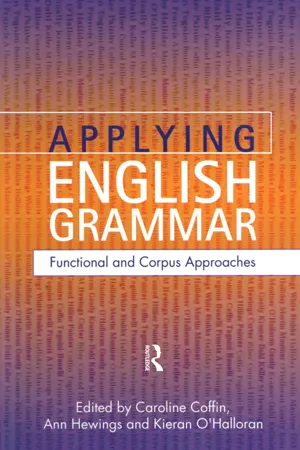
eBook - ePub
Applying English Grammar.
Corpus and Functional Approaches
- 336 pages
- English
- ePUB (mobile friendly)
- Available on iOS & Android
eBook - ePub
Applying English Grammar.
Corpus and Functional Approaches
About this book
Information
Part | 1 |
Introducing Corpus Linguistics and Systemic Functional Grammar
Introduction
(a) Yeah but when you tread on them, they crunch.
(b) The pest status of the cockroach derives mainly from an aesthetic abhorrence of what is regarded as a loathsome intruder.1
One of the above pieces of language is written and the other is spoken, both coming from real sources. If we didn’t know the sources and had to say which was which, it wouldn’t take us very long to decide. We’d no doubt say that (a) is more likely to be spoken and (b) more likely to be written. But to what extent would this be just an intuition about the typicality of a pattern? Up until relatively recently, it would be difficult to respond to such a question with anything other than saying that we’re native speakers of English and in our experience this pattern is common in speech. But now, we are in a powerful position to be able to answer questions such as these. This is because in the last few years the technology has been developed for assembling huge corpora of English as well as the computational methods for searching them quickly. So by consulting a large corpus of spoken language, we can find out that our intuition was correct and that the grammatical pattern in (a) is more common in speech than in writing.
In this Part, Chapter 2 by Ronald Carter draws on corpus studies to shed light on the nature of spoken grammar and how in many ways its patterns differ from those of writing. For example, Carter highlights how an extensive corpus examination reveals specifically spoken grammatical forms such as HEADS. These occur at the beginning of clauses in speech, e.g. in: ‘That girl, Jill, her sister, she works in our office’. From a written point of view, HEADS look suspect since they contain more than one grammatical subject. But this is to ignore their specific function in speech – to help listeners orient to a topic – a function not needed in writing where the information can be more drawn out without causing too much labour in the reader’s processing. Indeed, it is due to the technological advances mentioned above that grammarians are in a stronger position to treat spoken grammar not as inferior to written grammar but as different in kind in a number of ways.
Through using corpus investigation to examine spoken grammar and thus its differences from written grammar, Carter gives us something of a bird’s-eye view of English. But as we descend a little in altitude, we can see very clearly with corpus study that there are interesting and surprising differences in English writing as well, differences that we may well not have been able to work out from intuition alone. Douglas Biber and Susan Conrad’s Chapter 3 compares three different types of written English – academic prose, fiction and journalism, alongside one type of spoken English – conversation. They show how an examination of corpus data reveals interesting and important differences between these registers. Indeed, some of the insights that corpus linguistics provides with regard to English grammar can have valuable applications. In English language teaching the progressive aspect (e.g. we are sitting) has traditionally been thought of as a common choice in conversation. However, Biber and Conrad’s corpus investigation shows that the simple aspect (e.g. we sit) is twenty times more common in conversation than the progressive. Corpus research can, then, be useful in correcting perceptions among language professionals. Moreover, given the breadth and height with respect to English of studies such as Biber and Conrad’s as well as Carter’s, their evidence for variation in English allows us to see the following very clearly: there is no such thing as English in the sense of a uniform, monolithic entity.
Before you read the above two chapters, Elena Tognini-Bonelli usefully introduces you in Chapter 1 to some of the key concepts used in corpus linguistics, e.g. collocation, colligation and the interrelation between lexis and grammar. Not only are theoretical issues with regard to corpora probed here, such as how corpora are defined, but methodological issues are given attention too. You will also get a feel for the different purposes for which corpora can be used, e.g. in translation, and be introduced to the corpus software known as a concordancer. A concordancer is a crucial instrument in that it reveals patterns of lexico-grammatical meaning which, for the most part, users of English are only semi-consciously aware of.
The chapter by Tognini-Bonelli makes clear that having enormous databases of English can be very useful. A database in and of itself, however, can only point to how things are. A census database might tell us that families in the north of a country have on average something close to five children while in the south of a country families on average have something close to one child. So if we came across a family with seven children we might make the reasonable assumption that this family is more likely to be living in the north. But the census information cannot tell us why this is the case. We’d have to consider the differences in context, for example, are salaries bigger in the north than in the south enabling parents to have more children? We’d have to interpret the data by making meaningful connections with the context.
In the same way that the database tells us that sentence (b) at the beginning of this introduction is more likely to be written than spoken it cannot tell us why this is the case. To understand this properly, we have to understand the contexts in which we produce English and how these affect our grammatical choices. Chapter 4 by Jim Martin shows why systemic functional grammar is especially suited to illuminating why grammatical choices in English are functionally motivated in relation to context. He takes us to this conclusion by first providing an overview of other approaches to grammar which have a focus on English structure and then revealing why systemic functional grammar has real explanatory power in illuminating English as a resource for making meaning. For Martin, systemic functional grammar has significant applied benefits, for example, its capacity to assist language learners to communicate more effectively in different registers.
In essence, Martin’s chapter, like the corpus linguistic chapters, takes a bird’seye view on grammar. In Chapter 5, though, Michael Halliday looks at academic English at a lower level of altitude than the corpus linguistic of Biber and Conrad by applying the approach that he pioneered – systemic functional grammar – to scientific English. Halliday argues that the difficulty many people have with scientific writing lies less with vocabulary, its ‘jargon’, but with its grammar. He uses the techniques of systemic-functional grammatical analysis for the purposes of problem-solving: coming up with practical grammatical insights as to why scientific writing can be so inaccessible and thus helping students to understand it.
These five chapters then provide you with ways into corpus linguistics and systemic functional grammar. More importantly, you will see in these chapters the applications and practical value of both approaches as well as the illumination they provide on the English language from a broad perspective.
Note
1 Source for spoken cockroach sentence is S. Eggins (1994) An Introduction to Systemic Functional Linguistics, London: Pinter Publishers. Source for written cockroach sentence is P.B. Cornwall (1968) The Cockroach: A Laboratory Insect and Industrial Pest, London: Hutchison.
1 | Working with Corpora: Iss... |
Table of contents
- Cover Page
- Half Title page
- Title Page
- Copyright Page
- Contents
- Acknowledgements
- Glossary
- General Introduction
- Part 1 Introducing Corpus Linguistics and Systemic Functional Grammar
- Part 2 Getting Down to Specifics with Corpus and Functional Approaches
- Part 3 Critical Text Analysis with Corpus and Functional Approaches
- Index
Trusted by 375,005 students
Access to over 1.5 million titles for a fair monthly price.
Study more efficiently using our study tools.
Frequently asked questions
Yes, you can cancel anytime from the Subscription tab in your account settings on the Perlego website. Your subscription will stay active until the end of your current billing period. Learn how to cancel your subscription
No, books cannot be downloaded as external files, such as PDFs, for use outside of Perlego. However, you can download books within the Perlego app for offline reading on mobile or tablet. Learn how to download books offline
Perlego offers two plans: Essential and Complete
- Essential is ideal for learners and professionals who enjoy exploring a wide range of subjects. Access the Essential Library with 800,000+ trusted titles and best-sellers across business, personal growth, and the humanities. Includes unlimited reading time and Standard Read Aloud voice.
- Complete: Perfect for advanced learners and researchers needing full, unrestricted access. Unlock 1.5M+ books across hundreds of subjects, including academic and specialized titles. The Complete Plan also includes advanced features like Premium Read Aloud and Research Assistant.
We are an online textbook subscription service, where you can get access to an entire online library for less than the price of a single book per month. With over 1.5 million books across 990+ topics, we’ve got you covered! Learn about our mission
Look out for the read-aloud symbol on your next book to see if you can listen to it. The read-aloud tool reads text aloud for you, highlighting the text as it is being read. You can pause it, speed it up and slow it down. Learn more about Read Aloud
Yes! You can use the Perlego app on both iOS and Android devices to read anytime, anywhere — even offline. Perfect for commutes or when you’re on the go.
Please note we cannot support devices running on iOS 13 and Android 7 or earlier. Learn more about using the app
Please note we cannot support devices running on iOS 13 and Android 7 or earlier. Learn more about using the app
Yes, you can access Applying English Grammar. by Caroline Coffin,Ann Hewings,Kieran O'Halloran in PDF and/or ePUB format, as well as other popular books in Lingue e linguistica & Linguistica. We have over 1.5 million books available in our catalogue for you to explore.