eBook - ePub
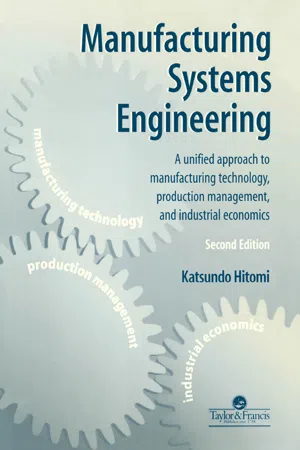
Manufacturing Systems Engineering
A Unified Approach to Manufacturing Technology, Production Management and Industrial Economics
- 560 pages
- English
- ePUB (mobile friendly)
- Available on iOS & Android
eBook - ePub
Manufacturing Systems Engineering
A Unified Approach to Manufacturing Technology, Production Management and Industrial Economics
About this book
This second edition of the classic textbook has been written to provide a completely up-to-date text for students of mechanical, industrial, manufacturing and production engineering, and is an indispensable reference for professional industrial engineers and managers.
In his outstanding book, Professor Katsundo Hitomi integrates three key themes into the text:
* manufacturing technology
* production management
* industrial economics
Manufacturing technology is concerned with the flow of materials from the acquisition of raw materials, through conversion in the workshop to the shipping of finished goods to the customer. Production management deals with the flow of information, by which the flow of materials is managed efficiently, through planning and control techniques. Industrial economics focuses on the flow of production costs, aiming to minimise these to facilitate competitive pricing.
Professor Hitomi argues that the fundamental purpose of manufacturing is to create tangible goods, and it has a tradition dating back to the prehistoric toolmakers. The fundamental importance of manufacturing is that it facilitates basic existence, it creates wealth, and it contributes to human happiness - manufacturing matters. Nowadays we regard manufacturing as operating in these other contexts, beyond the technological. It is in this unique synthesis that Professor Hitomi's study constitutes a new discipline: manufacturing systems engineering - a system that will promote manufacturing excellence.
Key Features:
* The classic textbook in manufacturing engineering
* Fully revised edition providing a modern introduction to manufacturing technology, production managment and industrial economics
* Includes review questions and problems for the student reader
Information
PART ONE
Essentials of Manufacturing Systems
This part describes basic concepts and principles of manufacturing systems and manufacturing systems engineering. Fundamentals of production and manufacturing (Chapter 1) and systems (Chapter 2) are discussed, then manufacturing systems are defined within three aspects—structure (plant layout), transformation (production process), and procedure (manufacturing management) (Chapter 3). In addition, two important modes of production—mass production and multi-product, small-batch production—are mentioned (Chapter 4). Fundamental frameworks of integrated manufacturing [and management] systems are displayed (Chapter 5).
Three major flows in manufacturing pointed out in Chapter 1—the flow of materials, the flow of information (technical, managerial), and the flow of value (or costs)—are related to Parts II, III, and IV.
CHAPTER ONE
Fundamentals of Manufacturing
1.1 Definitions of Production and Manufacturing
1.1.1 Transition of Production Mode
What is Production?
Production is the making of something new—either tangible (‘products’) or intangible (‘services’ that disappear in the very act of their creation). Today intangible ‘ideas’ are also included under the heading of production. Production is one of the most basic and important functions of human activities in modem industrial societies and is now viewed as a cultural activity. This English term appeared in 1483,1 stemming from producere (Latin/lead forward).
Three Modes of Production
The mode of production has changed with time in the following three ways (Encyclopedia Americana, 1965).
- (1) In ancient times nature was the sole source of wealth;2 that is, agriculture, hunting, fishing, mining, and their like were the basic productive activities. This category is now known as primary industry.
- (2) About two hundred years ago, pioneers of economics such as Adam Smith (1723-90), David Ricard (1772-1823), and John Stuart Mill (1806-73) included ‘manufacture’ as an element in the creation of wealth, introducing the concept of ‘vendability: production for the market’. The term ‘manufacture’ originally appeared in 1622, stemming from manu factum (Latin/made by hand). Production in this sense puts special emphasis on making things which are tangible (‘products’). This category is now known as secondary industry, which includes manufacturing, construction, and public utility generation.
- (3) Towards the latter part of the nineteenth century, the concept of ‘utility’ came to be used by the marginal utility economists such as William Stanley Jevons (1831-82), Karl Menger (1840-1921), and Marie Esprit Léon Walras (1834-1910). Economically, utility is an index expressing the degree of satisfaction of a human want. This term originally appeared in 1440, stemming from utilis (Latin/useful). With the introduction of this concept, the meaning of production was widened: 'production is a creation of utility’. Hence it further includes ’services’, that is, accompanying transportation, sales, trade, and other service activities. Now this category is known as tertiary industry.
Free/Economic Goods
As above there is no clear distinction between material (tangible) production and immaterial (intangible) production3 from the standpoint of economics; the only significant distinction has been between the following two goods:
- free goods available in unlimited quantities at no cost, such as air and river water, and hence, need not be produced;
- economic goods limited to a quantity sufficient to satisfy human wants completely.
Economic goods need to be produced at a required time and place with expenditure. In this sense, ’scarcity’ specifies economic goods.
1.1.2 Whatare Production and Manufacturing?
Production and Manuíactureling] Defined
In a narrow sense production is understood to be 'the transformation of raw materials into products by a series of energy applications, each of which affects well defined changes in the physical or chemical characteristics of the materials’ (Danø, 1966).
Since this definition applies only to producing tangible goods (products) such as in the manufacturing and process industries, it is termed manufacturing (or manufacture). A place which executes manufacturing is a 'factory’ or a 'workshop’. Firms concerned with manufacturing are 'manufacturing firms’ or 'manufacturers’.
Today’s Meaning of Manufacturing/Production
The original meaning of manufacture was to make things by hand, as mentioned previously. However, the present meaning has quite widened: 'Manufacturing’ is 'the conversion of a design into a finished product’, and ‘production’ has a narrower sense, namely the physical act of making the product (Young and Mayer, 1984). In 1983 CIRP (International Conference on Production Research) defined manufacturing as ‘a series of interrelated activities and operations involving the design, materials selection, planning, manufacturing production, quality assurance, management and marketing of the products of the manufacturing industries’. Note how this definition includes the inextricable linking of design into the manufacturing system.
'Manufacturing’ should be recognised as a series of productive activities: planning, design, procurement, production, inventory, marketing, distribution, sales, management.
1.1.3 Why is Manufacturing Important?
Manufacturing Matters in Three Features
Manufacturing—the production of tangible goods or products—has a history extending several thousand years and contains the following three important features (Hitomi, 1994).
- (1) Providing basic means of human existence. Without the manufacture or production of goods a human being is unable to live, and this is increasingly so in modem society.
- (2) Creation of wealth of nations. The wealth of a country or a nation is created by manufacturing. A country where manufacturing has been exhaust...
Table of contents
- Cover
- Half Title
- Title Page
- Copyright Page
- Table of Contents
- Foreword
- Preface
- About the author
- PART ONE Essentials of Manufacturing Systems
- PART TWO Process Systems for Manufacturing
- PART THREE Management Systems for Manufacturing
- PART FOUR Value Systems for Manufacturing
- PART FIVE Automation Systems forManufacturing
- PART SIX Information Systems for Manufacturing
- PART SEVEN Social Systems for Manufacturing
- Concluding Remarks
- Review Questions and Problems
- Index
Trusted by 375,005 students
Access to over 1.5 million titles for a fair monthly price.
Study more efficiently using our study tools.
Frequently asked questions
Yes, you can cancel anytime from the Subscription tab in your account settings on the Perlego website. Your subscription will stay active until the end of your current billing period. Learn how to cancel your subscription
No, books cannot be downloaded as external files, such as PDFs, for use outside of Perlego. However, you can download books within the Perlego app for offline reading on mobile or tablet. Learn how to download books offline
Perlego offers two plans: Essential and Complete
- Essential is ideal for learners and professionals who enjoy exploring a wide range of subjects. Access the Essential Library with 800,000+ trusted titles and best-sellers across business, personal growth, and the humanities. Includes unlimited reading time and Standard Read Aloud voice.
- Complete: Perfect for advanced learners and researchers needing full, unrestricted access. Unlock 1.5M+ books across hundreds of subjects, including academic and specialized titles. The Complete Plan also includes advanced features like Premium Read Aloud and Research Assistant.
We are an online textbook subscription service, where you can get access to an entire online library for less than the price of a single book per month. With over 1.5 million books across 990+ topics, we’ve got you covered! Learn about our mission
Look out for the read-aloud symbol on your next book to see if you can listen to it. The read-aloud tool reads text aloud for you, highlighting the text as it is being read. You can pause it, speed it up and slow it down. Learn more about Read Aloud
Yes! You can use the Perlego app on both iOS and Android devices to read anytime, anywhere — even offline. Perfect for commutes or when you’re on the go.
Please note we cannot support devices running on iOS 13 and Android 7 or earlier. Learn more about using the app
Please note we cannot support devices running on iOS 13 and Android 7 or earlier. Learn more about using the app
Yes, you can access Manufacturing Systems Engineering by Katsundo Hitomi in PDF and/or ePUB format, as well as other popular books in Technology & Engineering & Industrial Management. We have over 1.5 million books available in our catalogue for you to explore.