eBook - ePub
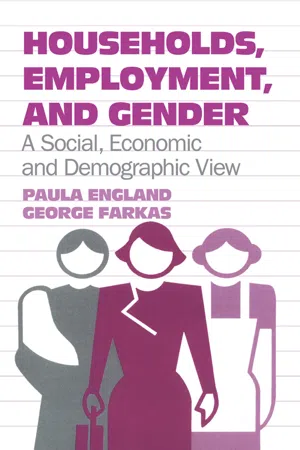
Households, Employment, and Gender
A Social, Economic, and Demographic View
- 248 pages
- English
- ePUB (mobile friendly)
- Available on iOS & Android
eBook - ePub
About this book
During the twentieth century arrangements governing love, work, and their routinization in households and employment underwent a transformation. During this period women gained employment opportunities. This reduced sex differentiation, but did not equalize the roles or power of men and women. The goal of this book is to describe the trends and patterns that remain constant amidst the change, and to provide an integrated framework for understanding them.The authors focus on a three-tier level of integration that is not available in other studies of this kind. First, they combine the topics of households and employment, showing similarities and causal links between household and employment arrangements. Second, a conceptual framework is provided that gives attention to both individuals' choices and to the structural constraints that limit available options. Finally, an integration of economic and sociological views of employment, demographic behavior, and other household behavior is examined.By using both individual and structural views, Paula England and George Farkas provide an overview of this coupling. This work is unique in that it draws from both economics and sociology and from demographers in both disciplines. Households, Employment, and Gender is an analytic synthesis for scholars and an invaluable sourcebook for classes on gender, labor, the family, social demography, economics, and economic sociology.
Information
BIBLIOGRAPHY
| Adams, Bert N. | |
| 1979 | “Mate selection in the United States: A theoretical summarization.” In Burr et al. (eds.), Contemporary Theories About the Family, Vol. I, pp. 259–267. New York: The Free Press. |
| Arnold, F., Bulatao, R., Buripakdi, C., Chung, B., Fawcett, J., Iritani, T., Lee, S., and Wu T. | |
| 1975 | The Value of Children: A Cross-National Study, Vol. 1: Introduction and Comparative Analysis. Honolulu: East-West Institute. |
| Arrow, Kenneth | |
| 1971 | Essays in the Theory of Risk Bearing. Chicago: Markham. |
| 1972 | “Models of job discrimination” and “Some mathematical models of race in the labor market.” In A. Pascal (ed.), Racial Discrimination in Economic Life. Lexington, MA: Lexington, Heath. |
| 1974 | “Limited knowledge and economic analysis.” American Economic Review 64, 1–10. |
| Auerbach, Alan J. and Kotlikoff, Laurence J. | |
| 1984 | “Social security and the economics of the demographic transition.” In H. J. Aaron and G. Burtless (eds.), Retirement and Economic Behavior, pp. 255–278. Washington, D.C.: The Brookings Institution. |
| Bahr, S. J. | |
| 1972 | “A methodological study of conjugal power: a replication and extension of Blood and Wolfe.” Unpublished doctoral dissertation, Washington State University. |
| 1974 | “Effects on power and division of labor in the family.” In L. W. Hoffman and F. I. Nye (eds.), Working Mothers. San Francisco: Jossey-Bass. |
| Balswick, Jack O. and Peek, Charles W. | |
| 1971 | “The inexpressive male: A tragedy of American society.” The Family Coordinator 20, 363–368. |
| Banfield, Edward C. | |
| 1970 | The Unheavenly City. Boston: Little, Brown and Company. |
| Baron, James N. | |
| 1984 | “Organizational perspectives on stratification.” Annual Review of Sociology 10, 37–69. |
| Baron, James N. and Bielby, William T. | |
| 1980 | “Bringing the firm back in: stratification, segmentation, and the organization of work.” American Sociological Review 45, 737–755. |
| 1984 | “The organization of work in a segmented economy.” American Sociological Review 49, 454–473. |
| Barro, Robert J. | |
| 1984 | Macroeconomics. New York: John Wiley and Sons. |
| Bart, Pauline | |
| 1969 | “Why women’s status changes in middle age: The turns of the social ferris wheel.” Sociological Symposium 3, 1–18. |
| Barton, Allen H. | |
| 1968 | “Bringing society back in: Survey research and macro methodology.” American Behavioral Scientist 12, 1–9. |
| 1970 | “Commentary and debate: Allen Barton comments on Hauser’s context and consex.” American Journal of Sociology 76, 514–517. |
| Bean, F., Curtis, R., and Macrum, J. | |
| 1977 | “Familism and marital satisfaction among Mexican Americans: The effects of family size, wife’s labor force participation, and conjugal power.” Journal of Marriage and the Family 39, 759–767. |
| Beck, E. M., Horan, P. M., and Tolbert, C. M. II | |
| 1978 | “Stratification in a dual economy.” American Sociological Review 43, 704–720. |
| 1980 | “Social stratification in industrial society: Further evidence for a structural alternative.” American Sociological Review 45, 712–719. |
| Becker, Gary S. | |
| 1957 | The Economics of Discrimination, 1st ed. (2nd ed., 1971). Chicago: University of Chicago Press. |
| 1964 | Human Capital, 1st ed. (2nd ed., 1975). New York: National Bureau of Economic Research. |
| 1981 | A Treatise on the Family. Cambridge, MA: Harvard University Press. |
| Becker, ... | |
Table of contents
- Cover
- Half Title
- Title Page
- Copyright Page
- Table of Contents
- I. Overview
- II. Households
- III. Employment
- IV. The Future
- Bibliography
- Author Index
- Subject Index
Trusted by 375,005 students
Access to over 1.5 million titles for a fair monthly price.
Study more efficiently using our study tools.
Frequently asked questions
Yes, you can cancel anytime from the Subscription tab in your account settings on the Perlego website. Your subscription will stay active until the end of your current billing period. Learn how to cancel your subscription
No, books cannot be downloaded as external files, such as PDFs, for use outside of Perlego. However, you can download books within the Perlego app for offline reading on mobile or tablet. Learn how to download books offline
Perlego offers two plans: Essential and Complete
- Essential is ideal for learners and professionals who enjoy exploring a wide range of subjects. Access the Essential Library with 800,000+ trusted titles and best-sellers across business, personal growth, and the humanities. Includes unlimited reading time and Standard Read Aloud voice.
- Complete: Perfect for advanced learners and researchers needing full, unrestricted access. Unlock 1.5M+ books across hundreds of subjects, including academic and specialized titles. The Complete Plan also includes advanced features like Premium Read Aloud and Research Assistant.
We are an online textbook subscription service, where you can get access to an entire online library for less than the price of a single book per month. With over 1.5 million books across 990+ topics, we’ve got you covered! Learn about our mission
Look out for the read-aloud symbol on your next book to see if you can listen to it. The read-aloud tool reads text aloud for you, highlighting the text as it is being read. You can pause it, speed it up and slow it down. Learn more about Read Aloud
Yes! You can use the Perlego app on both iOS and Android devices to read anytime, anywhere — even offline. Perfect for commutes or when you’re on the go.
Please note we cannot support devices running on iOS 13 and Android 7 or earlier. Learn more about using the app
Please note we cannot support devices running on iOS 13 and Android 7 or earlier. Learn more about using the app
Yes, you can access Households, Employment, and Gender by Paula England in PDF and/or ePUB format, as well as other popular books in Social Sciences & Business General. We have over 1.5 million books available in our catalogue for you to explore.