This work is a wide-ranging and sensitive examination of the lived experience of intimate stalking victimization. It explores how it feels and what it means to be stalked by a former intimate and how this situation creates dilemmas for victims and their advocates. What is it like to try to become a "victim" in the eyes of the law and then to remain one, when almost anything a woman does to manage the violent emotions of an ex-husband or ex-boyfriend can backfire and discredit her claims? The author draws upon a broad array of rich data, including a survey of college women, courtroom testimony, prosecutors' case files, interviews with victims and observations in a prosecutor's office and a stalking survivor's support group to illustrate the difficulties women face as they work to cope with danger - and to negotiate the hazardous terrain of legal systems - simultaneously. For some victims, Dunn shows, prosecution processes are more traumatic than the events that brought them to seek legal help and her analysis of the historical, cultural and gendered frameworks in which stalking victimization and prosecution takes place accounts for the additional trauma. Definitions of situations and identities are contested rather than given in these arenas where lives and self-concepts rest in the balance. The ways in which we socially construct and confer meaning upon intimate violence and its victims profoundly shape what happens to ordinary women facing extraordinary circumstances. "Courting Disaster" illuminates what we can learn from their experience, whether we are working in these arenas or theorizing about how they do, and sometimes do not, work.
eBook - ePub
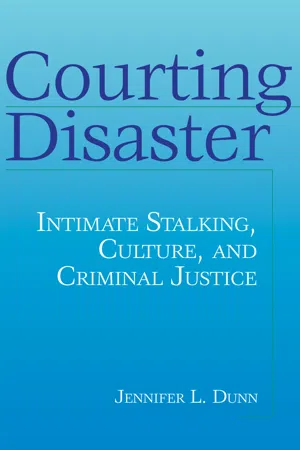
Courting Disaster
Intimate Stalking, Culture and Criminal Justice
- 204 pages
- English
- ePUB (mobile friendly)
- Available on iOS & Android
eBook - ePub
About this book
Information
1 Pursuing Justice:
Setting the Stage for Intimate Stalking Victimization
This book is about women who are being coerced, Intimidated, and stalked by former intimates. It is about the things these women do to manage this situation, and what happens to them as a consequence. Stalking is a behavior that has relatively recently been defined as problematic, and as criminal when violence or the threat of violence occurs. This new category of crime has created a new category of victim, the stalking victim, and this is a story of how some of these new kinds of people come into being, interact with their former partners, and seek help. It is about experiencing stalking victimization and, also, about living through what some women consider a form of secondary victimization by the criminal justice system. We will discover that these are complex and reciprocal processes.
The identity of the stalking victim is not inherent in any person or experience, but is contingent upon interpretation. Thus this book is also an account of the definitional processes that take place as a woman decides that she is a victim of stalking and seeks to convince others of this. It uses a variety of data and methods to examine this phenomenon from the perspectives of both victims and law enforcement agents, and adds to our understanding of attributions of responsibility and blame when violence occurs between intimates. By examining social constructions of this particular type of victimization and the choices stalking victims make, we learn more in general about the forces constraining human decisions.
Stalking victimization is complicated because it is an ongoing process. It often doesn’t stop once the criminal justice system is involved. Women who are being stalked by their former partners face a profound dilemma in their efforts to manage their pursuers and to pursue their cases through the criminal justice system. Like all crime victims, they deal with a justice system that traditionally has depended upon them as witnesses, but not given priority to their needs as victims. Like others who fall prey to intimates, in highly gendered crimes, these women describe working particularly hard to establish and maintain their credibility. Unlike other crime victims, however, they must do so even as they face almost unimaginable difficulties simply getting the criminal behavior to cease.
We shall see that the processual, structural, gendered and relational aspects of stalking victimization can lead to more than the usual frustration with the “system.” Indeed, stalking’s character surely plays a part in these women’s sometimes counter-productive efforts in their own behalf. In turn, victims7 responses may decrease their credibility or permit stalking to escalate or both. If they then fail to gain the assistance of legal advocates, this amplifies feelings of “secondary victimization”—assertions of re victimization by the criminal justice system—even as primary victimization continues.
The nature of intimate stalking cases provides an opportunity to observe women’s strategies for managing interactions with their former partners and with law enforcement, and for managing their “victim” identities, over a period of time. We can thus examine an extended relationship between victims, offenders, and law enforcement actors in ways that few other crimes provide, and that allows for relationships between “victims” and “victimizers” that are far from straightforward or unambiguous. This should be of special interest to victimologists and victim advocates.
What makes intimate stalking victimization sociologically interesting are the ways in which these component features of interaction are shaped by the social structures, cultural frameworks, and institutional organizations within which they take place. The stalking itself, the responses of women to their pursuers, the attributions that criminal justice actors make on the basis of these responses, and the consequences of these attributions for these women are not idiosyncratic actions and events. Rather, they are all influenced and constrained by repertoires of possible and “appropriate” action, cognition, and feeling. These are socially derived, maintained, and reproduced. This book tries to show the reader what it is like to be stalked and to have to convince others that one is truly a stalking victim. In addition, it explores some of the social forces that give these experiences their unique character. And because era, culture and power give to victims’ lives their frightening textures and bitter flavors, these are examined as well.
Consider the following excerpt1 from a preliminary hearing in which the victim was being cross-examined by a defense attorney:
Q: And you’ve had no intention since that time that you filed the restraining order… to ever want to see [the defendant] again, be with him emotionally, physically, or any manner whatsoever, you want the relationship over from that point in time forward, is that correct?
A: I knew that in the back of my mind.
Q: You never wanted to see him again; isn’t that right?
A: Correct.
Q: And you still felt that way continuously from that day forward all the way to today’s date in court; isn’t that right?
A: Correct.
Q: So you’ve never called him anywhere; is that right?
A: I would return. I haven’t initialed [sic] the contact.
Q: You say you returned calls?
A: Yes.
Q: Now, you know that it is a violation of the restraining order for you to call him and for him to even speak to you; isn’t that correct?
A: For him, yes.
Q: So why do you call him and encourage him to talk to you with those phone calls?
A: When he is calling and threatening my parents, when he is saying he is on his way, I will talk to him.
The defense attorney tried to cast doubt on this woman’s claim that she was a stalking victim by questioning her in a way that suggested that she continued to have a voluntary relationship with the defendant even after obtaining a restraining order. Even as she attempted to define herself as being forced to continue interacting with her former partner, he sought to portray her as a willing participant.
When a woman claims that her lover or spouse is victimizing her (whether the crime is battery, sexual assault, or stalking), the intimacy, and all of the cultural meanings that attach to romantic and sexual relationships between men and women, become part of what she and others must take into account when they decide what kind of situation they are facing and what is to be done about it.
A COURSE OF CONDUCT: HISTORICAL, CULTURAL, AND HIERARCHICAL FRAMEWORKS
Before being immersed in the horrors and the struggles of stalking victims, however, some empirical and theoretical background information is necessary. This chapter begins with a general introductory discussion of the new laws criminalizing stalking, paying particular attention to the history of this legislation in California (the first state to enact an ti stalking statutes), the distinct nature of stalking as a recognized crime, and by comparing the demographics of stalking victimization to domestic violence victimization. Not only is stalking a fairly newly defined crime, but like the gendered crimes of rape and domestic violence, it depends on evidence of victim noncompliance with the defendant and evidence that the victim did not precipitate or encourage the defendant’s behavior. This makes the behavior of victims particularly susceptible to “framing” processes, in which their actions in response to stalking come under scrutiny and their character questioned. Prosecution and conviction of stalkers is especially difficult. This, coupled with the ongoing nature of being stalked, may likely make the victim feel twice victimized.
We then review briefly some literature on the social construction of reality and the prosecution of “gender violence” crimes to place intimate stalking into context. This is followed by a description of the research setting and the data from which this study emerged.
The Historical Context for AntiStalking Legislation
Like all social problems, stalking has a history. While behaviors that we now define as stalking may have been occurring as long as there have been intimate relationships, it is only recently that stalking has become framed as “something we should do something about” and then criminalized. Kathleen Lowney and Joel Best (1995) examined media sources and found that it wasn’t until 1989, when television actress Rebecca Shaeffer was murdered in the doorway of her apartment building by an obsessed fan, that stalking became a social issue. This well-publicized incident was one of many cases of celebrity stalking that received widespread attention in the popular press and contributed to a new construction of stalking as a social problem. This social problem became institutionalized with the passage of antistalking legislation. However, the legislation, like the enforcement processes I will describe, fails to encompass the complexity of stalking victimization.
After four women, all but one of whom had sought help from authorities2, were killed by former partners in a six-week period in Orange County in 1990 (Beck 1992), California became the first state in the nation to enact antistalking legislation, followed shortly by 47 additional states and the District of Columbia (Lowney and Best 1995); Maine uses an antiterroriz-ing statute. According to Lowney and Best (1995) the success of claims about stalking and the resulting legislation in the other states were linked to support by battered women’s movements and victims’ rights movements, who framed stalking as a form of domestic violence and used their considerable resources to keep stalking a topic for public discourse and action. With the enactment of antistalking legislation, victims had a new resource: “upon criminalizing stalking, the state becomes responsible for investigating the crime, initiating the proceedings, providing the evidence, and seeking punishment” (Morville 1993:927). In spite of continuing concerns about the constitutionality and effectiveness of such legislation,3 antistalking measures are seen as more effective than the civil remedies they replace, such as injunctions against harassment that require women to hire private attorneys and seek monetary damage but fail to otherwise incapacitate stalkers. Legislation is supported by victims’ rights advocates, including the National Organization for Victim Assistance, the National Victims Center, and the National Battered Women’s Law Project (Morville 1993).
The largest study to date of stalking incidence and prevalence was conducted by Patricia Tjaden and Nancy Thoennes (1998a) as part of the federally funded National Violence Against Women Survey for November 1995 through May 1996. In their description of their findings, Tjaden and Thoennes describe stalking as follows:
Stalking generally refers to harassing or threatening behavior that an individual engages in repeatedly, such as following a person, appearing at a person’s home or place of business, making harassing phone calls, leaving written messages or objects, or vandalizing a person’s property. These actions may or may not be accompanied by a credible threat of serious harm, and they may or may not be precursors to an assault or murder (1998a: 1)
Stalking is typically defined by the statutes as “willful, malicious, and repeated following and harassing of another person” (National Criminal Justice Association 1993:13). Some states additionally proscribe “lying in wait,” nonconsensual communication, and “surveillance.” A “pattern of conduct” is required by most states to establish that stalking has occurred, meaning that a series of acts occurs, and many insist that a “reasonable fear” for safety or of death or bodily injury exists. California, like most states, has the narrowly constructed requirement that a “credible threat” be made by the stalker, “with the intent to place [the victim] in reasonable fear of death or great bodily injury or of the death or great bodily injury of his or her immediate family.” This threat does not have to be a verbal threat, but can include conveying threat using other symbolic means (National Institute of Justice 1996:6).
Initially, there were numerous and problematic variations in the language of these statutes that made them extremely difficult to enforce, leading to congressional hearings resulting in the Project To Develop a Model Antistalking Code for States (National Criminal Justice Association 1993). The National Institute of Justice, through Police Executive Research Forums, surveyed police chiefs in 248 local, county, and state police agencies, as well as in the largest cities in ten states with no Forum, and criminal justice agencies and police agencies in Australia, Canada, and the United Kingdom. Thirteen percent of the respondents in states with stalking laws in place said their laws offered inadequate intervention options, stating that “specific actions should be defined as stalking to avoid confusion with other charges” and that their laws were “too vague, overly broad, or too difficult to prove and prosecute” (National Criminal justice Association 1993:40). In addition, the researchers found the language of “credible threat” to be problematic, noting that it “might be construed as requiring an actual verbal or written threat,” that many stalkers engage in conduct that is threatening, and that, therefore, this language referring to such behavior ought not to be included in the model code (National Criminal Justice Association 1993:45).
Several writers have drawn attention to problems associated with the credible threat provision of much antistalking legislation. Michèle In-grassia (1993), reporting in Newsweek, described the ineffectiveness of stalking laws in deterring some offenders, in cases that don’t appear to meet the law’s requirements and in which victims are thus unable to obtain protective orders. These cases, Ingrassia says, “underscore the difficulty of creating laws to deal with the murky issues of stalking… the most difficult problems lie in discerning a credible threat from a casual remark” (1993:28). She goes on to say that 75 to 80 percent of cases involve people who were once married or dating, complicating the ability of observers to adjudicate contested claims about statements the alleged stalker makes. Lieutenant John Lane of the Los Angeles Police Department’s Threat Management Unit, in his testimony before the U.S. Senate, had this to say:
The one hurdle that we have trouble with in meeting the standards of our stalking law is the credible threat issue. The first element is simply to establish a pattern of willful, malicious conduct wherein a suspect follows and annoys and basically establishes a pattern of fear. But it also has to rise to a standard of where that suspect makes a credible threat, an overt threat, a communication to do them great bodily injury or death… It has been our experience to date that many of our suspects don’t do that. They do everything but, and they scare the heck out of our victims… they don’t come right out and—I mean, it is implied by many of their acts and behaviors, but they don’t actually communicate that direct threat. (U.S. Senate 1993:72)
Lieutenant Lane suggests that the language of the California antistalking legislation be modified to eliminate the credible threat standard in favor of a “reasonable fear” standard, in which stalking behaviors create a reasonable fear in a reasonable person that he or she is in danger. Even this standard may be problematic, however; according to Joan Zorza of the National Battered Women’s Law Project, “Courts often look at the ‘reasonable’ man standard [b]ut what might not be terrifying to a reasonable man is terrifying to a reasonable woman” (cited in Furio 1993:91).
Zorza’s statement suggests a perception of male bias in legal definitions, and there continue to be struggles over constructions of the imaginary person in legal discourse (Woody and Viney 1996). Several critics of the presumably gender neutral “reasonable person” standard (that has begun to replace the “reasonable man”) argue that even this hypothetical is usually male, and that a “reasonable woman” standard is more appropriate in highly gendered crimes such as rape and in sexual harassment cases (Ehrenreich 1990; Forell and Matthews 2000; Leland 1994; Pinkston 1993; Scheppele 1991). In the case of stalking, Forell and Matthews argue that this crime is “viewed through a male-focused lens” (2000:123) that circumscribes reasonableness, and thus stalking laws “remain an inadequate remedy” (2000:129). They conclude:
Applying the reasonable woman standard in determining what conduct creates reasonable fear explicitly incorporates the perspective of women, the group most commonly stalked and the group with the most to fear when they are stalked. This gendered standard will help decision makers recognize that the “reasonable” fear of bodily injury that must be shown for a stalking remedy should be women’s fear, not men’s. (2000:129)
Others find problems associated with the “reasonable woman” standard; for example, Eisen man (1995) claims the standard is “culture-bound” and biased against men.
The National Institute of Justice, in drafting model antistalking legislation, tried to address issues of overbreadth and vagueness, as well as problems associated with due process (ambiguously worded statutes may not provide individuals with “fair notice” of the types of behavior proscribed by the law), the restriction of movement, proportionality in sentencing, double jeopardy, and the right to bail. Despite the efforts of this group, both the adequacy and constitutionality of even the model legislation continues to be problematic (Faulkner and Hsiao 1994). The American Civil Liberties Union (as well as the National Organization for Men) has expressed concerns that overzealous prosecutors could use the laws to “suppress the rights of political dissidents and others” (Morville 1993). In sum, it appears to be extremely difficult to draft legislation that is sufficiently inclusive to encompass the range of dangerous behaviors in which stalkers engage, and at the same time excludes behavior protected by the First and Fifth Amendments.
The National Institute of Justice project members “expressed concern and serious reservations about the current trend in this country of ‘federalizing’ any high-profile or topical crime issue in this country” and they concluded that Congress “should not enact a federal antistalking law states and local governments are best situated to formulate and enforce laws that proscribe stalking behavior” (National Criminal Justice Association 1993: 12). The federal government did, however, distribute the Model Antistalking Legislation to the States, and with the help of the National Criminal Justice Association, conducted a series of regional seminars to assist the States in developing and implementing legislation (National Institute of Justice 1996). Many states have since revised their antistalking legislation to address the issues described above. However, findings from the National Violence Against Women Survey led Tjaden and Thoennes (1998a) to conclude that credible threat requirements should be eliminated entirely from antistalking statutes, as fewer than half of the women they identified as stalking victims had been explicitly threatened by their stalkers.
Stalking As Intimate and Gendered Violence
We will see that “credible threat” represents only one ambiguous aspect of intimate stalking when we examine actual cases. Another aspect is intimacy. What is the relationship between stalking and other forms of intimate violence? The National Violence Against Women Survey cited above provides useful data in this regard, not only because a representative sample of 8000 men and 8000 women w...
Table of contents
- Cover Page
- Half title
- Title Page
- Copyright Page
- Dedication
- Contents
- Acknowledgments
- 1 Pursuing Justice: Setting the Stage for Intimate Stalking Victimization
- 2 I’ll Be Watching You: The Lived Experience of Intimate Stalking
- 3 Innocence Lost: Accomplishing Victimization in the Domestic Violence Unit
- 4 A Romantic Interlude: Cultural Constructions of Courtship and Compliance
- 5 Damned If You Do: Social Problems Work, Emotion Work, and the Worthy Victim
- Bibliography
- Index
Trusted by 375,005 students
Access to over 1.5 million titles for a fair monthly price.
Study more efficiently using our study tools.
Frequently asked questions
Yes, you can cancel anytime from the Subscription tab in your account settings on the Perlego website. Your subscription will stay active until the end of your current billing period. Learn how to cancel your subscription
No, books cannot be downloaded as external files, such as PDFs, for use outside of Perlego. However, you can download books within the Perlego app for offline reading on mobile or tablet. Learn how to download books offline
Perlego offers two plans: Essential and Complete
- Essential is ideal for learners and professionals who enjoy exploring a wide range of subjects. Access the Essential Library with 800,000+ trusted titles and best-sellers across business, personal growth, and the humanities. Includes unlimited reading time and Standard Read Aloud voice.
- Complete: Perfect for advanced learners and researchers needing full, unrestricted access. Unlock 1.5M+ books across hundreds of subjects, including academic and specialized titles. The Complete Plan also includes advanced features like Premium Read Aloud and Research Assistant.
We are an online textbook subscription service, where you can get access to an entire online library for less than the price of a single book per month. With over 1.5 million books across 990+ topics, we’ve got you covered! Learn about our mission
Look out for the read-aloud symbol on your next book to see if you can listen to it. The read-aloud tool reads text aloud for you, highlighting the text as it is being read. You can pause it, speed it up and slow it down. Learn more about Read Aloud
Yes! You can use the Perlego app on both iOS and Android devices to read anytime, anywhere — even offline. Perfect for commutes or when you’re on the go.
Please note we cannot support devices running on iOS 13 and Android 7 or earlier. Learn more about using the app
Please note we cannot support devices running on iOS 13 and Android 7 or earlier. Learn more about using the app
Yes, you can access Courting Disaster by Jennifer L Dunn,Jennifer Dunn in PDF and/or ePUB format, as well as other popular books in Social Sciences & Sociology. We have over 1.5 million books available in our catalogue for you to explore.