
- 448 pages
- English
- ePUB (mobile friendly)
- Available on iOS & Android
eBook - ePub
Hydrogen Aircraft Technology
About this book
Liquid hydrogen is shown to be the ideal fuel for civil transport aircraft, as well as for many types of military aircraft. Hydrogen Aircraft Technology discusses the potential of hydrogen for subsonic, supersonic, and hypersonic applications. Designs with sample configurations of aircraft for all three speed categories are presented, in addition to performance comparisons to equivalent designs for aircraft using conventional kerosine-type fuel and configurations for aircraft using liquid methane fuel. Other topics discussed include conceptual designs of the principal elements of fuel containment systems required for cryogenic fuels, operational elements (e.g., pumps, valves, pressure regulators, heat exchangers, lines and fittings), modifications for turbine engines to maximize the benefit of hydrogen, safety aspects compared to kerosine and methane fueled designs, equipment and facility designs for servicing hydrogen-fueled aircraft, production methods for liquid hydrogen, and the environmental advantages for using liquid hydrogen. The book also presents a plan for conducting the necessary development of technology and introducing hydrogen fuel into the worldwide civil air transport industry. Hydrogen Aircraft Technology will provide fascinating reading for anyone interested in aircraft and hydrogen fuel designs.
Information
Chapter 1
HYDROGEN IN AERONAUTICS
1.1. BALLOONS
The first use of hydrogen in aeronautics was for the inflation of balloons. Early balloon experiments were flown using hot air as the lifting medium. Hydrogen was first employed when, in France, a small silk balloon was constructed by the Roberts brothers, under the direction of physicist J.A.C. Charles. It was flown in Paris on August 27, 1783. It rose to a height of 3000 ft and traveled a distance of 15 mi despite a pouring rain.
Later that year, on December 1, a larger hydrogen-filled model, 26 ft in diameter, was launched which carried two passengers, the physicist Charles and one of the Roberts brothers. The flight traveled 25 mi from Paris in less than 2 h. It occurred just 10 d after the historic flight by the Montgolfier hot-air balloon in which human passengers were first carried aloft.
The Charles/Roberts hydrogen balloon was made of silk covered with a thin layer of crude rubber. The gondola was suspended from a net of ropes which encompassed the gas bag. A valve at the top of the bag could be opened by a rope available in the gondola to release hydrogen gas when the aeronauts wished to descend. Stones were carried along to serve as ballast. This fundamental arrangement is still used today, with changes reflecting primarily only the use of modern materials.
Hydrogen balloons have been used for scientific work, e.g., to study the physics and chemistry of the atmosphere and the stratosphere, to provide meteorological data, and to gather evidence of the effect of high altitude on human performance; for military operations, such as reconnaissance and observation; as well as for sport. The use of hydrogen in balloons has largely been supplanted today by helium because of safety considerations.
1.2. AIRSHIPS
Airships came into being as a result of man’s desire to control the direction and speed of flight. Numerous attempts were made to achieve such control with balloons without measurable success. In 1852, a Frenchman, Henri Giffard, constructed an airship 144 ft long and 40 ft in diameter (88,000 ft3) on which he mounted a steam engine of his own design. The steam engine weighed 350 lb and developed 3 hp. It turned a propeller 11 ft in diameter. Giffard flew this hydrogen-filled airship from the Hippodrome in Paris on September 24, 1852, attained an estimated speed of 6 mph, and demonstrated the first appreciable control of a lighter-than-air craft.
In 1872, a German engineer, Paul Haenlein, developed and flew an airship powered by an internal combustion engine. The engine was fueled by gaseous hydrogen which was drawn from the lifting cells of the airship envelope.
The first airship to possess sufficient control to enable it to return to its point of departure was a battery-powered French design. This hydrogen-filled craft was constructed and flown by Charles Renard and A.C. Krebs on August 9, 1884. It completed a circular flight of about 5 mi.
A significant step leading to the use of hydrogen in commercial air transportation occurred in 1900 when the first rigid airship designed by Count Ferdinand von Zeppelin, the LZ-1, made a successful flight. In 1911, commercial air operations were started by a German transportation company, Deutsche Luftschiffahrts-Aktien-Gesellschaft, commonly known as DELAG, using five Zepellin airships. In the next 5 years, before the operations were terminated in 1914 by World War I, these hydrogen-filled airships made 1600 flights carrying 37,250 passengers without injury.
In addition to this activity in Germany, in the first decade of the 20th century, most of the major countries in the world were active in airship development and construction: Great Britain, France, and the U.S. in particular. Italy, Spain, Poland, Switzerland, and Japan were actively engaged in airship operations.
World War I catalyzed tremendous development activity in airships on both sides. Many hydrogen-filled airships and barrage balloons saw service. The Treaty of Versailles prohibited further development in Germany and stopped manufacture of airships by the Zepellin company until the U.S. Navy commissioned construction of the airship LOS ANGELES, designated by Zeppelin as the LZ-126, as a part of wartime reparations. In Ocober 1924, the Zeppelin factory at Lake Constance, Germany completed construction of the LZ-126, inflated it with hydrogen, and delivered it to the U.S. by a transatlantic flight. In the service of the U.S. Navy, the LOS ANGELES was inflated using helium. It had a displacement of 2,470,000 ft3. The LOS ANGELES was flown a total of 4320 h and was decommissioned at Lakehurst, NJ in 1932. It was dismantled in 1939.
The next airship built by the Zeppelin Co., the LZ-127, was the original GRAF ZEPPELIN. It was completed in September 1928 and saw 9 years of continuous, successful service using hydrogen as the lifting medium. When decommissioned in 1937, this 3,708,600-ft3, rigid airship had made 590 flights (including 144 ocean crossings, mostly between Germany and South America) and had flown 1,053,391 mi carrying 13,110 passengers and 235,300 lb of mail and freight.
In 1936, the Zeppelin Co. built the LZ-129, a 7,063,000-ft3 design christened HIN-DENBURG. It was 803 ft long and employed the conventional Zeppelin design with an aluminum framework consisting of 36 longitudinal girders and 15 wire-braced main transverse frames. Hydrogen-filled gas cells were contained within the cloth envelope covering the framework. The gas cells were rubber-covered cloth. Propellers turned by four 1100-hp Mercedes-Benz diesel engines provided the HINDENBURG with a maximum speed of 84 mph. At a cruising speed of 78 mph, the airship had a range of 8750 mi, carrying 50 passengers in spacious accommodations.
In 1936, the first commercial air service across the North Atlantic between Germany and the U.S. was initiated with the HINDENBURG carrying 1002 passengers on ten scheduled round-trips. Eastbound crossings averaged 65 h; westbound, 52 h.
On May 6, at the end of the westbound leg of the first round-trip scheduled for the 1937 season, while approaching its mooring mast at Lakehurst, NJ, the HINDENBURG burst into flames and was destroyed. Of the 96 persons on board, 35 lost their lives. In addition, one member of the ground crew was killed when crushed by one of the engines from the airship. These were the first passenger fatalities in the history of commercial airship operations.
The cause of the fire is officially recorded as being due to a discharge of atmospheric electricity in the vicinity of a hydrogen leak. There had been an electrical storm in the vicinity of Lakehurst 2 h before the arrival of the HINDENBURG and the theory is credible. A strong case has also been made for the possibility that the fire was initiated as an act of sabotage by antifascist sympathizers.1 Elements of a photographic flash bulb were found in the wreckage, and subsequent investigation indicated that a member of the crew, killed in the accident, was involved in suspicious activity both before and during the flight.
In any event, the destruction of the HINDENBURG signaled the end of the use of hydrogen in commercial airships. In retrospect, the safety record compiled by the hydrogen-filled airships was phenomenal considering the very fragile containment system used for the combustible gas.
The LZ-130, also bearing the name GRAF ZEPPELIN, was a slightly modified sister ship of the HINDENBURG. It was designed to use helium and was completed and tested (using hydrogen) in September 1938. However, the tense international situation at the time was sufficient grounds for the U.S. to refuse permission to export helium to Germany, so the LZ-130 was flown only with hydrogen for a limited number of exhibition flights over Germany. Both the original and the new GRAF ZEPPELINs were dismantled in 1940 to provide aluminum for the Nazi war effort.

FIGURE 1–1 B-57 aircraft used in 1956 NACA test of hydrogen as fuel for aircraft engines.
1.3. NACA-LEWIS FLIGHT RESEARCH PROGRAM
In 1955, a report by Silverstein and Hall of the (then) NACA-Lewis Flight Propulsion Laboratory was published in which the potential of liquid hydrogen as a fuel for use in both subsonic and supersonic aircraft was explored.2 Among other advantages, the significant improvement in maximum range which theoretically can be realized by using hydrogen was observed.
As a result of this study, an experimental program was initiated to demonstrate the feasibility of burning hydrogen in a turbojet engine at high altitude. A U.S. Air Force B-57 twin-engine medium bomber was modified as shown in Figure 1–1 and first flown in 1956. Liquid hydrogen (LH2) was carried in a tank located under the left wing tip. Gaseous helium was carried in a tank of similar size and shape under the right wing tip for use as a pressurant.
Initially in the program, the hydrogen tank was pressurized to 55 psia with gaseous helium to cause the LH2 to flow to a heat exchanger where it was vaporized. The heat exchanger was a simple air/hydrogen design where air under flight conditions provided the heat sink to convert the LH2 to gaseous state.
The regulator which controlled the flow rate of the gaseous hydrogen (GH2) to the engine was located downstream of the heat exchanger. It was a ratio controller which utilized the metered JP fuel flow from the conventional engine speed control to adjust the flow of hydrogen gas from the heat exchanger. The weight flow rates were adjusted to be inversely proportional to the heats of combustion of the two fuels:
When the engine was operating on hydrogen, the flow of JP fuel was recirculated back to its tank.
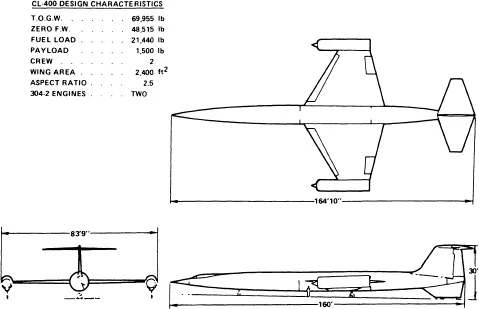
FIGURE 1–2 Three-view drawing of proposed Lockheed CL-400 hydrogen-fueled reconnaissance aircraft.
During the later phases of the program, instead of the pressure-feed system, the LH2 was pumped from the wing tip tank using a specially designed, positive displacement pump located within the tank but shaft-driven from outside the tank by a hydraulic motor.3 The last three flights in the test program were conducted using the pump-fed system.
In the NACA hydrogen flight test program, the converted B-57 aircraft took off and climbed to the altitude and speed specified for the test, typically 50,000 ft and Mach 0.75 over Lake Erie, using conventional JP...
Table of contents
- Cover
- Title Page
- Copyright Page
- Table of Contents
- Chapter 1 Hydrogen in Aeronautics
- Chapter 2 The Potential of Hydrogen as Fuel for Aircraft
- Chapter 3 Early Transport Aircraft Studies
- Chapter 4 Subsonic Transport Aircraft
- Chapter 5 Hypersonic Aircraft
- Chapter 6 Military Aircraft
- Chapter 7 Airport Requirements
- Chapter 8 Safety
- Chapter 9 Environmental Considerations
- Chapter 10 Implementing Use of Hydrogen as Fuel for Aircraft
- Chapter 11 The Outlook for Hydrogen: A Summary
- Appendix
- Index
Trusted by 375,005 students
Access to over 1.5 million titles for a fair monthly price.
Study more efficiently using our study tools.
Frequently asked questions
Yes, you can cancel anytime from the Subscription tab in your account settings on the Perlego website. Your subscription will stay active until the end of your current billing period. Learn how to cancel your subscription
No, books cannot be downloaded as external files, such as PDFs, for use outside of Perlego. However, you can download books within the Perlego app for offline reading on mobile or tablet. Learn how to download books offline
Perlego offers two plans: Essential and Complete
- Essential is ideal for learners and professionals who enjoy exploring a wide range of subjects. Access the Essential Library with 800,000+ trusted titles and best-sellers across business, personal growth, and the humanities. Includes unlimited reading time and Standard Read Aloud voice.
- Complete: Perfect for advanced learners and researchers needing full, unrestricted access. Unlock 1.5M+ books across hundreds of subjects, including academic and specialized titles. The Complete Plan also includes advanced features like Premium Read Aloud and Research Assistant.
We are an online textbook subscription service, where you can get access to an entire online library for less than the price of a single book per month. With over 1.5 million books across 990+ topics, we’ve got you covered! Learn about our mission
Look out for the read-aloud symbol on your next book to see if you can listen to it. The read-aloud tool reads text aloud for you, highlighting the text as it is being read. You can pause it, speed it up and slow it down. Learn more about Read Aloud
Yes! You can use the Perlego app on both iOS and Android devices to read anytime, anywhere — even offline. Perfect for commutes or when you’re on the go.
Please note we cannot support devices running on iOS 13 and Android 7 or earlier. Learn more about using the app
Please note we cannot support devices running on iOS 13 and Android 7 or earlier. Learn more about using the app
Yes, you can access Hydrogen Aircraft Technology by G.Daniel Brewer,G. Daniel Brewer in PDF and/or ePUB format, as well as other popular books in Technology & Engineering & Aeronautic & Astronautic Engineering. We have over 1.5 million books available in our catalogue for you to explore.