In this powerful and wonderfully accessible meditation on psychoanalysis, hermeneutics, and social constructivism, Donnel Stern explores the relationship between two fundamental kinds of experience: explicit verbal reflection and "unformulated experience," or experience we have not yet reflected on and put into words. Stern is especially concerned with the process by which we come to formulate the unformulated. It is not an instrumental task, he holds, but one that requires openness and curiosity; the result of the process is not accuracy alone, but experience that is deeply felt and fully imagined.
Stern's sense of explicit verbal experience as continuously constructed and emergent leads to a central dialectic at the heart of his work: that between curiosity and imagination, on one hand, and dissociation and unthinking acceptance of the familiar on the other. The goal of psychoanalytic work, he holds, is the freedom to be curious, whereas defense signifies the denial of this freedom. We defend against our fear of what we would think, that is, if we allowed ourselves the freedom to think it.
Stern also shows how the unconscious itself can be reconceptualized hermeneutically, and he goes on to explore the implications of this viewpoint on interpretation and countertransference. He is especially persuasive in showing how the interpersonal field, which is continuously in flux, limits the experience that it is possible for participants to reflect on. Thus it is that analyst and patient are together "caught in the grip of the field," often unable to see the kind of relatedness in which they are mutually involved.
A brilliant demonstration of the clinical consequentiality of hermeneutic thinking, Unformulated Experience bears out Stern's belief that psychoanalysis is as much about the revelation of the new in experience as it is about the discovery of the old
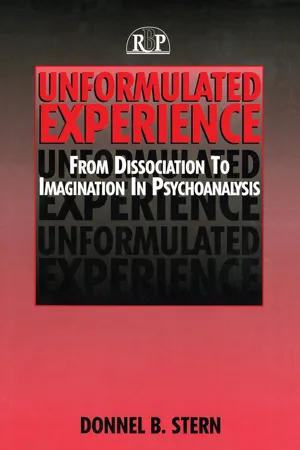
eBook - ePub
Unformulated Experience
From Dissociation to Imagination in Psychoanalysis
- 310 pages
- English
- ePUB (mobile friendly)
- Available on iOS & Android
eBook - ePub
About this book
Information
Experience Formulated and Unformulated
1
The Given and the Made
A Constructivist View
The great challenge for psychoanalysis has always been the problem of the given and the made. Somehow we must negotiate the dual claims that experience is discovered, that it is structural and preexists our knowing of it, and that it is entirely understandable in phenomenological terms, by means of grasping the process of understanding itself. At issue in psychoanalysis are nothing less than our conceptions of mind and experiencing: consciousness, the unconscious, the defenses, the nature of representation and interpretation, and the kind of significance we attribute to language. The concept of unformulated experience, which takes center stage in chapter 2 and holds it throughout the book, is the central character in my approach to these problems, and the coming chapters are my attempts to grapple with them. In this introductory chapter, I offer the broadly hermeneutic context, the narrative tradition, so to speak, from within which the main character speaks.
Winnicott's Dialectic
Winnicott (1971) taught that the given and the made constitute a paradox. We take given experience and make it into something that is our own; but it is just as true that we make or construct experience only by avoiding violations of the givens that define what the experience can be. Any experience is sometimes given, sometimes made, depending on how and when we look at it. Sometimes, perhaps when we are wisest, it is both.
But in day-to-day life, many experiences are more one than the other: for the painter, the painting is more made than given; for a rider, the horse is more given than made. It is true that the love of the rider for the horse and for the feeling of the ride are "made" things, but they are quite inextricable from the very "given" horse, because one loves and rides this horse, no other. The painting derives from experiences of the artist's that may have been reworked, recontextualized, and more fully imagined, but that nevertheless have a given reality as well; that is why, for the painter if not for the viewer, the art always exists in the context of the given events of the painter's life.
But even so, the painting remains more made than given, and the horse is more given than made. The import of Winnicott's paradox is not that the contributions of our constructions and given reality are always equal, but that both are always present and inextricable from one another. It does not violate the terms of the paradox to observe that the given and the made are also a dialectic.
To accept that experience is made in the present is to accept that other experience was made in the past. The givens in experience are not timeless essences; they themselves had to be constructed, once upon a time. And if an organized experience becomes part of a later moment, the organization it brings into that later moment will no longer be entirely appropriate. It will need to be recontextualized—and recontextualization is really just another word for yet another episode of organization, or reinterpretation. Every moment is made anew, although the experiences of moments past have a very great deal to do with what the experience of each present moment will be.
And so another way to talk about the given and the made is to refer to what we can make now out of what we have made then, or in the words of François Jacob (1982), the possibilities of actuality: "Whether in a social group or in an individual, human life always involves a continuous dialogue between the possible and the actual. A subtle mixture of belief, knowledge, and imagination builds before us an ever changing picture of the possible. It is on this image that we mold our desires and fears" (p. viii).
Psychoanalytic Constructivism
In the recent literature of American psychoanalysis, it has been constructivist or hermeneutic writers who have most frequently considered the problem of the given and the made. Hermeneutic contributors, whose work originates in a philosophical program, have included Jürgen Habermas (1971), Paul Ricoeur (1970, 1977, 1981), Roy Schafer (1976, 1978, 1983, 1992), Barry Protter (1985, 1988, 1996), and Donald Spence (1982, 1987, 1988a, 1990, 1993), and, from a more fully social-constructionist position, Philip Cushman (1991, 1994, 1995).
Hermeneutics and constructivism are very closely related. The term "constructivism" has been used in recent psychoanalysis to designate a perspective with a hermeneutic agenda, but one that originates less in philosophy than in the clinical recognition that experience is at least partially indeterminate and is created in interaction. Contributions to constructivism have been made by Aron (1996), Fourcher (1992, 1996), Mitchell (1988, 1993), and me (Stern, 1983, 1985, 1987, 1989, 1990, 1991, 1992a, 1994, 1996a, b), but the most influential contribution has been the groundbreaking series of papers published over the last 15 years by Irwin Hoffman (1983, 1987, 1991, 1992a, b, 1994, 1996), whose "social constructivism" (more recently, "dialectical constructivism") has left an indelible impression on a generation of clinicians. Along with Edgar Levenson (1972, 1983, 1991)—whose work is not, however, constructivist in orientation (Hoffman, 1990; Levenson, 1990)—Hoffman has been more responsible than anyone else for the widespread acceptance of the analyst's inevitable unconscious participation and embeddedness in the ongoing therapeutic interaction.
However else they may be different, constructivist and hermeneutic accounts have in common the basic tenet that an individual's experience has no natural or intrinsic organization. It does not come prefigured. Until it is organized, which is accomplished by interpreting it, or taking a perspective on it, experience is "fundamentally ambiguous" (Mitchell, 1993, p. 57). This principle makes it quite natural and comfortable for the constructivist unconscious to be conceptualized as unformulated experience.
Psychoanalytic constructivists understand experience as the joint creation of interacting influences from within and without—from the ephemera of social life and the more enduring structures of one's inner world. Internal and external influence also continuously shape each other, partly by changing form and actually becoming forms of one another. One's structured inner world affects the kind of shaping influence one unwittingly selects from the social world; and reciprocally, as relationships in the social world impact on the inner world, they eventually become more inner than outer, by means of the various processes that fall under the rubric of internalization. The creation of experience in constructivist terms is continuous: each moment's experience arises from the experience of the moment before.
Constructivists also share a view of time. We are used to thinking of the present as the creation of the past. The succession of moments in a life is not arbitrary, after all. There is emotional and intellectual continuity in the way we create each moment from the previous one, so that the past must be contained and reflected in every new construction of the present; and just as the previous moment shapes the present one, the distant past, through a long succession of moments, shapes both, so that our early years have the greatest influence on us. The distant past survives in the shape of the present, as in traditional psychoanalytic thought.
But just as constructivism teaches us to see the inner and the outer as a dialectic in continuous flux, it sensitizes us to the dialectic of time: the past is as much the creation of the present as the present is of the past. History, after all, can only be told looking backwards. In Frank Kermode's (1985) words, "meaning changes, including past meaning; and . . . the past is inextricable from the present of the interpreter. There and then cannot be detached from here and now, and objectively inspected. The past becomes, at least in part, a construction of the present" (p. 7).
When we talk about the given and the made in psychoanalysis, then, we are referring not to the contrast between humanly constructed meaning and what came before it, but to what we find pre-constructed and what we make from it. The events of the moment combine with the preconstructed past, and the world of others falls together with our preconstructed inner life.
The making of a reflective experience from preconstructed materials requires engaging those materials, or taking a perspective on them. We can say the same thing from the other direction: to take a perspective on the preconstructed—that is, to think about it or experience it from a particular vantage point—is what it means to interpret it. Novel experience, or discovery, is creative interpretation; cliché is trivial, uninspired, or conventional interpretation. But even the most commonplace and familiar experience is interpretive or perspectivistic activity.
Now, consider that to take a perspective is to back away far enough to gain critical distance. It is not possible, after all, to "know" something we are so fully involved in that we are only living it. Such a state, if it were all we had, would be something like what Freud meant by "primary narcissism" or the illusory fusion with objects that Lacan calls "the Imaginary." In a world we could not back away from, there would be no such thing as subjectivity. There would be no experiencing at all, just an undifferentiated wholeness of which each of us would be an equally undifferentiated part.
Postmodernism: The Verbal in the Nonverbal
We know only one means by which we can create critical distance: symbolic representation. It is only our capacity for symbolization that makes possible interpretation and the adoption of perspective. It is only symbolization that makes possible knowable experience.
To grasp or interpret (or construct or know) experience requires that symbols be related to one another. A symbol unrelated to other symbols, a symbol with a solitary existence, would not be a symbol. It would be a thing—and a thing without meaning, at that. Meaning depends on the relations and differences between symbols, not on fixed identifications of symbols with entities. It is the relations of symbols, or signs, with one another that define them and lend them interpretive power. This was the primary insight of linguist Ferdinand de Saussure (1966; for an introduction, see Culler, 1976), whose groundbreaking work, soon after the turn of the century, is the source of both structuralism and poststructuralism. (Anthropologist Gregory Bateson [1972] made the same point in a different and quite independent way.) When I point to an object and say, "That is a tree," for example, my designation is meaningless unless we also know that this "tree-thing" is not grass, corn, bushes, shrubs, hammers, houses, clouds, and so on. "Green" does not derive its meaning by identification with a particular wavelength of light, but by its difference from turquoise, chartreuse, blue, yellow, and red.
A system of interrelated symbols is a language, and that thought quickly leads us from the conclusion that all experience is interpretation to the thought that all interpretation is linguistic. If experience is interpretation, language is the condition for experiencing.
This view of language, along with psychoanalytic constructivism itself, are outgrowths of the many streams of contemporary thought (philosophy of science, poststructuralism, pragmatism, and contemporary hermeneutics) that join together in the one great postmodern conclusion: all experience is linguistic.1 The corollary is social construction: Language itself represents the joined voices and perspectives of those who have come before us, and into whose world we are born ("thrown," as Heidegger puts it). In our turn, we will contribute, usually in ways we cannot imagine and seldom come to know, to the ways our descendants know life. Our ancestors' social innovations are "sedimented" (Foucault) in our languages, and therefore in our individual lives, in ways we so take for granted that we tend to accord them the status of objective, essential, unchanging reality. They have become "normalized" (Foucault, 1980), or "legitimized" and "objectivated" (Berger and Luckmann, 1967). Reality is a social construction, though it feels so familiar and inevitable that we can scarcely believe it is anything other than natural.
These are the ideas that inaugurated postmodernism and cast suspicion on the modernist project of discovering the one objective truth through the application of science and reason. If reality is not a simple, objective given that preexists us, and that will go on beyond us in just the same way, there are no essences to search for. Knowledge is a cultural product, a reflection of the values of the culture in which it is made. Knowledge commonly enforces such values, in fact. As examples that are now so thoroughly evident and familiar that they have themselves become part of convention, consider the enforcement effects of our own field's past "knowledge" of the psychopathology of homosexuality and of the "natural" femininity reflected in certain roles and activities. Recent efforts to demonstrate the "objective" inferiority of African-American intelligence are especially to the point, because many of the people who found this "finding" repugnant nevertheless were reduced to attacking it by trying to show that it was not "good science." The very fact that the argument was couched in scientific terms led these people into the reflexive acceptance that it could be challenged only on its own grounds. Now, that is knowledge functioning as enforcement: the power of science to shape the "fact" under consideration was accepted unquestioningly by even those who did not believe the "fact" that was shaped. By its very existence, knowledge affirms the sources of expertise that certify and underwrite it in the first place.
One of the lessons of all this is that if there is no one thing to know, there can be no one way of knowing. Methods of knowing, too, are social constructions, and therefore imbued with unexamined assumptions and biases, so that no method or technique can be trusted as the road to truth, as we once trusted science to be. Science remains crucial; but it is crucial as a method, one that should be studied for its inevitable political and moral implications, and not as the method of producing knowledge.
The traditional metaphor of language as the mirror of nature, a means for representing what is real, has lost all viability. It used to seem that language obeyed human command with the same absence of resistance or will demonstrated by a screwdriver or a knife and fork. No more. In a very real sense, language uses us; we have become the utensils. Language is no longer our tool, but the very crucible of our experience. The world has turned upside down, or at least our picture of it has.
Hermeneutics and Poststructuralism
The word "postmodernism" covers a great deal of ground, and only part of that ground lies under the foundation of this book. Poststructuralism, the loosely defined set of ideas most commonly associated with Derrida, Lacan, Foucault, and their colleagues and students, is probably what most people think of as postmodernism. But for the most part, poststructuralism has not been the ground of my thinking, because for most poststructuralists there is no particular truth to be learned, only prior (and basically arbitrary) ways of understanding to be deconstructed, freeing meanings that had been obscured. Understanding, in the usual sense in which it is conceived in psychoanalysis—the direct understanding of experience—is not the aim. Instead, the goal is the uprooting and exposure of the inconsistencies and hidden purposes inherent in the concepts we employ in conventional understanding. Even Lacan, for whom "Truth" is actually of paramount importance, and "recognizing, respecting, and speaking it are . . . unequalled acts of virtue" (Bowie, 1991, p. 112), considers that what is true "cannot inhere in individual states of mind or states of affairs, and can only be syncopated and spasmodic" (p. 114). Truth for Lacan is found in error, misapprehension, nonsense, word-play, and the weird juxtapositions of dreams. Truth "can as easily be fabricated from lies and evasions as from a plain man's report on things as they are" (p. 114). This "truth of the speaking subject" is not what most American analysts mean when they refer to interpretation and understanding, nor is it what either I or the hermeneutic philosophers who have inspired me mean by those terms.
On the other hand, it has been the poststructuralists more than any others, and especially Foucault (1980; see chapter 8), who have brought to our thinking a new sensitivity to the ubiquity of power relations. Power has an unconscious structuring role in every interaction, including every interaction between analyst and patient, because each of us is defined by his or her place in systems of difference: gender, ethnicity, age, and so on. Apart from critical theorists, such as Jürgen Habermas (e.g., 1971), hermeneuticists have not often acknowledged that their analyses are necessarily embedded in power relations. This lack will have to be addressed if hermeneutics is to continue being useful to psychoanalysis.
In the coming years, the rest of psychoanalysis will begin to catch up with its feminists and theorists of gender (e.g., J. Mitchell, 1974; Dinnerstein, 1976; Kristeva, 1980; Fast, 1984; Irigaray...
Table of contents
- Cover
- Title
- Copyright
- Dedication
- Contents
- Preface
- Acknowledgments
- Part I. Experience Formulated and Unformulated
- Part II. Reconsidering Self-Deception: Toward a Theory of Dissociation
- Part III. Unformulated Experience in the Work of the Analyst
- Notes
- References
- Index
Trusted by 375,005 students
Access to over 1.5 million titles for a fair monthly price.
Study more efficiently using our study tools.
Frequently asked questions
Yes, you can cancel anytime from the Subscription tab in your account settings on the Perlego website. Your subscription will stay active until the end of your current billing period. Learn how to cancel your subscription
No, books cannot be downloaded as external files, such as PDFs, for use outside of Perlego. However, you can download books within the Perlego app for offline reading on mobile or tablet. Learn how to download books offline
Perlego offers two plans: Essential and Complete
- Essential is ideal for learners and professionals who enjoy exploring a wide range of subjects. Access the Essential Library with 800,000+ trusted titles and best-sellers across business, personal growth, and the humanities. Includes unlimited reading time and Standard Read Aloud voice.
- Complete: Perfect for advanced learners and researchers needing full, unrestricted access. Unlock 1.5M+ books across hundreds of subjects, including academic and specialized titles. The Complete Plan also includes advanced features like Premium Read Aloud and Research Assistant.
We are an online textbook subscription service, where you can get access to an entire online library for less than the price of a single book per month. With over 1.5 million books across 990+ topics, we’ve got you covered! Learn about our mission
Look out for the read-aloud symbol on your next book to see if you can listen to it. The read-aloud tool reads text aloud for you, highlighting the text as it is being read. You can pause it, speed it up and slow it down. Learn more about Read Aloud
Yes! You can use the Perlego app on both iOS and Android devices to read anytime, anywhere — even offline. Perfect for commutes or when you’re on the go.
Please note we cannot support devices running on iOS 13 and Android 7 or earlier. Learn more about using the app
Please note we cannot support devices running on iOS 13 and Android 7 or earlier. Learn more about using the app
Yes, you can access Unformulated Experience by Donnel B. Stern in PDF and/or ePUB format, as well as other popular books in Psychology & Philosophical Hermeneutics. We have over 1.5 million books available in our catalogue for you to explore.