![]()
1
Starting phonetics
This chapter will look at what we already know about phonetics, exploring writing and spelling, texting and talking. It looks at the relationship between speaking and spelling and between speech sounds, letters of the alphabet and symbols. The IPA chart and transcription are introduced and the different types of phonetics (articulatory, acoustic, auditory), accents, our attitudes to what people sound like, and the phonetics/phonology interface.
1.1 WHAT WE ALREADY KNOW
1.1.1 Writing
Before we look more deeply into phonetics, it is worth finding out what we already know about this subject. Far from being a strange and different discipline, phonetics touches our everyday lives in a huge number of ways and has done so since the moment we were born (and maybe even earlier, while we were still in the womb). Phonetics, of course, is the study of speech sounds, but before we can really get to grips with these, we need to dispel a few myths about writing and spelling, and explore the relationship between the spoken and written forms of languages.
Most of us learn to speak very early in our lives but at school we all grapple with the intricacies of writing. Around the world, the first writing system many of us use is based on applications of the Extended Latin Alphabet (ELA). (If you are not sure what this means, check it out by looking at the fonts and symbols available on your computer.) Our familiarity with this alphabet, and with other alphabets such as the Greek alphabet, depends very much on where we live in the world. In the Faroe Islands, for example, shapes such as æ, ø and ð are part of everyday orthography (see Figure 1.1). In Greece, ε, β and Φ are taken for granted in the same way. It is shapes like these from the ELA plus a few extras from the Greek alphabet that we use to ‘write phonetics’. We give the name transcription to this writing and instead of referring to letters, we call the shapes that we use symbols.
Figure 1.1
Faroese street sign meaning ‘Doctor’s surgery’.
One advantage to transcribing is that once you have learnt the various symbols of the International Phonetic Association’s alphabet1 (reproduced in what is called the IPA chart on page xiv), you can write down what people are saying regardless of the language they are speaking. This is a massive bonus! You can write down what people are saying not only in English, French and Spanish, but also in Chinese, Korean, Russian, Arabic or Cherokee without ever having to learn a new writing system at all. With training, you can learn to write down the speech sounds of any one of the 5,000 to 8,000 living languages spoken in the world today.
1.1.2 Spelling
Writing is one thing, but spelling is quite another. Some languages have what we call ‘phonetic spelling’ – when you write words in normal orthography, it is almost the same technique as transcribing them because particular letters of the alphabet or specific groups of letters always refer to the same sound. In fact, the correct term for this is phonemic spelling. So, in languages like Malay, for example, or Italian, once you have learnt the spelling-to-sound rules, you can often say words out loud and sound quite authentic even without knowing the language itself. Dutch, too, has a reasonably phonemic spelling system and many syllabaries are phonemic in structure, but perhaps the most phonemic spelling system of all is the Mkhedruli alphabet used to write Georgian (see Figure 1.2). Developed as early as the third century AD, every distinctive sound has its own orthographic representation. In comparison, a language like English is a learner’s nightmare and this is true whether you are a native-speaker at school learning to spell and read or a non-native speaker learning to read, write and pronounce the language.
Figure 1.2 Example of Georgian writing from The North Wind and the Sun.2 Source: Shosted & Chikovani (2006).
Ex 1.1
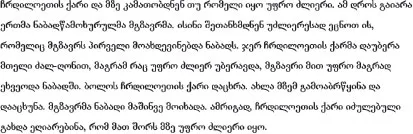
Look at the following short utterances written in Georgian:
Unless you know the language and have learnt how to read it, you will not be able to read (1)–(5) above. However, once they are re-written, using transcription (based on broad phonetic symbols for Georgian) you will find you can easily begin to read them and say them aloud. You won’t sound exactly like a native speaker of the language, but at least you can give it a try:
(1) [nela] slowly
(2) [dalaki] barber
(3) [guda] leather bag
(4) [zari] bell
(5) [tseri] thumb
Hint: [e] is similar to the sound in English bed, [ɑ] is similar to the sound in English palm.
(Note the convention of placing phonetic transcriptions inside a pair of square brackets.)
A language more familiar to many of us is Italian. In Italian, c(c) followed by <a>, <u> or <o> reflects the [k]-sound (like the second sound in the English word skin). In English, however, this same sound can be spelled c(c) in cake or occur, k or ck in kick, (c)q(u) in words like racquet, bouquet, unique, queue (which starts [kj-] when we say it, as if it ought to be spelled <ky>) or quiet (which starts [kw-], as if it was spelled <kw>). But in phonetic transcription (sometimes also called ‘phonetic spelling’) every time you hear a [k]-sound, you write a k-shape – Italian casa would look more like <kasa> and English cake, occur and kick (provided we just concentrate on the [k] sound) more like <kake, okur, kik> while racquet, bouquet, unique, queue and quiet would be transformed into something more like <raket, bouket, yunike, kyue, kwiet>. Of course, there are still glaring problems in the English words, but the Italian example is now almost a proper phonetic transcription, [kasa].
The vagaries of English spelling were encapsulated once and for all by the spelling-reformer and playwright, George Bernard Shaw, who invited us to read the English word fish spelled ghoti: effect...