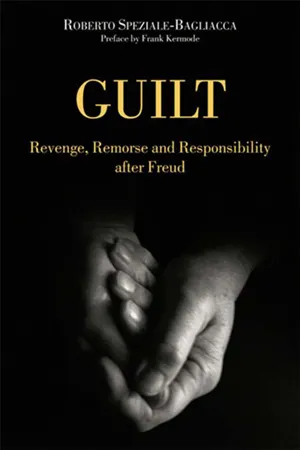
Guilt is an original, closely argued examination of the opposition between guilty man and tragic man. Starting from the scientific and speculative writings of Freud and the major pioneers of psychoanalysis to whom we owe the first studies of this complex question, Roberto Speziale-Bagliacca goes on to focus on the debate between Klein and Winnicott in an enlightened attempt to remove blame and the sense of guilt from religion, morality and law.
Drawing on an impressive range of sources - literary, historical and philosophical - and illustrated by studies of composers, thinkers and writers as diverse as Mozart and Chuang Tzu, Shakespeare and Woody Allen, Guilt covers a range of topics including the concept of guilt used within the law, and the analyst's contribution to the client's sense of guilt.
Previously unavailable in English, this book deserves to be read not only by psychoanalysts, philosophers. scholars and forensic psychiatrists interested in the theory of justice, but also be the ordinary educated reader.
- 256 pages
- English
- ePUB (mobile friendly)
- Available on iOS & Android
eBook - ePub
About this book
Information
Chapter 1
A view from the past
Young criminals are often extremely loath to admit that their parents might be bad or guilty and yet are only normally reluctant to acknowledge that they themselves are bad or guilty. This book offers a series of reflections that may allow us to formulate some hypotheses capable of explaining apparently paradoxical phenomena such as this.
Sigmund Freud never actually wrote a book dedicated entirely to guilt, but the various comments he made on the subject throughout his work make him the true initiator of the study of the sense of guilt and certainly the first person to approach the question systematically. Moreover, Freud the thinker shed much light on the logic upon which guilt is based. We shall be looking at the meaning of the term “logic” (or ethos) at greater length later, so readers who find themselves unable to grasp its meaning immediately should bear with me. Freud was gifted with deep insight into certain aspects of the world of guilt, and this enabled him to embark on a difficult enterprise whose conclusion, however, he did not live to see: the construction, piece by piece, of the psychological as opposed to the moral or legal category of guilt. There were at least two sides to Freud’s project: one was to look at the multiple aspects of the sense of guilt, the other to examine the responsibility human beings bear for all forms of objective guilt, that is to say, guilt that is felt as a result of causing harm to another person.
In order to give an idea of the break with tradition brought about by psychoanalysis in its early stages, it is perhaps worth describing the cultural climate that still prevailed at the time when Freud, who had already made significant advances in his understanding of the sense of guilt, was writing The Ego and the Id or The Economic Problem of Masochism, in other words around 1923 or 1924. To this end we need only read, for example, the entry under “guilt” in the famous Dictionary of Philosophy and Psychology, edited by James M. Baldwin (at the time a professor at Princeton University) and published in 1925. Leading contemporary scholars and thinkers from America and Europe were invited to contribute to this work: Pierre Janet, for example, the great psychologist from the Sorbonne, a protégé of Charcot, the man who was to contend with Freud the credit for being the first person to introduce the concept of the unconscious; John Dewey, William James and C.S. Pierce, the acknowledged fathers of American pragmatism, as well as the Italian anthropologist, neurologist and psychiatrist Enrico Morselli (whom Freud a year later in a letter to Weiss called “an absolute jackass”).
The entry reads as follows:
[Guilt is] the state of having committed a crime, or consciously offended against moral law. The absence of guilt is innocence. The view of guilt differs according as the standpoint is that of law or that of morality. From the former point of view guilt means a transgression of a positive law, though this view is often modified in the judgement passed upon the act by taking into account the transgressor’s knowledge or ignorance of the law, and even his temptations to transgress. From this point of view it has been regarded as the contrary of merit.
The conclusion to this article by Professor W.R. Sorley of the University of Cambridge suggests that he was writing without any significant psychological sources to draw on:
Merit is only present when the moral action is performed in opposition to a psychically present immoral tendency; guilt is present only when the immoral action is performed in spite of a psychically present moral consciousness.
Although meant for a dictionary of psychology, Sorley’s article concentrates solely on objective guilt and makes no reference to personal experience, to “sense of guilt” or remorse. He mentions the fact that a person has to be conscious of having caused offence, he talks about a psychically present immoral tendency and refers to other phenomena relating to moral conscience, but goes no further than that. The impression is that he had absolutely no conception of “sense of guilt”. One would have thought that inadequate definitions such as this would find no place in a post-Freud dictionary of psychology, but the reality was different.
Freud’s insights were also to affect our understanding of the terms Sorley was looking at: responsibility, crime and wrong-doing. Freud was a champion of psychic determinism, which has had many eminent advocates since ancient times. One such was the second-century AD figure of Galen of Pergamon, the leading exponent of Greco-Roman medicine before its decline. Galen asked himself the question: how can one praise or reprimand, hate or love (and thus also blame) a person who is not good or bad as such but only because of his or her disposition, which is clearly the result of other factors? If one pursues this line of reasoning, a person need not feel any sense of guilt; but equally the question has to be asked whether it is possible to talk of authentic voluntary participation in a guilty act.
For Galen, the causes that have a determining effect on people’s freedom are the processes that form the embryo and the climatic, food and environmental factors that influence the state of the body. Accordingly, in his view, the clinician should not judge the patient. Judgement and criticism are incompatible with the desire to understand and to heal. But, as will become clearer in the chapters to come, it is not only the physician who should not judge.
Freud’s discovery of the dynamic unconscious, which enabled him to argue that our Ego is not as free as we would all like it to be and that no-one is responsible for his unconscious, seems to belong to a very similar perspective. That guilt should not be a question of judgement is also suggested by the fact that one synonym of guilt is “error”. The idea that guilt is linked to error has survived across the ages, from Homer to the present day, in the word fault or the French faute, Italian fallo, Spanish falta, which can all refer to both “blame” and “error”.
What do we really mean when we talk about guilt as a psychological category? Several emotional as well as theoretical obstacles stand in the way of a simple answer to this question. We can begin by saying that guilt and sense of guilt have entered the common vocabulary we all use and have become part of the language itself. For many guilt has replaced the idea of “sin” and, paradoxically, even the idea of “cause”; we can see this when, in an example of the survival of animistic thinking, we say that an overflowing river is to blame if someone drowns.
Since time immemorial, the idea of relinquishing the perspective that looks at things in terms of guilt (based on the need to find a culprit, to punish and be punished) and giving up the hope of redemption has always seemed to provoke panic and anxiety. The Galen perspective unleashes fears of anarchy, ungovernability, destructive impulses and nihilism.
Often, though not always, people are unable even to conceive of a way of thinking about guilt which departs from this traditional approach. The reasons for these fears, this difficulty, are deeply rooted: our entire civilisation has indeed been built on the ethos of guilt and responsibility.
The function of the analyst
Our analyses teach us that there are people in whom self-criticism and moral conscience — in other words, highly valued achievements of the psyche — are unconscious, and, as such, their most relevant effects … not only the deepest things but also what are for the Ego the highest things can be unconscious.(Freud, The Ego and the Id)
On the subject of guilt, the science founded by Freud has always found itself in an impasse. This contradiction has been described by the French researcher Jacques Goldberg, who has made an effort to understand the fundamental importance of guilt in psychoanalytical theory and practice. Expecting the psychoanalytical approach to this subject to offer a morality that would be expressed in terms of the imaginary, or even in terms of ideology, he was disappointed that this was not the case. “Instead of freeing us from guilt, psychoanalysis has no difficulty in saying that we are all guilty and more ‘immoral’ than we think. But our guilt is often unconnected with any motivations we might adduce”. However, he asks: “can we do without this idea? Indeed, what, according to Freud, constitutes the universe of mental illness if not the painful feelings connected to guilt and the expectation of punishment? And did not Freud even go so far as to compare psychoanalysis to a legal hearing during which the culprit has to be discovered and, in some way, forced to confess?”1 In his very direct way Goldberg points to a series of problems, including the judgemental moralism that seems to underlie Freud’s metaphor. Is this analysis accurate or is it unfair? This book is an attempt to examine these questions.
Later Freud was to look more closely at the complications of guilt/sin, but initially his interest was attracted by something much more limited, something which caused his patients particular suffering. As he studied the crazy, cruel and punitive way obsessives constantly reproached themselves, he discovered that self-accusation came back “unchanged but rarely in a way to draw attention to itself, thus remaining for some time as a pure sense of guilt without content”.2 Since nowadays we are accustomed to the idea that there is a vast unconscious world inside us all, it is perhaps difficult to appreciate the brilliance of this observation and the originality of the model Freud was working out. He was immediately aware of the complexity of the subject. His metaphors almost seemed to turn emotion into a person, an interlocutor: “The conscious Ego stands in the presence of obsessive representation as if facing something extraneous that it does not trust”. He also talks about the appearance of depression: the Ego can be “affected by a form of episodic melancholy”.3
More than ten years later, his thinking became more precise and concrete; he talked of a “sense of guilt about which we know nothing … an awareness of guilt … which we must define as unconscious, although this is an apparent contradiction in terms. It has its source in certain remote psychic processes, but is constantly revived in the temptation that is renewed at every relevant occasion, and on the other hand gives rise to a lurking, waiting anxiety, an expectation of disaster, connected through the idea of punishment to the internal perception of temptation”.4 Not only is the Ego not master in its own house, to use his famous metaphor, but it would not even recognise all the drives that make it act. These drives are also to be found in the moral and religious sphere.
If accepted completely, these ideas call into question traditional ethics as well as our everyday sense of morality. Freud moves into a bewildering area that defies easy understanding: “the obscurity that still envelops unconscious senses of guilt has not been illuminated by any discussions about it. All that has happened is that the complications have multiplied”, he sums up.5
It was at this point that Freud started to become interested in the origins of the sense of guilt. He wavered between two explanations which both ultimately proved to be of little use in dealing with patients. On the one hand, in Totem and Taboo, one of his most daring and controversial works, he posited a connection between the sense of guilt and a primitive situation that had obtained at the dawn of time, a situation in which the father was domineering and jealous, kept all the women for himself and drove away his children as they grew up. Guilt results from the murder of this father (a “criminal act”, thus objective guilt) committed jointly by his children, but it is also generated by the ambivalence felt by the children: “they hated the father, a powerful obstacle to their need for power and their sexual claims, but they also loved and admired him”. After committing patricide the sons consumed the totemic meal which allowed them to internalise the father: this was the beginning of a process of identification with the hated and beloved father—enemy.
In Totem and Taboo Freud does not say which of these elements is to be considered the primary source of guilt. The situation is complex, the result of a combination of determining factors: “it is probable that … the moral conscience is born, on the basis of an emotional ambivalence, out of specific human relations which create this ambivalence”, as well as out of certain “conditions”.6 However, it is not easy to discard the hypothesis that, although the story has the truth-content of an allegory, Freud the writer (if not exactly Freud the theoretician) sees the hate of the sons as originating in the violence of the father. This question was later to give rise to much discussion. This sense of guilt led to the two principal taboos of totemism: the bans on patricide and on incest.
However, as we said, Freud’s thinking was also moving in another direction. In Beyond the Pleasure Principle (1920) he sought to explain the roots of the sense of guilt by referring to the death wish; in other words, the tendency of the psychic apparatus to try to reduce tensions completely and to restore all living things to the inorganic state (“every living being necessarily dies by natural causes”). This idea of a ”death instinct/wish“ is a hypothesis which Freud himself called ”speculative“ but which he used to explain various phenomena observable in the relationship with the patient. The antagonist of the death wish is the life instinct, whose task is to tame and free the death instinct, turning it to the outside through the use of the muscles. This is at the origin of the concepts of the destructive drive, the drive to possess and the will to power.
This concept of Freud’s provoked several radical reactions: Ernest Jones was one of the many who criticised him, arguing that the idea ran counter to all biological principles. And even today the most reliable theories seem to prove Jones right: for biologists death remains a mystery.7
One of the many possible explanations for this change in direction is that Freud probably realised that he lacked an adequate theory or strategy for dealing therapeutically with the “complicated”, disturbing and previously unsuspected experience of guilt and consequently felt forced to step outside psychology. He did not turn to theology, moral philosophy or law, but nonetheless had to move away from too close a relationship with the patient. In this sense we can say that Freud at this point had yet to fully explore the psychological dimension of guilt.
Freud thought he could deal with guilt by shifting it (into biology) or by condensing it (for example, in the myth of Oedipus).8 By doing so, however, all he was doing was following his customary approach of moving between myth and biology. However strange it may seem now, he was u...
Table of contents
- Cover
- Half Title
- Title Page
- Copyright Page
- Dedication
- Excerpts
- Table of Contents
- Foreword by Frank Kermode
- After re-reading: a preface
- Chapter 1
- Chapter 2
- Chapter 3
- Chapter 4
- Chapter 5
- Chapter 6
- Chapter 7
- Chapter 8
- Chapter 9
- Chapter 10
- Chapter 11
- Appendix: a note on terms
- Postscript
- Notes
- Bibliography
- Name index
- Subject index
Trusted by 375,005 students
Access to over 1.5 million titles for a fair monthly price.
Study more efficiently using our study tools.
Frequently asked questions
Yes, you can cancel anytime from the Subscription tab in your account settings on the Perlego website. Your subscription will stay active until the end of your current billing period. Learn how to cancel your subscription
No, books cannot be downloaded as external files, such as PDFs, for use outside of Perlego. However, you can download books within the Perlego app for offline reading on mobile or tablet. Learn how to download books offline
Perlego offers two plans: Essential and Complete
- Essential is ideal for learners and professionals who enjoy exploring a wide range of subjects. Access the Essential Library with 800,000+ trusted titles and best-sellers across business, personal growth, and the humanities. Includes unlimited reading time and Standard Read Aloud voice.
- Complete: Perfect for advanced learners and researchers needing full, unrestricted access. Unlock 1.5M+ books across hundreds of subjects, including academic and specialized titles. The Complete Plan also includes advanced features like Premium Read Aloud and Research Assistant.
We are an online textbook subscription service, where you can get access to an entire online library for less than the price of a single book per month. With over 1.5 million books across 990+ topics, we’ve got you covered! Learn about our mission
Look out for the read-aloud symbol on your next book to see if you can listen to it. The read-aloud tool reads text aloud for you, highlighting the text as it is being read. You can pause it, speed it up and slow it down. Learn more about Read Aloud
Yes! You can use the Perlego app on both iOS and Android devices to read anytime, anywhere — even offline. Perfect for commutes or when you’re on the go.
Please note we cannot support devices running on iOS 13 and Android 7 or earlier. Learn more about using the app
Please note we cannot support devices running on iOS 13 and Android 7 or earlier. Learn more about using the app
Yes, you can access Guilt by Roberto Speziale-Bagliacca in PDF and/or ePUB format, as well as other popular books in Psychology & Jurisprudence. We have over 1.5 million books available in our catalogue for you to explore.