The wisest teachings of Buddhism say that, like all oppositions, one must move beyond gender. But as Serinity Young shows in this enlightening work, the rhetoric of Buddhist texts, the symbolism of its iconography, and the performative import of its rituals, tell different, and often contradictory, stories. In Courtesans and Tantric Consorts, Serinity Young takes the reader on a journey through more than 2000 years of biographical writings, iconographic depictions, and ritual practices revealing Buddhism's deep struggles with gender.
Juxtaposing empowering images of women with their textual repudiation, beginning with the Buddha himself who abandoned his wife; tantric courtesans who are considered necessary to male enlightenment with fertility rituals designed to ensure male offspring; tales of gender-bending gods and goddesses with all male heavens; Serinity Young draws on a vast range of sources to reveal the colourful, and often troubling, mosaic of beliefs that inform Buddhist views about gender and sexuality.
eBook - ePub
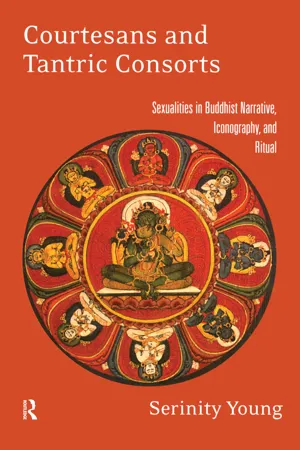
Courtesans and Tantric Consorts
Sexualities in Buddhist Narrative, Iconography, and Ritual
- 298 pages
- English
- ePUB (mobile friendly)
- Available on iOS & Android
eBook - ePub
Courtesans and Tantric Consorts
Sexualities in Buddhist Narrative, Iconography, and Ritual
About this book
Information
PART I
Life of the Buddha
CHAPTER 1
REJECTION AND RECONCILIATION
REJECTION: THE PRINCE IN THE WOMEN’S QUARTERS
As a young man the Buddha is said to have lived a carefree, luxurious life in which he was purposely protected from the harsher realities of human existence. His father, King Śuddhodana, conspired in this deception due to a dream the Buddha’s mother, Queen Māyā, had at the time of his conception. She dreamed a white elephant approached her, struck her side with its trunk, and then entered her womb.1 When sages were consulted about the dream, they predicted it meant Queen Māyā was pregnant with a son who would become a cakravartin, either a great king or a great ascetic. Hearing that, the Buddha’s father was determined to shape his son’s future toward kingship and away from asceticism by focusing him on life’s pleasures, which he did by removing all unpleasant sights from the palace compound. Inevitably, cracks began to appear in Śuddhodana’s fortifications, and what followed next is crucial to understanding the one-pointedness of the Buddha’s spiritual quest. When he was thirty years old he rode out of the palace and was radically changed by four visions created by the gods. On four consecutive days the Buddha mounted his chariot and left through one of the four palace gates. Each day, during his ride, he had a different vision. For the first time in his life he saw an old man, followed by a sick man, and on the third day, a dead man. These three visions introduced him to the existence of suffering and to the transitory nature of the human condition. His fourth and final vision, that of a male ascetic, became the solution to the existential problem of suffering and impermanence posed by the first three visions. He would become an ascetic and seek a way to liberate himself from the repetitive cycle of birth, death, and rebirth.
This well-known story is fraught with meaning for Buddhists, beginning with its emphasis on the number four: four days, four gates representing the four cardinal points, and four visions. Four is a number signifying wholeness in South Asia,2 and in this instance it signifies the Buddha’s sudden, but complete, grasp of all existence: all beings experience the suffering of becoming sick, growing old, and dying, only to once again be reborn and go through the same process, endlessly caught on the Wheel of Becoming.
The story is meant to express the Buddha’s shock, the shock of a thirty-year-old man for whom this was news, and to awaken those who hear the story into realizing that they too, like the Buddha, live as if such suffering does not exist. The biographies stress that the Buddha was a handsome and coddled prince, a young man of overly refined sensitivities, to make his realization more palpable, so that we can comprehend how these four encounters changed his life. The story tries to make us understand that if we, too, truly looked reality in the face, as the Buddha did in these visions, we would recoil from the pleasures of life and ask, as he did, Is this all there is, or is there something beyond what we now know, a way out of the inevitable suffering of growing old, being ill, and dying? In this way, as the Buddha begins his search, the story invites us to join him.
The story also anticipates its audience’s reluctance to abandon worldly life and it gets around this by lingering over just what the Buddha is giving up, particularly his sexual involvement with women. The Lalitavistara, hereinafter the LV, refers to this period of the Buddha’s life as when “the Bodhisattva resided in the women’s quarters” (bodhisatvasya-antaṃpura-madhyagatasya), sometimes translated as the harem.3 Further, it lists the enjoyment of women as one of the activities of a bodhisattva.4 A bodhisattva is someone who has made the vow to become a buddha, and is the term used for the Buddha before his enlightenment. The Buddhacarita, hereinafter the BC, also refers to the antampura, which includes courtesans (vāramukya), and refers to the Buddha as a captive of women who are skilled in sexual pleasure.5 He also has wives, who will be discussed at length in chapter 5. The ensuing drama of the Buddha’s abandonment of worldly life is decorated with long passages describing the harem women that emphasize three stages in his relationship to them: (1) the appropriateness of the young prince’s involvement with beautiful, sexually available women; (2) his turning away from such pleasures, which heightens the seductive ploys of the women as they attempt to hold on to him; and (3) his disgust with the (female) body and complete rejection of women.
The Buddha’s four visions changed his relationship with the world, and the biographies personify the world through the harem women: like them, it is as beautiful and seductive as it is illusory and transitory. The biographies ascribe familiar and gender-specific qualities to the Buddha: a lone, heroic man struggling against almost insurmountable forces, such as chaos and illusion, which are personified by women.6 In these early sections of the biographies a Buddhist gender dynamic is established: men cut through to ultimate reality and women try to impede their progress; women are the opposition.7 Women are not participants on the same human journey, but are obstacles to it.8 The Buddha’s biographies identify women with materiality (saṃsāra) and sexuality, in contrast to men who are identified with spirituality (dharma). Portraying the Buddha’s resistance to these, the most beautiful and seductive of women, may originally have been meant to inspire men to imitate the Buddha and turn away from more average women, but it carried within it the seeds of a wholesale rejection of women.9 Representations of this rejection in texts and iconography when combined with the prevailing social reality, eventually led Buddhists to question women’s ability to achieve enlightenment. What began as a symbolic use of women to represent the worldly life and sexuality actually perpetuated the prevailing negative views about women, such as their polluted status.10 Marina Warner has made the point that “a symbolized female presence both gives and takes value and meaning in relation to actual women.”11 In other words, a constant exchange takes places between images, both textual and iconographic, and reality. As we shall see below, this happens time and again as Buddhism spreads into different cultural areas, including its current encounter with feminism in the West.
There are, however, other moments in the LV when women are portrayed positively. For example, at one point the Buddha is reclining in the women’s quarters listening to the women as they play musical instruments, but through these instruments he hears divine beings make long speeches exhorting him to leave home. The Buddha, now set on his course to abandon worldly life, preaches to the women, who make a strong wish for his enlightenment.12 This wish demonstrates positive, if traditional, female characteristics, such as the ability to support and sustain male practitioners, and contrasts with their ability to ensnare men. Significantly, these women are the first beings the Buddha instructs and makes ready for enlightenment. Actually, the LV is a rather woman-friendly text, especially when compared to the BC, which is much more unrelenting in its negative representations of women and does not mention either their wish or their future enlightenment. This may in part be due to the fact that although both texts were composed sometime between the first century B.C.E. and the first century C.E., the LV is the work of anonymous compilers of oral stories about the Buddha, while the BC is the work of a single author, the monk Aśvaghoṣa. Additional comparisons between these two texts will be made below.
A careful reading of both texts, though, reveals that it is actually men who are behind the women’s efforts to keep the Buddha involved in worldly life. In the BC, when he asks his father’s permission to leave home, King Śuddhodana orders guards to prevent this and also orders the women of the harem to use their sexuality to distract the Buddha.13 His friend Udāyin takes the Buddha to a pleasure grove filled with harem women, whom he has instructed in the art of seduction. The women act out page after page of sexual ensnarement, such as stumbling against the Buddha, whispering in his ear, letting their garments slip, and so on.14 Aśvaghoṣa places a greater emphasis on the harem women and gives them more space than does the LV. Maurice Winternitz explains the inclusion of these passages as follows:
The presentation of love scenes is one of the indispensible elements of an ornate court poem. The poet [Aśvaghoṣa] fulfills this requirement by describing the blandishments of the beautiful women, by which they seek to tempt the prince (IV, 24–53); and in the highly-coloured description of the night scene in the harem, which is the cause of the prince’s flight from the palace, the poet reveals his knowledge of the science of love.15
A short time later, though, the sexual attractiveness of the women is swept away when the gods cause the women to fall asleep in awkward positions. Long, dramatic passages now describe the ugliness of the women as they “lay in immodest attitudes, snoring, and stretched their limbs, all distorted and tossing their arms about.”16 Others looked like corpses and oozed saliva. Seeing them in this way, the Buddha concludes: “Such is the real nature of woman in the world of the living, impure and loathsome; yet man, deceived by dress and ornaments, succumbs to passion for women.”17
The LV has similar, if briefer passages on the sleeping women. The gods appear and ask the Buddha: “How can you be joyful in the midst of this cemetery in which you live?” The Buddha then looked around the women’s quarters and answers: “I do, in truth, dwell in the middle of a cemetery!”18
The Buddha is seeing women, and the world, with different eyes. Significantly, this scene introduces cemeteries into the imagery associated with women, which is the beginning of enduring Buddhist associations between women, death, and desire.19 The Buddha is seeing their inevitable fate, which is death; for him, they are already in a cemetery.
Men are not associated with death and decay in the way women are, in spite of the fact that the Buddha’s realization about death and decay occurs through his three visions of men, not women, in varying stages of decline. These three visions of an old man, a sick man, and a dead man form the core of his doctrine about the human condition, for both women and men, but aside from these three visions, its realization in the world is portrayed exclusively through women, as will be shown in chapter 7.20 The fourth vision of a male ascetic is the s...
Table of contents
- Cover
- Halftitle
- Title
- Copyright
- Dedication
- Contents
- Illustrations
- Acknowledgments
- Abbreviations
- Note on Transliteration
- Introduction
- Part I Life of the Buddha
- Part II Parents and Procreation
- Part III Sexualities
- Conclusion
- Bibliography
- Index
Trusted by 375,005 students
Access to over 1.5 million titles for a fair monthly price.
Study more efficiently using our study tools.
Frequently asked questions
Yes, you can cancel anytime from the Subscription tab in your account settings on the Perlego website. Your subscription will stay active until the end of your current billing period. Learn how to cancel your subscription
No, books cannot be downloaded as external files, such as PDFs, for use outside of Perlego. However, you can download books within the Perlego app for offline reading on mobile or tablet. Learn how to download books offline
Perlego offers two plans: Essential and Complete
- Essential is ideal for learners and professionals who enjoy exploring a wide range of subjects. Access the Essential Library with 800,000+ trusted titles and best-sellers across business, personal growth, and the humanities. Includes unlimited reading time and Standard Read Aloud voice.
- Complete: Perfect for advanced learners and researchers needing full, unrestricted access. Unlock 1.5M+ books across hundreds of subjects, including academic and specialized titles. The Complete Plan also includes advanced features like Premium Read Aloud and Research Assistant.
We are an online textbook subscription service, where you can get access to an entire online library for less than the price of a single book per month. With over 1.5 million books across 990+ topics, we’ve got you covered! Learn about our mission
Look out for the read-aloud symbol on your next book to see if you can listen to it. The read-aloud tool reads text aloud for you, highlighting the text as it is being read. You can pause it, speed it up and slow it down. Learn more about Read Aloud
Yes! You can use the Perlego app on both iOS and Android devices to read anytime, anywhere — even offline. Perfect for commutes or when you’re on the go.
Please note we cannot support devices running on iOS 13 and Android 7 or earlier. Learn more about using the app
Please note we cannot support devices running on iOS 13 and Android 7 or earlier. Learn more about using the app
Yes, you can access Courtesans and Tantric Consorts by Serinity Young in PDF and/or ePUB format, as well as other popular books in Theology & Religion & Buddhism. We have over 1.5 million books available in our catalogue for you to explore.