Is learning disability determined from birth?
Psychoanalysis has always striven to reconstruct damaged human subjectivity. However, with a few exceptions, people with learning disabilities have long been excluded from this enterprise as a matter of course. It has been taken for granted that learning disability is a deficient state in which psychodynamics play but a minor role and where development is irrevocably determined by organic conditions.
First published in German in 1980s and published here in English for the first time, this brave and provocative book was one of the first to attempt to understand learning disabilities in terms of psychoanalysis and socio-psychology. Controversially, the author does not distinguish between a primary organic handicap and a secondary psychological one; rather, she argues that it is developed from the very outset of the process of socialisation during the interaction of caregiver and infant, and therefore gives the analyst room to work on this maladapted socialisation. She illustrates the effectiveness of this theory when put into practice in a number of illuminating case studies.
Still as influential and powerful as when it was first published, Nameless will be of interest to psychoanalysts and clinicians from across the mental health services who work with people with learning disabilities.
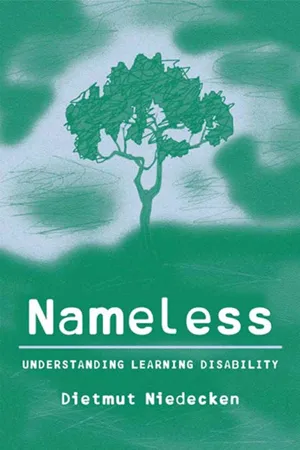
- 272 pages
- English
- ePUB (mobile friendly)
- Available on iOS & Android
eBook - ePub
About this book
Information
Chapter 1
‘Learning Disability’1 as an institution and the forgotten human dimension
In an institution for people with learning disabilities where I once worked, I met a boy of about 16 years old who could only utter one word. He would repeat it endlessly all day long, yet it was never possible to discern any meaning in this word that could be related to the current situation. The word was ‘Papi’. He always said it with the same questioning intonation and rhythm, usually two or three times consecutively. I can remember nothing more of him than this. Sometimes it goes round in my head like a well-known tune whose meaning is both known, and yet hidden, through my own carefully forgotten past. When I think about it, it seems to me that this ‘Papi, Papi?’ was like a question that had been asked long ago but which had never received an answer. It was as if the young boy had once stood before a door, which he clearly felt was the door to his life; as if he had knocked and given the password but the door had remained shut. It seemed to me that since that time, this boy had not been able to say anything else but this password; he felt it was the right one, the key to his life that was inaccessible to him because no one was there whom he could call ‘Papi’. ‘Papi, Papi …’ it was clear that this was no longer a name; no one was being addressed; it was simply a tune keeping alive the moment when the boy had called his father by his name and had not been heard – perhaps because he was not there or because he did not know how to answer.
It seems to me that the lives of many people with learning disabilities amount to little more than this: standing doggedly in front of a closed door, endlessly repeating a password to which no one knows the answer when it is needed. Why they remain standing in front of this door, whether it is the only door there is, whether there is something that prevents them from searching further, or whether the strength of their wish to be let in prevents other attempts from being made, are some of the questions I shall be addressing in this book. Still more important for me is the question of whether there are ways of discovering the answer that is being sought after, ways of helping them open their door. This question expresses the desperate, persistent hope that I thought I heard behind the lifelong repetition of the password Tapi, Papi’.
Of course, this hopelessness cannot easily be brushed aside. No one is being addressed with the words ‘Papi, Papi’. They are, by any reckoning, meaningless; at least they have become so. They are addressed to no one and no one is expected to answer. They have become a mere tune. How are we to find an answer to a question that is not being or is no longer being asked?
So in this single, endlessly repeated word, the boy was giving expression to the most extreme contrast between hope and hopelessness. Any chance visit to an institution catering for people with learning disabilities will bear witness to such a polarity. There may be a young girl addressing all newcomers with the same ambiguous question to which they all give the wrong answer as if, by obstinately insisting on her question, an answer might finally be forthcoming. A child may be sitting around on a bench for hours doing nothing but hitting himself (or herself) in the face with awfully repetitive monotony, and yet looks so fairy-like that if only one could one would happily send him straight to paradise. Or there may be a young man at the entrance who, with a frightening grin, zealously opens the door for all those who are leaving the ghetto into the Promised Land outside as though, were he to really make himself meek and humble, someone might one day open the door to the outside for him, so that having humbled himself he might be exalted.2 The demeanour of people with learning disabilities confronts us with this contrast everywhere; similarly those who live and work with them feel torn between extreme hope and hopelessness, between the euphoria of compulsive activity and giving up in resigned indifference.
The first time I worked in an institution for people with learning disabilities, a grandiose phantasm (without which I could not have done the work at all) lay behind my euphoric attempts to save individual cases from a life of institutional misery: I would be able to help and save people where others had given up long ago. In fact, after a while in the institution, I became known as the specialist for ‘people who challenged the service’, but the contrast between my high-flying dreams and the slowness and laborious-ness with which the therapies made progress was hardly bearable, and the struggle which I openly waged against the resignation and indifference of many colleagues and superiors was at the same time a struggle against my own temptation to sink into indifference, which, of course, made it doubly wearing.
In institutions for people with learning disabilities, the split between euphoria and hopelessness recurs not simply as an individual phantasm but also as an enactment of the whole community. At one end of the spectrum, the old-fashioned institutions represent the extreme of death phantasms and impotence. They are ghettos we would prefer to think do not exist. Once inside, the visitor is so alarmed by the misery that hits him like a formless mass that, in order to save his skin, he hurries through in a numbed state, with his senses half shut-off, trying to get out again as quickly as possible through this door to purgatory, rapidly forgetting what he has seen, back into the daylight of normality which has been altered by the experience of this visit.
The other extreme (and there are naturally intermediate stages – progressive homes, day centres, etc.) is characterised by establishments considered to be progressive and exemplary: the latest centres for early diagnosis and intervention.3 In contrast to the paralysing depression, indifference, lack of vision in the large establishments, these are characterised by brisk activity, lavish expenditure on equipment, a lot of trained workers and team work. The newest acquisitions are put at the service of children (not the adults, of course) in a continual effort to bring them back into the realm of approximate normality by offering them as much help, as soon as possible. There is an overwhelming compulsion to succeed; failure is unthinkable. They are monuments of hope and phantasised omnipotence, the institu-tionalisation of that despairing hope which I thought I heard in ‘Papi, Papi …’. Only, what has become of this hope in places such as these?
Subsequent to a job interview in such an institution, I was taken around by the senior doctor who showed me all the nicest, best-equipped, well-lit rooms, with shining wooden floors; the stylish waiting-room full of children's toys; the corridors, whose walls displayed many photographs of the successful, intensive work going on, along which the qualified staff walked briskly and with a sense of purpose to their next task. On the way back to the office a small boy stumbled clumsily across our path with his crutches. ‘My name's Jorgi,’ he said with an unnaturally elevated and exaggerated voice, staring at the doctor from behind his thick glasses with wide-open, but unsmiling – in fact anxious and fleeting – eyes, ‘I'm doing fi-ine!’ ‘Yes, Jorgi, you're always doing fine, aren't you?’ replied the director in a friendly manner as he walked with a light gait past the youth who was standing in his way. As we continued he said to me: ‘This is one of our children’.
‘I'm doing fi-ine!’ – I remembered having heard that before, on my first day in the institution. In order to pamper me, I was first placed on a ‘quiet’ ward for well-adjusted adult men. My task was to go for a walk with a patient who, I was promised, would cause no difficulties. ‘Heinzi’ was his name, and I was to hold him by his hand and take him for a walk. But why? I did not know the grounds at all whereas Heinzi had been living there for many years … and, taking a grown man by the hand like a toddler, well, it was embarrassing. During the walk ‘Heinzi’ said little. At most, he replied just once to a clumsy question I had asked, in the elevated and exaggerated voice of a child who wants to make himself the adult's favourite. From time to time, he said in the same manner and without being solicited, ‘I'm doing fi-ine’. But then, out of this rosy world and, once again, unsolicited and barely articulated, came a roar, the roar of a threatening, deep, powerful, man's voice: Heinz. ‘Heinzi’ looked around him for a moment uncertainly, drew in his breath, and repeated in a whisper, ‘I'm doing fi-ine!’ When I asked about this afterwards, somewhat startled, I was told: ‘It wasn't anything important, he does that sometimes, it doesn't mean anything’.
Yes, indeed, what has become of the hope?
The initial shock over the parallel between the two scenes makes me aware that in my presentation of it the tension between hope and hopelessness, clearly noticeable in the first account, has in the meantime subsided. The intonation of ‘I'm doing fi-ine’ is in both cases exactly the same: unnatural, false, grovelling, an enormous lie. The T want to get better’ which must have been underlying it, i.e. the desire and the hope, are perverted into a meaningless and hopeless formula, since the ‘doing fi-ine’ leaves nothing to be desired or hoped for. The transition from desperate dependence on nothing but the unremitting repetition of hope into its opposite almost escaped me while I was writing this. And yet, in retrospect, it is already slightly visible in those phantasms in which I wanted to see the boy on the bench who was hitting himself, and the humble man at the entrance gate, liberated – ‘into paradise’. If I take the image to its logical conclusion, I wanted to transport the child into death, the end of all hope, and the one who humbled himself ‘would be exalted’, but only, as the Bible vainly promises, at the Last Judgement, and not in life. But what have they done to me that I feel I have to transport them into the beyond by writing such phantasms?
What have ‘Heinzi’ and ‘Jorgi’ done that makes them feel that they must apologise to every man and woman they meet by saying, ‘I'm doing fi-ine’? ‘Jorgi’, at least, seems to fear he will be punished for stumbling across our path in the corridor. In this service where one is particularly impressed by the excellent equipment and by the photographs on the corridor walls of the children in care, documenting all the activity going on there, children apologise immediately by saying, ‘I'm doing fine’, as if they feared they might be got rid of once and for all because their clumsiness does not fit in with the image of a centre that is running smoothly and efficiently. It is as if they have to pay for being tolerated by colluding with the cliche ‘this is one of our children – and our children always do well’. How else can the fervently uttered phrase be understood than as a response to the pressure to succeed exerted by an organisation created at great expense? If you are not a success and do not integrate properly, if you are not ‘doing fi-ine’, the child is made to understand, you will be cast out and forgotten about forever (and so ‘Jorgi’ will end up where ‘Heinzi’ already is, in the institution – a place for purgatory and the ‘final solution’.
So the extremes of hope and hopelessness, of omnipotent helping and impotent sustaining are intermingled in ‘Jorgi's’ and ‘Heinzi's’ histories, in the fear of the truth of the final outcome, i.e. being cast out and forgotten about.
‘If a person is not excluded,’ writes Maud Mannoni, the French psychoanalyst, then, ‘he will be integrated into “normality”, at whatever price – without any questions being asked with regard to the meaning that madness or retardedness may have for some people. In this way, illness becomes institutionalised.’4
What does Mannoni mean here by institution? Institutions are bound by fixed systems of rules in the service of hierarchical interaction-structures that can no longer be seen in terms of their interactional meaning, but rather as naturally unmodifiable. However, this is what ‘learning disability’ looks like for us, too. One principle of progressive teaching on learning disability is that one should not speak of ‘patients’ since people with learning disabilities are not ill. The word ‘patient’ suggests a hierarchy – it would be better to speak of die Geistigbehinderten5 as it is a question of the natural, unalterable reality of their otherness. Do such linguistic nuances really dispense with hierarchy? Hardly. What is dispensed with, however, are the terms of interactional interdependence: one cannot only be ‘geistig behindert’ but one can become so; and the word ‘patient’ signifies less ‘being ill and inferior’ than ‘someone who is suffering’, from the Latin ‘patiens’ = suffering. For illnesses, there are causes; ‘ Geistigbehindertseirt (having a learning disability) is the direct result of some kind of organic defect that we think does not concern us. We might feel a sense of responsibility for the suffering of ‘ geistig behinderte’ (those who have become numbed, who have learning disabilities) but the term serves to keep this potential awareness unconscious.
In what follows, I will at times have to violate some of the well-intentioned progressive uses and abuses of language met with in the field of learning disability in order to bring certain institutionalised, warded-off experiences back into the arena of language and discussion. Indeed, the dreadfulness of the word ‘Mongol’6 is somehow much more telling and says so much more about the fate of people branded with it than the increasingly abstract and inaccessible terms that have currency today in the progressive teaching on learning disability. Who, for example, is able to make head or tail of a term like ‘trisomy-21’?
‘Mongol’ has a very precise meaning which those of us who are ‘blessed with late birth’7 (Federal Chancellor Helmut Kohl) do not want to know too much about: it refers to what in Germany was once publicly called leben-sunwertes Leben8 with all the attendant consequences. True, ‘Mongols’ and other ‘learning disabled people’ are no longer subjected to the final solution of the gas chambers; but here, too, we have simply ‘come to terms’ with our frightful past (whatever that means) but cannot, of course, ‘overcome’ it by trying to make cosmetic revisions of the official phraseology. ‘Jorgi's’ look expressed mortal fear, and my phantasies humanely and elegantly transported the subservient man at the entrance gate and the child on the bench who was hitting himself into the beyond. Murder is no longer committed openly but what led to the crimes of National Socialism has not lost its power because the phraseology has been revised. It persists – subliminally, imperceptibly, carefully covered up9 – in the phantasms that dominate our thinking and feeling about ‘people with learning difficulties’. We will learn more about these phantasms shortly.
One of them is contained in the following words of Bertolt Brecht, ‘the womb which this crawled out of is still fertile’.10 Bertolt Brecht tells us more than he perhaps intended; for, in his phantasy, it was a womb that gave birth to the monster-child of National Socialism. The cause of the unspeakable murders, Brecht leads us to understand, is the female sex. Like all phantasms, this one also contains a distorted truth, namely, that one of the most important sources of the collective murderous and suicidal tendencies of our Western enlightened world that culminated in Hitler's fascism is the polarity between feminine impotence and masculine omnipotence, the subjugation of women by men. Theodor W. Adorno and Max Horkheimer11 referred to this in the Dialectic of Enlightenment (and their thesis has been taken up and discussed critically in feminist research).12
The womb gave birth to a monster and was the origin of the most monstrous guilt. Even today mothers who bear children who have learning disabilities experience themselves, at least in the initial moments of recognition, as begetters of monsters, as failures, as guilty, whereas fathers, hiding behind their work, are often content to leave them with these feelings – ‘people with learning disabilities’ are women's business, i.e. mothers’ business. Having for hundreds or thousands of years been unable to develop their mental faculties, women have learnt in our society, where productivity is what counts first and foremost, that their children – male, if possible -are their achievement, their raison d'être. When, due to an impairment, a child cannot provide them with this identity, he or she has no reason to exist and they themselves have no proof of their own value, indeed, of their own right to exist (the womb is ‘still’ fertile: is Brecht hoping to get rid of it?) Worse still, the ‘monster’ child is an image of a woman's ‘failure’, her ‘guilt’, and as such it has to be hidden, swept under the carpet. When mothers – and fathers too – are confronted with the shock of the diagnosis, they often consciously feel an impulse to kill their children. This is not due to personal badness but is rather a reflex-response to the phantasm that Brecht formulated. This phantasm is probably the central motive for our attitude towards people with learning disabilities – and their mothers. It is the attribution, the projection, of our monstrous collective guilt, the unspeakable failure of our enlightened awareness, onto individuals. Just how efficiently this works and what consequences it has, we shall have to look at more closely.
The institution ‘Learning Disability’ is thus based on the projection of collective death wishes onto individuals. Such tendencies do not manifest themselves today as they did 45 years ago. Now it is more appropriate to speak of soul murder. ‘The misfortune of the disability has to be brushed aside! No one seems to worry about the fact that we are making the child feel insecure by giving him the feeling that we would prefer he was different from the way he is.’ – ‘I was born with a spastic paralysis. Today, the diagnosis would certainly be “cerebral palsy” – so the boy must be treated immediately, given therapy, in order to give him every chance of rehabilitation. It does not seem to occur to anyone that I myself might not find the spastic paralysis so terrible and, therefore, do not need to be rehabilitated.’13 People with learning disabilities are not so articulate; language is more or less inaccessible for some of them. Unlike the physically disabled person cited above, they are unable to tell us that instead of having a sense of solidarity with the child for the suffering he or she experiences in society on account of his or her disability, we tend to identify with society and its norms. We assume that the child must either want not to be disabled, or at least to be less disabled, before this desire is attributed to him during the process of stigmatisation. The only thing that seems to matter is adapting the child to the current dominant norm; the alternative, exclusion and death, seems all too inevitable. Faced...
Table of contents
- Cover
- Half title
- Full title
- Copyright
- Contents
- Author's preface to the English edition
- Foreword by Valerie Sinason
- Translator's acknowledgements
- Introduction by Mario Erdheim: Learning disability, murder and phantasm
- 1. ‘Learning Disability’ as an institution and the forgotten human dimension
- 2. The interface between institution and fate. Diagnosis as a Trojan horse: guilt-exonerating but equally a handicapping label
- 3. The process of developing learning disabilities
- 4. The enactment of soul murder
- 5. From anxiety to technological treatment strategies
- 6. Attempts at breaking out
- 7. A child without behavioural difficulties
- 8. Possessed by the devil
- 9. The infantocidal introject
- Epilogue: Solidarity
- Notes and references
- Bibliography
- Index
Trusted by 375,005 students
Access to over 1.5 million titles for a fair monthly price.
Study more efficiently using our study tools.
Frequently asked questions
Yes, you can cancel anytime from the Subscription tab in your account settings on the Perlego website. Your subscription will stay active until the end of your current billing period. Learn how to cancel your subscription
No, books cannot be downloaded as external files, such as PDFs, for use outside of Perlego. However, you can download books within the Perlego app for offline reading on mobile or tablet. Learn how to download books offline
Perlego offers two plans: Essential and Complete
- Essential is ideal for learners and professionals who enjoy exploring a wide range of subjects. Access the Essential Library with 800,000+ trusted titles and best-sellers across business, personal growth, and the humanities. Includes unlimited reading time and Standard Read Aloud voice.
- Complete: Perfect for advanced learners and researchers needing full, unrestricted access. Unlock 1.5M+ books across hundreds of subjects, including academic and specialized titles. The Complete Plan also includes advanced features like Premium Read Aloud and Research Assistant.
We are an online textbook subscription service, where you can get access to an entire online library for less than the price of a single book per month. With over 1.5 million books across 990+ topics, we’ve got you covered! Learn about our mission
Look out for the read-aloud symbol on your next book to see if you can listen to it. The read-aloud tool reads text aloud for you, highlighting the text as it is being read. You can pause it, speed it up and slow it down. Learn more about Read Aloud
Yes! You can use the Perlego app on both iOS and Android devices to read anytime, anywhere — even offline. Perfect for commutes or when you’re on the go.
Please note we cannot support devices running on iOS 13 and Android 7 or earlier. Learn more about using the app
Please note we cannot support devices running on iOS 13 and Android 7 or earlier. Learn more about using the app
Yes, you can access Nameless by Dietmut Niedecken in PDF and/or ePUB format, as well as other popular books in Psychology & Developmental Psychology. We have over 1.5 million books available in our catalogue for you to explore.