![]()
1 Strong Openings
Learning Benefits
– Highlights the idea of ‘visual literacy’ by demonstrating that children can glean much information from even simple images.
– Creates opportunities for useful thinking skills such as speculation, inference and deduction.
– Begins to establish an important aspect of the ‘creative ethos’ – how many ideas can we have and what use can we make of them?
– Introduces a key element of Using Comic Art, which is to use the style, tone and structure of comic art as a visual analogue of style, tone and structure in writing – using pictures as a bridge into writing.
– Demonstrates a number of techniques for creating high-impact openings to stories.
Getting Attention
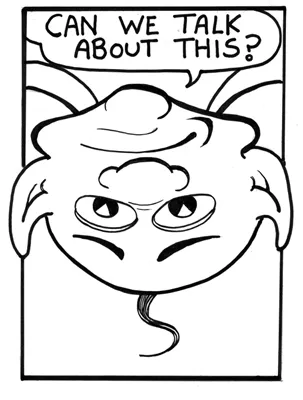
The immediate purpose of a strong opening is to hook the reader’s attention in order to ‘open the door’ into the story. There are many ways of accomplishing this. Figure 1.1 uses what we might call the unusual angle technique, combined with a close-up of the character’s face so that his situation remains a mystery.
A lot of information can be gleaned from even a simple image like this. The shape of the character’s ears suggests the genre of Fantasy. His little curl, and what he says, convey a rather humorous tone. The friendliness of the face (even though he looks rather worried just now) and the element of caricature add to this. Whatever’s happening, we don’t really expect nastiness to follow: if there’s going to be any violence, it’s likely to be slapstick rather than gory and brutal.
Activities
1(a) Show the picture to the class and ask the children what they think might be going on. Mention that, although the artist will have a definite idea in mind, their answers aren’t wrong within the context of this activity – you are encouraging speculation based on the rule that in order to have our best ideas, we must have lots of ideas.
1(b) Ask about the emotional tone of the picture. If the children aren’t sure about this task, mention the character’s curl of hair and what effect that has on us. Ask about the character’s tone of voice as he says ‘Can we talk about this?’
1(c) Collect some descriptive details of the character’s face – broad, round head with a single curl of hair; large, oval eyes; wide, fleshy nose; angular cheekbones sloping towards a rounded chin; a worried-looking expression. Ask for suggestions for a name, preferably in keeping with the tone of the image. We thought a name like Poddle would suit – although you could be ironic with something like Maximus the Unconquerable.
Tip You can add a further dimension to this activity by asking the class to imagine the colour of the character’s eyes and skin, to listen to his voice with their mind’s ear, to touch his face in imagination and gain an impression of the texture of his skin. This kind of VAK (visual, auditory, kinaesthetic) check is easy to do, and develops children’s multisensory thinking.
1(d) Summarise the information gathered so far – Fantasy, unusual angle, close-up, humorous tone, mystery about to be revealed. Once the image has been explored in this way, ask how it might be written as a couple of sentences to open the story. Here’s our attempt …
Because Poddle was hanging upside down, he looked as though he was smiling. In fact he was deeply worried and his usually cheerful brown eyes were wide with concern. ‘Can we talk about this?’ he wondered. He had wanted his voice to be deep and strong, but to his dismay the words came out more like a thin squeak.
Notice how the close-up technique of the comic panel is reflected in the writing. There is no mention of anything beyond what we can see in the picture. The construction of the picture guides the structure of the writing. In this sense, the image literally serves as a ‘writing frame’ – this is a strategy that we’ll be using often in Using Comic Art.
Notice also that only some of the details gathered earlier have been used. This is an important point to make to the children. Authors usually know more than they put into a narrative, and even if details are never used, they still help to inform the writer about the world of the story. Deciding what to put in and what to leave out also implies discrimination and control of the imagination – vital skills that underpin any written outcome.
Many Doorways
Looking at the opening panel from a range of comics quickly establishes that there are many interesting ways to begin a story. The visual nature of comics makes the point effectively and serves as a precursor to trying out these strategies in written form. Here’s what we found by picking six comics at random.
Five superheroes line up to defend the Earth against a rampaging monster.
A group of travellers out of shot cross a gloomy, mountainous landscape. Their opening conversation establishes that they’re on a dangerous mission in enemy territory.
A man is driving recklessly along a winding road at night. A woman beside him warns him about the speed (the following sequence of small ‘quick-fire’ panels shows the car hurtling out of control and bursting into flames).
The hero warns the elders of a tribe that a respected friend is actually in league with the enemy.
A skeletal creature leaps out of the bushes at a young couple walking through the park – the speech bubble says ‘Rraaaggghhhh!’
The hero wonders if she can defuse a bomb in time – the nearby clock shows that there’s less than a minute to go!
Activities
1(e) You will need some comics for this exercise. Split the class into groups. Give each group a comic and ask them to ‘translate’ the first panel into one or two opening sentences of a story. Circulate the comics so that each group does this several times.
1(f) Compare the opening sentences for a given panel. Talk about the similarities and differences. Why did the writers choose those particular words/details? Through discussion, generate an opening sentence or two for each story, combining the good ideas from as many groups as possible.
1(g) Now do activity 1(f) the other way round. Look at the opening few sentences from written stories and ask the children to describe what that would look like as a drawn panel that opens the story. Some of them may even want to draw it.
1(h) Show the children the opening sentences generated from a comic that they have not seen. What picture do the words make in their imaginations? (Children who enjoy drawing might want to sketch out their ideas at this point.)
Opening panels/sentences can be categorised in a different way. A further trawl through some comics showed us these visual techniques.
Long shot/overview – of landscape empty/with figures moving across/of building/of something approaching over the next few panels.
Close-up – of character, whole person or face/of object.