![]()
This chapter provides lists of conversation topics on everyday events and matters in the life of a young child. A few minutes conversation on any chosen topic allows the parent and child to explore ideas and facts, make associations, comparisons and acquire information. This shared time confirms to the child that adults are a valuable source of information about the world. For the parent the dialogue can be equally rewarding as an opportunity to find out more about the child’s thinking. All the activities are intended to give the child a greater sense of self.
Myself and my family
Physical appearance
Talk about each other’s appearance - look in a mirror.
‘My hair is short. Your hair is curly.’
Parts of the body
•Examine and talk about different parts of the body, size and shape of hands, how joints bend, what body parts are for. Ask the child to name a part of the body.
‘Let’s start with our heads and go downwards to our toes, naming as many parts of our bodies as we can.’
•Give the child some clues to different parts of the body and tell the child that you want them to try to guess what they are. For example:
‘These help you to see.’
‘These help you to hear.’
‘You have five of these on each hand.’
‘These grow on the ends of your fingers.’
‘You have five of these on each foot.’
‘These grow on the ends of your toes.’
‘This helps you to smell.’
‘This helps you to talk.’
‘This helps you to breathe.’
‘This helps you to throw a ball.’
‘This helps you to kick a ball.’
‘These cover your eyes when you sleep.’
‘These help you to bite your food.’
‘These help you to hold a pencil.’
‘This bends when you touch your head.’
‘This bends when you walk upstairs.’
•Take turns in giving instructions (this can be played as a ‘Simon says’ game). For example:
‘Close your eyes; open your eyes; stand up; sit down; stand on one foot; hold up your hand; hold up two hands; put your hands down; hold your nose; touch your head; now hold your nose and rub your tummy; put one hand on your head and the other on your tummy; now turn round very slowly; with one hand touch your nose, mouth, chin, knee; clap your hands once; now twice; now three times.’
•Say ‘I am becoming very, very small.’ Demonstrate this and ask the child to bend as low as possible, or to curl up on the floor. Then take it in turns to:
‘Touch your nose with one hand; touch your mouth with your elbow (Try!); touch your feet with both hands; touch your hair with one thumb; take one step forward; now take two steps back; now stand very tall again; now shrink and become very small.’
•Then say:
‘I am going to say a part of your body, and as I say it, I want you to touch it - I shall say the word quite fast, so listen very carefully: head, tummy, elbow, feet, ankle, eyes, ears, neck, back, hair, shoulders, cheek.’
This can be repeated varying the order of the words, and/or the speed, to suit the child.
•Play ‘O’Grady says’. For example:
O’Grady says:
‘Hold your hand behind your back.’
Tut your feet together.’
‘Clap your hands three times.’
‘Stand with your feet apart.’
‘Sit on the floor.’
‘Hands on head.’
‘Touch your toes.’
‘Fold your arms.’
‘Stand on tiptoe.’
‘Stand on one leg.’
‘Clap you hands four times.’
‘Crawl on all fours/hands and knees.’
‘Clench your fists tightly.’
‘Sit on the floor.’
‘Stretch your arms as high as you can.’
‘Clap your hands twice.’
•Use two parts of the body at the same time and describe the activity, for example, rub wrist on leg, scratch back with fingers, put lips on hand.
Basic details of self
Parent and child, together, list basic information, such as:
•child’s name, address, age, date of birth/birthday, school
•details of other family members, brothers, sisters, other close relations such as uncles, aunts, grandparents, close friend.
Family details
•The parent shares information and stories about family members with the child.
•A longer-term project would be to compile family histories by collecting photographs, asking family members to discuss events in their lives with the child, and weaving stories around a family object or household items.
Making maps
•Parent and child draw simple maps/plans of:
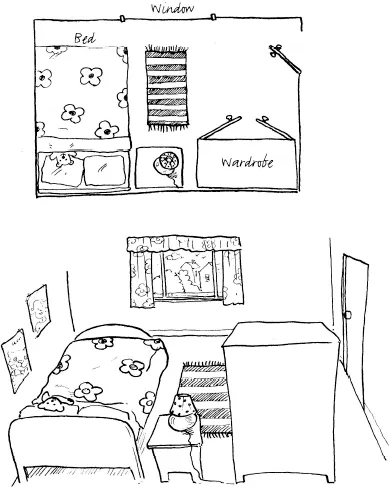
a room in the home, showing furniture, door, window (for example see Figure 1.1);
their home, showing different rooms; upstairs and downstairs;
their garden;
their street, where their home is, and showing where friends and neighbours live;
the neighbourhood, showing the child’s school, library, shops and park.
FIGURE 1.1 A plan of Kelly’s bedroom
•Ask the child to give you (or Teddy, or an imaginary visitor) directions to a friend’s home, shops, school, park. What is the best way to get there? On foot, by bus, by train, by boat?
All about me
What I can do
Parent and child talk about each skill (see overleaf). Tick off what has been learned and discuss what needs to be practised next.
Likes/dislikes
Talk about the child’s likes and disli...