This book is available to read until 4th December, 2025
- 472 pages
- English
- ePUB (mobile friendly)
- Available on iOS & Android
eBook - ePub
Available until 4 Dec |Learn more
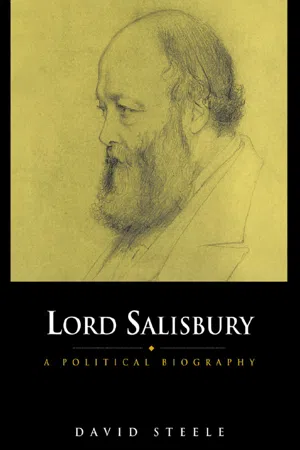
Lord Salisbury
About this book
First published in 1999. Robert Arthur Talbot Gascoyne-Cecil, born 3 February 1830; known as Lord Robert Cecil until June 1865 and thereafter as Viscount Cranborne until his succession as the third Marquess of Salisbury in April 1868. This is a study of a notably cerebral politician, who revealed the qualities necessary for success and survival in a career to which he appeared unsuited at the start. No prime minister was less inclined to accept conventional wisdom at face value, or to succumb to the routines of office
Frequently asked questions
Yes, you can cancel anytime from the Subscription tab in your account settings on the Perlego website. Your subscription will stay active until the end of your current billing period. Learn how to cancel your subscription.
No, books cannot be downloaded as external files, such as PDFs, for use outside of Perlego. However, you can download books within the Perlego app for offline reading on mobile or tablet. Learn more here.
Perlego offers two plans: Essential and Complete
- Essential is ideal for learners and professionals who enjoy exploring a wide range of subjects. Access the Essential Library with 800,000+ trusted titles and best-sellers across business, personal growth, and the humanities. Includes unlimited reading time and Standard Read Aloud voice.
- Complete: Perfect for advanced learners and researchers needing full, unrestricted access. Unlock 1.4M+ books across hundreds of subjects, including academic and specialized titles. The Complete Plan also includes advanced features like Premium Read Aloud and Research Assistant.
We are an online textbook subscription service, where you can get access to an entire online library for less than the price of a single book per month. With over 1 million books across 1000+ topics, we’ve got you covered! Learn more here.
Look out for the read-aloud symbol on your next book to see if you can listen to it. The read-aloud tool reads text aloud for you, highlighting the text as it is being read. You can pause it, speed it up and slow it down. Learn more here.
Yes! You can use the Perlego app on both iOS or Android devices to read anytime, anywhere — even offline. Perfect for commutes or when you’re on the go.
Please note we cannot support devices running on iOS 13 and Android 7 or earlier. Learn more about using the app.
Please note we cannot support devices running on iOS 13 and Android 7 or earlier. Learn more about using the app.
Yes, you can access Lord Salisbury by Dr E David Steele in PDF and/or ePUB format, as well as other popular books in History & World History. We have over one million books available in our catalogue for you to explore.
Information
CHAPTER ONE
Formative Influences
Family and School
In a surprising lapse from his usual good taste Mr Gladstone brought up, in private, the old story that Salisbury, then prime minister, was really the son of a Whig predecessor, Lord Melbourne. A noted Tory hostess, his mother was one of the attractive and intelligent women linked with that charming and gifted man.1 The point of the anecdote is that by then Salisbury’s reputation was second only to Gladstone’s: Melbourne seemed a more likely father than the second Marquess of Salisbury, whose membership of two cabinets left no mark on British politics. In fact, the future prime minister owed a great deal to his Cecil inheritance, in every sense. Rank and wealth provided a solid foundation for a political career starting in the mid-nineteenth century, when the prestige of the aristocracy had never stood higher in his lifetime, wrote one of the greatest of contemporary radicals, looking back on nearly fifty eventful years.2 Like other forgotten magnates, the second marquess was a considerable figure in the localities which he dominated. He combined strong Toryism and resistance to the state’s modest encroachments on the independence of county government with a zeal for improvement that his opponents acknowledged. Boys directly employed by him on his property at Hatfield were fined if they failed to attend the night school he established for them in the village: half a century later only his son’s determination got the abolition of fees for elementary schooling through a reluctant cabinet. The father exploited the coming of the railways to his wide estates, took a keen interest in canals and went in for agricultural innovation. The son accepted the chairmanship of the ailing Great Eastern Railway and oversaw its recovery. He, too, was a conscientious and improving landlord in the intervals of politics. His father was notoriously intolerant of political dissent among his dependants, but a perceptive, and witty, local obituarist—a Liberal—allowed that he was a kind patron, a good employer, and a hero even to his valet.3
The quasi-feudal surroundings of Hatfield were not a guarantee of security and happiness for the young Lord Robert Cecil, as he was known until 1865. Although he was the third son, born in 1830, it was soon clear that he might expect to succeed his father or brother in the title: a second son died in infancy, and the heir was from an early age the victim of a degenerative disease which blinded him before he grew up. Robert was oppressed by the misery of his schooldays and by a tendency to depression which, according to expert medical opinion in his early manhood, seemed likely to shut him out from a life of action. The loss of his mother when he was nine must have affected him, though there is no direct evidence of emotional damage on that score. Five years separated him from the younger of the two older sisters, and four years from the brother, Eustace, who was his junior; he was never close to any of his siblings. He inherited her charm from his mother, Frances Gascoyne, as well as, in due course, her substantial contribution to the Cecil fortune. At six, when he was sent away to school, his nature was passionate and sensitive; since he was not physically robust, it exposed him to taunts that ended only with his schooldays. His memory of “an existence among devils” at that first carefully chosen preparatory school was unfading. He refused to send his own sons away until they were old enough for Eton, several years older than himself when he went there at ten, to an Eton that retained a good deal of its eighteenth-century brutality, vice and anarchic freedom. The experience of his first school was repeated, and his troubles were compounded by the exceptional promise of his work. Promoted into a form with boys who were his seniors, he proceeded to defy the custom which dictated that he should help his less talented and lazier elders with their exercises.4
That obstinacy was significant. He told his father, at fourteen, that he would not “sacrifice my liberty at the bidding of one lower than myself”. The language may amuse in its context, but he meant what he said. His prolonged unpopularity and wretchedness are traceable to a dogged refusal to conform to Etonian mores in several important respects. He avoided the playing fields and the river, and had, it appears, no close friends. In quietly pathetic letters home, he wrote that he was “bullied from morning to night without ceasing” when out of the form master’s or the housemaster’s sight; literally kicked out of meals and forced to spend the evenings in a corner until the house was asleep. Robert’s claim that his work had fallen off as a result was not borne out by his school reports. The housemaster, who enjoyed a good reputation, found it hard to believe that the boy was so badly treated. Highly strung and solitary, Robert may have exaggerated his ill treatment. In later life, he related how in the holidays he shunned the streets of the West End and kept to its byways, in dread of encountering the schoolfellows he loathed. Eventually, the second marquess, always a concerned if formidable parent, took him away after five years. Until he went up to Oxford in 1848, he remained at Hatfield with a tutor. Eton left him with an acute sense of the intolerance and irrationality that are more often than not the reward of independent spirits. His school contemporaries had demonstrated that no social class could claim to be exempt from those failings. Authority, in the persons of his father and housemaster, had been found wanting. To the end of his days, Robert Cecil was a sceptic and a libertarian in purely secular matters, though with a conservative bent.5
In retrospect, at thirty, Cecil rationalized his experience of boys and masters. The value of public schools lay not in their inadequate academic education but in the introduction they provided to adult realities at every level. He compared them favourably with those private schools where masters supervised the pupils closely. The essential nature of a school like Eton as a schoolboy republic prepared youth for the conditions of life in “a free country”. He likened the difference between the two kinds of school to that between English constitutionalism and the governments of the Continent. “The analogy”, he maintained, “…is very close”. Schoolmasters were seldom superior in intelligence and judgement to their charges. Reliance upon them for guidance and protection, as upon government in a larger world, “fatally weakens the fibre of…character”. The great strength of public schools was that “a salutary neglect” of the boys enabled them to learn how to survive by their unsupported efforts, and to do so without paying the price of failure in an adult environment. Bullying and fagging inculcated the social truth that, while the strong prevail, submission has its limits. Boys discovered for themselves “how bullies are to be resisted, and…the decoy ducks of vice…detected and foiled”. They lived, as they would do when grown men, within the framework of a public opinion to which they contributed. Cecil did not forget that Eton’s public opinion had all but broken his spirit. Revisiting the school for the first and last time, when he took his two elder sons for their first term, plunged him into black depression, so painful were his memories. His intellect might be satisfied with the theory that a public school was the making of a man, but the reminder of the personal cost was too much for him.6
His sons’ Eton, he was careful to ascertain, was a much improved place, academically and in other ways. Through his association with the Reverend Nathaniel Woodard, the founder of the eponymous schools, Cecil became, a little reluctantly, an advocate of taking public school education to a level of the middle classes unused to it. In the speeches which Woodard induced him to deliver in that cause, he dwelt on the need to surround and check the influence of the schoolmaster “on his solitary throne” by the independent opinion of the school as a whole, “which scrutinized, and criticized, and judged all actions”. The idea reflected the values and practice of Etonian youth; the humbler institutions whose establishment he encouraged had a different atmosphere. His mature reflections suggest that the lessons he drew from five unhappy years helped to form a successful political philosophy. The realistic democrat of the 1880s and 1890s had learnt the importance of consensus, and the penalties of defying it, in a thoroughly English setting. In the short term however, his schooldays had turned a highly strung and promising child into a nervous, depressive young man, socially ill at ease. Underneath there were reserves of toughness: it must not be forgotten that he had invited his persecution. As happened in similar cases, Oxford went far to heal his open wounds.7
Oxford and Tractarianism
The highly intelligent and vulnerable youth who went up to Christ Church in 1848 had made good the “scandalous deficiency” of his Eton education.8 His father had engaged a Cambridge don as a tutor in the holidays, and saw that between school and home the boy acquired a command of French and German. After Eton the same tutor took a receptive pupil forward in mathematics. Botany was an enthusiasm of those days, and Cecil was later to be an amateur of physics and chemistry, corresponding with scientists and conducting experiments in his laboratory at Hatfield. He was already, and remained, very well read. His teachers at Eton had been struck by the precocity of his work in divinity: wide reading only fortified a natural religious faith. The logical and experiential weakness of Christian apologetics was plain to his young mind: so were those of its radical critics. But he had yet to satisfy his religious needs. Politics was an absorbing interest from childhood, and coloured by his father’s high Toryism. Oxford was a time of self-discovery in those and other respects. The solitary boy at Eton and Hatfield made friends and attracted admirers. He found he had a talent for speaking and writing; there were forecasts of political distinction. It did not matter that he was entered for a pass degree, as his father and the Dean of Christ Church decided in accordance with common practice for young men of his rank. His studies, it has been shown, reached a standard well above that expected for passmen, in recognition of which he was awarded honours in mathematics with his degree. In 1853, four years after his early graduation, he sat for and obtained a fellowship at All Souls; his standing there as founder’s kin did not exempt him from a stiff competitive examination. Successes masked the nervous cost of his transformation in someone who had yet to develop the mastery of himself that subsequently impressed observers.9
His circle at Oxford mixed aristocrats—the fourth Earl of Carnarvon, Frederick Lygon, later the sixth Earl Beauchamp, and the eighth Marquess of Lothian, who died comparatively young—with intending clergymen. There was no repetition of Cecil’s humiliations at school. In an adult world, people courted a magnate’s son and likely heir; “his toadyism chills me”, he wrote of one unwelcome acquaintance.10 The bloods for whom Christ Church was famous had roughed up Gladstone during his time there; they hardly troubled Cecil: perhaps because, unlike Gladstone, he did not have an aura of priggishness. Conspicuous in a set that combined social prestige and intellectual liveliness, Cecil was chosen as prime minister when the members amused themselves by distributing cabinet office in some distant future among their leading figures. The more perceptive thought he would outgrow his Toryism and appear on the Whig side. A surviving example of his oratory in the Oxford Union, where he was elected secretary and treasurer, is unremarkable. Tories were still pledged to restore the Corn Laws effectively abolished in 1846 and deemed essential to the well-being of the landed interest, and therefore to England’s political health: “I cannot agree to destroy the institutions on which this country rests…in order to conciliate any class”, he announced. Yet there was a note of conviction in the performance for an undergraduate audience. He could not forgive Peel for breaking up his party and, on a less public occasion, spoke of him as condemned to lie in “the grave of infamy which his tergiversation had dug”. He was at his best in a college essay club—“the Pythic Club”—founded by Lord Dufferin, who was to serve Cecil as ambassador at St Petersburg, Rome and Paris, and viceroy of India. In that setting Cecil shone; the papers he read were superior to the rest. They evinced lasting dislike and scepticism of the economic orthodoxy to which old-fashioned Tories were deferring in spite of themselves. His views on social subjects seemed “rather perilous” to his hearers. That youthful sensitivity to the casualties of the Victorian economic miracle was characteristic.11
A letter written by a coming lawyer-politician, Roundell Palmer, lord chancellor under Gladstone in the 1870s and 1880s, affords a glimpse of Cecil’s quality at twenty-one. Palmer, whose brother Horsley was an Oxford friend of Cecil, described him as able and high-minded with an urge to give practical expression to his ideals: he was animated by “a desire to do something for mankind in his time”.12 That aspiration, which informed his politics, was rooted in his religious faith. Dissatisfaction with the Church of England as he knew her turned him towards the Tractarians who rivalled the Evangelicals in their strenuous efforts to regenerate the Establishment. The new High Churchmanship of the Oxford Movement was the strongest tie with his university friends. He scorned old High Churchmen with their “ignorant horror” of Roman Catholicism and their “shallow, hazy” understanding of Christian truth. They were incapable of effective resistance to the contraction of belief in the face of radical theology and the secularizing tendency of the age; he dismissed them as “the squeezable High and Dry”. For the Low Church he felt active hostility. The fundamentals of their position were unacceptable: the emphasis on justification by faith rather than by faith and works, and on Scripture interpreted without adequate reference to tradition. An unfortunate bishop whom he encountered was condemned as “a thoroughgoing Bibliolater”; a man “much tainted” by a leaning to justification by faith alone. At this period of his religious history, Cecil embraced “High Church truths” with few reservations, deploring “Protestant latitude”. A follower of Newman’s replacement at the head of the Catholic revival in Anglicanism, he was proud to call himself a Puseyite, despite, or even because of, the opprobrium attached to the name.13
The cornerstone of Cecil’s Tractarian faith was its emphasis on the Eucharist in a Catholic sense, as offering in perpetuity the sacrifice of Christ upon the Cross for suffering humanity; in line with the teaching of John Keble and Pusey he rejected the Roman doctrine of transubstantiation for giving too materialistic an idea of the tremendous change in the elements of bread and wine. For the rest of his life Cecil was a notably devout and regular communicant. In this crucial respect, Tractarianism met his spiritual needs without offending an intellect that recoiled from other features of Catholicism. Never, apparently, tempted to go over to Rome, he maintained, like most of those who adhered to the Oxford Movement, that the Church of England had preserved more of early Christianity than the Roman church had succeeded in doing. His religion was patristic, and the medieval church suspect. He considered the Papal claims intolerable, and shrank from popular Marian devotions as requiring him to “worship the Virgin”.14 Some Tractarians were drawn to the practice of sacramental confession: he was typical of his countrymen in objecting to it as an invasion of conscience and subversion of individual responsibility. Nor did he care for the Tractarian propensity to an unctuous clericalism alien to the Establishment; to him, as to a Protestant public, the prelate who embodied that trend, Samuel Wilberforce, was “Soapy Sam”. The temper of Cecil’s churchmanship differed significantly from that of his fellow Tractarian Gladstone, who was altogether more ecclesiastical in outlook. Nor would Gladstone have faulted another bishop for taking “too charitable a view of the characters of those whom he has to oppose”.15
The self-confidence of his immature pronouncements on politics and religion was deceptive. His outward prosperity—the recognition of ability and promise in his fashionable college and at the Union—hid uncertainties that fed the depressions to which he was prone; an affliction that may have been hereditary and was complicated by fussiness over his health, a lifelong trait. The desire to leave the world a better place than he found it fought with a sense of his inadequacy that was real to the sufferer. The worst period of doubt and anxiety occurred in 1849–50 and shortened his time at Oxford. The decision to remove him in 1849 was taken on the insistence of Henry Acland, a young physician with a distinguished career before him. There followed a year spent attempting to read for the Bar. It seems that his illness was psychosomatic; as his daughter remarked, contemporary medicine had much to learn in that area. However, Acland arrived at what was evidently the right diagnosis, and prescribed a conventional remedy in such cases: an extended sea voyage. Cecil always regarded him as his saviour, and they were to form an enduring friendship. Nearly two years of travel in 1851–3 to South Africa, Australia and New Zealand, and home again round Cape Horn, did not effect a permanent cure. On his return he again succumbed to “nerve storms”, as he termed them, which prostrated him. Nevertheless, his colonial experiences, recounted in letters to his family and to a clerical friend and Oxford contemporary, the Reverend Charles Conybeare, were important for his personal, and also for his political, development.16
Colonial Impressions
The traveller’s letters can be supplemented by a journal kept for about a year. These sources show that Cecil enjoyed the understanding and support of his family; there is no trace of distrust and resentment on either side. His father’s concern for him was not lessened by remarriage in 1847 to a woman little older than his son, or by the birth of their five children. Relations between stepmother and stepson were friendly. The new marchioness, Lady Mary Sackville-West, daughter of the fifth Earl de la Warr, was socially ambitious with a taste for politics. She attracted the friendship of able men, and through her Cecil was brought into closer contact with the ruling circles to which the Cecils had belonged for centuries. The security his family provided could not remove the uncertainty about his future, which aggravated, if it did not cause, Cecil’s condition. He was someone in search of a settled purpose; a reading of his journal suggests that he might well have ended by taking holy orders, as he contemplated doing. Intensely interested in the prospects for Anglicanism in the colonies, he sought out its leaders, who were gratified by this unusual solicitude in an aristocratic visitor. While there is some political comment in his diary and correspondence, he judged the transplanted civilization of white settlers by the society they had created, and above all by their receptiveness to religion. The last was his final test, as a statesman, of a country’s health. His observations would be worth reading even if one were unaware of the writer’s destiny. Though he lacked the subtlety that came later, the lightness of touch, the distinguishing irony and the ability to delineate character and motive in a quite secular fashion were all present in his early twenties.17
The expatriate clergy who ministered to the colonists reflected the influence of the Oxford Movement which, Cecil noted, could make “a very decent Puseyite” of a typical churchman with his “caution and complaisance, especially to those above him”. He never cared much for moderate men in religion or politics, and in his youth was intolerant of them. As a very young man he was inclined to share the apocalyptic vision of a changing world common to ardent Tractarians and Evangelicals in the middle of the century: they believed themselves to be facing a concerted assault by the forces of heresy and unbelief. He was particularly concerned to discover how the Church of England was faring in South Australia, where, exceptionally for the empire then, she did not have the support of the state. To his dismay, he found in the Bishop of Adelaide a prelate who actually said that the Church was “neither High nor Low but Broad”. Cecil thought this stance “a logical absurdity…a grand practical excuse for cowardice”. The organization of the unestablished church in South Australia—“Protestant and plutocratic with a vengeance”—might have been designed to promote everything the Tractaria...
Table of contents
- Cover Page
- Title Page
- Copyright Page
- Maps
- Preface
- Biographical Note
- Introduction
- Chapter One Formative Influences
- Chapter Two The Rising Politician
- Chapter Three The Second Reform Act
- Chapter Four The Conscience of the Party
- Chapter Five The Making of a Statesman
- Chapter Six The Eastern Question and the Foreign Office
- Chapter Seven A Leader in Waiting
- Chapter Eight The First Premiership and Ireland, 1885–6
- Chapter Nine The New Conservatism in Practice
- Chapter Ten European Security and Imperial Expansion
- Chapter Eleven The Politics of Opposition 1892–5
- Chapter Twelve Unionist Democracy, 1895–1900
- Chapter Thirteen The System under Strain: Diplomacy and War, 1895–1900
- Chapter Fourteen Anti-climax
- The Balance Sheet
- Manuscript Sources
- Notes