eBook - ePub
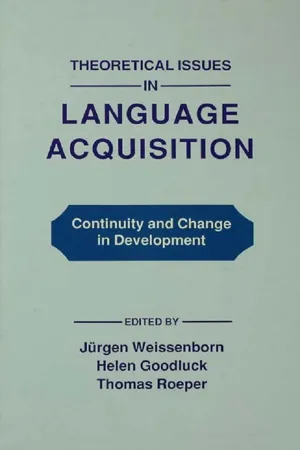
Theoretical Issues in Language Acquisition
Continuity and Change in Development
- 328 pages
- English
- ePUB (mobile friendly)
- Available on iOS & Android
eBook - ePub
Theoretical Issues in Language Acquisition
Continuity and Change in Development
About this book
In recent linguistic theory, there has been an explosion of detailed studies of language variation. This volume applies such recent analyses to the study of child language, developing new approaches to change and variation in child grammars and revealing both early knowledge in several areas of grammar and a period of extended development in others. Topics dealt with include question formation, "subjectless" sentences, object gaps, rules for missing subject interpretation, passive sentences, rules for pronoun interpretation and argument structure. Leading developmental linguists and psycholinguists show how linguistic theory can help define and inform a theory of the dynamics of language development and its biological basis, meeting the growing need for such studies in programs in linguistics, psychology, and cognitive science.
Information
1 | Introduction: Old and New Problems in the Study of Language Acquisition |
Max-Planck-Institut für Psycholinguistik
Nijmegen, The Netherlands
Nijmegen, The Netherlands
University of Ottawa, Canada
University of Massachusetts-Amherst
Four questions define the core concerns for a theory of language acquisition:
1. What is the adult grammar? That is, what is the end state of development?
2. What assumptions about language does the child bring to the task of language acquisition?
3. What developmental stages are exhibited?
4. How is language development possible in principle and in fact? That is, what are the conditions for successful learning?
We will briefly comment on these questions and the way they are addressed in the different contributions in this volume.
I. ADULT LINGUISTIC KNOWLEDGE
The authors in this volume share a number of common assumptions concerning adult linguistic competence; these assumptions underlie much work in current generative linguistic theory. Adult languages are assumed to be characterized by cognitive-particularity and modularity. By cognitive-particularity we mean the independence of linguistic constructs from other systems of knowledge; that is, we subscribe to the belief that linguistic knowledge cannot be reduced to principles governing non-linguistic aspects of human ability, although the latter may influence linguistic systems. By modularity, we refer to the assumption that linguistic knowledge itself comprises a number of highly specialized subsystems of rules and principles, each with its own function.1
Differences between adult languages provide some of the most telling evidence in favor of the assumption of cognitive-particularity. For example, English and Italian differ with respect to the grammaticality of questions of the type illustrated by the English question:
(1) Who do you think that came?
In English such questions are ungrammatical although the equivalent sentence without the complementizer that is perfectly good:
(2) Who do you think came?
In Italian, questions equivalent to (1) are grammatical, as shown by:
(3) Chi credi che è venuto?
These facts cannot be related to any general, nonlinguistic aspect of human cognition. No candidate principles for a nonlinguistic explanation exist and such an explanation would entail the odd assumption that adult speakers of Italian and adult speakers of English differ in their general cognitive makeup. The kind of explanation that has been put forward in the linguistic literature in the past decade or so depends on intricate, system-specific, properties of linguistic rules (see, e.g., Rizzi, 1982).
Most of the chapters in this collection assume the basic correctness of a particular version of the modular approach to linguistic knowledge, that is, the “principles and parameters” approach of Chomsky (1981) and subsequent works. In this approach, languages vary along a number of particular dimensions and a given adult language can be characterized by its “parameter-settings”—the choice of values for a particular rule system, which then affects the applicability of particular principles of grammar. To take an elementary example, languages differ in the position of heads of phrases. A language may be head-initial (such as English) or head-final (such as Japanese and German); the verb as head of the verb-phrase will be realized as phrase-initial in English and phrase-final in Japanese and German (the latter showing the base order in subordinate clauses only). This division between language types can be characterized as the setting of a parameter in the phrase structure module of the grammar (X-bar theory). We will return to other examples of modules of the grammar that exhibit significant variation between adult languages, and which have received considerable attention in both theoretical research and language acquisition research.
II. The Child's Linguistic Abilities
The authors in this volume not only share fundamental assumptions concerning the nature of adult linguistic knowledge (cognitive-particularity and modularity), they also share some basic assumptions concerning the nature of language acquisition. Specifically, they share the assumption that language acquisition could not be achieved unless the child were endowed with a substantial component of innate linguistic knowledge. In other words, children are assumed to acquire language with the aid of principles of Universal Grammar: the set of principles that define the range of possible human languages.
One motivation for assuming the innateness of Universal Grammar is “Plato's problem” (Chomsky, 1986b): How can we know so much on the basis of so little evidence? The fact that there are innumerable errors that one would expect children to make, but that, in fact, never show up, argues for strong constraints on the learning process. For example, children appear to follow structure-dependent syntactic rules from the outset. This may be illustrated by the fact that there is no evidence that children ever consider a rule for forming yes-no questions along the lines: invert the first noun (phrase) with the first auxiliary verb, producing (erroneous) forms such as “*Is the man who tall is rich?” (from “The man who is tall is rich”), although many of the question forms the child hears would be compatible with such a rule.2 A rich, innate component of linguistic knowledge will help explain the absence of many logically possible errors. Other powerful arguments for an innate basis of linguistic knowledge are the fact that language learning takes place in childhood without effort or a need for special instruction, and proceeds in a comparable manner under both normal and special conditions such as deafness and blindness (see Mills, 1983; Gleitman, Gleitman, Landau, & Wanner, 1989).
III. CURRENT ISSUES
The latter part of the 1970s and the early 1980s saw a burst of work in language acquisition that enhanced the plausibility of the view that language acquisition proceeded quite rapidly and under constraints imposed by (presumably innate) principles of grammar. For example, a number of studies have argued that at a very early stage a child develops a system that reflects the head-parameter setting for his or her language. By the third year, English-speaking children are sensitive to the fact that in their language the verb phrase is head-initial, and Japanese-speaking children to the fact that in their language it is head-final (Lust & Chien 1984; Lust & Wakayama 1979). Even in languages such as German, in which the basic head-final position of the verb phrase is not reflected in the surface word order of main clauses (but in subordinate clauses only), the system is acquired early on (Clahsen, this volume).
Other studies have successfully probed for knowledge of structure-based principles of grammar, such as the principle that precludes a definite pronoun from coreferring with an NP that it is structurally superior to (Principle C of Chomsky's [1981] binding theory). Thus preschool children are sensitive to the fact that the pronoun he and the NP the dragon can refer to the same individual in (4) but not in (5),
(4) Before he left the cave the boy stretched
(5) He left the cave before the boy stretched
(see, e.g., Solan, 1983; Crain & McKee, 1985), although errors of interpretation do occur. The total array of data makes sense if children are aware of principles such as Principle C and apply the principle to adult-like structures. To put it another way, evidence for sensitivity to a structure-based principle is also evidence for knowledge of the structures that condition its application and we have good reason, as a result of studies from the late 1970s and early 1980s, to suppose that not merely the basics of language-specific word order are in place by the third year, but also fairly detailed specifications of phrasal configurations.
Accepting the correctness of these observations, the way is open for the study of subtle, nonobvious questions concerning language development. The second and third questions with which we began: (2) what stages of development are observed and (3) what are the conditions for successful learning, are now beginning to be the focus of intensive work in language acquisition, some of which is represented in this volume.
III.i Stages of Development
Plainly, language development exists: The child must get from an initial state of absence of knowledge to knowledge of a grammar more or less identical to that of the adult language(s) he or she is exposed to. We can sketch three possible views concerning the form a child's grammar can take during development. They differ from each other with respect to how much they assume the child's linguistic representations to be constrained by principles of Universal Grammar. They are: (a) the Strong Continuity Hypothesis, (b) the Weak Continuity Hypothesis, (c) the Discontinuity Hypothesis.3
The Strong Continuity Hypothesis. From the onset of language acquisition, all principles of Universal Grammar are available to the child and at each point in time the grammar of the child allows only for structures that are also structures of the target language. As far as we know, this strong position has not been explicitly taken, although work by Crain and Fodor (1987) comes close to it.
The Weak Continuity Hypothesis. During development, the grammar of the child permits structures that are impossible or only marginally possible in the target language but are possible structures in other languages, that is, they obey principles of Universal Grammar. Moreover, the principles are used in such a way that each non-adult grammar corresponds to a “possible human language.” This position seems to be the most popular in the literature. (It is assumed and/or discussed under various names in, inter alia, Borer & Wexler, 1987; Clahsen, this volume; Finer, 1989; Goodluck, 1986; Goodluck & Behne, this volume; Hyams, 1986, this volume; Nichigauchi & Roeper, 1987; Wexler & Manzini, 1987; Pinker, 1984, 1989; Randall, this volume; Roeper and de Villiers, this volume; Weissenborn, this volume; White, 1982.)
The Discontinuity Hypothesis. There are stages of language development that are not constrained by Universal Grammar (Felix, 1987, this volume). The Discontinuity Hypothesis assumes that principles of grammar mature. Maturation itself does not necessarily imply discontinuity as we have defined it here, that is, systems that violate universal grammar. Borer and Wexler (1987, 1988) assume maturation without any violation of principles of Universal Grammar.
While the distinction between the three hypotheses is quite clear in principle, it is often a difficult matter to tease out evidence for one type of analysis rather than another for any given grammatical stage. For example, we have mentioned that by the third year there is quite firm evidence that children have arrived at an adult-like setting of the head-parameter for their language; that is, they have acquired a knowledge of basic phrase structure configurations appropriate to their language. But what about the very earliest stages, when children are just beginning to put words together into multiword utterances? Are the first multiword utterances governed by phrase structure specifications appropriate to the language being acquired (a Strong Continuity position)? Or are they governed by a phrase structure system that is a full-fledged system, but one that is not correct for their language (a Weak Continuity position)? Or do they altogether lack levels of phrasal structure and types of syntactic category that characterize adult systems (a Discontinuity position)?
The recent literature contains a variety of positions that are, in effect, Discontinuity analyses: for example, Lebeaux (1988), Radford (1988a, 1990), and Guilfoyle and Noonan (1988), have all argued for a version of the hypothesis that early syntactic systems are characterized by an absence of functional categories. In the X-bar theory of phrase structure, a distinction is made between lexical categories such as Noun, Verb, and Preposition, and the phrasal categories that they head on the one hand, and functional categories and their phrases, on the other. The latter are closed-class categories4 which serve, inter alia, to express and assign various (often morphologically realized) syntactic and semantic properties such as tense, aspect, and agreement for person and number on verbs and case, gender, and number on nouns, and to provide some of the structural positions utilized in sentences with word orders other than the normal order of declarative sentences.5 For example, the word that in a sentence such as “John said that Bill left” is a member of a functional category (complementizer), which heads its own phrase type, the complementizer phrase. In the adult grammar, a sentence-initial question word (such as what in “What did John eat?”) occupies a position inside the complementizer phrase. On the assumption that all languages exhibit a system of functional categories, the hypothesis that early speech lacks such categories is in effect a discontinuity hypothesis.6
Such a Discontinuity assumption is not mandated by the data, however. It should be kept in mind that almost all of the evidence for a restricted system, that is, for a system without functional categories, is the absence of positive evidence for a more highly articulated one, and that while certain studies may not allow us to decide, there are other pertinent studies that are not compatible with the absence of functional categories. For example, Weissenborn (this volume, 1990) and Weissenborn, Verrips, & Berman (1989) argue that children learning French and German make distinctions at an early age that mandate the presence of some functional categories. A similar conclusion is reached by Lillo-Martin (1986, this volume) in her study on the acquisition of American Sign Language. Moreover, even where there is an apparent absence of functional categories, one may hypothesize that the child has functional categories, but that these, for whatever reasons, are not realized by lexical items, such as the complementizer that at an early stage, or features of the INFL-component (Pierce, 1989; Radford, this volume; Valian, 1990). In some ways this current debate revives in new terminology the sort of debates about the nature of early grammars that have been going on since the early 1970s (cf. McNeill, 1970; Bowerman 1973) and illustrates the extreme difficulty of accurately determining the nature of very early grammars. Similar problems are to be found in the literature on children's knowledge of the possibility of sentences without an overt subject (Hyams, 1986, this volume; Valian, 1989; Roeper & Weissenborn, 1990; Weissenborn, this volume).
We do not wish to give the impression, however, that the indeterminacy surrounding the exact nature of the child system in some areas of grammar is a sign that the field of linguistically driven language acquisition research is doomed to rehearse forever old problems with no new breakthroughs. The problems that recur (such as the syntactic nature of very early speech) are central and difficult and progress is being made. One important way in which recent linguistic theory has opened new vistas for the study of child language is through the growth of cross-linguistic research. This is well illustrated by recent research and ongoing work on the development of syntactic movement rules, particularly question movement. In the Chomskyan framework, the formation of questions and other sentence types involves movement of the questioned element to the front of the sentence (to a position in the complementizer phrase, as has been mentioned). Languages differ in the manner in which they “use” movement. In some languages, such as English or German, the question word moves “in the syntax,” that is, movement is an operation linking deep structure (D-Structure) and surface structure (S-structure); in others, such as Chinese, move...
Table of contents
- Front Cover
- Half Title
- Title Page
- Copyright
- Contents
- Preface
- List of Contributors
- 1. Introduction: Old and New Problems in the Study of Language Acquisition
- 2. Language Acquisition as a Maturational Process
- 3. Learnability Theory and the Problem of Development in Language Acquisition
- 4. Maturation and Learning: Linguistic Knowledge and Performance: A Commentary on Clahsen and Felix
- 5. The Catapult Hypothesis: An Approach to Unlearning
- 6. Principles versus Criteria: On Randall's Catapult Hypothesis
- 7. Development in Control and Extraction
- 8. Comments on Goodluck and Behne
- 9. Ordered Decisions in the Acquisition of Wh-questions
- 10. Comments on Roeper and de Villiers
- 11. A Reanalysis of Null Subjects in Child Language
- 12. Null Subjects in Early Grammars: Implications for Parameter-setting Theories
- 13. Comments on Hyams and Weissenborn: On Licensing and Identification
- Author Index
- Subject Index
Trusted by 375,005 students
Access to over 1.5 million titles for a fair monthly price.
Study more efficiently using our study tools.
Frequently asked questions
Yes, you can cancel anytime from the Subscription tab in your account settings on the Perlego website. Your subscription will stay active until the end of your current billing period. Learn how to cancel your subscription
No, books cannot be downloaded as external files, such as PDFs, for use outside of Perlego. However, you can download books within the Perlego app for offline reading on mobile or tablet. Learn how to download books offline
Perlego offers two plans: Essential and Complete
- Essential is ideal for learners and professionals who enjoy exploring a wide range of subjects. Access the Essential Library with 800,000+ trusted titles and best-sellers across business, personal growth, and the humanities. Includes unlimited reading time and Standard Read Aloud voice.
- Complete: Perfect for advanced learners and researchers needing full, unrestricted access. Unlock 1.5M+ books across hundreds of subjects, including academic and specialized titles. The Complete Plan also includes advanced features like Premium Read Aloud and Research Assistant.
We are an online textbook subscription service, where you can get access to an entire online library for less than the price of a single book per month. With over 1.5 million books across 990+ topics, we’ve got you covered! Learn about our mission
Look out for the read-aloud symbol on your next book to see if you can listen to it. The read-aloud tool reads text aloud for you, highlighting the text as it is being read. You can pause it, speed it up and slow it down. Learn more about Read Aloud
Yes! You can use the Perlego app on both iOS and Android devices to read anytime, anywhere — even offline. Perfect for commutes or when you’re on the go.
Please note we cannot support devices running on iOS 13 and Android 7 or earlier. Learn more about using the app
Please note we cannot support devices running on iOS 13 and Android 7 or earlier. Learn more about using the app
Yes, you can access Theoretical Issues in Language Acquisition by Juergen Weissenborn,Helen Goodluck,Thomas Roeper in PDF and/or ePUB format, as well as other popular books in Personal Development & History & Theory in Psychology. We have over 1.5 million books available in our catalogue for you to explore.