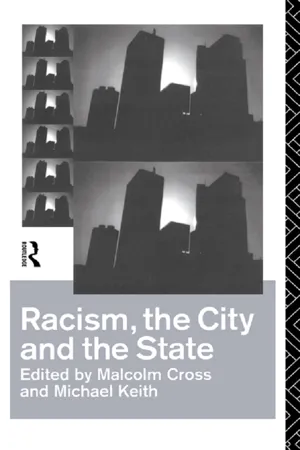
Does the concept of ethnicity divide the oppressed or unite minorities? Is the term `community' a dangerous fiction? What are the relations between the liberal capitalist democratic state and racialized minority groups? The contributors to this book confront and discuss these questions, bringing together ideas on urban social theory, contemporary cultural change and analysis of racial surbordination in order to explore the relationship between racism, the city and the state.
The book concentrates on the urban context of the process of racialization, demonstrating that the city provides the institutional framework for racial segregation, a key process whereby racialization has been reproduced and sustained. Individual chapters explore the profound divisions inscribed on the face of the city, showing for example that ethnicity is more powerful than social class in moulding the identities of new migrants to California, and that the reconstruction of French capitalism has opened new opportunities for the growth of right-wing popularism. The contributors show how, in the UK, urban space over the last two decades has been redefined and reconstructed in ways which sustain separation and racial inequality, and they highlight how black minorities struggling for survival in Britain's cities are seen as responsible for violence, crime, poverty and overcrowding.
- 256 pages
- English
- ePUB (mobile friendly)
- Available on iOS & Android
eBook - ePub
Racism, the City and the State
About this book
Information
Subtopic
Social Policy1
RACISM AND THE POSTMODERN CITY
Michael Keith and Malcolm Cross
At one end of Canon St Road, London E1, you can pay £4 for a two-course meal. At the other end of the street, less than 500 metres away, the same amount of money will buy a single cocktail in Henry’s wine bar in a postmodern shopping mall come upmarket residential development. The very urban fabric here, as in so many other cities across the globe, has altered at a feverish rate in the past decade.
The street runs south from the heartland of the rag trade and clutter of manufacturing, retail and wholesale garment showrooms on Commerical Road. Residentially, the north end is occupied almost exclusively by the Bengali community in one of the poorest parts of any British city. Three hundred yards south, the road crosses Cable Street, a short distance away from a mural commemorating a defiant Jewish community confronting Moseley’s fascist Blackshirts in 1926, the caption ‘they shall not pass’ now addressed to the adjacent gentrified terrace. A few hundred yards further and the microcosm is completed by Tobacco Dock, cast as the ‘Covent Garden of the East End’, although suffering badly in the depression of the early 1990s.
The leitmotif of social polarization is unavoidable. Golf GTIs share the streets uneasily with untaxed Ford Cortinas. Poverty is manifest, affluence is ostentatious. Gentrification sits beside the devalorization of old property. The appeals for information in the police posters tell of yet another racist attack, just as the graffiti with which they are decorated demonstrate the credence given locally to the powers of police investigation. The juxtaposition of such extremes is not novel. But the scale of change and its rapidity is undeniable, and has become common across the globe. The change appears to take place in and through cities. Racism persists through such changes and retains its chameleon-like character to adapt to any and every new environment (Sivanandan 1976).
We take it as axiomatic that there are no natural processes underscoring these changes. The turmoil has a logic; it is the outcome of a diversity of contingent political, economic and cultural forces which shape both the contemporary city and the society that the city hosts. Change only assumes the appearance of natural evolution. In this spirit, this volume is hopefully a small contribution to the effort to strip the image of natural succession away from the reality of manufactured transformation of urban form.
THE CONTEXT
The 1980s, which witnessed such a massive change in the nature of postindustrial capitalism, were characterized by a commensurate ferment in the social theory which was offered to make a sense of it. In particular, political economy, urban social theory and contemporary cultural change all boasted of major ‘sea changes’, epitomized in the debates which described the end of organized capitalism and the advent of ‘post-Fordism’, a sustained debate on the essence of the ‘urban’, and the fevered, if occasionally arcane, competitions to write a seminal definition of ‘the postmodern’.
Yet the incandescence of this spate of innovation could not obscure the repetition of a major omission in subject matter which had impoverished the social theory that the new vogues superseded. At its crudest, the experiences addressed by new social theory tended to be Eurocentric, bourgeois, elitist and culturally monolithic. The advent of regimes of flexible accumulation in one part of the world went on at the same time as Fordist production systems were just taking root in less affluent regions. The salience of the experience of migrant communities in metropolitan economies was rarely considered in frequently exotic portrayals of cultural change.
At times, academic social theory embodies a series of disparate and disconnected schools of thought, underwritten by political differences and reinforced by the academic division of labour between departments. Because of this, we have tried, in this volume, to bring together contributors from different academic subject areas and backgrounds in an attempt to address just a few of these silences and omissions. In particular, there are three fields of debate that we believe could profit from the interdisciplinary synthesis of which this book is at least the beginnings.
Urban social theory
There is clear evidence of the spatial realization of industrial restructuring (Massey 1984; Scott and Storper 1986; Scott 1988; Smith and Feagin 1987). It has also been claimed that the tie between accelerating technological advance and the radical restructuring of late capitalist economies has created a new ‘postmodern city’ which serves as the key reference point for these changes (Jameson 1984; Cooke 1988; Soja 1989). The city in turn, then, mediates the new social relations on which it ultimately depends. In this context, the resurgent urban social theory of the 1980s has focused on the structure and realization of social processes in space and time (Dear 1986).
But the postmodern city, if it exists at all, incorporates a way of seeing as well as a way of being. In other words, we are talking as much about a new conceptualization of the city as well as a new form of urbanism.
Theories of racism and racialization
Over the same period, there has been a growth in the theorization of race and racism which has run in parallel with these developments. This work has provided sophisticated analyses of the politics and ideology of racism, but has not provided the conceptual tools to link these developments with the underlying processes of change in capitalist societies (Miles 1982, 1987). It is widely accepted that a ‘racialization’ of social relations has been evident, as minorities have become permanent features of Western economies, but the processes of their incorporation and the structures which are thereby constituted have not appeared as central themes in mainstream social theory.
Consequently, the urban context of the process of racialization provides the central rationale to the concerns of this book. In order to define a decentred conceptualization of ‘race’ (Omi and Winant 1986), it is essential to focus upon the processes which reproduce racial divisions in time and space. This accords well with Stuart Hall’s notion of a mutiplicity of ‘racisms’, replacing simplistic and often misleading understandings of the term.
There is a theoretical need to tie the ideological to the economic, and to understand the recursive nature of the (time—space) link between racism and the mobilization of racial groups. This is the case not only in terms of the labour process in newly emergent production relations, but also in terms of residence, spatial concentration and consumption relations (cf Gilroy 1987).
Meanwhile, empirical studies have continued to point to the racialization of space and the further structuring of labour markets along racial- and gender specific lines. Moreover, the politics of civil society at the local level has reflected this transformation, but the tendency has been to see this simply as a growth in ‘equal opportunity’ policy, rather than the result of a racialized contestation over the control of locale (Jenkins and Solomos 1987).
The postmodernism debate
As a term which may be traced from architectural vogue to a ubiquitous prefix for any description of the contemporary, ‘postmodernism’ has come to elude any easy definition or consensual usage. On one level, it has become little more than a useful label for description. However, there are three themes that recur in much postmodernist writing which are particularly relevant to the interdisciplinary changes in social theory that this book seeks to address.
First, the 1980s have witnessed an increasing suspicion of the ability of contemporary societies to provide a scientific analysis of themselves. Often represented as a crisis of knowledge, or the end of enlightenment reason, such a sea change has questioned both the forms of social practice which sought to solve social problems and the technocratic discourses in social science which underwrote them.
Second, associated with this rejection of analytical certainty in studies of the social world are the writings of various authors which might be collectively labelled ‘post-structuralist’. These have provided one of the main influences on both postmodernist thought and contemporary urban social theory. Although there is no simple equivalence between post-structuralism and postmodernism, the former has continually informed the latter.
The third theme which is central to postmodernist social forms is the continual reflection on the nature of time, embodied in a repeated revisiting of the past, either aesthetically (as in literature, figurative art and architecture), rhetorically (as in the left and right politics of ‘heritage’) or materially (as in the increased stress on the significance of conjuncture and context in social theory).
At a time of rapid change in the social form of cities in late capitalist societies, and in the theories which seek to interpret them, the notion of postmodernism is, then, both a relevant conceptual standpoint from which to observe change and a useful means of classification.
The papers collected in this volume all address, in some way, the inter section of these themes and share an attempt to persuade mainstream social theory of the importance of racism in understanding contemporary social change. Because of this perspective on the nature of ‘theorization’, there is no elitist assertion that black struggles can learn from postmodern social theory. A central tenet of this work is that it is often the reverse that is the case. For example, the sort of contingent community alliances which have characterized the anti-racist movement commonly prefigured those theorized in notions of cultural change which focus on the decentred subject, while both the politics of identity and a focus of interest in the ‘new times’ draw in large measure from the experiences of those communities of resistance taking on the forces of racism and racial subordination.
So the notion of social ‘theory’ employed here is very much one which tries critically to make sense out of the world through a process of abstraction, rather than by discerning the regularities and repetitions of social pattern which are identified with the intention of creating laws of generalization and predictions of future outcomes. In part, the crisis of enlightenment is a crisis of the truth claims made by the social scientists and engineers of human souls in the post-war era under both socialism and capitalism. In this sense, it is important to emphasize that theory — in the reading of the term employed here — is always learning from the experiences of real people, rather than lecturing about them. The realm of theoretical abstraction exists alongside empirical experience, not in a privileged relation to it, nor as a superior form of discourse about it. This is not to deny the value of studying patterns of human behaviour, but rather to assert that generalizations so developed have no privileged status, and that their significance is contingent on meanings instilled through human experience.
In this sense, the central aim of this book is to pinpoint areas of academic debate which can benefit from an interdisciplinary focus in comprehending and combating racism. We are not trying to produce a grand synthesis, or to lay the foundations of yet another theoretical narrative of sly banality or esoteric impenetrability, but rather to point towards some of the areas where there might be a potentially fruitful rearticulation of some ideas and literatures which, because of the academic division of labour, have tended to develop in isolation from one another.
Certain themes emerge from this interdisciplinary focus. The six areas we point to here as potentially fruitful for further analysis are dealt with in a manner which is necessarily superficial. Each deserves at least one book in its own right. Notwithstanding this, they do emerge both from this volume and other recent debates as contestable issues which are central to the reproduction of racism in the contemporary world.
Discourses of urbanism, the search for an urban political economy, the underclass, the tensions between local and central state, the politics of identity and the politics of scale provide the six organizing subject areas around which this chapter is structured. Conceptually, ‘the city’ is a key organizing theme which either runs through these subjects or provides their central focus. But less obviously, it appears to be a different city on each occasion. It is this characteristically slippy usage that prompted Saunders (1983) to call for the abandonment of notions of the urban altogether. We prefer instead to recognize this mutability by affirming ‘the urban’ as contingently useful; the city is a point of closure from which theoretical understanding and practical politics are launched.
THE IMAGINARY CITY
The city has always occupied a central, if ambiguous, position in the imaginary worlds of social theory. As a prerequisite for mass production, as a crucible of both state and popular power, facilitating modernization and enabling insurrection, mass urbanization ran contemporaneously with what is commonly cited as the rise of modernism (Sennett 1977; Harvey 1989). Modernity demanded the production and reproduction of the city while modernism was characteristically an urban phenomenon (Harvey 1989: 25; Schorske 1981; Lash 1990).
This connection is commonly taken further. Typically, Jameson (1984) cites with approval Benjamin’s causal link between the emergence of modernism and a new experience of city technology. Yet within modernist thought, particularly in the social sciences, this very contemporaneity identified the city with the problems of social life. Rousseau’s Paris, Engel’s Manchester, Booth’s London and Park’s Chicago were all, in their very different ways, sources of class exploitation, social pathology and alienation. Likewise, the great reforming thinkers of the late nineteenth and early twentieth century came to see the city itself as possibly the primary malevolent influence on contemporary social life. In this vein, Le Corbusier and Ebenezer Howard shared a profound anti-urbanism which came to be identified so closely with the ascendancy of modernist thought in the mid-twentieth century, particularly in Britain and North America. Ridding society of the city was the moment of creative destruction that was a prerequisite for a better future, whether by revolution or by the ‘destruction of the street’ (Berman 1982: 65–71), or by a thousand garden cities. It was this antipathy that was to rationalize the officially endorsed, socially engineered transformations of so much of mid- to late-twentieth century urban space. In short, the cities of the industrial past were economically functional but were considered and commonly remembered as dystopian nightmares.
In marked contrast, the city of the post-industrial present is possibly economically superfluous but socially cherished. In both oppositional (broadly left oriented) and conservationist (conservative) writing, a new urbanism has emerged in the past two or three decades which restores the cultural primacy of the urban in an era in which culture and the cash nexus seek out the city as playground.
Prefigured in the brilliant but disingenuous nostalgia of Jane Jacobs’s influential Death and Life of Great American Cities, the city becomes a suitable case for treatment, an area to be reclaimed by the urban pioneers of gentrification (Smith 1989; Zukin 1982), a site for the richest production of cultural capital. The city is the territory on which Prince Charles shall fight his most celebrated causes célèbres, where the icons of postmodern culture will be erected, where the tensions between the local and the central state become most acute, and, perhaps most importantly of all, where radical mutations in the cultural and social processes of gender, race and class formation will be realized.
These changes have been reflected in much contemporary social theory as well as in popular representations of urban life. There is a new optimism about the nature of the urban experience, so that in Marxism Today:
…the new vision of the city will also emphasise its nature as a means of communication, a place where people meet, talk and share experiences, where they think and drink together. Cities work only if they are places where people engage in a collective process of making meanings and defining their place in the world.(Mulgan 1989)
In California, the self-styled Los Angeles School of Geographers and Planners has arrogated the task of defining the diagnostic features of this new urban condition, whose leitmotif might be taken from Ed Soja’s notion that ‘It all comes together in LA’. In their self-conscious emulation of both Park’s Chicago and Adorno’s Frankfurt, ‘They have made clear that they see themselves excavating the outlines of a paradigmatic postfordism, an emergent twenty-first century urbanism’ (Davis 1990: 84). Again, the new city is celebrated, even as it is simultaneously condemned as the site of new oppressions. As Mike Davis has pointedly remarked:
By exposing the darkest facets of the ‘world city’ (Los Angeles ‘new Dickensian hell’ of underclass poverty in the words of UCLA geographer Allan Scott) the LA school ridicules the Utopias of LA 2000. Yet, by hyping Los Angeles as the paradigm of the future (even in a dystopian vein), they tend to ...
Table of contents
- Cover
- Racism the City and the State
- Full Title
- Copyright
- Contents
- List of contributors
- 1 RACISM AND THE POSTMODERN CITY
- 2 POSTMODERNISM AND UTOPIA, AN UNHOLY ALLIANCE
- 3 ‘POLLUTING THE BODY POLITIC’: RACIST DISCOURSE AND URBAN LOCATION
- 4 THE POSTMODERN CITY AND THE SOCIAL CONSTRUCTION OF ETHNICITY IN CALIFORNIA
- 5 MIGRATION AND THE RACIALIZATION OF THE POSTMODERN CITY IN FRANCE
- 6 FROM EQUAL OPPORTUNITY TO ‘THE NEW SOCIAL CONTRACT’: RACE AND THE POLITICS OF THE AMERICAN ‘UNDERCLASS’
- 7 DIFFERENCE AND INEQUALITY: POSTMODERN RACIAL POLITICS IN THE UNITED STATES
- 8 RESIDENTAL SEGREGATION AND THE POLITICS OF RACIALIZATION
- 9 THE LOCAL POLITICS OF RACIAL EQUALITY: POLICY INNOVATION AND THE LIMITS OF REFORM
- 10 IS RACE REALLY THE SIGN OF THE TIMES OR IS POSTMODERNISM ONLY SKIN DEEP?: BLACK SECTIONS AND THE PROBLEM OF AUTHORITY
- 11 ASPECTS OF NATIONALISM AND BLACK IDENTITIES IN POST-IMPERIAL BRITAIN
- 12 FROM PUNISHMENT TO DISCIPLINE? RACISM, RACIALIZATION AND THE POLICING OF SOCIAL CONTROL
- Bibliography
- Name index
- Subject index
Trusted by 375,005 students
Access to over 1.5 million titles for a fair monthly price.
Study more efficiently using our study tools.
Frequently asked questions
Yes, you can cancel anytime from the Subscription tab in your account settings on the Perlego website. Your subscription will stay active until the end of your current billing period. Learn how to cancel your subscription
No, books cannot be downloaded as external files, such as PDFs, for use outside of Perlego. However, you can download books within the Perlego app for offline reading on mobile or tablet. Learn how to download books offline
Perlego offers two plans: Essential and Complete
- Essential is ideal for learners and professionals who enjoy exploring a wide range of subjects. Access the Essential Library with 800,000+ trusted titles and best-sellers across business, personal growth, and the humanities. Includes unlimited reading time and Standard Read Aloud voice.
- Complete: Perfect for advanced learners and researchers needing full, unrestricted access. Unlock 1.5M+ books across hundreds of subjects, including academic and specialized titles. The Complete Plan also includes advanced features like Premium Read Aloud and Research Assistant.
We are an online textbook subscription service, where you can get access to an entire online library for less than the price of a single book per month. With over 1.5 million books across 990+ topics, we’ve got you covered! Learn about our mission
Look out for the read-aloud symbol on your next book to see if you can listen to it. The read-aloud tool reads text aloud for you, highlighting the text as it is being read. You can pause it, speed it up and slow it down. Learn more about Read Aloud
Yes! You can use the Perlego app on both iOS and Android devices to read anytime, anywhere — even offline. Perfect for commutes or when you’re on the go.
Please note we cannot support devices running on iOS 13 and Android 7 or earlier. Learn more about using the app
Please note we cannot support devices running on iOS 13 and Android 7 or earlier. Learn more about using the app
Yes, you can access Racism, the City and the State by Malcolm Cross,Michael Keith in PDF and/or ePUB format. We have over 1.5 million books available in our catalogue for you to explore.