- 400 pages
- English
- ePUB (mobile friendly)
- Available on iOS & Android
eBook - ePub
Advances in Nonlinear Dynamos
About this book
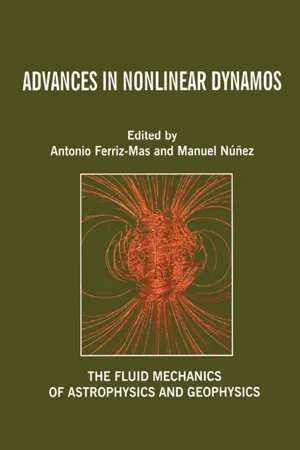
Nonlinear dynamo theory is central to understanding the magnetic structures of planets, stars and galaxies. In chapters contributed by some of the leading scientists in the field, this text explores some of the recent advances in the field. Both kinetic and dynamic approaches to the subject are considered, including fast dynamos, topological methods in dynamo theory, physics of the solar cycle and the fundamentals of mean field dynamo. Advances in Nonlinear Dynamos is ideal for graduate students and researchers in theoretical astrophysics and applied mathematics, particularly those interested in cosmic magnetism and related topics, such as turbulence, convection, and more general nonlinear physics.
Information
1 The field, the mean and the meaning
SRON Laboratory for Space Research, Sorbonnelaan 2, 3584 CA Utrecht, The Netherlands, E-mail: [email protected]
This chapter is about the fundamentals of mean field dynamo theory, with an emphasis on the statistical aspects of the theory. The equations for passive vectorial transport (dynamo equation) and passive scalar transport are derived on a par, as applications of the theory of stochastic equations with multiplicative noise. Only approximate transport equations for mean quantities exist, and the approximations are scrutinized in relation to the ensemble average and the azimuthal average. A summary of the elementary physics of the dynamo equation is followed by an analysis of the influence of mean shear flows and resistive effects on the transport coefficients α and β. It is argued that the dynamo equation contains in practical situations no higher than second-order spatial derivatives. The physics of turbulent diffusion and the information content of the dynamo equation is analysed, and it is concluded that transport equations for the mean can only make probabilistic statements about the physical systems to which they apply. They cannot predict the evolution for all times. This is elucidated for ensemble and azimuthal averages at the hand of examples, referring to the phase memory and magnetic energy losses of the solar dynamo, and to the variability and reversals of the geodynamo. The accent is on clarity of presentation, and on linear theory. A few remarks on nonlinear theory are made.
1.1. Introduction
Mean field dynamo theory seems to have a controversial status. To some it is their natural habitat, while others shy away from it because they maintain that the basic tenets are not understood or do not apply to real dynamos. In spite of this, much work in the literature on global magnetic fields is based on mean field theory. There are two main reasons for that. The first is that there is often no viable alternative. It is true that the magnetic Reynolds number Rm of the geodynamo is sufficiently small that several groups have succesfully performed fully resolved three-dimensional simulations (Glatzmaier and Roberts, 1995; Kageyama and Sato, 1997; Kuang and Bloxham, 1997; Christensen et al., 1998). While these computations have demonstrated that self-consistent dynamo action is able to overcome resistive decay of the currents, the demands on computing resources are extreme. A routine study of many different cases, and runs extending over a long time and in the correct parameter regime are impossible. And stellar dynamos have such high Reynolds numbers that fully resolved MHD simulations of the whole dynamo will be impossible for the forseeable future. Only a small section of the dynamo can be addressed, and that is helpful for an understanding of the physical mechanisms at work (Nordlund et al., 1992, 1994; Brandenburg et al., 1996).
A second important reason for the popularity of mean field theory is that it works rather ...
Table of contents
- Cover
- Half Title
- Title Page
- Copyright Page
- Table of Contents
- List of contributors
- Preface
- 1 The field, the mean and the meaning
- 2 Fast dynamos
- 3 On the theory of convection in the Earth’s core
- 4 Dynamo action of magnetostrophic waves
- 5 Magnetic flux tubes and the dynamo problem
- 6 Physics of the solar cycle
- 7 Highly supercritical convection in strong magnetic fields
- 8 Thin aspect ratio αΩ-dynamos in galactic discs and stellar shells
- 9 Computational aspects of astrophysical MHD and turbulence
- 10 Topological quantities in magnetohydrodynamics
- Name index
- Subject index
Trusted by 375,005 students
Access to over 1.5 million titles for a fair monthly price.
Study more efficiently using our study tools.
Frequently asked questions
Yes, you can cancel anytime from the Subscription tab in your account settings on the Perlego website. Your subscription will stay active until the end of your current billing period. Learn how to cancel your subscription
No, books cannot be downloaded as external files, such as PDFs, for use outside of Perlego. However, you can download books within the Perlego app for offline reading on mobile or tablet. Learn how to download books offline
Perlego offers two plans: Essential and Complete
- Essential is ideal for learners and professionals who enjoy exploring a wide range of subjects. Access the Essential Library with 800,000+ trusted titles and best-sellers across business, personal growth, and the humanities. Includes unlimited reading time and Standard Read Aloud voice.
- Complete: Perfect for advanced learners and researchers needing full, unrestricted access. Unlock 1.5M+ books across hundreds of subjects, including academic and specialized titles. The Complete Plan also includes advanced features like Premium Read Aloud and Research Assistant.
We are an online textbook subscription service, where you can get access to an entire online library for less than the price of a single book per month. With over 1.5 million books across 990+ topics, we’ve got you covered! Learn about our mission
Look out for the read-aloud symbol on your next book to see if you can listen to it. The read-aloud tool reads text aloud for you, highlighting the text as it is being read. You can pause it, speed it up and slow it down. Learn more about Read Aloud
Yes! You can use the Perlego app on both iOS and Android devices to read anytime, anywhere — even offline. Perfect for commutes or when you’re on the go.
Please note we cannot support devices running on iOS 13 and Android 7 or earlier. Learn more about using the app
Please note we cannot support devices running on iOS 13 and Android 7 or earlier. Learn more about using the app
Yes, you can access Advances in Nonlinear Dynamos by Antonio Ferriz-Mas,Manuel Nunez in PDF and/or ePUB format, as well as other popular books in Ciencias físicas & Astronomía y astrofísica. We have over 1.5 million books available in our catalogue for you to explore.