- 400 pages
- English
- ePUB (mobile friendly)
- Available on iOS & Android
eBook - ePub
About this book
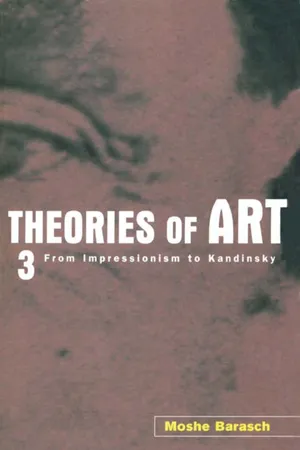
In this volume, the third in his classic series on art theory, Moshe Barasch traces the hidden patterns and interlocking themes in the study of art, from impressionism to abstract art. Barasch details the immense social changes in the creation, presentation, and reception of art which have set the history of art theory on a vertiginous new course: the decreased relevance of workshops and art schools; the replacement of the treatise by the critical review; and the emerging interrelationship between scientific inquiry and artistic theory. The consequent changes in the ways in which critics as well as artists conceptualized paintings and sculptures were radical, marked by an obsession with intense sensory experiences, psychological reflection on the effects of art, and an attraction to the exotic and alien--making for the most exciting and fertile period in the history of art criticism.
Information
PART IIEmpathy |
| 7 | |
IntroductionAn Empathy Tradition in the Theory of Art |
In these crucial four decades from the end of the nineteenth century to the beginning of the twentieth, a further trend emerged in the theoretical reflection on art that became increasingly dominant in early-twentieth-century thought. Strange as it may seem, this trend is difficult to define precisely in a single word or short phrase; no simple label fits it exactly, it does not go under any “ism.” The cluster of ideas and conceptual endeavors of which it is constituted is far more diverse than those making up other contemporary trends in art criticism. These difficulties of labeling are confusing. One surely cannot speak of a “doctrine” here. One cannot even envisage the pertinent statements as parts of a common tradition. It is often not clear whether the same trend of thought is being referred to in the different attempts to understand the emotional life and art that are to be considered here.
Yet no serious student following the stages of the movement we shall present, would doubt its intrinsic unity and coherence. What the different attempts, seemingly worlds apart, have in common is, first of all, a dominant theme, and even some specific ramifications following from the overall subject. Closer investigation may further reveal some common attitudes. In the following discussion we shall call this theme “empathy,” and will speak of an empathy tradition in the theory of art. The term “empathy” should not be understood as an indication of a tightly closed conceptual framework defining the theme of our discussion. Rather, it should be understood as the designation of the main core, of the mere center, of these variegated attempts to solve the riddle of art.
The history of what we here call the empathy trend is complex and intricate. Before we begin our story, it may therefore be useful to indicate briefly what is currently meant by empathy. It has two main meanings—closely related to each other, yet not fully identical—that are significant in our context. It means, first, the projection of one's own personality onto the personality of another in order to understand him or her better; the intellectual and emotional identification of oneself with another. One's own personality may also be projected onto an inanimate object, and one's emotions, feelings, and responses may thus be attributed to such an object. Second, and this is of particular importance in the experience and study of art, empathy may describe the artist's attitude to what he represents, and particularly the attitude of the spectator, who revives in his or her own mind the emotions conveyed by the artist's representation.
The latter element of our brief description, the spectator's intuitive grasp of the mood expressed in the work of art he is looking at, must have been taken for granted in most periods of history. Ever since there was a theory of art, it seemed self-evident (whether or not explicitly stated) that the spectator relives, and thus understands, what is represented in the work of art. In the very first text that can be considered a “theory of art,” Leone Battista Alberti's book On Painting, written in 1435, this view is clearly stated. “The istoria will move the soul of the beholder when each man painted there clearly shows the movement of his own soul. It happens in nature that nothing more than herself is found capable of things like herself; we weep with the weeping, laugh with the laughing, grieve with the grieving.”1
Leonardo da Vinci expressed a similar attitude. To illustrate the power of the image, for example, he wrote: “A painter once made a picture which made everybody who saw it yawn and yawn repeatedly as long as they kept their eyes on this picture, which represented a man who was also yawning.”2 The power of the image is manifested in its ability to elicit the empathy of the beholder. This conceptual tradition continued vigorously continued into the following centuries.
Without delving into the complex story of empathy any further (that would require a volume of its own), we can say that, though the tradition of various empathy concepts that emerged between the fifteenth to the eighteenth and nineteenth centuries was not forgotten, in the second half of the nineteenth and the early years of the twentieth centuries there arose a radically new approach to empathy. Both the scope of empathy and the ways in which the concept were used were new. In turning to these modern developments we shall first take a brief look at what the sciences taught about this subject, and then concentrate on what was said about art.
NOTES
1. Alberti, On Painting, p. 77.
2. da Vinci, Treatise on Painting, # 22.
| 8 | |
Gustav Fechner |
To indicate the particular moment at which the movement we shall attempt to trace in this part first appeared, and also to suggest something of the intellectual situation that formed its original background, it seems appropriate to begin with a discussion of Fechner. Fechner was a student and thinker of unusual richness of interest and complexity of thought; his work shows an exceptional versatility. It should therefore be stressed at the outset that we do not intend to draw a portrait of Fechner the scholar, but only to emphasize some assumptions that, if only indirectly, had a formative influence on the orientation of the empathy trend in art theory, and to a large extent indicated the problems that remained at its center.
Gustav Theodor Fechner (1843–87) was primarily a student of chemistry and physiology; he is remembered as the founder of what is called psychophysics, and promoter of the measurement of the phenomena under study. After a nervous breakdown, he turned to the study of philosophy, with particular emphasis on metaphysics (including what he had learned of Indian thought), and even some theology. To all these he tried to apply the experimental methods of the natural sciences, the study of which he pursued throughout his life.1
Fechner is also known as the founder of experimental aesthetics. It was mainly in the later stage of his life that he included aesthetics in the wide range of his studies. His major work in this field, Vorschule der Aesthetik (1876),2 was one of his last. But as Rudolf Arnheim has rightly noted, Fech-ner's concern for aesthetics derived direcdy from the core of his basic conceptions.3 The Vorschule shows how Fechner's studies in various disciplines merged, but it also indicates how greatly the reflection on beauty and art was, at least in one intellectual current, permeated by scientific thought. Though a collection of essays rather than a systematically planned treatise, it gives a distinct idea of Fechner's approach to the visual arts. This approach, incidentally, had already been briefly outlined by him in an article (“On Experimental Aesthetics”) published in 1871.4
In his explicit discussion of aesthetics, it has convincingly been shown that Fechner was more hesitant about speaking out with regard to his general ideas than he was in his other works.5 Why in the Vorschule he should have failed to spell out his guiding principles is a matter of conjecture; the very fact that he dealt with beauty (no matter how one interprets this concept) as the subject matter of aesthetics has been taken as an indication of his compromise with accepted views, hallowed by a venerable tradition. But it has also been maintained that his whole work has an important aesthetic dimension or bearing on the matter of aesthetics.
Fechner began the Vorschule with a revealing juxtaposition: aesthetics, he said, can be studied “from above” and “from below.” In this short opening essay (I, pp. 1–7) he provided both an indication of his own doctrine, and a polemical clarification of his position versus the philosophical tradition of reflection on the arts. Aesthetics “from above” begins with the “ideas and concepts of beauty, art, and style, and their position within the system of the most general concepts, especially their relation to the true and the good.” The difficulty with this approach is that it does not give us a clear orientation, and it does not explain why we find things the way they are. He called this approach “philosophical,” making it clear that he had the philosophy of German idealism in mind, that is, the philosophies of Schelling and Hegel (I, pp. 2,6).
Aesthetics “from below” is not philosophical; it is, as he said, “empirical” (I, p. 2). The true themes of empirical aesthetics are not the ideas of beauty and art, but our actual experiences and their careful analysis. It is not our thought but our experience that matters. Aesthetics “from below,” it should be kept in mind, is not only a change of direction (whatever this may mean precisely); it is in an important sense a change of subject matter; it simply deals with something other than aesthetics “from above.” Empirical aesthetics is concerned with experiences and perceptions, not with ideas. If Hegelian reflection on the arts was ultimately a contemplation of ideas, Fechner's reflections became a kind of applied psychology.
By turning from an analysis of pure ideas to the observation and investigation of aesthetic experiences as they take place in the real world, Fechner hoped to achieve his main aim, namely, to make aesthetics an experimental science. Setting himself this goal implied tacitly accepting several assumptions. To some of these assumptions I shall shortly return. I shall begin, however, with what Fechner openly declared as his purpose in his discussion of aesthetics.
Fechner believed that experimental aesthetics, based on careful observation and the comparison of many actual aesthetic experiences, makes possible the discovery and formulation of “aesthetic laws.” To formulate such laws should be the major aim of aesthetics. “The essential task of a general aesthetics are… the classification of the concepts and the stipulation of the laws… and their most important application in the theory of art” (I, p. 5).
Now, Fechner was well aware of the complexities of the subject; hence he knew that finding general, compelling rules, or “laws,” is a particularly difficult and intricate matter in the field of aesthetics and the arts. You cannot discover laws in aesthetics as you can—or so some people believe—in, say, physics. If there is here a general law, Fechner said, a law that determines the spectator's individual aesthetic reactions and experiences, “it is for us still covered by darkness” (I, p. 42). Nor did he believe, it seems almost unnecessary to say, that such a law, were we ever able to discover it, would make it possible to “program” an artist (to use a modern term) to create aesthetically satisfactory works of art. But awareness of all these shortcomings of human nature did not excuse the student from the task of searching for aesthetic laws.
Aesthetics and the study of art, Fechner believed, seek to discover the laws of beauty. But what is termed “laws of beauty” is an intricate, deceptive matter. The concept does not simply describe a common emotional response to a given form, or complex of forms, it attempts to be more than the observation of a rule of human behavior. Fechner supposed (without saying so explicitly) that a law of beauty also has some kind of metaphysical nature and status. A law of beauty, embodied in a visually perceived object or form, demands an experience on two levels, as it were; we should add that it has a certain degree of ambiguity.
Aesthetic reflection in Antiquity was acquainted with the problem. We know of several Greek and Roman artists, architects, and philosophers who distinguished between beauty in itself and its pleasing appearance.6 The latter is well known under the Greek term eurhythmia. Already in the fourth century B.C. Philo Mechanicus said that those shapes are eurhythmic which “are suited to the vision and have the appearance of being well shaped.” And we recall the distinction made by Vitruvius, the first-century architect, between symmetria and eurhythmia, the latter being “a pleasing appearance and a suitable aspect.”7 In other words, ancient thinkers had a special category for the pleasing quality of forms as they appear in our subjective experience. Fechner did not quote the ancient sources, but he clearly adopted and further developed, their conceptual framework. He spoke of Wohlgefälligkeit, which may be translated as “pleasant” or “agreeable,” though it may carry a stronger connotation than the English.
Given Fechner's frame of mind it seems natural that he would try to find some specific laws of beauty. To be sure, he did not even suggest that these laws could be models offered for imitation, but such ideas had been suggested in vague and confused form by others. By searching for such laws, Fechner placed himself within a venerable tradition, partly philosophical and partly workshop-oriented; it was a tradition that had many intrinsic affinities with the practical theory of art. Fechner was well aware of this ancestry. He himself referred to the solutions offered by Winckelmann, Hogarth, and others (I, pp. 184 ff). But before we look at what he said about these writers and artists, it is worth noting that essentially he conceived of beauty—the beauty perceived by the eye and represented in the visual arts—as a kind of relationship, a system of proportions reducible to mathematical terms. At least in this respect, he was within the great conceptual tradition that goes back to Plato. Perfect beauty for him was a relationship between different magnitudes, expressible in numerical terms.
Now, Fechner knew that in the course of history several concrete models had been suggested as embodiments of beauty (I, p. 183). These were models of “direct pleasantness” (directe Wohlgefälligkeit). He was particularly attracted by th...
Table of contents
- Cover Page
- Half Title page
- Title Page
- Copyright Page
- Dedication
- Contents
- Preface
- Introduction
- I Impressionism
- II Empathy
- III Discovering the Primitive
- IV Abstract Art
- Bibliographical Essay
- Name Index
- Subject Index
Trusted by 375,005 students
Access to over 1.5 million titles for a fair monthly price.
Study more efficiently using our study tools.
Frequently asked questions
Yes, you can cancel anytime from the Subscription tab in your account settings on the Perlego website. Your subscription will stay active until the end of your current billing period. Learn how to cancel your subscription
No, books cannot be downloaded as external files, such as PDFs, for use outside of Perlego. However, you can download books within the Perlego app for offline reading on mobile or tablet. Learn how to download books offline
Perlego offers two plans: Essential and Complete
- Essential is ideal for learners and professionals who enjoy exploring a wide range of subjects. Access the Essential Library with 800,000+ trusted titles and best-sellers across business, personal growth, and the humanities. Includes unlimited reading time and Standard Read Aloud voice.
- Complete: Perfect for advanced learners and researchers needing full, unrestricted access. Unlock 1.5M+ books across hundreds of subjects, including academic and specialized titles. The Complete Plan also includes advanced features like Premium Read Aloud and Research Assistant.
We are an online textbook subscription service, where you can get access to an entire online library for less than the price of a single book per month. With over 1.5 million books across 990+ topics, we’ve got you covered! Learn about our mission
Look out for the read-aloud symbol on your next book to see if you can listen to it. The read-aloud tool reads text aloud for you, highlighting the text as it is being read. You can pause it, speed it up and slow it down. Learn more about Read Aloud
Yes! You can use the Perlego app on both iOS and Android devices to read anytime, anywhere — even offline. Perfect for commutes or when you’re on the go.
Please note we cannot support devices running on iOS 13 and Android 7 or earlier. Learn more about using the app
Please note we cannot support devices running on iOS 13 and Android 7 or earlier. Learn more about using the app
Yes, you can access Theories of Art by Moshe Barasch in PDF and/or ePUB format, as well as other popular books in Art & Art Theory & Criticism. We have over 1.5 million books available in our catalogue for you to explore.