eBook - ePub
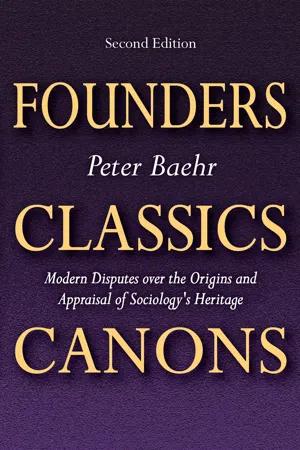
Founders, Classics, Canons
Modern Disputes Over the Origins and Appraisal of the Social Sciences
- 310 pages
- English
- ePUB (mobile friendly)
- Available on iOS & Android
eBook - ePub
Founders, Classics, Canons
Modern Disputes Over the Origins and Appraisal of the Social Sciences
About this book
Founders, classics, and canons have been vitally important in helping to frame sociology's identity. Within the academy today, a number of positions feminist, postmodernist, postcolonial question the status of "tradition."In Founders, Classics, Canons, Peter Baehr defends the continuing importance of sociology's classics and traditions in a university education. Baehr offers arguments against interpreting, defending, and attacking sociology's great texts and authors in terms of founders and canons. He demonstrates why, in logical and historical terms, discourses and traditions cannot actually be "founded" and why the term "founder" has little explanatory content. Equally, he takes issue with the notion of "canon" and argues that the analogy between the theological canon and sociological classic texts, though seductive, is mistaken.Although he questions the uses to which the concepts of founder, classic, and canon have been put, Baehr is not dismissive. On the contrary, he seeks to understand the value and meaning these concepts have for the people who employ them in the cultural battle to affirm or attack the liberal university tradition.
Trusted by 375,005 students
Access to over 1.5 million titles for a fair monthly price.
Study more efficiently using our study tools.
Information
Subtopic
SociologyIndex
Social Sciences1
Introduction
This book is a work of synthesis and argument. It arranges and critically evaluates a series of debates about the origins, meaning and value of the sociological tradition. Unlike many other studies of classical sociology devoted to the ideas of, say, Marx, Durkheim, and Weber, the present enquiry contains very little exegesis. Its concern is not to rehearse what “the classics” said, but to delineate what classics are: how they are best comprehended and how they gained their textual prominence. Nor does this book purport to offer a history of sociology. Instead, it is an investigation into some of the organizing and authoritative categories through which sociology's history continues to be understood. Two categories—founders and classics—have been particularly important in helping to frame sociology's precarious identity. They have recently been joined by a third: “canon.” Today this identity is being challenged as never before. Within the academy, a number of positions—feminist, postmodernist, post-structuralist, post-colonial—converge in questioning the status of “the tradition.” These currents in turn partly reflect wider social questioning about the meaning and uses of knowledge in technologically advanced societies.
The key aim of this study is to review and assess a considerable body of literature that deals with the interpretation and reception of sociology's “classic” texts. The concept of classics is a complex one, but essentially it draws our attention to a scale of judgment according to which a particular work is deemed to be especially worthy. A classic, in other words, belongs to a pantheon of texts by virtue of its peculiar eminence and exemplary character. But what is the nature of this eminence? Chapters 4 and 5 examine various responses to this question, notably those that focus on the functions classics perform for the scholarly community that employs them; the rhetorical or suasive force classics are said to possess; the conflicting or complementary ways in which they are best to be understood by modern interpreters; and the processes of reception through which they have been elevated to their current standing. Although these chapters are largely documentary in tone, they also suggest why attempts to establish abstract criteria of classicality are likely to fail. More positively, chapter 5 provides an analytical framework by means of which, I contend, classic formation is usefully charted.
The concept of classic is often equated with two other notions: founders and canon. The former has a well-established pedigree within the discipline, while widespread usage of the latter in sociology is much more recent. Chapters 2 and 3—on Founders—and 6— on Canons—present arguments against the use of these notions in interpreting, defending and attacking sociology's great texts and authors. Those chapters show why, in logical and historical terms, discourses and traditions cannot actually be founded, and why the term founder has limited explanatory value. Equally, they demonstrate that the analogy between a theological canon and sociological classic texts, though seductive, will not bear close scrutiny. Even so, the job of the sociologist is not exhausted, indeed is it only just beginning, with the demonstration that some idea is erroneous or problematic. Far more interesting to discern is why people subscribe to it. “Founders” is part of sociology's collective memory (to use Maurice Halbwachs's felicitous term), a tenacious simplification of complex events and processes that reduces the real history of sociology to a basic archetype. The sources of this archetype, I conjecture, derive from myth, religion1 (or at least theology) and notions of paternity all of which have migrated to the sociological domain. Canon, a concept with theological overtones, is also problematic. Part of a broader struggle for control of the academic curricula, it has become embroiled in a polemic from which there is little hope of rescuing it. My opposition to these concepts (founders, canons) is certainly not an objection to myth or to religion or even to collective memory per se. It is an objection to arguments that mistake the metaphorical for the literal, and that caricature an ambiguous and complex sociological legacy.
How then are we to understand “classic” texts in sociology or, indeed, classics more generally? There is no simple answer. Bernard Knox (1993: 21) remarks that the “primacy of the Greeks” in Western literature “is neither an accident nor the result of a decision imposed by higher authority; it is simply a reflection of the intrinsic worth of the material, its sheer originality and brilliance.” Harold Bloom (1994: 3), thinking paradigmatically of Shakespeare, contends that the principal quality of a great work of literature is “a mode of originality that either cannot be assimilated, or that so assimilates us that we cease to see it as strange.” These sentiments, which some might be tempted to echo when defending the classics of sociology, are admirable in their forthrightness. They are also, of course, highly question-begging, even for those of us who are in sympathy with them. While an aesthetic defence of the classics of literature is possible, even plausible, aesthetic profundity of itself is no guarantee of a text's ascent to classical stature. The text must not only be great but be recognized as such and that is a culturally mediated process. To survive, to be transmitted, it must secure agents of enthusiasm whose success is, like everything human, contingent not guaranteed.
The great works of Marx, Weber, Durkheim, and Simmel, among others, also have a powerful aesthetic quality and pathos. They, too, have, in their manner, assimilated and shaped us. Though each of these authors claimed, with justice, to address particular social, political, and economic constellations, many of their ideas speak to the very nature of being human and of living in the modern world. But will their works survive for the same time, and in the same ways, that the works of Shakespeare, Milton, and Hobbes have endured in literature and political theory? The sociological classics are just too recent for us to be confident of their longevity.2 Perhaps they will survive, vouchsafing a protean ability to make sense of radically different social conditions (for the society of subsequent centuries is unlikely to bear many characteristics of its nineteenth- and twentieth-century predecessors).3 Still, because appeals to “originality” and “intrinsic worth” can all too easily become circular and will, in any case, convince no one who is temperamentally hostile to them, I avoid such claims in this book. Instead, I argue that the achievements of the classical tradition are best appreciated through comprehending the arduous road that any text must travel to become, and remain, classic; and through a related understanding of the contribution that classics make to the conversation about the nature of human knowledge and existence.
A classical legacy can both be a source of inspiration for an epoch or a crushing and stagnating burden on it (Collins 1992: 75-77). It can both exclude potentially valuable ideas and prove capable of embracing them. It can both be a source of mindless regurgitation and of bracing intellectual challenge. Anyone who reads this study will quickly discern how much value its author accords sociology's classical legacy and the liberal university tradition that nourishes it. It is my expectation nonetheless that, in the spirit of a report and an argument, rather than a polemic, those who disagree will find here ample material with which to do so.
Notes
1. The relationship between myth (in the anthropological sense) and religion is not a matter I pursue here. Both encompass frameworks dealing with the most important questions of Being: of our origins, nature, and redemptive possibilities. As such, the secularist who identifies religion with myth can still accept the moral seriousness of both. The religious believer, committed to the reality of God, will go still further, convinced that while one can subscribe to a myth, one cannot worship it and that the secularist's
Blind unbelief is sure to err,
And scan his work in vain;
God is his own interpreter,
And he will make it plain
(William Cowper [1731-1800], Light Shining out of Darkness).
2. An International Sociological Association opinion survey, conducted in 1997, asked ISA members to rank five twentieth century books that had been most influential to them as sociologists. With a response rate of 16 percent (455 out of 2,785 members replied), the top ten books of the century were Max Weber, Economy and Society (20.9 percent); C. Wright Mills, The Sociological Imagination (13.0 percent); Robert K. Merton, Social Theory and Social Structure (11.4 percent); Max Weber, The Protestant Ethic and the Spirit of Capitalism (10.3 percent); Peter Berger amd Thomas Luckmann, The Social Construction of Reality (9.9 percent); Pierre Bourdieu, Distinction: A Social Critique of Judgment and Taste (9.5 percent); Norbert Elias, The Civilizing Process: Power and Civility (6.6 percent); Jürgen Habermas, The Theory of Communicative Action (6.4 percent); Talcott Parsons, The Structure of Social Action (6.2 percent); and Erving Goffman, The Presentation of Self in Everyday Life (5.5 percent).
“Which five books do you believe constitute the sociological classics?” may well have produced a different ranking since, as I will argue later, one can accord a book classic standing but not find it personally persuasive or important for one's own work. Still, it is interesting that not one of the texts of Marx, Durkheim, and Simmel appears in the ISA's top ten.
3. To be sure, a classic's survival in sociology depends not only on its being pertinent to changed conditions, but also on its being read, especially by competent readers (i.e., those who can understand and apply its concepts, and who are motivated to understand and apply them). One can readily imagine a situation where the former condition holds, but where the latter does not because of the atrophy of the sociological tradition.
2
Founders of Discourse
Introduction
Few terms are more commonplace in descriptions of sociology's past than those of “founders” or “founding fathers.” That sociology has founders is a disciplinary platitude, evidence of a metaphor that has died “off into literalness,” and become one of those “skeletons which remain after the capacity to arouse the senses...has been rubbed off by familiarity and long usage” (Rorty 1989:16, 152). Yet that description is only partly accurate: the “founder” idea is also the source of various bones of contention. What, then, makes a person a “founder,” and in what, more generally, might the “act” of founding be said to consist?
In this chapter and the next, I probe some of the key assumptions behind the notions of founders and founding as they have come to be employed in sociological literature, current and otherwise. The main purpose of the present chapter is to examine critically two major attempts—those of Michel Foucault and Sheldon Wolin—to identify the formative “moments” during which, supposedly, discourses and disciplinary traditions are established. The next chapter, in contrast, deals with the question of institutional innovation. The distinction between the founding of discourses, and the founding of institutions will, in these truncated remarks, appear rather obscure. So let me now offer some conceptual discriminations that will both clarify these comments and also make intelligible the narrative organization of this chapter and the one that follows it.
Founders: Discursive and Institutional, Deliberative and Appropriated
Though the terms “founder” and “founding fathers” circulate as common currency in sociological discussion, a survey of actual usage reveals that not one but four rather different ideas are being canvassed under these labels. The first is of a Founder with a magisterial capital F. Founders in this sense include the so-called Founding Fathers of sociology—minimally, the trinity of Marx (1818-1883), Durkheim (1858-1917), and Max Weber (1864-1920), but also often including Comte (1798-1857), Simmel (1858-1918), and Pareto (1848-1923) among others. These Founders are primarily invoked as heroes of a discipline that would be unrecognizable without their presence. Their iconic status is based, ostensibly, on a twofold contribution. First and foremost, they are believed to be responsible for founding a specific discourse, that is, a stock of presuppositional ideas formative of one of sociology's traditions (e.g., Comte and positivist sociology; Weber and interpretive sociology). Second, these figures provide important symbolic markers for sociology by conferring on it a lineage and by circumscribing its professional domain in relation to other disciplines; in short, Founders (I shall henceforth drop the upper case) are an aspect of sociology's professional legitimation. It was this second feature of founders that prompted Alvin Gouldner (1959: ix) to write that
A “founding father” is a professional symbol which can be treated as a trivial detail by no one who wishes to understand the profession as a social organization. Where there are conflicts, by later generations, concerning who their “founding father” was, we suspect that this may be a serious question essentially reflecting a dispute over the character of the profession.
“Discursive” founders, it transpires, are often imagined to lay the “tracks” of traditions. Their importance is held to derive more from the stock of ideas they have provided for sociology than from any organizational contribution to it they have made. This distinguishes them from “institutional” founders—our second category—which refers to people whose significance lies in the fact that they established some artefact or institution demonstrably related to the sociological enterprise: for instance, a sociology journal, an academic society or association, a university department. In this sense it comes naturally for us to talk of, for instance, Albion Small (18541926) as the founder of the first Department of Sociology in the U.S.A. at the University of Chicago in 1892, and of the American Journal of Sociology in 1895 (Maus, 1962 [1956]: 97);1 or of René Worms (1867-1926) as the founder in 1893 of the Institut International de Sociologie and (in the same year) the Revue internationale de sociologie; or of Dürkheim as the founder of the Année sociologique in 1896—though in all these cases, the actual “founding” presupposed a number of conducive social conditions, and was the product of a collaborative endeavor. Contrasted especially to Small and Durkheim,
Max Weber's activity as a sociologist was much less institutionalized. He was not a professor of the subject; he supervised for a limited period several research projects for the Verein für Sozialpolitik [Association for Social Policy]; he tried—and failed—to institutionalize two research projects on the press and on voluntary associations through the Deutsche Gesellschaft für Soziologie [German Sociological Society]; he wrote Wirtschaft und Gesellschaft [Economy and Society] as one section of a comprehensive series of handbooks on economics, organized by the publisher Siebeck; he edited a great journal of social science and social policy, very little of which was devoted to sociology. The connections of his sociological activities with institutions were peripheral, fragmentary, and transient (Shils 1982 [1970]: 309).
Table 2.1
Founders
Founders
Discursive | Institutional | |
Worms | - | + |
Small | -/+ | + |
Durkheim | + | + |
Weber | + | -/+ |
Marx | + | - |
The above analysis yields at least the possibilities laid out in table 2.1. Two features of it call for immediate comment. To begin with, the relationship between the discursive and the institutional domains is, in reality, immensely porous. Small was not only instrumental in setting up the Department of Sociology at Chicago. He was by virtue of that position a constitutive member of that ethnographic, politically liberal, and socially reformist tradition known as the Chicago School. Furthermore, to the degree that the work of so-called discursive founders is taken up by academics as material for research programs, in curricula, etc., it becomes institutionalized. With these provisos, the division between discursive and institutional is still a useful one. For one thing, it highlights different sources of influence on sociology; for another, it points to the relative autonomy...
Table of contents
- Cover Page
- Halftitle Page
- Title Page
- Copyright Page
- Dedication
- Content Page
- Acknowledgements
- 1. Introduction
- 2. Founders of Discourse
- Introduction
- Founders: Discursive and Institutional, Deliberative and Appropriated
- Foucault's Founders
- Wolin and “Epic Theory”
- Constitutions, Discourses, Founders
- Conclusion
- 3. Founders of Institutions
- Introduction
- The Social Context of Innovation
- Creativity, Reputation and Intellectual Networks
- The Shadow Group Revisited
- Institutional and Deliberative Founding: Durkheim and the Année Sociologique
- The Founder Idea: A Conjectural Genealogy
- Conclusion
- 4. The Utility, Rhetoric, and Interpretation of Classic Texts
- Introduction
- A Definition of Classic Texts
- Classics in Common? The Uses of Classical Theory and the Discipline of Sociology
- Rhetoric in the Classical Tradition
- Understanding Classic Texts
- Presentism
- The Historicist Critique and Alternative
- Objections to Historicism
- Conclusion
- 5. Classicality: Criteria and Reception
- Introduction
- The Stratification of Classic Texts
- “Criteria” of Classicality?
- Classics and their “Reception”
- Classic Reception, Classic Formation
- The Classics, Gender, and Sexuality
- Excursus on Classic Appraisal in Sociology and the Arts
- Conclusion
- 6. Canons
- Introduction
- “Canon” in Current Social Theory: Usages and Appraisals
- Conflicting Terminologies
- The Christian Canon and the Classics of Sociology
- Significance of the Canon Debate: The Controversy Over Higher Education and the Purpose of the University
- The University and the Jargon of “Relevance”
- Conclusion
- 7. A Concluding Look at the Three Concepts
- Appendix on Translation and Reception: The “Iron Cage” and the “Shell of Steel": Parsons, Weber and the stahlhartes Gehäuse metaphor in The Protestant Ethic and the Spirit of Capitalism
- Bibliography
- Index
Frequently asked questions
Yes, you can cancel anytime from the Subscription tab in your account settings on the Perlego website. Your subscription will stay active until the end of your current billing period. Learn how to cancel your subscription
No, books cannot be downloaded as external files, such as PDFs, for use outside of Perlego. However, you can download books within the Perlego app for offline reading on mobile or tablet. Learn how to download books offline
Perlego offers two plans: Essential and Complete
- Essential is ideal for learners and professionals who enjoy exploring a wide range of subjects. Access the Essential Library with 800,000+ trusted titles and best-sellers across business, personal growth, and the humanities. Includes unlimited reading time and Standard Read Aloud voice.
- Complete: Perfect for advanced learners and researchers needing full, unrestricted access. Unlock 1.5M+ books across hundreds of subjects, including academic and specialized titles. The Complete Plan also includes advanced features like Premium Read Aloud and Research Assistant.
We are an online textbook subscription service, where you can get access to an entire online library for less than the price of a single book per month. With over 1.5 million books across 990+ topics, we’ve got you covered! Learn about our mission
Look out for the read-aloud symbol on your next book to see if you can listen to it. The read-aloud tool reads text aloud for you, highlighting the text as it is being read. You can pause it, speed it up and slow it down. Learn more about Read Aloud
Yes! You can use the Perlego app on both iOS and Android devices to read anytime, anywhere — even offline. Perfect for commutes or when you’re on the go.
Please note we cannot support devices running on iOS 13 and Android 7 or earlier. Learn more about using the app
Please note we cannot support devices running on iOS 13 and Android 7 or earlier. Learn more about using the app
Yes, you can access Founders, Classics, Canons by Peter Baehr in PDF and/or ePUB format, as well as other popular books in Social Sciences & Sociology. We have over 1.5 million books available in our catalogue for you to explore.