This 5th volume of the Appalachian Conference discusses how the brain processes information, the role of memory and value, and models of creativity. It pursues aspects of cognitive neuroscience and behavioral neurodynamics, such as the topic of values and quantum-distributed processing in the brain.
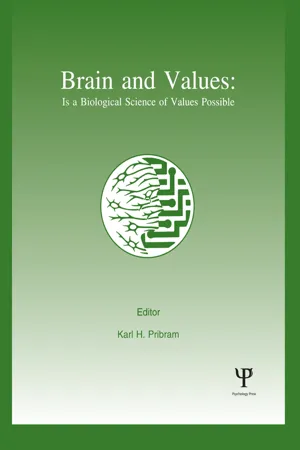
- 576 pages
- English
- ePUB (mobile friendly)
- Available on iOS & Android
eBook - ePub
About this book
Information
Publisher
Psychology PressYear
2018Print ISBN
9780805831542
9781138411531
Edition
1eBook ISBN
9781134997923
Preference
4
Stimulus Class Formation in Animals
Abstract
The simplest kind of stimulus class is one defined simply by a common trained response. Other stimulus classes do not require training of each of the members but they derive their membership from the physical similarity among class members through the process of stimulus generalization. Stimulus classes of greater interest are nonsimilarity based classes for which membership implies properties not explicitly experienced, or so-called emergent properties. Nonsimilarity-based or arbitrary classes can develop when two or more arbitrary stimuli become directly associated through their pairing with a common event. These classes appear to develop during matching-to-sample training when two or more samples are associated with the same comparison (i.e., many-to-one matching).
Convergent evidence will be presented for the development of emergent relations between these samples (or for their common coding) in the form of: (1) Transfer: When a subset of these samples is associated with new comparisons there is evidence that the remaining samples are also associated with the new comparisons. (2) Interference/facilitation: When a subset of these samples is associated with new comparisons and a delay is inserted between the samples and new comparisons, interpolation of one of the remaining samples into the delay will interfere with or will facilitate matching accuracy depending on whether the interpolated sample was paired with the same comparison as the current sample in original many-to-one training. (3) Partial versus total reversal: When originally trained sample-comparison associations are reversed, reversals are faster when all of the associations are reversed than when only half of the associations are reversed (and the rest remain relevant). (4) Samples associated with the same comparison are harder to discriminate from each other (in a simple successive discrimination) than are samples associated with different comparisons. (5) The retention functions (matching accuracy as a function of delay inserted between the sample offset and comparison onset) for samples associated with the same comparison are much more similar in slope than those same retention functions when samples are associated with different comparisons.
The relation between this kind of stimulus class formation and formal (Sidman) stimulus equivalence will be discussed. Specifically, direct evidence for the three defining characteristics of stimulus equivalence (reflexivity, symmetry, and transitivity) in animals will be presented. Finally, the relation between stimulus class formation and human language will be addressed.
A stimulus class is defined by any group of stimuli that have some property in common. The simplest kind of stimulus class is one defined by a common response. All of the items in a refrigerator can be thought of as a stimulus class because they share a common location and can each be obtained by making a similar response (opening the door of the refrigerator). Stimulus classes of this type typically derive their membership from specific experience (i.e., having placed something in the refrigerator). Representing the members of a class by a common tag or label can serve as a useful and efficient means of storing, retrieving, and communicating information (e.g., about where the item can be found). But if the only relation among members of such a stimulus class is their physical location, such a class would have few implications for the organization of information beyond what was already known about specific experienced responses.
Stimulus classes of greater interest are those for which membership implies properties not explicitly experienced. In the case of the refrigerator example, if I knew that an novel food object had been placed in the refrigerator, I might conclude that it would likely spoil relatively quickly at room temperature. This would be an inference, or emergent property of the novel substance, based on learning about other objects that are typically placed in a refrigerator. The kind of stimulus class of interest here is that for which untrained properties can be shown to emerge. In other words, they are classes in which members are not just related to the class but are also related to each other, such that, unless explicitly trained otherwise, whatever happens to one member of the class will have an effect on the other members.
Consider for a moment the stimulus class DOG as it might be used by humans. Not only might this class contain experiences with a wide variety of dog breeds, but it might also contain pictures of dogs, the sound of the spoken word “dog,” and the written word “DOG.” The value of such as stimulus class is in our ability as humans to use information about one member of the class to make inferences about other members of the class. If you saw a dog bark, you might assume (whether correctly or not) that other dogs bark as well. Similarly, if you were told that there was a widespread outbreak of rabies among dogs, that might change your behavior in the presence of dogs that you encountered (other members of that class).
Perhaps the most important benefit to an organism of emergent relations among members of a stimulus class is when the value of one member of the class changes (e.g., is associated with fear or pain) and the organism can react appropriately, not only to that member of the class, but to other members of the class as well. Thus, emergent relations among members of a stimulus class allow a specific learning experience involving a change in value to have wide spread effects on the value of unexperienced events in the class. The capacity for emergent relations allows organisms to extend learning far beyond the events experienced.
In the remained of this chapter I will describe the various emergent relations that can develop among stimuli in a class and will present evidence of these relations. I will also address some of the controversies in the literature concerning emergent relations among stimuli in a class by humans and nonhumans.
Stimulus Classes that Show Emergent Relations
Similarity Based Classes: Stimulus Generalization
The simplest kind of emergent stimulus property is one based on stimulus similarity. Given that an organism has been trained to respond to a particular stimulus, it also will tend to respond to other stimuli in proportion to their similarity to the training stimulus. Thus, there is generally a monotonie relation between the similarity of the test stimulus to the training stimulus and the strength of the response. This function, relating stimulus similarity to response strength, is generally referred to as the gradient of stimulus generalization. To the extent that such generalized responding reflects the organisms inability to distinguish between the training stimulus and similar test stimuli (e.g., because the training and test stimuli may share many stimulus elements, Estes, 1950) the phenomenon may be of interest primarily to map an organism’s sensory capacity (i.e., determine psychophysical functions for the animal). Generalization gradients have also served as a tool for the assessment of stimulus control (see, e.g., Honig & Urcuioli, 1981). If, for example, one trains a pigeon to respond to a red light in the presence of a 1000 Hz tone, one can ask to what extent the hue and the tone control responding by systematically varying each.
But generalization gradients can have theoretical implications as well. For example, some would argue that if an organism’s ability to detect stimulus differences varies as a function prior experience, it suggests the presence of theoretically important psychological processes such as attention (Lashley & Wade, 1946), and perceptual learning (Hall, 1991). Thus, obtaining a flat generalization gradient following a particular kind of experience may suggest that an animal is not attending to stimuli that would otherwise gain control of responding.
Alternatively, stimulus generalization may reflect a process quite different from the inability to detect stimulus differences. Hull (1943) has suggested that animals have a natural tendency to respond to stimuli similar to those experienced in training, even when those stimuli can be readily discriminated from the training stimuli and from each other. Consistent with this hypothesis is the finding that a declining gradient of stimulus generalization does not depend on the animal’s prior experience with discriminations involving the tested dimension (Peterson, 1962; Riley & Leuin, 1971). Apparently, the detection of stimulus differences can occur in the absence of prior discrimination experience.
Although stimulus generalization has important implications for general theories of learning (see e.g., Mostofsky, 1965), I will not consider such examples of stimulus classes in assessing the ability of animals to demonstrate emergent relations among stimuli.
Nonsimilarity Based Classes
Similarity based classes can be defined by the relatively high correlation between stimulus similarity and the strength of the response. Nonsimilarit...
Table of contents
- Cover
- Title
- Copyright
- TABLE OF CONTENTS
- Acknowledgments
- Keynote
- Foreword
- Introduction
- Preference
- Utility
- Creativity
- Afterword
Trusted by 375,005 students
Access to over 1.5 million titles for a fair monthly price.
Study more efficiently using our study tools.
Frequently asked questions
Yes, you can cancel anytime from the Subscription tab in your account settings on the Perlego website. Your subscription will stay active until the end of your current billing period. Learn how to cancel your subscription
No, books cannot be downloaded as external files, such as PDFs, for use outside of Perlego. However, you can download books within the Perlego app for offline reading on mobile or tablet. Learn how to download books offline
Perlego offers two plans: Essential and Complete
- Essential is ideal for learners and professionals who enjoy exploring a wide range of subjects. Access the Essential Library with 800,000+ trusted titles and best-sellers across business, personal growth, and the humanities. Includes unlimited reading time and Standard Read Aloud voice.
- Complete: Perfect for advanced learners and researchers needing full, unrestricted access. Unlock 1.5M+ books across hundreds of subjects, including academic and specialized titles. The Complete Plan also includes advanced features like Premium Read Aloud and Research Assistant.
We are an online textbook subscription service, where you can get access to an entire online library for less than the price of a single book per month. With over 1.5 million books across 990+ topics, we’ve got you covered! Learn about our mission
Look out for the read-aloud symbol on your next book to see if you can listen to it. The read-aloud tool reads text aloud for you, highlighting the text as it is being read. You can pause it, speed it up and slow it down. Learn more about Read Aloud
Yes! You can use the Perlego app on both iOS and Android devices to read anytime, anywhere — even offline. Perfect for commutes or when you’re on the go.
Please note we cannot support devices running on iOS 13 and Android 7 or earlier. Learn more about using the app
Please note we cannot support devices running on iOS 13 and Android 7 or earlier. Learn more about using the app
Yes, you can access Brain and Values by Karl H. Pribram in PDF and/or ePUB format, as well as other popular books in Psychology & Cognitive Psychology & Cognition. We have over 1.5 million books available in our catalogue for you to explore.