Weather provides a wide variety of stimuli for our senses. The sound of thunder and gales, the smell of damp soil at the start of a summer thunderstorm are but temporary phenomena while the visual panorama of the changing sky that provides a more revealing insight into the workings of the dynamic atmosphere.
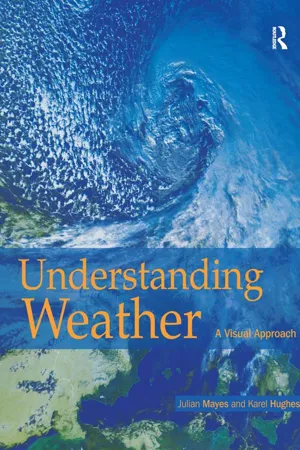
Understanding Weather shows how it is possible to understand weather and climate by combining our ability to observe weather systems from the earth's surface with visualisation from above - notably by means of satellite imagery. This fusion of human observation with the contrasting capabilities of remote sensing gives us a new perspective for exploring the three dimensional atmosphere. Remote sensing imagery and real-time weather information are now widely available through the internet, allowing the reader to relate the case studies to today's weather situation.
As with all sciences, understanding starts with careful observation. This books aims to show that it is possible to analyse global weather systems through a visual approach rather than the traditional use of mathematics and physics. After examining the interaction of atmospheric heat, moisture and motion in a non-technical style, the contrasting but complementary techniques of weather observation from 'below' and 'above' are compared. The world's climates are then surveyed with key weather features illustrated by satellite imagery, highlighting the way in which weather events may develop into atmospheric hazards.
- 208 pages
- English
- ePUB (mobile friendly)
- Available on iOS & Android
eBook - ePub
Understanding Weather
About this book
Information
1
Heat and moisture in the atmosphere
Weather is about energy. Heating from the Sun is the fundamental energy input into the atmosphere and this provides the impetus for the creation of air motion. This energy combines with the plentiful moisture in the Earth’s atmosphere to create weather systems. Understanding the behaviour and distribution of heat and moisture in the atmosphere is the key to understanding weather systems and can be achieved by coupling ground-based and space-based (satellite) observations.
1.1 UNDERSTANDING THE ATMOSPHERE: A VISUAL APPROACH
The changing behaviour, movement and moisture of air around us is influenced by the characteristics of the atmosphere above us, in addition to the characteristics of the land and sea around us. Weather is an expression of the movement of air and moisture in three dimensions yet our use of weather maps, and most satellite images, encourages us to think of the atmosphere in two dimensions. In order to understand most weather processes we also need to consider the vertical dimension.
The science of meteorology may seem remote to our experience of weather on the ground. However, understanding the atmosphere above us is easier than it may at first appear because:
• the behaviour of the atmosphere follows certain basic ‘rules’. Responses to stimuli such as heat and moisture changes can thus be predicted, although precise outcomes from even the most sophisticated models are unrealistic because the atmosphere displays a significant degree of random (‘chaotic’) behaviour;
• we can understand changes in the atmosphere by watching cloudscapes, either directly or by means of satellite imagery. The changing form and amount of cloud provides a ‘language’ that can be read by an observer in order to understand weather.
DEFINING THE SCIENCES OF METEOROLOGY, CLIMATOLOGY AND WEATHER
Meteorology can be described as the science of the atmosphere. Changes in patterns of heat, moisture and motion in three-dimensional space can be described and accounted for by physical laws. However, the basic principles can often be expressed in simple (non-mathematical) terms because most advances in atmospheric science are based on careful observation. This is the approach taken here and the first two chapters provide this visual perspective on understanding meteorological processes.
Weather is the state of the atmosphere as experienced at a given time in a single location, usually on the surface of the Earth. It is the product of meteorological processes acting at any one time and includes such variables as temperature, rainfall, wind speed and the type and amount of cloud. As with meteorology, careful visual observation is the key to identifying and understanding weather situations and this is the main theme of Chapters 3 and 4.
Climate is the state of the atmosphere expressed over a longer time period, comprising both the averages and extremes of weather. Until about the mid-twentieth century climate was regarded as being sufficiently constant to encourage the use of 30-year averages to represent the longer term conditions. The variation of climatic averages over time is now widely acknowledged and this can provide a useful perspective on climatic change. The focus of Chapters 5 and 6 is, respectively, the climatic patterns of the mid-latitudes and the tropics.
OBSERVATIONS FROM ABOVE: SATELLITE REMOTE SENSING
The Earth is now regularly observed from a plethora of space-based platforms; from space we can gain a unique perspective on the weather. Earth Observation science is about remote sensing from above and observing objects of interest from a great distance. By using advanced space and computer-based technologies we are able to gain unprecedented insights into how our planet works.
Meteorological satellites, essentially platforms that carry a payload of instruments, are broadly grouped into two ‘families’ depending on their orbital path and altitude. They circumnavigate the Earth either by passing over the polar regions (i. e., near-polar orbits) at relatively low altitudes (e. g., 870 km) or are positioned directly above the equator in geostationary orbits at very high altitudes (e. g., 36 000 km) (Box 1.1).
Remote sensing instruments carried on board satellite platforms operate in different ways depending on whether they are ‘passive’ or ‘active’ systems. This book focuses on weather images constructed from data acquired from passive systems that depend entirely on solar radiation. Radar systems are ‘active’ as data is acquired by pulsing ‘artificial’ energy towards Earth and measuring the back-scattered return – solar energy is not involved.
Box 1.1 Weather satellites and sensors
Most of the images used in this book originate from Europe’s Meteosat series of satellites and the Advanced Very High Resolution Radiometer (AVHRR) carried on the National Oceanic and Atmospheric Administration’s (NOAA) Polar Orbiting Environmental Satellite (POES) platforms.
Meteosat platforms are geostationary and geosynchronous: they occupy apparently ‘fixed’ positions above the equator (from an Earth-bound perspective) because their speed and direction are synchronized with that of the Earth’s rotation (NOAA’s Geostationary Operational Environmental Satellite (GOES) system is similar). At around 36 000 km, the field-of-view (FOV) allows full Earth-disc imaging although the spatial resolution is degraded away from the equator because of Earth’s curvature. This ‘fixed’ orbit is appropriate for acquiring data for weather observations as the Earth is monitored continually and the large area (synoptic) coverage is ideal for tracking entire weather systems. A more advanced, second generation Meteosat (MSG) was launched in 2002.
The AVHRR is carried in a near-polar, Sun-synchronous orbit circling the Earth approximately 14 times daily, crossing the equator at the same local time so that solar illumination is constant and near-global coverage is achieved every 24 hours.
Space-borne sensors measure only selected radiances that have left the Earth system. This is only possible because the atmosphere is transparent to certain wavelengths of energy represented by the ‘atmospheric windows’ (see Figure 4.4 and Box 4.5) – but there is one exception. The ‘water vapour’ channels record emissions in a region of strong absorption (see Figure 2.14(d) and Section 4.5).
Satellite images are representations of the real world constructed from measurements of the brightness, or intensity, of electromagnetic energy measured by devices remote from the actual scene. Because it is unnecessary, and undesirable, to observe all wavelengths of energy leaving the atmosphere, only carefully selected clusters of signals are measured. These wavelength bands or channels have been chosen because they reveal useful information about the phenomena of interest demonstrated by the different types of weather images used throughout this book (Box 1.1).
1.2 THE THREE-DIMENSIONAL ATMOSPHERE
DEFINING THE COMPOSITION OF THE ATMOSPHERE
The Earth’s atmosphere is a shallow ‘envelope’ of well-mixed gases that provides an essential shield from harmful components of incoming radiation and helps to sustain a habitable environment for living organisms. Most of the mass of the atmosphere is made up of gases that are thoroughly mixed (up to 80 km) and occur in constant proportions: 78.1% nitrogen (N2), 20.1% oxygen (O2) and 0.9% argon (Ar). In addition, a range of gases can have a variable concentration over time but are geographically well mixed (Table 1.1). There is also one highly variable and essential gas – water vapour. This usually makes up about 0–4% of the volume of the total atmosphere. Water vapour – along with those gases denoted by an asterisk (*) in Table 1.1 – constitute the ‘greenhouse gases’, which together generate the greenhouse effect, defined in Box 1.4.
Aerosols are solid and liquid particles, such as dust, salt and sulphates, suspended in the atmosphere. These constituents originate from natural sources, for example, sulphates from volcanic eruptions, or through human activities such as the burning of sulphur-rich coal. Unlike the fixed and greenhouse gases, aerosols are not always resident in the atmosphere for long – they tend to be washed out in rain after a few days. As a result, they rarely become evenly distributed over the Earth’s surface. By changing the way in which light is scattered in the atmosphere, aerosols have an important influence on the climate system, including radiation balance and the sky’s appearance (Chapter 4).
DEFINING LAYERS OF THE ATMOSPHERE AND AIR PRESSURE
The gas that has the greatest variability over space and time is water vapour. It is mostly c...
Table of contents
- Cover
- Half Title
- Title Page
- Copyright Page
- Dedication
- Table of Contents
- List of boxes
- Foreword
- Acknowledgements
- Chapter 1 Heat and moisture in the atmosphere
- Chapter 2 The dynamic atmosphere – energy, motion and the creation of weather systems
- Chapter 3 Observing weather from the Earth’s surface
- Chapter 4 Observation from space: the view from above
- Chapter 5 Climates of the mid-latitudes
- Chapter 6 Tropical climates
- Index
Trusted by 375,005 students
Access to over 1.5 million titles for a fair monthly price.
Study more efficiently using our study tools.
Frequently asked questions
Yes, you can cancel anytime from the Subscription tab in your account settings on the Perlego website. Your subscription will stay active until the end of your current billing period. Learn how to cancel your subscription
No, books cannot be downloaded as external files, such as PDFs, for use outside of Perlego. However, you can download books within the Perlego app for offline reading on mobile or tablet. Learn how to download books offline
Perlego offers two plans: Essential and Complete
- Essential is ideal for learners and professionals who enjoy exploring a wide range of subjects. Access the Essential Library with 800,000+ trusted titles and best-sellers across business, personal growth, and the humanities. Includes unlimited reading time and Standard Read Aloud voice.
- Complete: Perfect for advanced learners and researchers needing full, unrestricted access. Unlock 1.5M+ books across hundreds of subjects, including academic and specialized titles. The Complete Plan also includes advanced features like Premium Read Aloud and Research Assistant.
We are an online textbook subscription service, where you can get access to an entire online library for less than the price of a single book per month. With over 1.5 million books across 990+ topics, we’ve got you covered! Learn about our mission
Look out for the read-aloud symbol on your next book to see if you can listen to it. The read-aloud tool reads text aloud for you, highlighting the text as it is being read. You can pause it, speed it up and slow it down. Learn more about Read Aloud
Yes! You can use the Perlego app on both iOS and Android devices to read anytime, anywhere — even offline. Perfect for commutes or when you’re on the go.
Please note we cannot support devices running on iOS 13 and Android 7 or earlier. Learn more about using the app
Please note we cannot support devices running on iOS 13 and Android 7 or earlier. Learn more about using the app
Yes, you can access Understanding Weather by Karel Karel Hughes,Julian Mayes in PDF and/or ePUB format, as well as other popular books in Scienze fisiche & Geografia. We have over 1.5 million books available in our catalogue for you to explore.