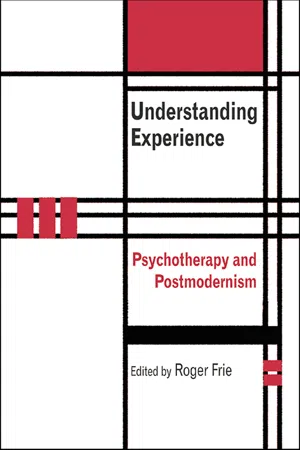
Understanding Experience: Psychotherapy and Postmodernism is a collection of innovative interdisciplinary essays that explore the way we experience and interact with each other and the world around us. The authors address the postmodern debate in psychotherapy and psychoanalysis through clinical and theoretical discussion and offer a view of the person that is unique and relevant today.
The clinical work of Binswanger, Boss, Fromm, Fromm-Reichmann, Laing, and Lacan is considered alongside the theories of Buber, Heidegger, Husserl, Merleau-Ponty, Sartre and others. Combining clinical data from psychotherapy and psychoanalysis with insights from European philosophy, this book seeks to fill a major gap in the debate over postmodernism and bridges the paradigmatic divide between the behavioural sciences and the human sciences.
It will be of great interest to clinicians and students of psychotherapy and psychoanalysis who wish to come to terms with postmodernism, as well as those interested in the interaction of psychoanalysis, philosophy and social theory.
- 246 pages
- English
- ePUB (mobile friendly)
- Available on iOS & Android
eBook - ePub
About this book
Information
Chapter 1
Sartre’s contribution to psychoanalysis
Betty Cannon
The work of the French philosopher Jean-Paul Sartre has impacted many fields, but is not often linked to psychoanalysis. This chapter considers the relevance of Sartre’s work for contemporary psychoanalytic theory and practice. I argue that adopting a Sartrean perspective can clarify a major theoretical difficulty in ego psychology, object relations theory, and self psychology: the problem of reconciling the discovery of new relational needs in earliest infancy and childhood with Freudian drive theory. I also believe a Sartrean perspective can help us reconceptualize the goal of psychoanalysis and the relationship between analyst and analysand, leading to more effective ways to facilitate significant change in therapy. In a certain sense, existential theory lies between traditional psychology, with its view of a substantive psyche, and postmodern views, which deconstruct and hence discard subjectivity altogether. Sartre’s idea of “prereflective consciousness” or implicit awareness keeps the experiencing subject at the heart of our considerations, while making room for understanding those divisions in consciousness which are the object of psychoanalytic investigations.
Linking existential philosophy with psychoanalysis, while not new, is hardly a dominant trend in English-speaking countries. In North America, for example, existential philosophy is more often considered to inform humanistic psychology with its emphasis on the here and now as opposed to classical psychoanalysis with its emphasis on the childhood origins of adult behavior. The term “existential/humanistic psychology” is often used to described the “third wave” in clinical practice, the first two being psychoanalysis and behaviorism. Hence the notion of an “existential psychoanalysis” may seem somewhat strange to readers unfamiliar with European traditions of thought.
Existential psychoanalysis is nonetheless a strong tradition. Indeed, Freud himself may have sensed the connection when he expressed a reluctance to read the existentialist philosopher Friedrich Nietzsche for fear his own ideas may have been preempted there (Freud [1914] 1953–74: 15–16). The European tradition of existential psychoanalysis spans the work of psychiatrists such as Ludwig Binswanger, Medard Boss, and Viktor Frankl, and draws on philosophical ideas from Edmund Husserl and Martin Heidegger through Martin Buber (see for example Binswanger 1963; Boss 1957, 1963; Frankl [1959] 1985; Husserl [1913] 1967; Heidegger [1927] 1962; Buber [1923] 1970).
There are, in addition, many psychoanalysts who do not readily identify themselves as existential, yet cite the influence of existential and phenomenological philosophy on their work. They include Erich Fromm and Frieda Fromm-Reichmann, who were friends and colleagues of Buber, and Hans Loewald and Stanley Leavy, who both acknowledge the influence of Heidegger. Roy Schafer (1976), who trained with Loewald and Leavy, introduces a new, action-oriented language for psychoanalysis, which moves strongly in the direction of existential-phenomenological thought. Rollo May, who trained at the William Alanson White Institute as an interpersonal psychoanalyst, first introduced European “existential analysis” to the English-speaking world with his influential work (coedited with Ernest Angel and Henri Ellenberger), Existence: A New Dimension in Psychiatry and Psychology (May et al. 1958).
The reader may notice that what is missing in this account of the development of existential psychoanalysis is the significant influence of Sartre. Since Sartre is usually considered to be among the most important existential philosophers, it is surprising that the only prominent European psychoanalyst to acknowledge a significant debt to him is R. D. Laing ([1959] 1979, [1961] 1976), whose roots lie in the British object relations school. This is curious in light of the fact that a major section of Sartre’s early philosophical masterpiece, Being and Nothingness ([1943] 1956), is entitled “Existential psychoanalysis.” Indeed Sartre employed the methodology of existential psychoanalysis in his psychobiographies. Sartre also found himself deeply in agreement with Freud’s insistence on the phenomena of disguise and repression. He merely disagreed with the mechanistic metapsychology that Freud used to explain them. Furthermore, in his later philosophy, Sartre came to insist that only psychoanalysis can account for the insertion of the individual into history. The intention of his later philosophy, as described in Search for a Method ([1960a] 1968), is to wed psychoanalysis to Marxism under the auspices of existentialism. His psychobiography of Flaubert is the offspring of that union.
Why then has there been this failure to mine the work of Sartre for psychoanalytic insights? I suspect part of the reason may lie in Sartre’s adamant insistence on rejecting the Freudian unconscious. Perhaps Sartre’s stance as a radical and activist also may have influenced this oversight, since American psychoanalysis in the guise of ego psychology appears curiously apolitical. Perhaps the more likely reason lies in what Sartre’s friend and former student, J.-B. Pontalis, called Sartre’s “thirtyyear-long [forty-year-long by the time of Sartre’s death in 1980] relationship with psychoanalysis, an ambiguous mixture of equally deep attraction and repulsion” (Pontalis in Sartre [1972] 1979: 220, emphasis in original). Sartre was as capable of criticizing psychoanalysis as of using its premises to understand human reality.
Pontalis was interested in reinterpreting the work of Sartre in the light of his relationship with psychoanalysis. In this chapter, I am interested in the possible impact that Sartre might have on psychoanalysis. I begin by examining Sartre’s ambivalent relationship with classical psychoanalysis and then explore the potential impact that a shift to a Sartrean view of human reality might have on psychoanalysis. I consider a theoretical crisis in contemporary ego psychology, object relations theory, and self psychology and contend that moving to a Sartrean perspective would solve the theoretical difficulties and further elucidate psychoanalytic developmental theory. Finally, I assess the impact of a Sartrean perspective on clinical practice, focusing in particular on the analytic relationship.
Sartre’s ambivalent relationship with psychoanalysis
Sartre’s debt to Freud is evident in a variety of his writings. To begin, the chapter on “Existential psychoanalysis” in Being and Nothingness could not have existed without the prior existence of Freudian psychoanalysis. It is both a critique and a tribute to Freudian psychoanalysis. Similarly Sartre’s psychobiographies of Genet ([1952] 1963), Baudelaire ([1946] 1950), and Flaubert ([1971] 1981, 1987) are demonstrations of the technique of existential psychoanalysis, and all owe to classical psychoanalysis the meticulous examination of their subjects’ childhoods as a way to understanding adult behavior. Sartre’s autobiographical sketch of his own childhood, The Words ([1963] 1964), is an essay in existential self-analysis. While all of these incorporate existentialist principles, they clearly demonstrate Freud’s significance for Sartre.
Furthermore there is a posthumous publication deriving from what is perhaps the strangest chapter in the history of Sartre’s relationship to psychoanalysis: his acceptance of an offer by producer John Huston to write a screenplay on Freud’s life. Sartre’s attraction to psychoanalysis is apparent in The Freud Scenario, written in 1958–59 and published under the editorship of Pontalis in 1984. Here Sartre presents a sympathetic Freud making a quite exciting discovery of the unconscious. To prepare himself to write it, he reread Studies in Hysteria and The Interpretation of Dreams and read Freud’s Autobiography, the Freud–Fleiss correspondence, and the first volume of Ernest Jones’s biography of Freud, which had just been translated into French. He had Michelle Vian laboriously translate aloud, line by line, the other Jones volumes. In Search for a Method, written shortly afterward in 1960, Sartre insisted that only psychoanalysis can provide the entrance into the world of childhood that is a necessary cornerstone for any viable social science theory. One can further see the influence of Freud on Sartre’s account of Flaubert’s hysterico-epilepsy in the first volume of The Family Idiot ([1971] 1981), written during the following decade.
The other side of Sartre’s relationship to psychoanalysis, his criticism, ranges from his famous critique of the unconscious in Being and Nothingness, to his later discussion of the analyst/analysand relationship in an article from Les Temps modernes (1969), republished in Situations VIII and IX (Between Existentialism and Marxism, [1972] 1979). “The man with a tape recorder” is a transcript of a tape recording made by a patient of a session with his analyst, presumably his last session. Sartre defends the man’s right to bring the tape recorder into the session and his own right to publish the interaction as representing “the irruption of the subject into the consulting room, or rather the overthrow of the univocal relationship linking the subject [analyst] to the object [patient]” (Sartre [l972] 1979: 200, emphasis in original). The tape recorder turns the tables on the analyst because there is now a “third” in the consulting room–a witness to the dyadic interaction that makes the analyst also an object, depriving him of his position as all-knowing observer. The analyst, of course, objects. Sartre says that the ensuing dialogue points to a critique not only of this particular doctor–patient relationship but also of the psychoanalytic relationship itself in situations where it does not include the aspect of reciprocity.
Let us be clear about what Sartre is critiquing. He is not objecting to the phenomenal reality lying behind what therapists and analysts alike see as the significant discoveries of Freud: transference, resistance, the defenses, the impact of childhood on adult life. Sartre explains his objections, which he maintains from his early philosophical work through Search for a Method, Critique of Dialectical Reason, and the Flaubert biography, in an interview:
I remain shocked by what was inevitable in Freud–the biological and physiological language…. Right up to the time of Fliess, as you know, he wrote physiological studies designed to provide an equivalent of the cathexes and equilibria he had found in psychoanalysis. The result is that the manner in which he describes the psychoanalytic object suffers from a kind of mechanistic cramp. This is not always true, for there are moments when he transcends this. But in general this language produces a mythology of the unconscious which I cannot accept. I am completely in agreement with the facts of disguise and repression, as facts. But the words “repression,” “censorship,” or “drive”–words which express one moment a sort of finalism and the next moment a sort of mechanism, these I reject.
(Sartre [1972] 1979: 37, emphases in original)
Whether we retain or reject the words, I think it is important to take Sartre’s critique seriously, since the “mechanistic cramp” to which he objects still affects many schools of psychoanalysis today.
While a majority of psychoanalysts probably no longer take seriously Freud’s metabiological and hydraulic metaphors, many are still encumbered by a view of the psyche as a “thing” that obeys laws of cause and effect similar to those affecting objects in the physical world. It is from this perspective that a particular analysis may become a “tragedy of impossible reciprocity,” as Sartre called the psychoanalytic dialogue discussed above (Sartre [1972] 1979: 202). The consequent reification of the psyche is the source of many therapeutic mistakes in an approach that otherwise has much to contribute to alleviating human misery. And this is true of contemporary ego psychology, object relations theory, and self psychology, which otherwise have valuable new insights, as well as classical analysis. In fact, I think we can easily recast many of the discoveries of contemporary psychoanalysis in Sartrean terms and thereby increase our understanding and therapeutic competence. Before doing so, however, we will first need to look at Sartre’s fundamental view of human reality as contrasted with Freud’s.
Nothingness at the heart of being: Sartre’s view of human reality
Sartre’s objections to the “mechanistic cramp” in Freud’s metapsychology are more thorough going than his well-known rejection of the Freudian unconscious. Indeed his rejection of the unconscious is based on a philosophical premise that separates his perspective from that of all versions of psychology as a positivistic science. Human reality, Sartre tells us, is a perspective on Being rather than an absorption in Being. It is the source of that nothingness or no-thingness by which Being is revealed. Or, as Sartre rather poetically says in Being and Nothingness, “Nothingness lies coiled in the heart of being–like a worm” (Sartre [1943] 1956: 56). Human reality is the source of this nothingness.
The phenomenology of philosopher Edmund Husserl is the source of Sartre’s objections to Freud’s reification of the psyche. For Sartre, there is no possibility of subdividing the psyche into consciousness, preconscious, and unconscious or ego, superego, and id. This is so because, from a phenomenological perspective, there is no independently existing psyche confronting an independently existing real world. Because consciousness is always intentional consciousness, that is, because it is always consciousness of this or that object, there is no division between consciousness and its objects in the usual sense. Consciousness discovers itself out there in the world, not in interiority. What passes for interiority is the attempt to take an objective perspective, the perspective of the Other, on the self. This results in the creation of that “quasi-object,” as Sartre calls it, the ego. It should not be mistaken for the “subject” or agent, which Sartre describes as “irrupting into the consulting room” in the remarks quoted above.
Sartre does not speak of the psyche but of consciousness because he does not see consciousness as a thing in the usual sense. Indeed, as Sartre says, consciousness is no thing. It is the “nothingness,” the perspective on being, the negation which is the foundation of all determination. Sometimes, in giving a lecture, I use the podium from which I speak as an example. Because I am not this podium, I can have a vantage point on it. This no-thingness is also the source of my freedom; indeed it is my freedom. Because I am not the podium, I can take a vantage point on the podium; for instance, I can use it as an example in the lecture. If I were a small child, I might climb on top of it and pretend to fly or crawl under it and pretend it is a house. Or if I were a demagogue, I might pound it to make a point. Similarly, a mountain is a very different object for a mountain climber, a geologist, or a person out for a pleasant drive. My intention, my way of grasping an object, determines my experience of that object. I discover my “self” in this interaction.
This is why the past looks determined–at least to the point in therapy where we re-experience it in its immediacy. Then hopefully it comes alive with all the objects through which I find myself making some original choice of a way of being in the world. The past looks determined because I do not find there a past self in the usual sense, but instead the objects which I constituted in this way or that as a part of my project or way of pro-jecting myself toward a particular future. For example, I might find a particular father whose rantings and ravings I lived as an admonition to silence, a silence that I find myself continuing to the present day despite the change in circumstances. Or perhaps it is more correct to say that I do not recognize the change in circumstances: I live my present circumstances as though my silence prevents the catastrophe of someone yelling at me. This is what they are for me until self/world hopefully changes in the course of analysis or in some other way. I am not dealing here with a mechanical “transference” of the past onto the present, but a way of grasping self/world that has its roots in my past and through which I am in the process of bringing into being a particular kind of future.
The situation, however, is more complicated than this because we do all develop forms of that quasi-object, the ego. We develop a vantage point on the self as well as the world, and we mistake that vantage point for the agent who creates it. All the confusion which exists in current psychoanalytic terminology about self, ego, and the like could perhaps be clarified by understanding that there is no “self” or “ego” in the usual sense of a fixed entity which is the author of my actions or reality orientation. When we go to the source of our actions, all we find is the “nothingness,” the intentional consciousness that relates to the world in this way or that, or else we find the world related to. This basic world-elatedness is experienced through “prereflective consciousness” or intentional implicit or gut-level awareness. It is not even verbal, since language according to Sartre is “for others.” Prereflective consciousness is, however, a seat of awareness that divides Sartre’s perspective from those of postmodern thinkers who would deconstruct the subject and reveal its totally fictional nature.
The ego, from this perspective, is a construct of “reflective consciousness.” It has a structure, but it is a structure which I give it and by which I develop and sustain a sense of “who I am” rather than the real structure of a solid object–although in a certain sense it is I who create any object’s structure by discovering and classifying it in this way or that (remember the mountain climber and the geologist with the mountain). The ego as subject is therefore unreal, and it must be de-structured and its fictional nature revealed in any thorough analysis. It is also contaminated by the voices of the original others which I mimic in an attempt to grasp this elusive object, my self.
For Sartre, then, there are three categories of Being: Being-in-itself or the phenomenal world which can never be known objectively as it is and which always overflows my attempts to grasp and categorize it; Being-for-itself or human reality which is a future directed perspective on Being with roots in the phenomenal world and my particular past; and Being-for-others, which is my awareness of the Other’s awareness of me. Human consciousness, Being-for-itself, is divided into two categories: reflective and prereflective. These are not two parts of the psyche, since consciousness has no component parts, but rather two moments of relating to the world: a nonreflective and a reflective moment. When consciousness turns and makes an object of itself, prereflective consciousness turns reflective. Sartre’s third cat...
Table of contents
- Cover Page
- Title Page
- Copyright Page
- Notes on contributors
- Preface
- Introduction: Between modernism and postmodernism: Rethinking psychological agency
- Chapter 1: Sartre’s contribution to psychoanalysis
- Chapter 2: Martin Buber and dialogical psychotherapy
- Chapter 3: Truth and freedom in psychoanalysis
- Chapter 4: Beyond postmodernism: From concepts through experiencing
- Chapter 5: A phenomenology of becoming: Reflections on authenticity
- Chapter 6: Language and subjectivity: From Binswanger through Lacan
- Chapter 7: Psychoanalysis and subjectivity in the work of Erich Fromm
- Chapter 8: The primacy of experience in R. D. Laing’s approach to psychoanalysis
- Chapter 9: The eclipse of the person in psychoanalysis
Trusted by 375,005 students
Access to over 1.5 million titles for a fair monthly price.
Study more efficiently using our study tools.
Frequently asked questions
Yes, you can cancel anytime from the Subscription tab in your account settings on the Perlego website. Your subscription will stay active until the end of your current billing period. Learn how to cancel your subscription
No, books cannot be downloaded as external files, such as PDFs, for use outside of Perlego. However, you can download books within the Perlego app for offline reading on mobile or tablet. Learn how to download books offline
Perlego offers two plans: Essential and Complete
- Essential is ideal for learners and professionals who enjoy exploring a wide range of subjects. Access the Essential Library with 800,000+ trusted titles and best-sellers across business, personal growth, and the humanities. Includes unlimited reading time and Standard Read Aloud voice.
- Complete: Perfect for advanced learners and researchers needing full, unrestricted access. Unlock 1.5M+ books across hundreds of subjects, including academic and specialized titles. The Complete Plan also includes advanced features like Premium Read Aloud and Research Assistant.
We are an online textbook subscription service, where you can get access to an entire online library for less than the price of a single book per month. With over 1.5 million books across 990+ topics, we’ve got you covered! Learn about our mission
Look out for the read-aloud symbol on your next book to see if you can listen to it. The read-aloud tool reads text aloud for you, highlighting the text as it is being read. You can pause it, speed it up and slow it down. Learn more about Read Aloud
Yes! You can use the Perlego app on both iOS and Android devices to read anytime, anywhere — even offline. Perfect for commutes or when you’re on the go.
Please note we cannot support devices running on iOS 13 and Android 7 or earlier. Learn more about using the app
Please note we cannot support devices running on iOS 13 and Android 7 or earlier. Learn more about using the app
Yes, you can access Understanding Experience by Roger A. Frie in PDF and/or ePUB format, as well as other popular books in Psychology & Phenomenology in Philosophy. We have over 1.5 million books available in our catalogue for you to explore.