![]()
SECTION I
3D Post Workflows
![]()
CHAPTER 1
Overview
“Postproduction (is) the most important element in the anatomy of filmmaking. It’s an art unto itself that structures the arc of your story… Frame by frame, with precision and skill, your canvas evolves its persona. Postproduction is the key to film magic or film mediocrity. From it comes your completed canvas, which is presented for all the world to see and critique.”
— Robert Evans, from his book THE KID STAYS IN THE PICTURE
1.1 Stereoscopic 3D
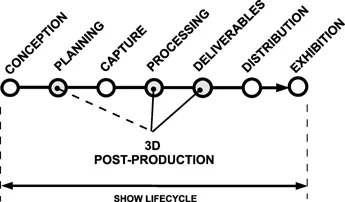
Stereoscopic 3D (3D) is the art and science of capturing, processing and presenting to audiences two slightly different two-dimensional (2D) representations of a scene. These two representations can, under the right conditions, simulate key aspects of human visual experience. For the purposes of this book, postproduction starts the instant imagery is captured, continues through creative and technical image processing and ends with the delivery of digital masters ready for distribution to audiences (see Figure 1.1).
In a sense, there is 2D only when there is the distinction of 3D. 2D visual grammar and assumptions have been part of our visual world since each of us was born. Digital technologies have sped up certain tasks and allowed for more creative iterations but fundamentally, 2D post workflows and techniques have been internalized in teams since the dawn of motion pictures.
Neither 2D nor 3D is an inherently superior method of visual storytelling. Each has its advantages and adherents. Most people who work in 3D also work in 2D. As 3D viewing options continue to enter the mainstream, so too will opportunities to create 3D content. To make the most of these opportunities, it’s important to understand the relative costs and benefits of 3D postproduction options. This is true whether you are a postproduction professional, independent filmmaker, researcher, hardware designer, game developer or simply someone who wants to find out more about this nascent visual medium. The approach in this book applies to educational, corporate, industrial, medical, and scientific 3D projects as well as to entertainment imaging. It is designed to provide a rapid introduction to most common issues and current best practices of 3D post.
Figure 1.1 3D Post in Show Lifecycle.
“Some people want to compartmentalize 3D as separate from the rest of the production because they are concerned that 3D will “bog down” the process. I respect that concern. However, I also think that it can be much more effective to collaborate on the 3D part, to have it as part of the shot planning process.”
— Dave Franks
1.1.1 Native & Converted 3D
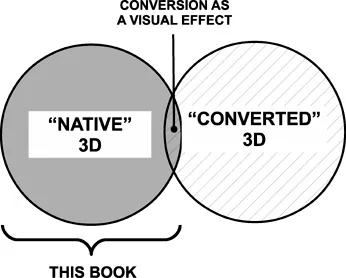
One important caveat: this book is geared toward so-called “natively shot” 3D shows, as opposed to shows created primarily through “2D-to-3D conversion.” Natively shot 3D is imagery captured via two or more image paths, typically a left (or “left eye”) path and a right (or “right eye”) path. Conversion in a 3D context means creating one or more eyes using imagery acquired via a single image path.
Figure 1.2 Native 3D & Converted 3D.
Conversion is an art and science itself and when done correctly can be indistinguishable from natively shot 3D. However, conversion is expensive in terms of per minute cost relative to budget of an independent and/or modestly budgeted production. Extensive high-quality conversion (for more than a few seconds of running time) is most likely out of the budget range of most independent 3D productions. There are pros and cons to both natively shot and converted 3D, but this discussion is outside the scope of this book. We consider conversion in the context of digital finishing and visual effects as a last resort fix for a must-have shot, or as a planned solution for a brief but complex visual effects and/or stunt sequence (Figure 1.2).
“What I talk to filmmakers today about hybrid productions that combine natively shot 3D and converted 3D. For example, if you are going to shoot aerials, you might consider shooting them in 2D and converting. Sometimes you cannot get in tight enough or there is action that you cannot adjust depth quickly enough.”
—Jonathan Shaw
2D-to-3D Conversion
2D-to-3D conversion is a distinct post specialty in itself and outside the scope of this book. The discussion of the relative benefits and drawbacks of “natively shot” (3D imagery acquired live) and “converted” 3D (3D imagery acquired by deconstructing and rebuilding elements of 2D imagery) is ongoing. To a 3D post team, there is no technical difference in handling image pairs generated by live 3D photography and imagery generated by conversion. Each method has its own peculiarities and generates its own issues and error conditions. A decision to go with a primarily natively shot workflow as opposed to a primarily converted workflow for a show is an aesthetic and financial one. The line between the two approaches—native vs. converted—has already begun to blur. These methods are by no means mutually exclusive. Both can be and have been successfully used in mainstream 3D productions.
In fact, most natively shot professional 3D shows use some kind of 2D-to-3D conversion techniques and tools somewhere in the post process. For example, most graphics (lower-thirds, bugs, credits, titles) in otherwise native 3D shows are 2D-to-3D conversions. The graphics are created in 2D, and then recreated for 3D simply by moving the virtual camera, re-creating the other eye, and rendering each eye, then compositing L and R into the live action. In the context of this book (which primarily addresses natively-shot independent 3D shows) conversion is considered a visual effect. Conversion is a potentially extremely useful technique to visual storytellers, especially when it comes to salvaging shots that could not otherwise be s...