eBook - ePub
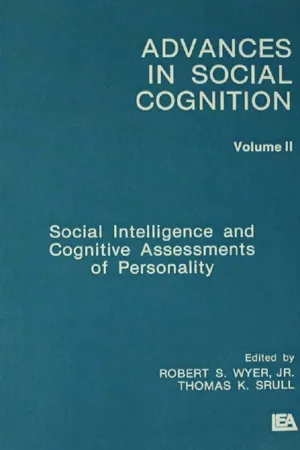
Social Intelligence and Cognitive Assessments of Personality
Advances in Social Cognition, Volume II
- 224 pages
- English
- ePUB (mobile friendly)
- Available on iOS & Android
eBook - ePub
Social Intelligence and Cognitive Assessments of Personality
Advances in Social Cognition, Volume II
About this book
This volume presents a new conceptualization of personality and social cognition that addresses both traditional and new issues. Written for students of personality, experimental and consumer psychology and cognitive science.
Information
Publisher
Psychology PressYear
2013Print ISBN
9780805805000
9780805805062
Edition
1eBook ISBN
9781134752010
1
Social Intelligence and Cognitive Assessments of Personality
Many personality theorists have spoken of the need for more integrated approaches to questions of individual adaptation to the social world. In this chapter, we take the study of human intelligence as source and inspiration for such an integrative endeavor. We have been greatly influenced by recent analyses of intelligence that focus on three aspects of problem solving: expertise, context, and pragmatics. We adopt this perspective in our own treatment of the social intelligence that, in our view, forms the cognitive basis of personality.
Social intelligence is multifaceted, domain and task specific, and reformulated in each significant life context. Therefore, there is little point in making global comparisons of individuals—measuring their “social IQ,” as it were. We disavow, explicitly and at the outset, any intention of offering yet another abstract individual-difference dimension for the psychometrician's mill. Nor do we wish to parlay the multidimensional nature of social intelligence into a new taxonomy of people that, like its forebears, will miss the flexibility and discriminative nature of human experience, thought, and action. We assume, by direct analogy to language, that an infinite variety of individual differences can be produced by the interactions among a finite set of general principles encompassing social learning, social cognition, and social interaction. Therefore, our primary task is to describe the general social-cognitive processes out of which human individuality is constructed. In addition, we wish to describe research that indicates how social intelligence is acquired, altered, and utilized in everyday life and clinical situations, throughout the life cycle. We pay particular attention to people's use of social intelligence in dealing with the mundane and monumental problems that they confront in the ordinary course of everyday living.
PERSONALITY AND COGNITION: EARLIER TREATMENTS
From a social-cognitive point of view, the study of personality can be viewed as the analysis of the ways in which people interpret situations, set goals within them, and plan and execute behavior that is consistent with these interpretations and goals. This viewpoint is not original to us, of course, and any unique contribution of ours must be viewed in the context of what came before.
Cognitive Styles as Personality
One of the longest standing traditions in personality and cognition has to do with the characteristic styles for perceiving and thinking that people develop (Gardner et al., 1959; Kagan & Kogan, 1970). Whereas these styles are typically measured in impersonal perceptual-cognitive tasks, the assumption is that they generalize to the interpersonal domain as well; that is, the proponents of the cognitive-style approach assume that performance on standard laboratory tasks is indicative of broad personality characteristics that mediate the person's behavior in the social world outside the laboratory. Many early theorists of cognitive style were influenced by psychoanalytic ego psychology, and related various stylistic dimensions to defensive as well as adaptive functions. However, one does not have to embrace psychodynamic theory in any form to appreciate the heritage of cognitive-style theory for modern cognitive approaches to personality. In fact, recent work in the cognitive-style tradition has emphasized the role they play in mediating adaptive social behavior rather than in defending against intrapsychic drives.
This trend is clearly illustrated in work on field embeddedness (also known as field dependence-independence, analytic-global style, and psychological differentiation; see Witkin et al., 1962; Witkin & Goodenough, 1977). In the laboratory, psychological differentiation is measured by a variety of impersonal laboratory tasks such as the Body Adjustment Test, Rod and Frame Test, and Embedded Figures Test. Witkin and Goodenough (1977) argue that there is a complex relationship between psychological differentiation and social behavior. For example, field-dependent people tend to be more conforming, dependent, and other directed than field-independent people. Another popular cognitive style is im-pulsivity–reflectivity (also called conceptual tempo; see Kagan et al., 1964; Messer, 1976), which describes the individual's tendency to reflect on the validity of the problem-solving process under conditions of uncertainty. Again, the style is typically measured by an impersonal laboratory task, such as the Matching Familiar Figures Test or the Design Recall Task, but performance on these tests is held to predict social behavior. For example, impulsivity predicts aggressiveness, shyness, and attention seeking in children—although not, somewhat paradoxically, risk taking or delay of gratification.
Field independence–dependence, impulsivity–reflectiveness, and other cognitive-style constructs have been subject to vigorous criticism (Baron, 1982; Laboratory of Comparative Human Cognition, 1982; Scribner & Cole, 1973). For example, the generality of the supposed cognitive style is often at issue: The various ostensible laboratory measures of psychological differentiation do not intercorrelate highly, and reflectivity does not appear to be consistent across various phases in the problem-solving process. In both cases, external relations with criterion social behaviors have proved difficult to replicate or subject to many qualifications. Moreover, cross-cultural studies often turn up evidence of value bias—who wants to be labelled field dependent or impulsive?—in apparent contradiction to the central tenet of cognitive style that opposite styles are equally adaptive.
The cognitive-styles tradition provides us with some important lessons about possible pitfalls in the study of cognition and personality. First, it is probably fruitless to attempt to develop a small set of basic cognitive styles derived from very abstract individual-difference constructs. Second, there should be no expectation that any aspect of problem solving necessarily will be generalizable across markedly different problem contexts, or different phases in the life cycle. Third, the effectiveness of any mode of thinking must be evaluated not with respect to normative standards within a culture, but rather with respect to the individual's own goals, as perceived within the framework of the life tasks in which he or she is currently engaged.
The Social Cognitivists
A more immediate and substantial source of the social-intelligence view of personality may be found in the work of the major proponents of social-learning theory: Rotter, Bandura, Kelly, and Mischel. We recognize that social-learning theory was originally formulated by Neal Miller and John Dollard. But their account of social learning was so closely tied to Hullian S–R formulations that it cannot be called cognitive in the modern sense. We also recognize that Kelly is not, strictly speaking, a social-learning theorist. In fact, in the preface to his 1955 monograph, he argued for throwing learning theory out altogether. Yet Kelly's theory is clearly social in its scope and clearly has a major learning component to it. Because Kelly's work has been so much of an influence on our own thinking (chiefly through Mischel), we include him in this statement of our intellectual history.
In any history of the development of social-cognitive approaches to personality, pride of place must go to Rotter, who proposed the first theory of social learning to employ cognitive concepts (Rotter, 1954; Rotter, Chance, & Phares, 1972). Rotter broke with the classic behaviorist view of social learning, as represented by the work of Miller and Dollard, in a number of critical respects. Whereas behaviorists defined reinforcements objectively, he defined them subjectively in terms of the value attached to various outcomes; whereas the behav-iorists defined reinforcement contingencies objectively in terms of stimulus– response probabilities, he defined them subjectively in terms of the individual's expectations. Whereas the behaviorists defined the situation objectively in terms of the array of stimuli impinging on the individual, he defined it subjectively in terms of the meaning ascribed to stimulus events. The result was an expectancy-value theory of choice, in which the individual regulates his or her own behavior in terms of goals, the expected probability of certain outcomes, and the values attached to them.
Alongside the various ideas pertaining to cognitive style, Rotter's construct of locus of control represents one of the earliest attempts to postulate an explicitly cognitive dimension of individual differences in personality. Somewhat paradoxically, however, the cognitive thrust of Rotter's theory has been obscured somewhat by the later conversion of locus of control into a broad trait-like construct. It is true that Rotter himself postulated individual differences in the person's generalized expectancy and developed a questionnaire measure permitting people to be classified as generally internal or generally external. But it is important to point out that Rotter also argued that the individual's generalized expectancies stood alongside specific expectancies tailored to the particulars of the situation. Moreover, Rotter viewed these expectancies as learned beliefs and thus subject to considerable change as a result of life experiences or therapeutic intervention. Conceptually, then, locus of control should not be viewed as a stable, consistent, trait-like dispositional entity, regulating behavior independent of environmental events and unresponsive to attempts at change.
Rotter's other contribution to the development of a cognitive approach to personality has also been obscured by the later emphasis on locus of control. In the preface to his seminal 1954 book, Rotter explicitly stated that his goal was to produce a social-learning theory of personality that would integrate the theories of Hull and Tolman. In other words, Rotter anticipated current concern with the interaction of cognitive elements such as expectancies with motivational elements such as goals and values. In fact, Rotter postulated a set of secondary psychological needs (including recognition status, dominance, and physical comfort), derived from physiological drives through learning in early childhood, which determine differences in the value attached to various reinforcements. By attending to needs, goals, and values as well as expectations, Rotter anticipated the current emphasis on hot as opposed to cold cognition in the social domain.
Rotter's theory is a theory of choice. It states that choices are determined by expectancies and values, and that expectancies and values are learned. However, despite Rotter's titular emphasis on social learning, he does not delve too much into the learning process itself. This aspect of social-learning theory has been analyzed most thoroughly by Bandura and his colleagues (Bandura, 1977b, 1986; Bandura & Walters, 1963) in terms of the distinction between learning by response consequences and learning by modelling. His emphasis on modelling gave even his earliest theoretical work a clearly cognitive flavor: Knowledge can be acquired through precept and example, simply by observation, without reinforcement (and without repeated exposure). However, even his analysis of learning by response consequences was cognitive in nature: direct experience of reinforcement provided the person with information about environmental outcomes and what must be done to gain or avoid them. As a result of either type of learning, the individual forms mental representations of experience that permit anticipatory motivation in the form of act–outcome expectancies. The cognitive emphasis in Bandura's work is so strong that his most recent statement is of a social-cognitive rather than a social-learning theory.
More recently, Bandura has moved away from analyses of the social-learning process in general to the more specific topic of the learned expectancies governing behavior. This recent work has focused on the role of self-efficacy expectations in regulating behavior and promoting behavior change. Bandura has distinguished between outcome expectancies—beliefs concerning the consequences of certain actions—and efficacy expectancies—beliefs concerning the ability to perform the actions required to produce certain outcomes. Individuals’ expectations about their personal efficacy influence their attempts to perform important tasks, their persistence in the face of failure, and their responses to stress. Within a particular domain, an individual is only as skilled as he or she thinks is the case; performance cannot be optimal without a sense of mastery. Note that self-efficacy is context specific. Thus self-efficacy theory is quite different from more generalized formulations concerning attributional style and locus of control. Note that it is not consistent with Bandura's emphasis to develop a test of generalized self-efficacy. Instead, self-efficacy serves as an example of how anticipatory expectations develop and change through social learning.
In keeping with his emphasis on self-efficacy expectancies, Bandura has considered in detail the role of internal standards and self-evaluation processes in motivating performance. Individuals engaged in goal-directed behavior match their progress with an internal standard of performance and evaluate their success or failure in accordance with their perceived self-efficacy at the task at hand. When self-efficacy is high, motivation will also be high even when current performance is substandard. When self-efficacy is low, motivation will be low even when current performance meets relevant standards. Self-regulation is a cyclical process, in which standards are set, performance monitored and evaluated, and standards revised; motivation and self-esteem rise and fall accordingly.
Kelly (1955) was probably the first major theorist to provide a thoroughly cognitive and fully idiographic treatment of personality. He characterized people as naive scientists engaged in explaining events in terms of hypotheses derived from personal constructs about themselves and the world. People differ in the nature of their personal constructs, how many they have available, and which they choose to apply at any given time. This constructive alternativism forms the basis for flexibility in the construal of social situations and events, and thus for discriminativeness in social behavior. Constructs are abstract cognitive frameworks—we might today call them schemata—composed of similarities and contrasts. Once a construct is applied to an object or event, it carries implications that the perceiver can use to anticipate other features or future events. Kelly assumed that individuals develop highly personalized, unique repertoires of personal constructs to interpret situations and events. People cannot understand the world except through their own constructs; but just as important, we cannot understand other people unless we understand the constructs that they bring to bear on the interpretive process.
Just as Rotter's concept of expectancies came to be identified with his construct of generalized locus of control, so Kelly's concept of personal constructs is often identified in terms of cognitive complexity. Some individuals have highly differentiated systems, involving many different constructs and a rich network of relations among them; others have very simple systems consisting of only a few constructs. In some individuals the personal construct system is so simple as to be monolithic. Kelly assumed that a high degree of complexity was characteristic of the personal construct systems of well-functioning adults, in that it afforded more opportunity for constructive alternativism. Following Kelly's own example, a number of investigators have proposed quantitative indices of cognitive complexity (Scott, Osgood, & Peterson, 1979). In a manner reminiscent of the various cognitive styles, and of the abuse of Rotter's concept of generalized locus of control (Rotter, 1975), this attempt to capture the cognitive basis of personality with a single individual-difference dimension seems fundamentally misguided. The core of personal construct theory is best viewed as residing in the content of the individual's personal constructs, the uniqueness of which effectively prohibits any simple nomothetic comparisons. Kelly's work is seminal because it showed how a theory of personality could give central weight to the interpretations that people make of their social world without assuming tha...
Table of contents
- Front Cover
- Half Title
- Title Page
- Copyright
- Contents
- Preface
- 1. Social Intelligence and Cognitive Assessments of Personality
- 2. Why a Theory of Social Intelligence Needs a Theory of Character
- 3. Social Intelligence and the Construction of Meaning in Life
- 4. The Functions of Personality Theories
- 5. Social Intelligence and Personality: Some Unanswered Questions and Unresolved Issues
- 6. On the Personalization of Motivation
- 7. Goal Orientation as Psychological Linchpin: A Commentary on Cantor and Kihistrom’s Social Intelligence and Cognitive Assessments of Personality
- 8. Production Systems and Social Problem Solving: Specificity, Flexibility, and Expertise
- 9. Psychodynamic-Systems Reflections on a Social-Intelligence Model of Personality
- 10. The Importance of Goals in Personality: Toward a Coherent Model of Persons
- 11. The Fate of the Trait: A Reply to Cantor and Kihlstrom
- 12. Social Intelligence and Adaptation to Life Changes
- 13. Social Intelligence and Personality: There’s Room for Growth
- Author Index
- Subject Index
Trusted by 375,005 students
Access to over 1.5 million titles for a fair monthly price.
Study more efficiently using our study tools.
Frequently asked questions
Yes, you can cancel anytime from the Subscription tab in your account settings on the Perlego website. Your subscription will stay active until the end of your current billing period. Learn how to cancel your subscription
No, books cannot be downloaded as external files, such as PDFs, for use outside of Perlego. However, you can download books within the Perlego app for offline reading on mobile or tablet. Learn how to download books offline
Perlego offers two plans: Essential and Complete
- Essential is ideal for learners and professionals who enjoy exploring a wide range of subjects. Access the Essential Library with 800,000+ trusted titles and best-sellers across business, personal growth, and the humanities. Includes unlimited reading time and Standard Read Aloud voice.
- Complete: Perfect for advanced learners and researchers needing full, unrestricted access. Unlock 1.5M+ books across hundreds of subjects, including academic and specialized titles. The Complete Plan also includes advanced features like Premium Read Aloud and Research Assistant.
We are an online textbook subscription service, where you can get access to an entire online library for less than the price of a single book per month. With over 1.5 million books across 990+ topics, we’ve got you covered! Learn about our mission
Look out for the read-aloud symbol on your next book to see if you can listen to it. The read-aloud tool reads text aloud for you, highlighting the text as it is being read. You can pause it, speed it up and slow it down. Learn more about Read Aloud
Yes! You can use the Perlego app on both iOS and Android devices to read anytime, anywhere — even offline. Perfect for commutes or when you’re on the go.
Please note we cannot support devices running on iOS 13 and Android 7 or earlier. Learn more about using the app
Please note we cannot support devices running on iOS 13 and Android 7 or earlier. Learn more about using the app
Yes, you can access Social Intelligence and Cognitive Assessments of Personality by Robert S. Wyer, Jr.,Thomas K. Srull in PDF and/or ePUB format, as well as other popular books in Psychology & History & Theory in Psychology. We have over 1.5 million books available in our catalogue for you to explore.