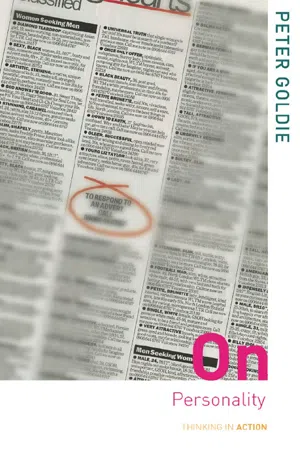
Warm, sensitive, creative, outgoing, cheeky, creepy. Scan any personal ads page and it's clear that to get a life you need a personality first. It is also a notion with a long and often bizarre history: in early Greece and medieval Europe, it was thought to depend on the balance of bile in the body.
On Personality is a thoughtful and stimulating look under the skin of this widely-used but little understood phenomenon. Peter Goldie points out that we rely on personality to do a lot of work: describe, judge, understand, explain and predict others as well as ourselves. Is it really up to this task? If personality is about 'character', is it a relic of a bygone Victorian age? If personality is so reliable, how can a virtue in one person be a vice in another?
Drawing on a great range of philosophers, novelists and films, from Aristotle, Hume, Kant and Nietzsche to Joseph Conrad, Middlemarch, War and Peace and Bridget Jones' Diary, Peter Goldie also discusses some famous psychology experiments. If personality is a reliable guide to predicting what people will do, he reflects on why people often surprise us and asks whether personality is simply down to chance and circumstance.
On Personality is essential reading for anyone interested in this fascinating but slippery concept. It will also make you think twice before writing your CV.
- 160 pages
- English
- ePUB (mobile friendly)
- Available on iOS & Android
eBook - ePub
On Personality
About this book
Information
Character, Responsibility and Circumspection
Four
RESPONSIBILITY AND FRAGILITY
In Chapter 2, I discussed the importance of motive and character in our moral evaluation of action. Byron, you will recall, rescued me when I was stranded, and our evaluation of what he did depended in part on his reasons for doing what he did, and on the sort of person he was. The importance of motive and character came out again in Chapter 3, in my champagne example of how two people can do the same thing, but for very different kinds of motive and out of very different kinds of character trait.
I want to explore two things in this chapter. The first is moral responsibility for motive and character. If someone is ruthlessly cruel, we hold him morally responsible for being that way – for having that trait; we don’t just hold him morally responsible for the ruthlessly cruel things that he does. This is a fact about what we do. But is it right for us to do this? How can we properly hold someone morally responsible for something that isn’t in his direct control – that might be a trait that he inherited from his parents (who, in Philip Larkin’s words, ‘fill you with the faults they had, And add some extra just for you’)?
The second thing I want to explore is the lessons that we can learn from our consideration of the fragility of character. The central lesson will be that circumspection about our own motives and character is, like strength of will, an executive virtue. We’ll hear what some great psychologists said about these things, before social psychology was a science: Nietzsche, Musil, St Augustine, Homer, and Joseph Conrad’s narrator and student of human nature, Marlow.
JIM AND THE CAPTAIN
To put flesh on the bones, I’ll take two characters from Conrad’s Lord Jim: Jim, and Jim’s Captain on his fateful voyage. 1 This book is all about character. Jim, the son of a country parson, went to sea at a young age, full of thoughts of how courageous he would be. ‘He saw himself saving people from sinking ships, cutting away masts in a hurricane, swimming through a surf with a line . . . always an example of devotion to duty, and as unflinching as a hero in a book’ (see page). He takes a berth as chief mate of a seedy, old, rusty, run-down steamer, the Patna, of dubious ownership, and captained by ‘a sort of renegade New South Wales German’, who ‘brutalized all those he was not afraid of, and wore a “blood-and-iron” air, combined with a purple nose and a red moustache’ (see page). Before setting off on the fateful voyage, they take on board 800 Muslims on pilgrimage to Mecca. ‘Look at dese cattle’, the Captain says.
One calm night, the Patna steams over a submerged wreck, and comes to a halt, with the rusty old iron bulkhead massively damaged under water, and looking as if it’s going to split at any moment. The pilgrims don’t know what has happened and remain quiet, but the white crew – four of them, including Jim and the Captain – see the danger. There are hardly any lifeboats, and if there were a general rush to escape, all would probably perish. The rest of the crew begin to get one of the boats off the chocks. ‘Aren’t you going to do something?’ Jim asks, and the Captain replies with a snarl ‘Yes. Clear out.’ After a fierce struggle, they get the lifeboat into the water. Jim hesitates, then jumps, or almost passively falls into the boat; ‘I knew nothing about it till I looked up’, said Jim later, to Conrad’s narrator, Marlow.
The Patna doesn’t sink, and all the pilgrims are saved, no thanks to the four escapees, who are picked up and taken to Bombay for a naval hearing. The Captain flees brazen-facedly, but Jim stays to face the music, and loses his licence. He is disgraced. And for the rest of the novel Jim moves from eastern seaport to eastern seaport, trying to keep one step ahead of his reputation.
Now, Jim and the Captain did the same thing. Each deserted a ship that he thought was about to sink, leaving on board 800 pilgrims to what he thought was a certain death. There is no doubt that this was a terrible thing to have done. But my interest here is not directly in what they did, but rather in the motivations and states of character and will which lie behind and serve to explain their actions. The Captain, as we will see, acted out of a bad character, and the question of moral responsibility will revolve around whether the Captain (and others like him with bad character traits) is responsible for being the way he is. Then I will turn to Jim, who, in contrast, acted not out of a bad character but out of a weakwilled failure to act as he knew he ought – in accordance with his own ideals of duty and courage. The lessons we can draw from Jim’s experiences will lead us to a discussion of the idea of being circumspect about our own motives and character.
DODGING DIRECT RESPONSIBILITY FOR A BAD CHARACTER
As a matter of fact, we do hold people directly responsible morally for their character traits. We hold the Captain directly responsible morally for being a cowardly bully: we reproach or condemn him for being the way he is. The question is whether or not we are right to do so. And there is a beguilingly simple argument that is supposed to show that we are not – that we cannot justifiably hold people directly responsible for having a bad character trait.
The argument goes like this:
- We’re only properly held directly responsible morally for what is in our direct voluntary control, for what we can bring about by directly trying. We can thus be held directly responsible for our actions and omissions because they are in our direct control. Try, right now, to move your arm! There, you did it – your arm moved. And you did this action just like that, just by directly trying.
- Having a particular character trait is not within our direct voluntary control in this sense; we can’t change our character traits just like that, by directly trying. Try, right now, to be a kinder person! Have you done it yet – are you kinder already? Surely not yet. When Twiggy said that her motto is ‘be kind, loyal and true’, she didn’t mean that all you need to do is try and it’ll happen, just like that, straight away.2
- Therefore we cannot be properly held directly responsible for our character traits.
This argument is certainly valid – the conclusion follows from the two premises. So, if one wants to resist the conclusion, as I do, one must consider whether or not the premises are true.
What about the second premise? Can we deny this, and say that we can change our character traits just like that? To say this would be to fly in the face of our ordinary way of thinking about character traits. Moreover, it would be to fly in the face of what I have been saying character is. Character traits are relatively enduring, and, as we saw in Chapter 2, it takes time and practice – habituation – for them to become embedded in our psychology; so they can’t be adopted, or got rid of, just like that, just by trying. So, although I will have quite a lot more to say later – especially in Chapter 5 – about how we can change our character traits over time, partly through directly trying to do other things, the second premise does seem right: character traits aren’t within our direct voluntary control in the way that actions are, such as your action of moving your arm.
So let’s look at the first premise. If we accept this premise, and the rest of the argument, we should realise that there will be other kinds of states of mind that fall outside the scope of direct moral responsibility: not just character traits, but beliefs, emotions, and long-term attachments to things and to people, for all of these seem not to be in our direct voluntary control either. And yet we do hold people directly responsible morally for their racist beliefs, for feeling envious of their colleagues’ successes, for loving their cats more than they love their children. So, even though the argument is beguiling, we should appreciate that it would have wide ramifications if we were to accept it.
What the proponent of the argument does at this stage, to block these counter-intuitive ramifications, is to say that what we really do in such cases is hold people indirectly responsible. According to their argument, we can’t be held directly responsible for having a morally bad character trait. But still, they add, we can be held indirectly responsible for our character, to the extent that we’re responsible for its causes. So, according to this view, the Captain of the Patna, a cruel and cowardly person, isn’t directly responsible for being a cruel and cowardly person now. But he is directly responsible for his past actions or omissions, for having done, and failed to do, things that have caused him now to be cruel and cowardly. And thus responsibility for character is only indirect – going via his past actions and omissions. And the same goes for beliefs, emotions and long-term attachments.
This indirect way of making people morally responsible for their character is, I think, to be resisted. There is a view at work here which we need to get to the bottom of: the view that moral responsibility for all kinds of psychological states (beliefs, emotions, attachments, character traits) should be reduced to, or turned into, moral responsibility for actions and omissions.3
So I think it’s the first premise we should doubt. And thinking more about the indirect route to moral responsibility for character should reinforce this doubt. Consider a woman who is a profoundly envious person, especially of others’ material possessions and successes. She is even envious of the successes of her friends. But she doesn’t know that she is. Should she, in the past, have done things to make herself a less envious person? But how could she have done, given her ignorance of her envy? So perhaps she should have known that she was envious, and she should have done things to find out about her ignorance? But perhaps we can trace this ignorance back to some other trait that is not within her direct voluntary control, and that she is not aware of; perhaps she is greedy for money, and doesn’t know it. So it looks as if the person who wants to make us only indirectly responsible for our character traits will find that, in some cases, it won’t be possible to pin the responsibility on any particular past voluntary action or omission. And when one thinks about our bad character traits, many of them are like this woman’s envy. We don’t realise we are self-righteous, inconsiderate, thoughtless, ungenerous and so on. But why should our ignorance get us off the hook?
One of the important consequences of the position that I’m advocating, of our being directly responsible for our bad character traits (and for our lacking certain good traits), is the way it affects our attitudes towards our own character. If I am envious, or inconsiderate, or ungenerous, I should accept responsibility for it, and reproach myself for being the way I am. And accepting responsibility like this is often the first step towards doing the things that might put me right. But my responsibility isn’t just to do these things. My responsibility – my direct responsibility – is for being the way I am – for being this kind of person.
THE SCORPION AND THE FROG
But now the following worry arises, which I think is often behind the rejection of my position. Surely we are often not to blame for our character traits because they are the result of a bad upbringing, or of some other factor in our past lives, inheritance perhaps, that was not our ‘fault’ (the Larkin point). That woman’s envy of her friends’ material successes might have come about because she was the child of grasping, materially minded parents. So it’s not her fault. The nature– nurture debate – how much of her envy is due to genetic inheritance and how much to upbringing and environment – is irrelevant; either way, it’s not her fault. (In fact, there are very persuasive arguments that it is senseless to ask, in respect of any individual person, how much of any given trait is due to genetic factors and how much to environment.4)
In a version of one of Aesop’s fables, a scorpion and a frog both want to cross the river. As the scorpion can’t swim, it asks the frog to give it a ride on its back. ‘But won’t you sting me?’ asks the frog. ‘Of course I won’t’, says the scorpion, ‘for if I did, I would drown as well as you.’ So they set off across the stream with the scorpion on the frog’s back. Half-way across, the scorpion stings the frog. Paralysed and sinking fast, the frog cries out, ‘But why? Now we will both drown.’ ‘I’m sorry’, says the scorpion, ‘I couldn’t help it. It’s in my nature.’
It can be very relieving to think that you aren’t responsible for being the way you are, and instead to blame your past, your heritage, your upbringing, your parents, your genes. This, I think, is part of the attraction of the position about moral responsibility that I reject. It gets you off the hook. My approach is that, in taking direct responsibility for being the way you are – for your character traits – and reproaching yourself for these traits if they’re bad ones, you are already in a position to start to try to be better. The expression ‘owning up’ is a nice one here: not in the sense of confessing, but in the sense of accepting some trait as your own (remember, though, that this isn’t the same as identifying with a trait).
In a sense, though, the scorpion is right. It’s right because it is a scorpion, and scorpions aren’t responsible for their actions or for their ‘character’ – their dispositions. We – we humans – are different, and this is the point of the fable. We humans can’t excuse all our morally bad actions because they are expressive of traits of character that aren’t our fault because they are ‘in our nature’.
Let’s apply this to the Captain in Lord Jim. According to my approach, we rightly hold him directly responsible morally for being the cruel, cowardly, heartless person that he is. But what if the Captain had been brought up by a brutalising father? Should we reproach or censure him less than if his vicious traits arose through his own voluntary actions? Perhaps. (I return to this point later.) Nevertheless, my point remains that, however our states of character have been arrived at, regardless of their causes, they are our responsibility, and we should own up to them – make them our own. It’s so easy to say what the scorpion said, that it’s not our fault.
THE SCOPE OF MORAL RESPONSIBILITY
Someone, like my opponent, who wants to resist the idea that we are directly responsible for our character traits, has another move to make at this point. ‘Where is the limit to moral responsibility?’ she rhetorically asks. ‘If I am morally responsible for character traits that I didn’t voluntarily bring about in myself, why aren’t I also morally responsible and to be reproached for any psychological trait that is a disposition to do morally bad things? Is there no limit to moral responsibility?’
The challenge is a fair one. To respond, what I need to do is to make out a fundamental difference between talent and virtue, and between defect and vice, and to show how this difference grounds a special kind of emotional response or attitude towards character traits – towards virtues and vices.
Let’s look at some emotional responses, or ‘reactive attitudes’ as Sir Peter Strawson calls them in his justly famous paper, ‘Freedom and resentment’. The table below shows some, of the negative variety.5
Let’s concentrate to begin with on just our negative belowthe- line reactive attitudes towards others – the bottom righthand box. We could say this: if (and only if ) it’s appropriate to hold X morally responsible for Y, then it’s appropriate to have one of these reactive attitudes towards X in respect of Y. Then, in rising to the challenge to say what the scope or reach of moral responsibility is, we need to say what are the X’s and the Y’s. Let’s start with the X’s.
See Table
Inanimate objects and non-human animals don’t fall into this category as potential objects of moral responsibility at all. Although you might blame the weather for spoiling the picnic, or the dog for knocking over the vase, this is (or ought to be) just a matter of attributing causal responsibility. That’s why the scorpion was right about itself: it’s not to be blamed for anything – for being disposed to sting frogs, or for the action of stinging this particular frog. Children below a certain age are (or ought to be) also exempt from moral responsibility and thus from these reactive attitudes. So too are (or ought to be) those who are mentally ill and cannot tell the difference between right and wrong – sociopaths for example.6 It’s really only rational persons about whom these attitudes are in principle appropriate. So the Captain of the Patna is not in principle exempt from moral responsibility, for he is a rational person, and knows the difference between right and wrong.
What can the X’s (rational persons we now know) be held morally responsible for? What is the scope of the Y’s? Well, there are actions – rational people can be properly held morally responsible for what they do. The Captain is morally responsible for abandoning what he thought was a sinking ship. But the issue here is whether rational persons can properly be held directly responsible morally for their character traits. Can the Captain be morally responsible for being such a brutal coward, and is it appropriate to condemn him for it?
I think that the heart of the matter is this: rational people are morally responsible only for those of their traits which are reasonresponsive, as are all character traits. Thus, reactive attitudes that are below the horizontal line in the table are appropriate here, but not in...
Table of contents
- Cover Page
- Title Page
- Copyright Page
- Preface
- One: The Pervasiveness of Personality
- Two: Good and Bad People: A Question of Character
- Three: The Fragility of Character
- Four: Character, Responsibility and Circumspection
- Five: Personality, Narrative and Living a Life
- Notes
Trusted by 375,005 students
Access to over 1.5 million titles for a fair monthly price.
Study more efficiently using our study tools.
Frequently asked questions
Yes, you can cancel anytime from the Subscription tab in your account settings on the Perlego website. Your subscription will stay active until the end of your current billing period. Learn how to cancel your subscription
No, books cannot be downloaded as external files, such as PDFs, for use outside of Perlego. However, you can download books within the Perlego app for offline reading on mobile or tablet. Learn how to download books offline
Perlego offers two plans: Essential and Complete
- Essential is ideal for learners and professionals who enjoy exploring a wide range of subjects. Access the Essential Library with 800,000+ trusted titles and best-sellers across business, personal growth, and the humanities. Includes unlimited reading time and Standard Read Aloud voice.
- Complete: Perfect for advanced learners and researchers needing full, unrestricted access. Unlock 1.5M+ books across hundreds of subjects, including academic and specialized titles. The Complete Plan also includes advanced features like Premium Read Aloud and Research Assistant.
We are an online textbook subscription service, where you can get access to an entire online library for less than the price of a single book per month. With over 1.5 million books across 990+ topics, we’ve got you covered! Learn about our mission
Look out for the read-aloud symbol on your next book to see if you can listen to it. The read-aloud tool reads text aloud for you, highlighting the text as it is being read. You can pause it, speed it up and slow it down. Learn more about Read Aloud
Yes! You can use the Perlego app on both iOS and Android devices to read anytime, anywhere — even offline. Perfect for commutes or when you’re on the go.
Please note we cannot support devices running on iOS 13 and Android 7 or earlier. Learn more about using the app
Please note we cannot support devices running on iOS 13 and Android 7 or earlier. Learn more about using the app
Yes, you can access On Personality by Peter Goldie in PDF and/or ePUB format, as well as other popular books in Philosophy & Ethics & Moral Philosophy. We have over 1.5 million books available in our catalogue for you to explore.